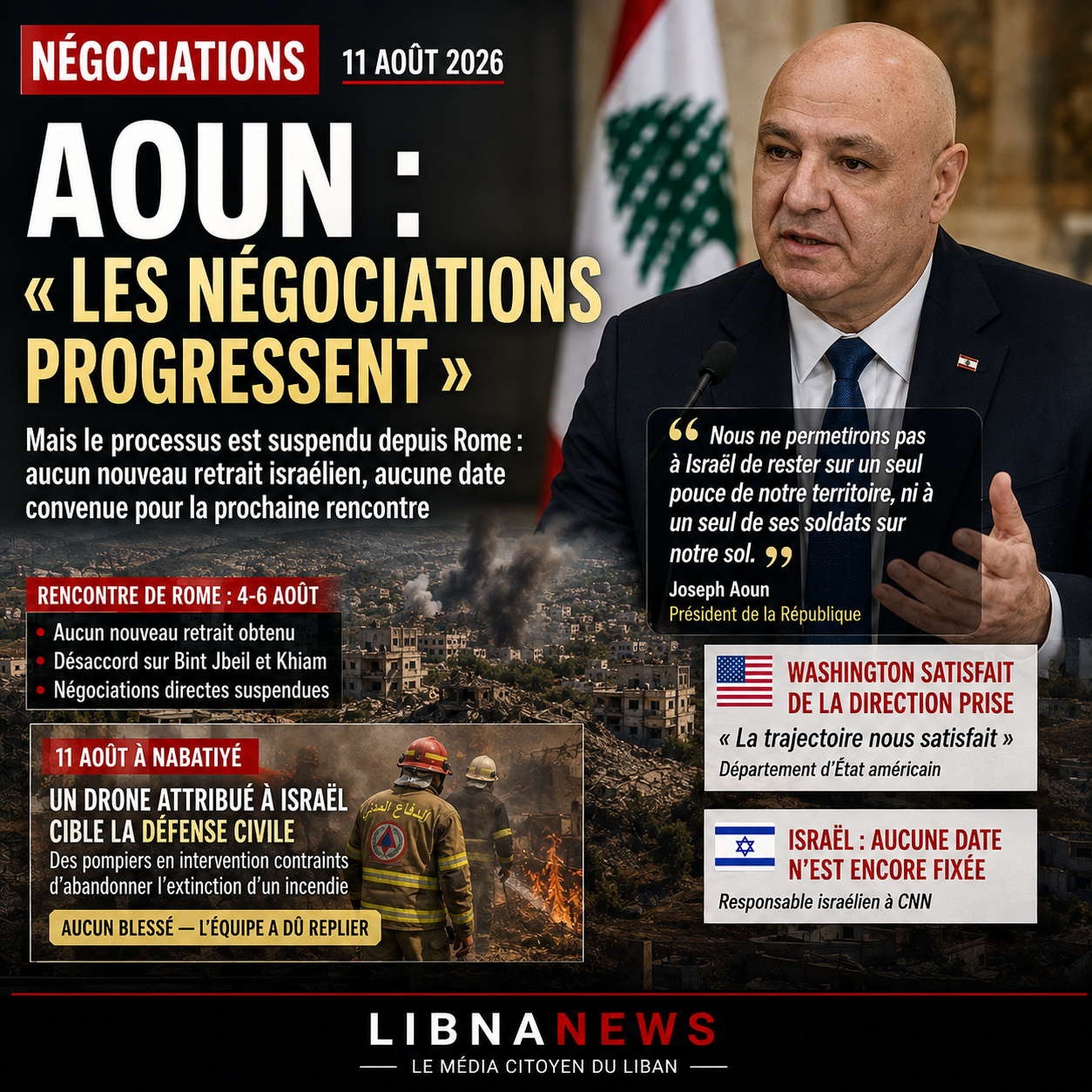






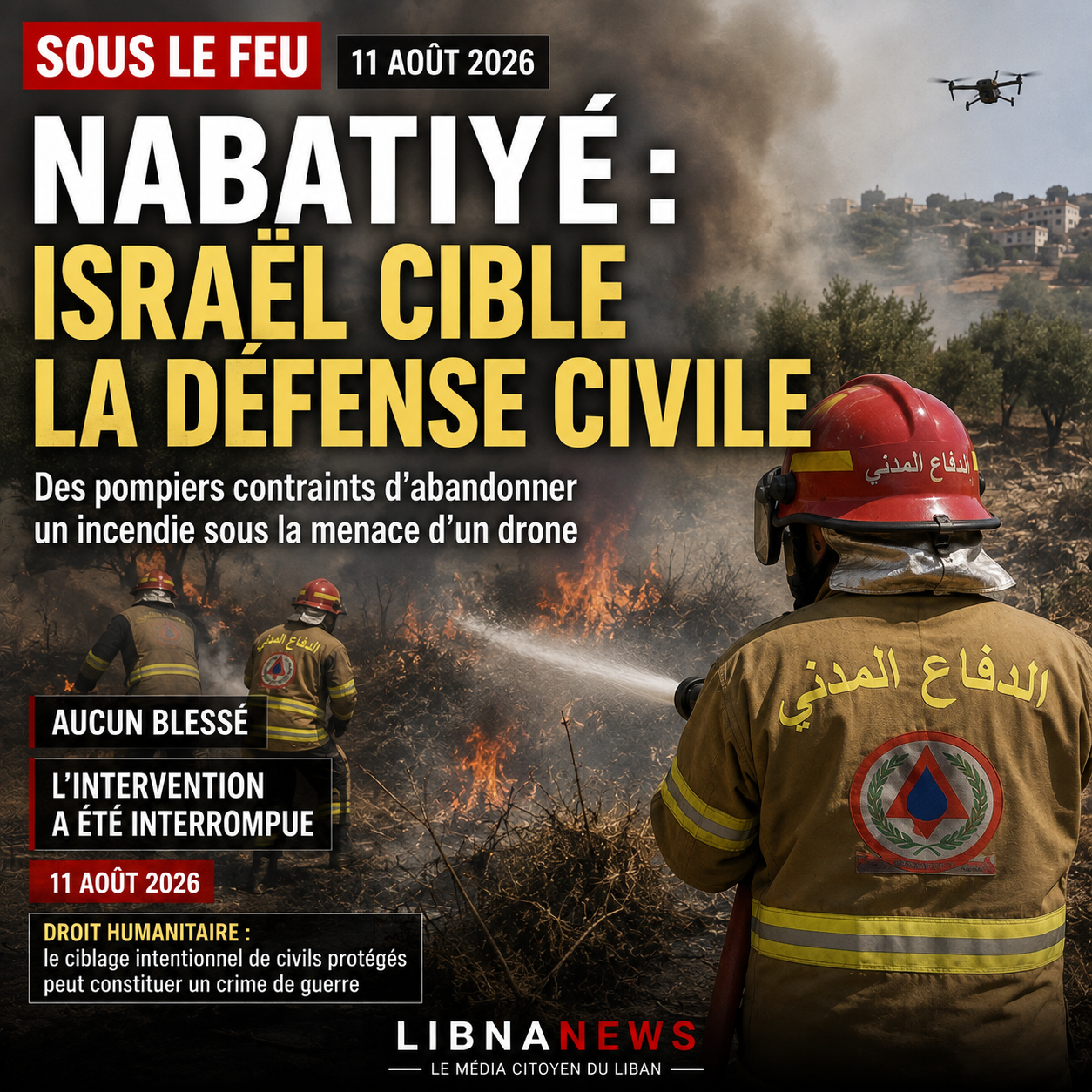
Lebanese Civil Defence announced on Tuesday, 11 August 2026 that its agents had been targeted by a drone as they intervened to extinguish a grass fire in the Nabatiyah area of southern Lebanon. No injuries were recorded as the teams interrupted their intervention and reached a safe place. The official communiqué does not designate Israel, but informed sources attribute the drone to the Israeli army. According to sources close to the case, this restraint in the public communication is part of the commitments accompanying the negotiation process with Israel, since Beirut agreed not to systematically designate the Israeli side in certain communiqués in order to preserve the discussions. The incident occurred in the aftermath of Israeli targeting against a Lebanese Army position and in a context of increased attacks on State institutions. It reinforces questions about the safety of civilian relief personnel and intervenes at a time when the continuation of the Lebanese-Israeli negotiations is being called into question.
Firefighters targeted during fire extinguishment
The incident occurred as the officers of the Directorate General of Civil Defence performed a regular mission to combat a vegetation fire. In a press release issued by the National Information Agency at 11.14 a.m., the Directorate General’s Information and Public Relations Service indicated that its teams were busy extinguishing a grass fire in the Nabatiyah area when they were « targeted by a drone ».
Firefighters immediately interrupted their intervention. They retreated to a safe place to avoid another attack. The Civil Defence states that none of its members was injured. It does not provide material balance sheets in its first press release and does not specify whether a vehicle or equipment has been damaged.
Nor does the text give the exact location of targeting in the Nabatiyah region. It does not specify the number of staff engaged or the means used to combat the fire. No indication is given on the state of the fire after the withdrawal of the teams. It remains to be seen whether the firefighters were able to return, whether another team took over or whether the fire continued to progress after they left.
The essential element, however, remains established by the Civil Defence itself: its agents were forced to abandon an extinguishing operation because they were targeted by a drone. The incident therefore directly prevented a civilian public service from fulfilling its mission.
Sources attribute the drone to Israel
The Civil Defence communiqué does not designate the perpetrator of the attack. He mentions only a targeting « by a drone ». However, sources informed of the circumstances of the incident attributed the aircraft to Israel and accused the Israeli army of targeting the teams present on the ground.
This difference between the official communiqué and the information gathered from sources does not necessarily mean that there is uncertainty about the origin of the drone. According to sources close to the negotiation process between Lebanon and Israel, it must be placed within the framework of Beirut’s political commitments since the opening of the discussions.
Lebanon would, inter alia, have undertaken, within the framework of the memorandum of understanding accompanying the process, to avoid systematically designating Israel in some official communications relating to incidents on the ground. According to the same sources, this restraint is intended to avoid a verbal escalation that could jeopardize negotiations under American mediation.
In this context, the absence of the word « Israel » in the Civil Defence communiqué should not be equated with a lack of attribution by operational sources. For Tuesday’s incident, the sources consulted refer directly to Israel. For its part, institutional formulation remains limited to the facts immediately necessary: targeting, withdrawal of teams and absence of injuries.
This practice of communication is particularly important when incidents involve public institutions. It creates a gap between the official description, deliberately sober, and the information available on the origin of the operations. It allows Beirut to preserve the diplomatic framework without preventing Israeli responsibility from being reported when established by informed sources.
A civilian mission interrupted under the threat of a drone
The nature of the mission performed by the officers is a central element of the incident. The teams were not involved in a military operation. They were fighting a grass fire, a classic mission of the Civil Defence during the summer season.
Their withdrawal therefore had an immediate effect on the security of the sector. A vegetation fire can progress rapidly when temperatures are high and grasses dry. Depending on its location, it can reach agricultural land, olive groves, homes, vehicles or electrical installations. Rapid intervention is one of the main factors preventing its extension.
When firefighters have to leave the site because of a military threat, priority changes. The protection of agents becomes superior to that of property and vegetation. Teams must take shelter even if the fire is not completely controlled. This is precisely what happened on Tuesday in Nabatiyah.
Civil Defence did not specify whether the fire had already been contained when its officers left the area. This information will be important for measuring the material consequences of the interruption. The first assessment only shows that no first aid worker was injured.
However, the absence of a victim does not reduce the operational scope of the event. An attack does not need to cause death or injury to prevent a rescue service from functioning. In this case, the threat was sufficient to stop the intervention.
Nabatiyah relief workers already exposed to attacks
The incident occurs in a region where relief workers have already been directly affected in recent months. The Nabatiyah Civil Defence suffered significant human and material losses in 2026, which explains the immediate caution adopted on Tuesday by the teams.
On 12 May, two members of the Civil Defence had been killed and one rescue worker injured while intervening with a victim. The Lebanese authorities then denounced Israel’s direct targeting of relief. The episode had placed the issue of protection of first responders at the forefront, forced to work in areas where danger may persist after a first strike.
Two months earlier, in March, eleven members of the Civil Defence had also been injured after an Israeli strike near their regional centre in Nabatiyah. The building, vehicles and equipment were damaged. The centre was then directly affected and destroyed in May, forcing the teams to continue their activities with reduced resources and from degraded facilities.
These precedents give Tuesday’s withdrawal a special meaning. Fire officers are aware that their teams have already been affected during operations and that their own centre has been destroyed. When a drone appears and targeting is found, the risk is therefore not theoretical.
The recurrence of these attacks also affects the overall capacity of Civil Defence in the region. Every vehicle destroyed, every equipment lost and every injured agent reduces the means available to respond to fires, road accidents, collapses or rescue operations. The pressure is therefore not limited to the event of the day.
Targeting relief and the issue of war crime
Civil defence officers are civilian personnel when performing their usual missions and are not directly involved in hostilities. International humanitarian law requires parties to a conflict to distinguish combatants from civilians and prohibits intentionally directing an attack against them.
This protection does not disappear because the first aid workers work in a region where military operations take place. A firefighter who extinguishes a fire, an ambulance attendant who transports an injured person or a rescuer who intervenes after an explosion retains his/her civil status as long as he/she is not directly involved in the fighting.
The intentional targeting of civilians constitutes a war crime. The Rome Statute of the International Criminal Court includes among war crimes the intentional conduct of attacks against the civilian population or against civilians who are not directly involved in hostilities. Customary international humanitarian law also requires the protection of civilians and certain personnel engaged in relief missions.
In the case of Nabatiyah, the Directorate General of Civil Defence states that its officers were « targeted ». The informed sources consulted attribute the drone to Israel. If an investigation finds that the operators knew that they were targeting civilian firefighters engaged in an extinguishment mission and nevertheless decided to attack them, the facts constitute a war crime.
The absence of injuries does not invalidate this potential qualification. The law does not make the prohibition of an intentional attack on civilians conditional on its success. An attack can be legally prohibited even when the persons concerned succeed in sheltering themselves.
The establishment of individual criminal responsibility would nevertheless require a precise documentation of the circumstances: type of drone, selected target, point of impact, information available to the operator and possible chain of command. These elements are not included in the press release issued Tuesday morning.
Two days under pressure for Lebanese institutions
The targeting of firefighters also occurs in the aftermath of another incident directly involving a Lebanese state institution. On 10 August, Israel targeted a Lebanese Army position. The succession of the two events gives the new Nabatiyah incident a broader security environment, without changing its essentially civilian character.
In less than 24 hours, an army position and then a Civil Defence team were exposed to Israeli operations. The two institutions do not have the same function and the applicable rules are not identical, but they are two pillars of the state presence in the southern regions.
This succession comes at a time when the role of Lebanese institutions is precisely at the centre of political and security discussions. Beirut states that it wants to extend State authority throughout the country and to strengthen the deployment of the army in the southern sectors. At the same time, Civil Defence must allow for a return to normal life by providing relief, firefighting and public response.
The incidents of 10 and 11 August show the practical difficulties of this strategy when institutions responsible for exercising authority or providing public services remain exposed to attacks themselves.
The incident occurs after the relative failure of Rome
This security context joins another issue without becoming the main subject of the incident: the negotiations between Lebanon and Israel. The seventh meeting was held in Rome from 4 to 6 August under American mediation and ended without further Israeli withdrawal from the South.
In particular, Beirut had called for the effective cessation of attacks and destruction and the opening of a new experimental zone allowing for Israeli withdrawal and the deployment of the Lebanese Army. Bint Jbeil and Khiam were among the Lebanese priorities. Israel did not accept either of these two areas at this stage and maintained its requests for additional safeguards on verification and disarmament.
Since Rome, Lebanon is seeking concrete action before the next meeting. The continuation of Israeli operations against public institutions complicates this position. The targeting of Civil Defence on Tuesday comes precisely as Beirut demands that the fall in attacks be visible on the ground before proceeding normally.
According to sources close to the case, the succession of incidents is now fuelling the possibility of a suspension of the Lebanese-Israeli negotiations. This suspension would not necessarily constitute a definitive break in the U.S.-mediated channel. Instead, it would be tantamount to delaying Lebanese participation in a new round until Israeli guarantees or actions were obtained.
This perspective remains linked to the diplomatic context and not to the Nabatiyah incident alone. The targeting of firefighters, however, reinforces a dossier already weakened by the absence of a new withdrawal in Rome and by the differences on the conditions of the eighth meeting.
Diplomatic restraint faced with field incidents
The memorandum referred to by the sources close to the negotiations is very important here. Beirut agreed to reduce the level of confrontation in its public communications in order to preserve the discussions. The 11 August Civil Defence communiqué, which describes a drone without designating Israel, illustrates this restraint.
But this diplomatic discipline becomes more difficult when public institutions are themselves involved. Lebanese sources attribute the Nabatiyah drone to Israel, while the communiqué remains neutral on its origin. The reader must therefore distinguish the official language imposed by the context of the award negotiations obtained from informed sources.
This difference could become more visible if incidents continue. Lebanon seeks to avoid political escalation while calling on Israel to reduce its operations. If no decline occurs, restraint in the press releases may no longer be sufficient to preserve an already weakened process.
The situation also places the United States, the mediators of the negotiations, in a difficult position. Washington wants to maintain the framework for discussions and get progress on military deployment and security issues. At the same time, Beirut calls for the institutions responsible for implementing those commitments to be able to work without being exposed to Israeli operations.
A civil defence that must continue to intervene
For the Nabatiyah teams, however, the immediate issue remains much more concrete than the negotiations. Fires, accidents and emergencies will continue to require their intervention, regardless of the diplomatic schedule.
Risk is now integrated into each mission. Firefighters must be able to reach a fire, deploy their means and stay on site long enough to control it. The presence of an armed drone can make each of these steps impossible. It can also lead to the evacuation of a team at the time when its intervention is most necessary.
The destruction of the regional centre and losses in the spring have already weakened local capacity. Tuesday’s incident shows that the risks are not limited to civilian defence buildings. They also follow the officers when they leave their base to intervene with the population.
The Branch reported no injuries after the August 11 targeting. She has not yet stated in her first press release whether the firefighters have been able to return to the site or whether the fire has finally been controlled. These are now the most directly expected information about the event.
Beyond this herb fire, the repetition of incidents raises a more lasting question for Nabatiyah: how can a normal rescue service be provided when those who have to protect the inhabitants themselves have to interrupt their mission in order to escape an attack? The next Civil Defence review will determine whether the teams were able to resume their work and assess the concrete consequences of the withdrawal imposed on Tuesday morning.