





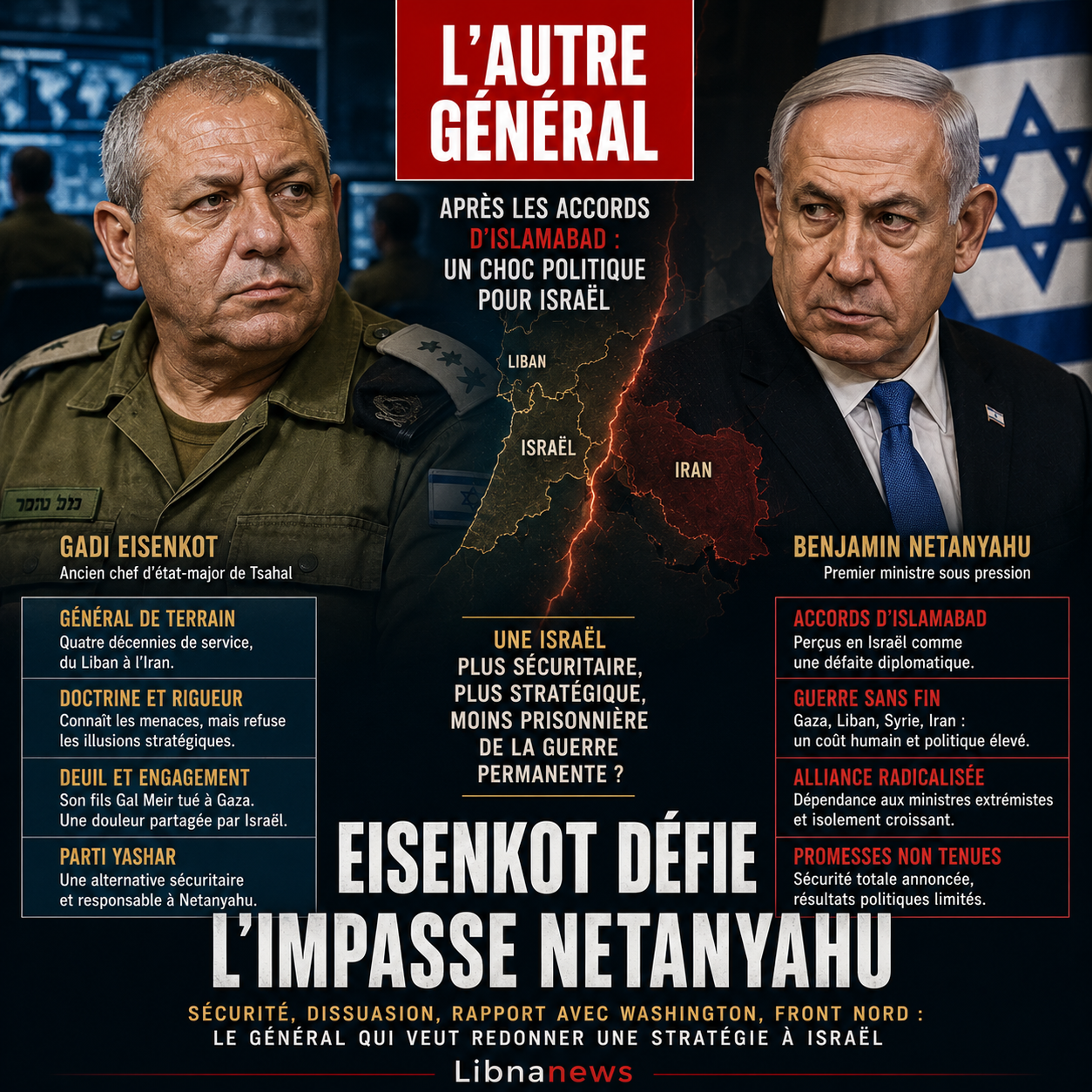
Gadi Eisenkot returns to the centre of the Israeli game as Benjamin Netanyahu seems weakened by a brutal diplomatic sequence. A former Chief of Staff of the IDF, a security figure rather than party tribune, he appears increasingly to be one of the few leaders able to speak to an Israeli society hardened by war without adopting the language of the most extremist ministers. The Islamabad accords, concluded between Washington and Tehran and perceived in Israel as a major diplomatic defeat, reinforced this momentum. They have shown that military superiority does not always guarantee political victory. In this vacuum, Eisenkot tries to embody an alternative: firm on security, hostile to strategic illusions, but anxious to restore a more rational decision-making chain.
A General Becomes Political Recourse
Gadi Eisenkot is not a newcomer. His name is associated with four decades of military career, the war against Hezbollah, indirect confrontation with Iran and the doctrinal modernization of the Israeli army. He commanded the Golani brigade, the northern region, and then the IDF group between 2015 and 2019. In a country where security remains the main political language, this path gives it legitimacy that few civilians can claim.
This legitimacy is not only institutional. Eisenkot has known the fronts that are obsessing today Israel: Lebanon, Syria, Gaza, Iran and the West Bank. It is not a moderate in the European sense. He defended the use of force, designed doctrines of pressure and carried out preventive operations against the Tehran regional relays. His difference with Netanyahu is therefore not in a supposed pacifism. Rather, it relates to the method, the relationship between military objectives and political results.
It is precisely this profile that can make it audible in an increasingly secure Israeli society. Since the attacks of 7 October 2023 and the long war that followed, an important part of the public no longer wants to hear abstract discourses about restraint. It calls for guarantees, victories, controlled borders and the neutralization of threats. Eisenkot does not dispute this need for security. He challenged the idea that permanent war, ill-defined and without diplomatic exit, could meet that need.
This nuance distinguishes him from the more classic opponents of Netanyahu. Yair Lapid speaks at the liberal center. Benny Gantz embodies another military figure, but her image has weakened as the recompositions unfolded. Naftali Bennett is trying to return to a pragmatic nationalist line. Eisenkot, on the other hand, advances with a more austere image. He doesn’t promise a new Israeli dream. It promises more serious governance, a shorter strategy, a less theatrical war and a public decision less subject to coalition interests.
A biography that speaks to several Israelis
Gadi Eisenkot was born in Tiberias in 1960 and grew up in Eilat, a Jewish family of Moroccan origin. This trajectory counts in Israeli politics. The country remains crossed by strong social and cultural lines between Ashkenazi elites, Mizrahi people, religious, lay people, inhabitants of large cities and peripheries. Netanyahu has long been able to speak on the social and symbolic peripheries of the country. Eisenkot can challenge this clout without appearing as a natural representative of the former Labour establishment.
His military rise adds to this social strength. It is not the result of a political dynasty. It was built in the army, according to a meritocratic narrative that many Israelis understand. The army remains one of the last places where the idea of a common destiny retains strength, despite the fractures on the conscription of the ultraorthodox, the settlers, the Supreme Court and the place of religion in the state.
This biography can make him a cross-sectional candidate. He can speak to the families of soldiers, the centrist voters, the former right-wing voters weary by Netanyahu, the security circles concerned about adventurism and some of the Mizrahim who do not recognize themselves in the historical left. This potential does not guarantee a victory. He explained why the polls paid him increasing attention.
His personal history also turned into a national tragedy. His son Gal Meir Eisenkot, a reservist mobilized in Gaza, was killed in December 2023. Family members also died during the war. This pain is part of Israel’s collective mourning. It makes it more difficult for its opponents to caricature it as a detached manager of the human price of operations. When he speaks of strategy, he does so as a former military leader, but also as a bereaved father.
This dimension does not automatically transform a general into a stateman. However, it gives it a rare political gravity. In a country saturated with slogans, anger and instant communication, Eisenkot often appears as a more retained character. This reserve can be a force. It can also be a weakness in an electoral campaign dominated by aggressive personalities.
The paradox of the Eisenkot doctrine
To understand Eisenkot, one must avoid a mistake. It does not represent a gentle break with Israeli military culture. It is one of the most successful products. As commander of the northern front, he was associated with the so-called doctrine of Dahiya, the name of the southern suburbs of Beirut largely destroyed during the 2006 war. This doctrine is based on the idea that Israel must respond to an attack by a non-state actor by a disproportionate force against the infrastructure that supports that actor.
This doctrine remains highly controversial. In Lebanon, it refers to the destruction of entire neighbourhoods, collective punishment and the erasure of the distinction between military and civilian objectives. In Israel, its defenders present it as an instrument of deterrence against organizations that are embedded in cities and villages. Eisenkot cannot therefore be presented as a natural opponent of force. He helped to think about massive employment.
This also explains why he can compete with Netanyahu. Part of Israel’s opinion is not looking for a leader who excuses power. She’s looking for a leader who’s using it effectively. Eisenkot can say that he knows Lebanon, Hezbollah and Iran. He may recall that deterrence requires clear objectives, not just images of destruction. He can criticize Netanyahu without being accused of naivety.
The paradox is there. Anyone who has given a doctrinal form to Israeli hardness can become the alternative to a government deemed too captive of his own radicality. Eisenkot does not necessarily question the foundations of Israeli security. It may call into question their political implementation. In his view, war must be waged with an end, measurable result, international coordination and coherence between military and diplomatic means.
This position places it at a distance from the far right. Itamar Ben Gvir and Bezalel Smotrich speak in terms of domination, annexation, unlimited pressure and refusal of external coercion. Eisenkot speaks more in terms of national interest, balance of power and orderly decision. The difference may seem small from Beirut or Gaza. However, it is significant in the current Israeli policy.
Netanyahu, the long war and the wear and tear of power
Benjamin Netanyahu remains Israel’s most formidable politician. He survived announced defeats, trials, break-up of alliances, diplomatic crises and massive protests. His grip on the right, his sense of coalition and his ability to turn every attack into evidence of persecution remain exceptional. But the Islamabad accords struck a central point in his story: the idea that he would be the only one able to contain Iran and dictate the terms of regional security.
The sequence is severe for him. After months of operations in Gaza, Lebanon, Syria and Iran, Israel can claim military successes. enemy infrastructure was destroyed. Officials of armed movements were targeted. The army has shown a very broad capacity for action. But the political outcome seems less favourable. Hamas maintains a presence. Hezbollah did not disappear. Iran signs with Washington a text that preserves part of its margin. Lebanon is part of an international guarantee logic that reduces Israeli freedom of action.
For Netanyahu, this contradiction is dangerous. He had promised a transformation of the Middle East by force. But Washington, its main ally, now imposes an exit logic. Worse still for him, this exit is through an agreement with Tehran. In Israel, therefore, the Prime Minister’s opponents can claim that he got war without winning. His supporters respond that he avoided existential threats. Part of the electoral debate will be held on this reading.
Recent polls show a fragile coalition and an opposition capable of gathering a majority, even if the balances remain unstable. Netanyahu maintains a solid foundation. But fatigue is progressing. Part of the population wants to move on. Another wants to continue the war. This contradiction makes the situation explosive. A more moderate leader may seem weak. A more radical leader may seem dangerous. Eisenkot tries to occupy the space between the two.
The Islamabad Accords, a Shock for the Israeli Right
The Islamabad agreements were received in Israel as a strategic shock. They indicate that Washington does not want to allow the regional war to continue without limits. They give Iran prospects for lifting sanctions, economic recovery and political recognition. They place Lebanon in a framework where territorial sovereignty must be guaranteed. For part of the Israeli right, this text resembles a reward given to Tehran after years of confrontation.
This feeling of diplomatic defeat is all the stronger as the text seems to have been negotiated without complete Israeli control. Netanyahu may challenge the interpretation of certain clauses. He can say that Israel will keep its freedom of response. He may refuse to withdraw from South Lebanon until Hezbollah is disarmed. But the political power ratio has changed. The United States has chosen a timetable, format and compromise that do not fully meet Israeli objectives.
This moment serves Eisenkot. He can denounce the failure of the Netanyahu strategy without defending the agreement as such. He may say that the fault lies not only in American concessions, but in Israel’s inability to translate its strength into diplomatic results. He can explain that a serious government should have coordinated its objectives with Washington, defined realistic red lines and avoided depending on the moods of the White House.
Criticism is formidable, because it does not come from a pacifist. She comes from a man who knows the operational constraints. Eisenkot may blame Netanyahu for having confused military action with strategy. He can say that the multiplication of the fronts has produced an illusion of power, but also a fatigue of the army, international pressure and increased dependence on the United States. The Islamabad agreements then become the indicator of a pilotage defect.
A tougher society, but not necessarily more faithful to Netanyahu
The Israeli population has been hardened since 2023. This development can be seen in support of broader military responses, distrust of compromises, rising absolute security discourses and increased tolerance of destructive operations. The trauma of October 7 upset the landmarks. Many Israelis no longer believe in fragile arrangements with enemies who promise their disappearance.
This hardening does not mean automatic support for Netanyahu. On the contrary, he can turn against him. Part of the opinion blames him for leaving the vulnerable country before 2023. Another criticises him for not delivering a clear victory after. The hostage families denounced the lack of priority given to their relatives. Military officials criticized the absence of a exit strategy. Right-wing voters believe that he gives way too much to American pressure. Centrist voters believe that he gives too much to Ben Gvir and Smotrich.
Eisenkot can benefit from this combination. He speaks to a society that wants firmness, but doubts the government’s competence. He can embody a disciplined form of patriotism. He does not promise immediate peace. He does not ask the Israelis to give up their fear. He tells them that fear must be governed, not exploited.
This argument can be echoed by the middle classes, reservists, military families and voters who demonstrated against judicial reform before the war. It may also affect some right-wing voters who no longer bear the excesses of the coalition. The question is whether this bloc can become a coherent political majority. Israeli history shows that the generals who entered politics rarely succeed without a strong partisan machine.
Yashar, the bet of an alternative government
After his departure from the formation of Benny Gantz and the Knesset, Eisenkot began to build his own political vehicle, Yashar, whose name refers to the idea of straight line or straight line. The choice of name summarizes the message. He wants to oppose Netanyahu a policy that is considered less manipulative, less dependent on extremes and more legible in its priorities.
The challenge is considerable. An alternative to Netanyahu cannot be limited to a personality. It must combine parties, voters and conflicting interests. She must speak to centrists, right-wing elders, liberals, security, lay people, families of soldiers and some moderate religious. It must also deal with the Arab parties, or at least with their parliamentary role, which is still an explosive subject in Israeli politics.
Polls now place Eisenkot among the serious rivals of Netanyahu, sometimes in a row with Naftali Bennett in the competition to lead the anti-Netanyahu camp. That doesn’t make him an obvious favorite. The Israeli system produces surprises. Coalitions are formed and are quickly defeated. Netanyahu retains an exceptional ability to delegitimize its opponents and break their alliances. But the appearance of Eisenkot as an option of government changes the equation.
Its main advantage is its security credibility. His main handicap is his lack of popular charisma. Netanyahu dominates the scene because he can tell a simple story: he against Israel’s enemies, he against the elites, he against external pressures. Eisenkot tells a more austere story: the state must become serious again, the army must not be instrumentalised, war must have a goal. This story can convince. However, it requires rare political discipline.
What Eisenkot would change for Lebanon
Given Lebanon, the emergence of Eisenkot should not be confused with a promise of automatic relaxation. His military history is intimately linked to the northern front. He knows Hezbollah as a strategic threat. It does not defend unconditional withdrawal or recognition of the balances imposed by Iran. A government led by him could remain firm, if not hard, on Hezbollah’s presence in southern Lebanon and on the movement’s military capabilities.
The difference could be somewhere else. Eisenkot would probably pay more attention to coordination with Washington, international legitimacy and achievable goals. It could try to avoid dramatic strikes that isolate Israel without producing lasting gain. It could accept security arrangements if they effectively remove Hezbollah from the border, strengthen the role of the Lebanese army and ensure credible international surveillance.
This does not mean that it would be in favour of Lebanese interests. He would defend Israeli interests. But it might consider that a Lebanese sovereignty better controlled by the State and by international guarantees is preferable to a permanent chaos exploited by Iran and Hezbollah. This distinction is important. In the current Israeli logic, the Lebanese State is often considered weak or absent. A more strategic approach could seek to strengthen the state interlocutor rather than speak only through bombs.
The Islamabad agreements make this reflection more urgent. If the final text imposed an Israeli withdrawal and a guarantee of Lebanese sovereignty, Israel would have to choose between obstruction, adaptation or negotiation. A Netanyahu depending on the far right may prefer confrontation. Eisenkot could seek to transform diplomatic constraint into a security arrangement. The outcome for Lebanon would then depend on Beirut’s ability to present a serious plan for the South.
A serious alternative, but not yet a complete answer
Gadi Eisenkot becomes a serious alternative to Netanyahu because he responds to a specific demand from the Israeli electorate: stay strong without being a prisoner of a flight forward. He has the credibility of the soldier, the personal mourning of the war, the experience of the staff and a distance from the excesses of the current coalition. He may accuse Netanyahu of losing control of the relationship with Washington, of misanticipating the political consequences of the war and of letting extremist ministers reduce Israel’s strategic margin.
But this alternative remains incomplete. Eisenkot has yet to demonstrate that he can lead a national campaign, build a coalition and formulate a clear project on the most explosive issues: Gaza, hostages, Lebanon, Iran, settlements, the Supreme Court, the ultra-Orthodox and the relationship with the United States. Being a good Chief of Staff is not enough to become a good Prime Minister. Israel has already experienced this illusion.
Yet its rise reflects a real evolution. After the Islamabad accords, the question for the Israelis is no longer just who will strike the strongest. It becomes aware of who will prevent the Israeli force from turning into a diplomatic impasse. Netanyahu promised total victory. The present moment sets out the limits of this promise. Eisenkot does not promise a near peace. It promises a more governed strategy, in a country where war has hardened minds but also exhausted confidence in those who lead it.