

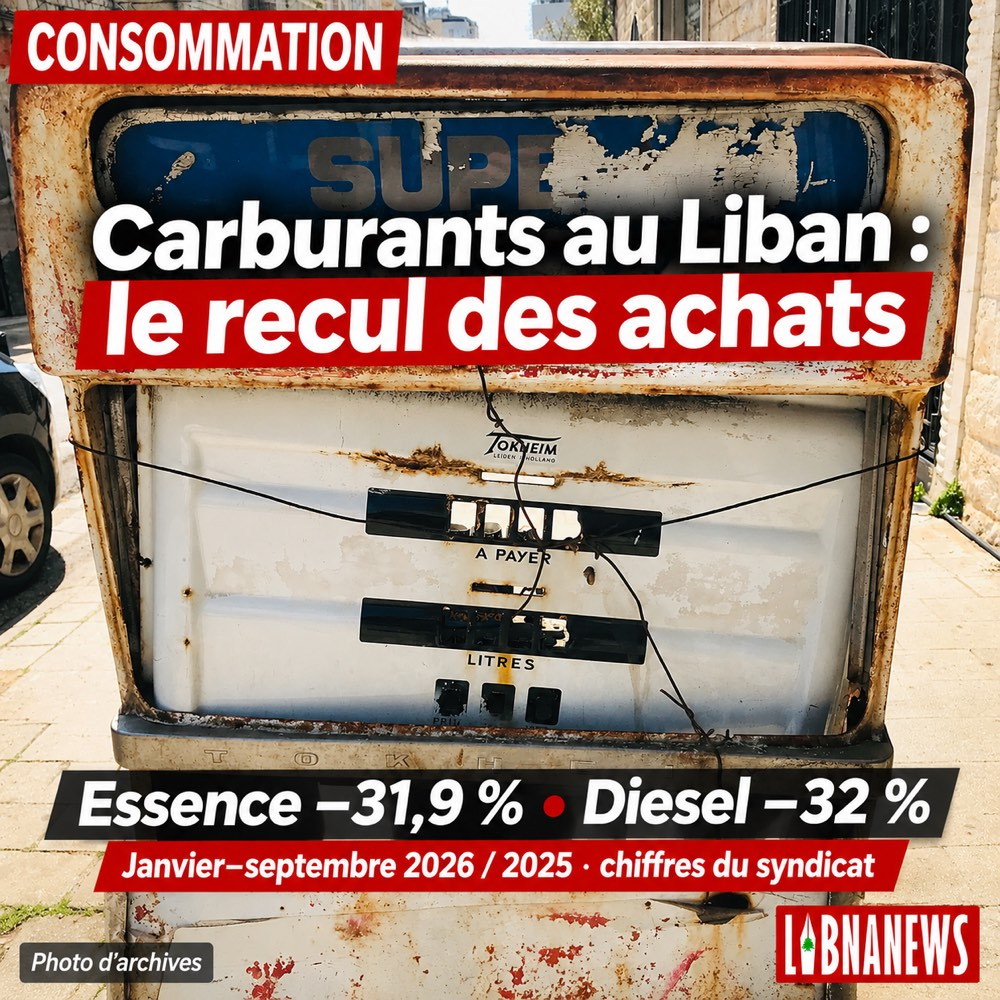
Fuel consumption in Lebanon fell by about a third between January and September 2026, according to figures presented by Georges Brax. The president of the gas station owners’ union reported a 31.9% decrease for gasoline and about 32% for diesel. He compared these nine months to the same period of 2025, in an interview published on November 14.
These figures describe a contraction of volumes, not a fall in prices. They come from the professional organisation mentioned by its president. Maintenance does not provide absolute quantities or details of their collection. They are therefore a sectoral indicator, without allowing separate measurement of purchases from each region or category of customer.
Fuel consumption: two almost identical declines
Gasoline and diesel perform different functions. The first is mainly associated with road movements. The second also supplies heating, electricity generation and freight transport. The reported decline thus affects several uses of energy. It cannot be reduced to the number of journeys of motorists alone.
| Product | Evolution presented by the union | Comparative period |
|---|---|---|
| Gasoline | -31.9% | January–September 2026 / January–September 2025 |
| Diesel | About -32 per cent | January–September 2026 / January–September 2025 |
The table does not add up the two percentages. Nor does it give the respective share of products in the market. Without their starting volumes, an exact total in litres or tonnes cannot be established. However, the proximity of the two rates indicates a contraction in the data presented for the two major fuel categories.
The period ends at the end of September. It therefore does not include all autumn and all future winter heating purchases. The figures should not be presented as an annual balance sheet of 2026. Nor do they describe a variation between September and October.
Split purchases rather than large reserves
Georges Brax associates this decline with the pressure on budgets. It describes households that reduce their displacement to the needs considered essential. In heating, he observed smaller and more frequent purchases. Some families buy only one keg at a time, rather than the quantities previously stored for the season.
This description covers practices observed by the professional. It is not accompanied by a quantitative household survey. However, it sheds light on the difference between need and purchase: a family may still need to warm up, without having cash to fill its reserve. A smaller quantity purchased does not automatically mean a lost energy need.
The trade unionist also refers to the effects on industry and trade. He cites in particular the food, plastics and paper industries, which face transport and energy costs. According to him, the increase in these charges reduces margins when companies cannot fully pass it on to their customers. The maintenance does not estimate this effect sector by sector.
Less litres does not mean a lighter bill
Brax’s diagnosis explicitly distinguishes prices and quantities. An increase in the unit price can push customers to buy less, without providing them with an equivalent economy. To calculate the trend in total expenditure, volumes and prices actually paid over the entire period would have to be available.
Maintenance does not measure this consolidated invoice. Nor does it allow the decline to be divided between financial constraints, changes in activity and other changes in usage. The pressure on purchasing power is the explanation put forward by Georges Brax. It does not constitute a statistical breakdown of all the causes of the decline in published material.
This reserve is important to interpret the figure. Presenting a decrease in consumption as an automatic gain in energy efficiency would be equally reducing. Available data do not measure equipment performance or precise substitution with other energy sources.
Diesel remains under surveillance as winter approaches
For the coming months, Brax anticipates different trajectories. It envisages a further relaxation of gasoline, but considers diesel more exposed to heating demand and transportation needs. These forecasts are not announced rates. They concern possible market developments, not the guaranteed amount of future purchases.
The professional manager advocates energy diversification in order to reduce exposure to external fluctuations. In the immediate future, his observation relates to the ability of households to finance their needs. The next surveys will allow the comparison to be extended to the last quarter, when heating purchases will weigh more heavily on diesel consumption.
Photo archive: former petrol pump in Jounieh, published in March 2022. This illustration does not represent a station closure in 2026. © Libnanews.com.





Comments