





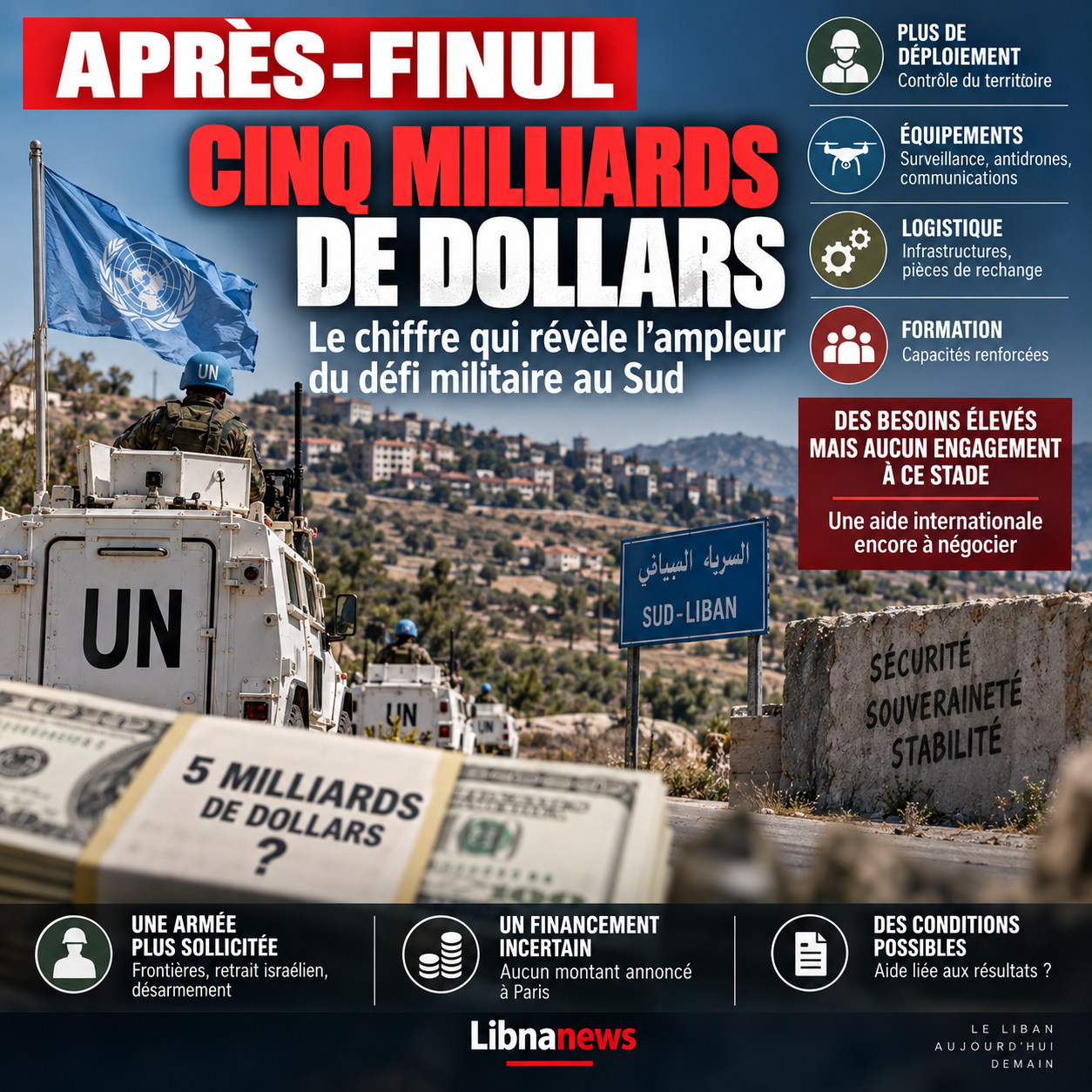
One figure, almost unnoticed in the political statements surrounding the Paris meeting, gives another dimension to the debate on the future of South Lebanon:$5 billion. According to a parliamentary source quoted by a media source on 18 September 2026, representatives of the military institution reported that, at a meeting of the Parliamentary Committee on Defence and the Interior held the previous week, the Lebanese Armed Forces would need about five billion dollars to carry out the missions currently carried out by UNIFIL in the South. The amount has not been officially announced by the army command in the available documents and should therefore remain presented as assigned information. But its order of magnitude suddenly sheds light on the problem facing the State: replacing an international force does not simply mean sending more soldiers south of Litani.
The issue becomes all the more sensitive as the planned end of the international mission comes at a time when the army is called upon to exercise more territorial responsibilities, to accompany a possible Israeli evacuation and to implement the government policy of concentrating weapons in the hands of the State. In Paris, Lebanon’s partners reaffirmed their support for this direction. However, no $5 billion envelope was announced. The gap between the responsibilities promised to the army and the means actually guaranteed is therefore one of the least visible, but the most important, post-FINUL cases.
What the five billions actually cover
It would be misleading to present the five billion as the mere « cost of replacing UNIFIL ». The parliamentary source cited does not provide the breakdown of this amount. There is no table to indicate how much would be spent on balances, vehicles, monitoring systems, infrastructure or equipment. The figure should therefore not be artificially detailed.
On the other hand, the discussions in Paris allow us to understand the nature of the needs that the army will face. King Abdullah II of Jordan publicly referred to the equipment needed to secure borders, the spare parts needed for existing equipment, the fight against drones and the surveillance of airspace. Other media sources stress logistical needs and the need for training tailored to new missions. The challenge is thus to transform capacity and not simply to increase staff.
UNIFIL now provides much more than a human presence. An international force has a supply chain, means of transport, communications, permanent installations and monitoring capacity. When it disappears, the space it leaves behind is not only measured by the number of soldiers leaving the territory. Some of its functions must be resumed, another may become unnecessary and some must be completely rethought around the responsibilities of the Lebanese army.
The challenge is also geographical. The army must be sufficiently present in the South to control the terrain while continuing to carry out its missions in the rest of the country. Massive strengthening in the south cannot be achieved by permanently weakening security arrangements elsewhere. Moreover, this is one of the reasons why support for the Internal Security Forces is associated with support for the army: the more resources the army concentrates on the South, the more the other institutions must be able to take over certain internal security missions.
The five billion give an indication of the depth of the proposed transformation. Although the amount still needs to be formally confirmed, it shows that post-FINUL is a problem with military structure before being a deployment problem.
Paris did not bring the five billion
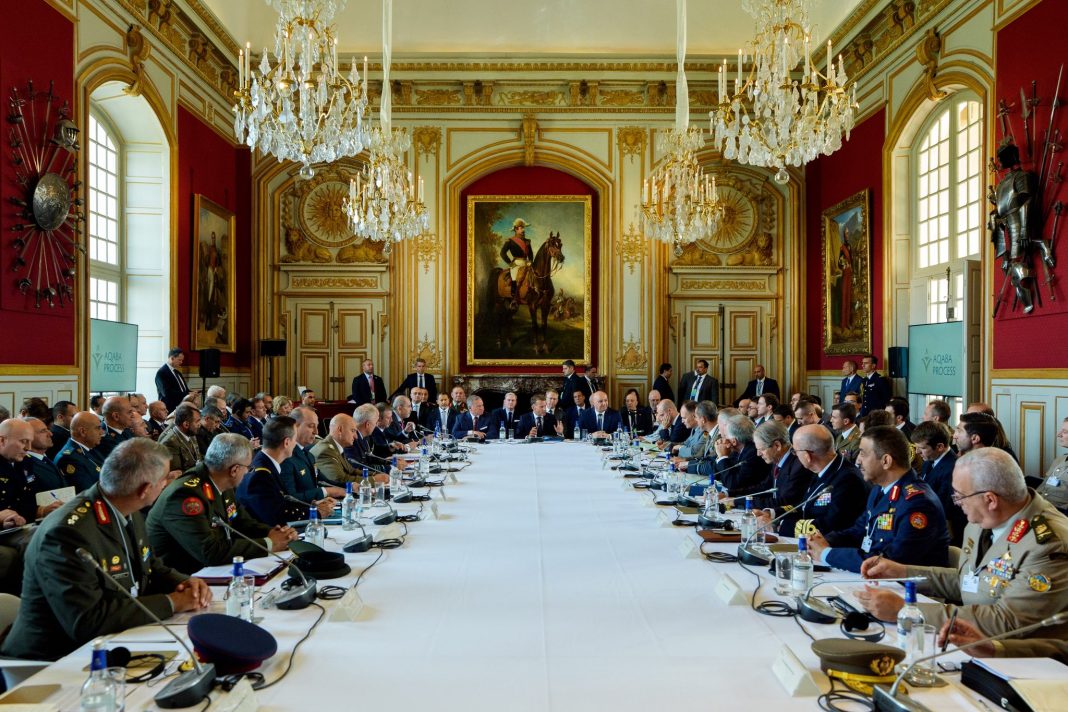
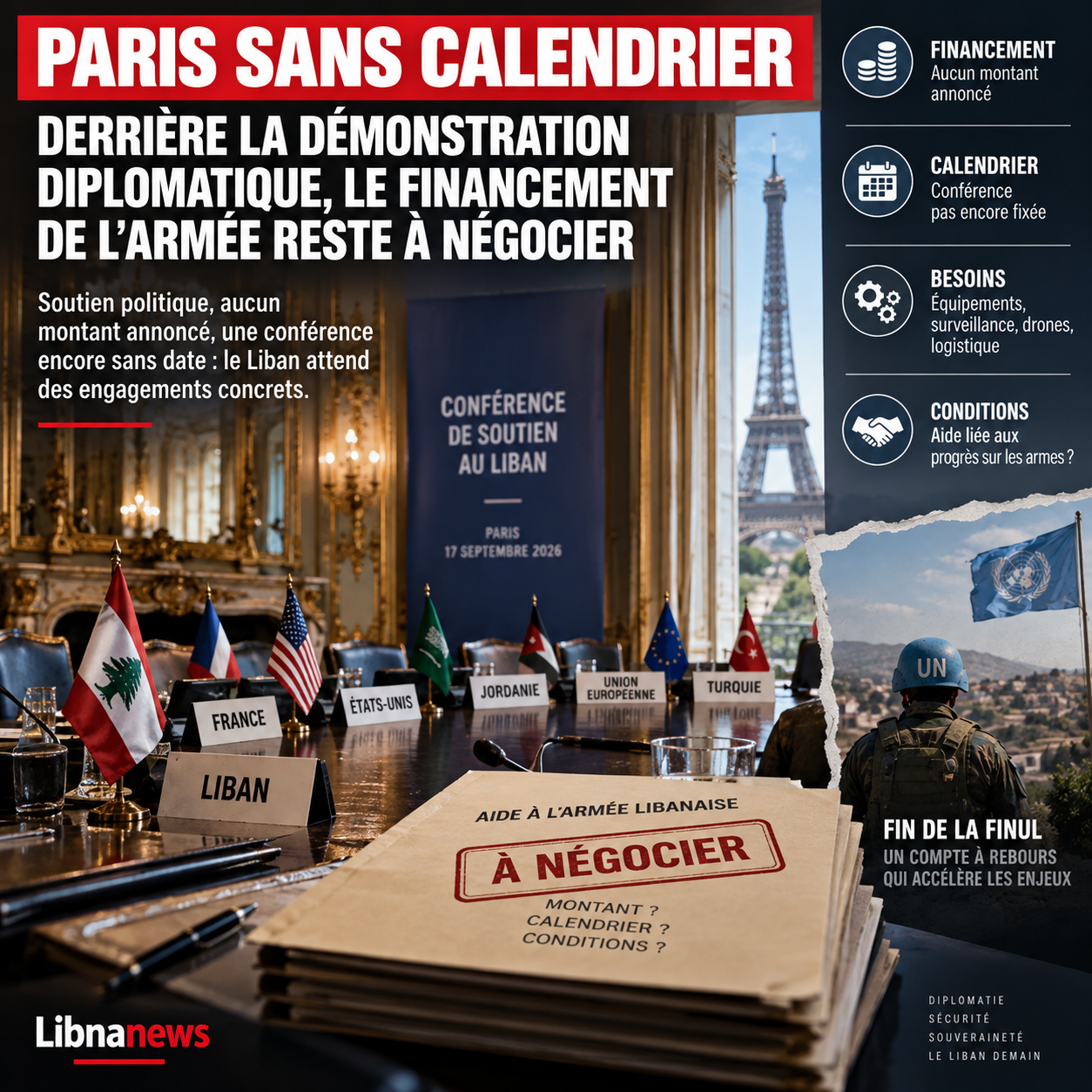
The purpose of the meeting on 18 September was precisely to prepare future international support for the army and the security forces. It brought together Lebanese, French, Jordanian, American, Arab and European officials and representatives of international organizations. However, the information from the discussions does not indicate any overall financial commitment corresponding to the magnitude of the need mentioned before the Parliamentary Committee.
The meeting was preparatory. It was to identify needs, coordinate partners and prepare a future conference. Reports were submitted by the Lebanese delegation to explain the demands of the army and the Internal Security Forces. Joseph Aoun asked that a road map and a clear timetable be established for the true support conference. King Abdullah II, for his part, indicated that a new meeting should be held before the end of the year to assess progress.
This diplomatic architecture shows that funding is not yet acquired. Needs are known or under definition, but commitments remain to be built. A media source also reported that the final date of the support conference was not yet set and depended on diplomatic consultations led by Paris and Amman.
In other words, the Lebanese State is already preparing for the transfer of responsibilities, while the full financing of this transfer is not secure.
This is probably the main risk of the current sequence.
The pitfall of conditionality
However, the most sensitive information does not concern the amount. It concerns the conditions that could accompany its financing.
According to diplomatic sources cited by several media sources, some of the international partners do not consider aid to the army as independent of the Hezbollah weapons file. A media source reports a US and Saudi approach linking substantial aid to the implementation of the State’s decisions on the concentration of weapons in its hands. Another describes conditions considered particularly demanding by its own sources and presents the military’s funding as closely associated with the expected results in the South.
A distinction must be made here between the established fact and the background information. The United States and Saudi Arabia have not publicly announced such a formula in the documents provided: such a quantity of weapons withdrawn will be entitled to such a sum. Nor does the corpus contain a document detailing an official financial condition. On the other hand, several media sources converge on the idea that donors want the strengthening of the army to bring about a concrete change in the control of arms and territory.
The problem is then almost mechanical. If the army needs several billions to acquire the capabilities to assume the post-FINUL, but some of these billions depend on its ability to fulfil certain missions first, the institution is faced with a difficult equation:it must produce the results which will justify the aid with means which it demands precisely because it lacks them.
This is where the French position takes on a particular meaning. Diplomatic sources described Paris as favouring a more gradual approach. The aid should enable the army to build its capabilities before all political and security objectives are imposed. This method also aims to prevent an institution conceived as a guarantor of national stability from being placed too quickly at the centre of an internal confrontation.
A military mission far beyond the border
Nor can the question of the five billions be separated from the evolution of the role that foreign partners want the army to play. Public discourse speaks of sovereignty, territorial control and border security. But the envisaged mission is broader: the army should also become the main instrument for the concentration of weapons in the hands of the State.
This transformation is considerable. It is no longer just about deploying units to Israel. The aim is to make the military institution the guarantor of a new internal equilibrium.
Joseph Aoun explicitly formulated this orientation in Paris by stating that the protection of Lebanon, its sovereignty and stability should be the responsibility of the military and security institutions of the State. He also stated that difficult decisions had begun to be implemented. King Abdullah II has linked the strengthening of the army to its ability to handle internal files and to ensure the concentration of weapons in the hands of the State.
Financing then becomes political. The five billion, if they actually correspond to the military institution’s estimate, would not only be used to replace international capabilities. They would help build an army that would occupy a much greater place in the organization of national security.
This difference explains why donors want to know exactly what they will finance.
Israeli withdrawal further complicates the equation
A parliamentary source raises a particularly sensitive question in this context: how can the State be asked to take over the defence of borders and sovereignty without giving it the corresponding military capabilities, while Israel retains positions in the South? The same source questions Lebanon’s guarantees against an Israeli advance north of the Litani River if Hezbollah gave up its weapons without the army having been strengthened beforehand.
This is an argument from a source and not a conclusion that should be repeated as certainty. But it reveals the heart of the disagreement on the calendar.
For a part of Lebanon’s partners, the concentration of arms in the hands of the State must enable the stabilization of the South and facilitate Israeli withdrawal. For those who defend a reverse sequence, the Israeli withdrawal and the prior strengthening of the army must create the conditions for dealing with the weapons file.
Both reasonings formally pursue the same result, but their order is opposite.
This question of sequence could be more decisive than the final amount of aid. Even if five billion were promised tomorrow, their use would still depend on how the Israeli withdrawal, the deployment of the army, the treatment of weapons and the establishment of the successor arrangement to UNIFIL were coordinated.
Five billion, but how many years?
Another unknown person deserves to be highlighted. The information available does not indicate whether the five billion would represent an immediate need, a multi-annual programme or all the investments necessary for a sustainable transformation of the army.
This lack of detail is essential. Five billion over one year would be an exceptional operation. The same amount spread over several years would be a long-term modernization programme. The budgetary, military and political implications would be very different.
Funding could also be divided into several categories. Some partners can provide equipment directly rather than money. Others can finance training. Some can support infrastructure or monitoring systems. Arab countries could participate financially while States with military industries would bring equipment.
It is probably in this form that future support will be negotiated: not a single cheque of five billion, but a complementary set of commitments.
However, this method is weak. The more funding is fragmented among donors, the more complex coordination becomes. Each State has its own rules, priorities and sometimes political conditions. The army can then receive equipment without the necessary spare parts, or obtain systems that are permanently dependent on the supplier country.
So the question is not just to raise five billion. A coherent capacity must be built.
The Lebanese State will also have to pay
Joseph Aoun added in Paris an element rarely emphasized: international aid cannot be the only financing of military and security institutions indefinitely. As public finances recover, the Lebanese State will have to bear an increasing share of their costs.
This statement addresses the structural problem. An army can be modernized by foreign donations. It cannot function sustainably only thanks to them. Balances, maintenance, fuel, infrastructure and equipment renewal are ongoing expenditures.
The future model must therefore be sustainable after donors have left.
This is particularly important if the army resumes functions currently performed by an internationally funded mission. Lebanon might otherwise succeed in the military transition while creating a budgetary burden that it could not maintain a few years later.
The debate on the five billion is thus directly linked to the debate on public finances. International support can finance the initial transformation. The sustainability of the scheme will then depend on the State’s ability to finance its own security apparatus.
The number that requires looking beyond speeches
The five billion still need to be formally confirmed and detailed. It would be premature to make it an agreed post-FINAL budget. But the information attributed to the parliamentary source already has a value: it reveals the gap between the simplicity of political discourse and the complexity of its execution.
To say that the army will gradually replace UNIFIL is easy. Giving the army the means to do so is much less. Monitoring, mobility, communications, maintenance, border protection and increased military presence in the South must be financed without weakening the security of the rest of the territory. At the same time, the Internal Security Forces must be strengthened. Finally, we must organize this rise in power at the very moment when the army is entrusted with the politically explosive dossier of the concentration of weapons in the hands of the State.
The figure of five billion therefore raises the question that diplomacy cannot avoid for long:do Lebanon’s partners really want to finance the army capable of carrying out the mission they are asking for, or do they want to get the political results first before committing the necessary resources?
The answer will largely determine the credibility of the post-FINUL. For the danger is not only that no international force replaces the current mission. It is that the Lebanese Armed Forces be officially designated to replace it before they have received the material, financial and operational resources corresponding to that responsibility.