





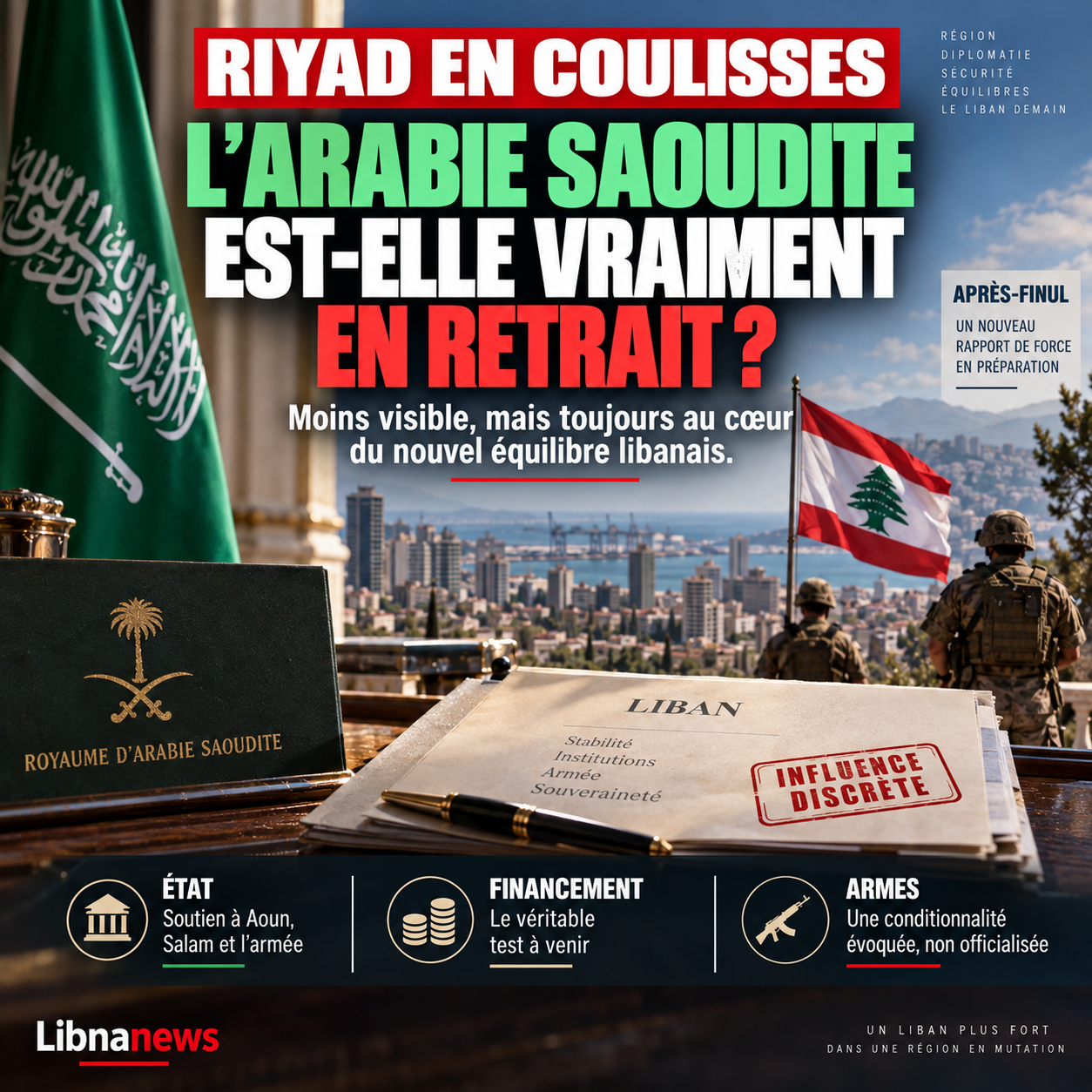
Saudi discretion in Lebanon may give the impression of erasure. However, information published by media sources on 18 September tells a different story. Riyadh would still be directly involved in the Lebanese case and would continue to support the presidency of Joseph Aoun, the government of Nawaf Salam and above all the strengthening of the army. The difference would be in the method: less public exposure, more political conditions and a willingness to see the Lebanese state produce results before external support changes scale. This reading is particularly important at a time when the end of UNIFIL forces Lebanon to seek substantial funding and when the issue of the State monopoly on arms becomes the main test of the new phase.
Several behind-the-scenes information mainly helps to rule out too simple a reading. Riyadh’s attention is strongly mobilized by Yemen and by the deterioration of regional security, but this would not mean that the Lebanese file has been abandoned. On the contrary, informed sources describe continued Saudi involvement. Another media source, based on diplomatic circles, goes further: it refers to a US-Saudi convergence on the need to link significant assistance to the army with concrete progress in implementing the state’s decisions on Hezbollah weapons. This second element is not confirmed by an official announcement and should therefore be considered as assigned information. However, it makes it clear why the absence of major Saudi financial announcements does not necessarily mean a lack of strategy.
Riyadh would support Aoun and Salam, but without returning to the former Lebanese policy
The informed sources describe a fairly precise Saudi position. Riyadh would continue to support the State and its institutions, with particular attention to Joseph Aoun, Nawaf Salam and the army. This is different from the periods during which Saudi policy in Lebanon relied more directly on partisan alliances, personalities or political networks. The centre of gravity now seems to be placed on the state institution.
This development deserves to be taken seriously, as it changes how Saudi influence can be exercised. Supporting a party allows intervention in the inner power ratio. To support the presidency, the government and the army is instead to invest in a transformation of the functioning of the state. In the current context, this transformation has a very concrete content: the State must gradually become the sole holder of military decision and weapons.
Convergence with Joseph Aoun therefore appears structural. The President said in Paris that the Lebanese had chosen the State and that the protection of the country must be the responsibility of its military and security institutions. Nawaf Salam also defends the concentration of weapons in the hands of the state. The army is called to extend its control in the South. In this context, Riyadh does not need to occupy the Lebanese political scene daily to see a significant part of its priorities directly addressed by the institutions.
This may explain part of his discretion. When the objectives pursued are enshrined in the State’s official policy, permanent public intervention becomes less necessary. It can even become counterproductive if it allows opponents of this policy to present it as a foreign injunction.
Saudi support could thus be more effective when it remains in the background.
The real indicator will be financial
The question, however, is how far this institutional support can go. Political statements cost little. The transformation of the army costs much more.
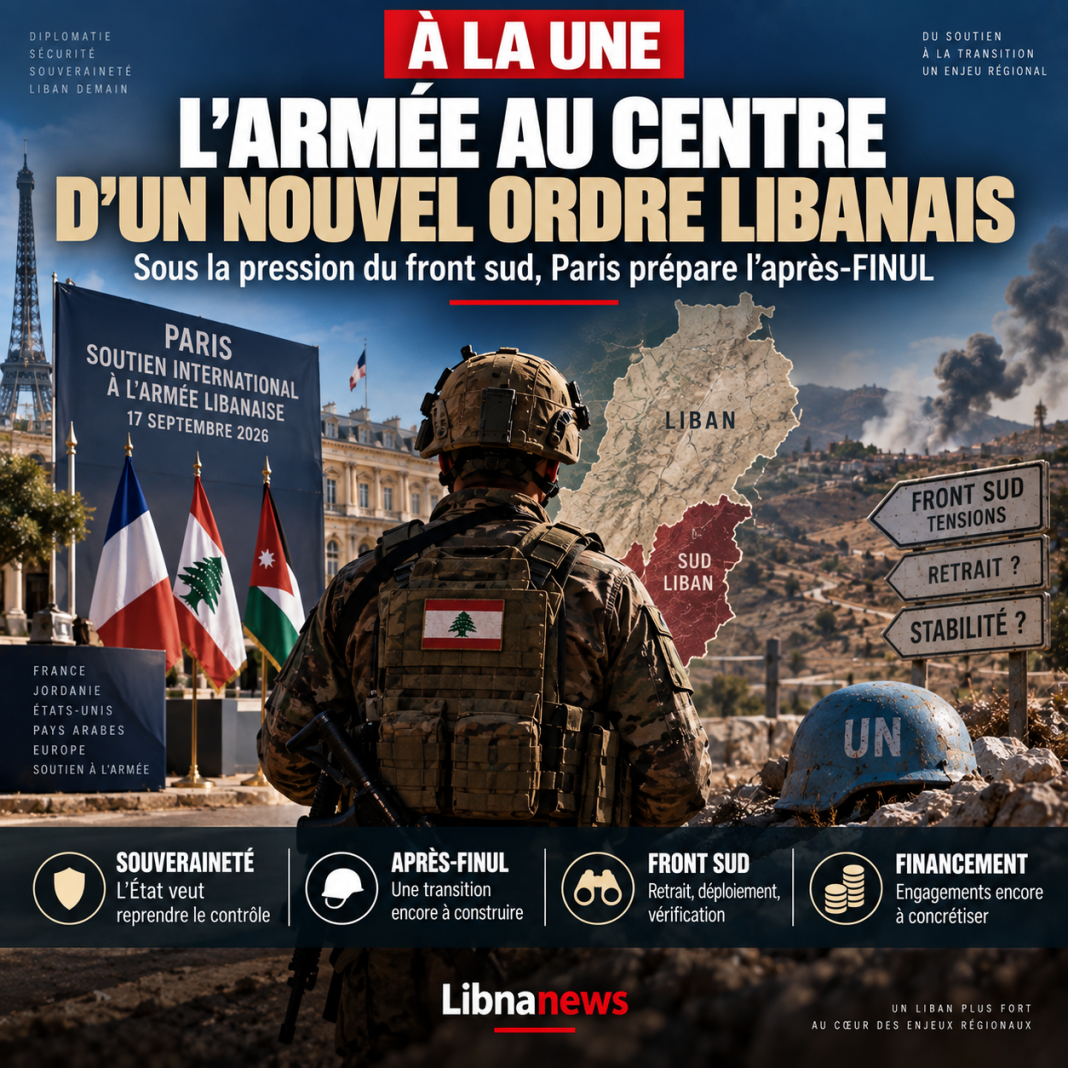
Information from a parliamentary source indicates a need of up to about $5 billion to enable the army to assume the functions required to return with UNIFIL’s departure. This amount is not confirmed by an official breakdown available and should remain treated as a reported estimate. It is sufficient, however, to show that Lebanon will not be able to finance all this transformation alone in the short term.
This is where Saudi Arabia is becoming a must again.
France can play a diplomatic role and provide certain capabilities. The United States is a major military partner and has equipment particularly useful to the army. Jordan has operational experience and can contribute to training and coordination. But the Gulf countries, particularly Saudi Arabia, have a financial capacity that can change the scale of the programme.
The absence of a spectacular Saudi announcement in Paris therefore makes it impossible to conclude that Riyadh will not participate. The meeting was preparatory. Needs still need to be transformed into specific requests and then into national contributions. The key moment will come when partners have to indicate what they are really willing to finance.
It is also at this point that any Saudi conditions will become more visible.
Helping the Hezbollah Army and Weapons: The Condition Not yet Written
A media source reports, on the basis of diplomatic information, the existence of an American-Saudi approach combining substantial aid to the army in the execution of government decisions on Hezbollah weapons. This formulation calls for an essential precaution: the sources provided do not present any signed agreement or official Saudi declaration establishing this condition formally. It would therefore be incorrect to write that Riyadh publicly put forward a financial ultimatum.
But the content of the information corresponds to an identifiable political logic. If the strategic objective is to make the army the only legitimate military instrument in the country, donors may want to ensure that the money invested effectively changes the relationship between the state and the armed structures beyond its control.
The difficulty lies in chronology. In order to exercise a real monopoly, the State must have a sufficiently strong military institution. However, if the funding needed to strengthen this institution depends on prior results in the arms case, the army may find itself facing a mission of which it does not yet have all the means.
It is on this issue that diplomatic sources describe a nuance between Paris and the American-Saudi approach. France would like a more gradual progression in order to avoid an internal confrontation and first give the army the means to increase its presence. Washington and Riyadh would be more committed to the effective translation of decisions already taken.
The difference is not necessarily an opposition to the final objective. It’s about how to get there.
Yemen explains part of Saudi discretion
The Yemeni crisis is another essential element in understanding Riyadh’s behaviour. The fighting around the Bab al-Mandeb Strait, the attacks attributed to the Houthis and the incidents affecting Saudi territory place the Kingdom in the face of a much more immediate threat than the Lebanese file.
Media sources on 18 September describe significant clashes around Yemen’s strategic axes, while maritime security has become a major concern. A Yemeni resident was killed in Saudi Arabia following the debris of an intercepted drone in the Taif area, while others were injured. The issue of Mecca’s security also came to the heart of the confrontation, with a Saudi accusation about an attempted attack and a denial by the Houthis.
In this context, it would be surprising that Lebanon is the first operational priority for Riyadh. But reduced priority does not mean disengagement. Informed sources stress this distinction precisely: the regional crisis absorbs a considerable part of Saudi attention, while the Lebanese issue continues to be monitored.
This hierarchy of priorities can even enhance Riyadh’s interest in institutional stabilization in Lebanon. The more the kingdom is confronted with tensions on its regional environment, the less better it is to see a new focus of lasting confrontation on the eastern Mediterranean.
The Lebanese case directly joins the regional confrontation with Iran
Lebanon cannot be isolated from the Yemeni case. In both cases, Riyadh is confronted with the question of the armed organizations linked to Iran and their relationship with the States in which they operate. The Lebanese and Yemeni situations are very different politically, institutionally and militarily. It would be abusive to confuse them. But they belong to the same strategic Saudi environment.
This also gives particular meaning to support for the Lebanese army. For Riyadh, strengthening the state is not only a policy of internal stabilisation. This theoretically reduces the ability of a non-state actor to engage the country in a regional confrontation without the official institutions fully controlling the decision.
The recent war has strengthened this issue. The Lebanese debate on the decision of war and peace is no longer abstract. It is directly linked to the economic, territorial and human consequences of a confrontation in which Hezbollah’s regional choices have played a major role.
The Saudi position can thus be understood as a long-term strategy: not to seek to replace one Lebanese actor with another, but to gradually push the system towards a model where the State has the necessary instruments to decide.
However, this strategy presents a risk. If viewed by a part of the population as an external project aimed exclusively at Hezbollah, it can reinforce the polarization that the strengthening of the state is supposed to reduce.
Hence the importance of the method.
Riyadh has no interest in turning the army into an opponent of a Lebanese party
One of the challenges for foreign partners is to support the army without changing the national perception of the institution. Its political strength is largely due to the fact that it remains one of the few public structures capable of maintaining trans-Community legitimacy.
Asking him to quickly become the instrument of a confrontation with Hezbollah could put this feature to the test. This is precisely what the gradual method advocated by some partners seeks to avoid.
For Riyadh, the dilemma is real. The kingdom wants a state capable of monopolizing weapons. But if the way to achieve this goal weakens the army or produces an internal conflict, the result would be contrary to its strategic interest.
The conditionality of the aid must therefore be handled with caution. It can be used to push institutions towards reform. It can also place them in an impossible position if the required objectives are faster than their operational capabilities and the political consensus available.
This is probably one of the reasons why possible conditions remain more perceptible in diplomatic information than in Saudi public statements.
The relationship with Washington gives Riyadh another lever
The American-Saudi dimension also deserves consideration. Both countries have common interests in strengthening the Lebanese State and limiting autonomous military structures. But they do not have the same instruments.
Washington can provide a significant portion of equipment, training and military support. The United States also has a decisive channel with Israel. Riyadh has financial capacity and Arab political influence.
Coordination between the two would thus combine the levers: American military assistance, Arab financing and diplomatic pressure on the various parties.
This possibility explains why the conditionality reported by the sources is presented as American-Saudi rather than strictly Saudi.
It also helps to understand why Paris seeks to preserve its own space. If Washington, Riyadh and Israel determined only the parameters of the future southern apparatus, the French role would be considerably reduced. The Paris meeting precisely enabled Emmanuel Macron to put France at the centre of the process by involving Jordan and other partners.
The issue of military support is therefore also a matter of distribution of international influence.
Saad Hariri’s return is another indicator to be monitored
An inner element could also be used to measure the evolution of the relationship between Riyadh and Lebanon: the repositioning of the Future Current and Saad Hariri.
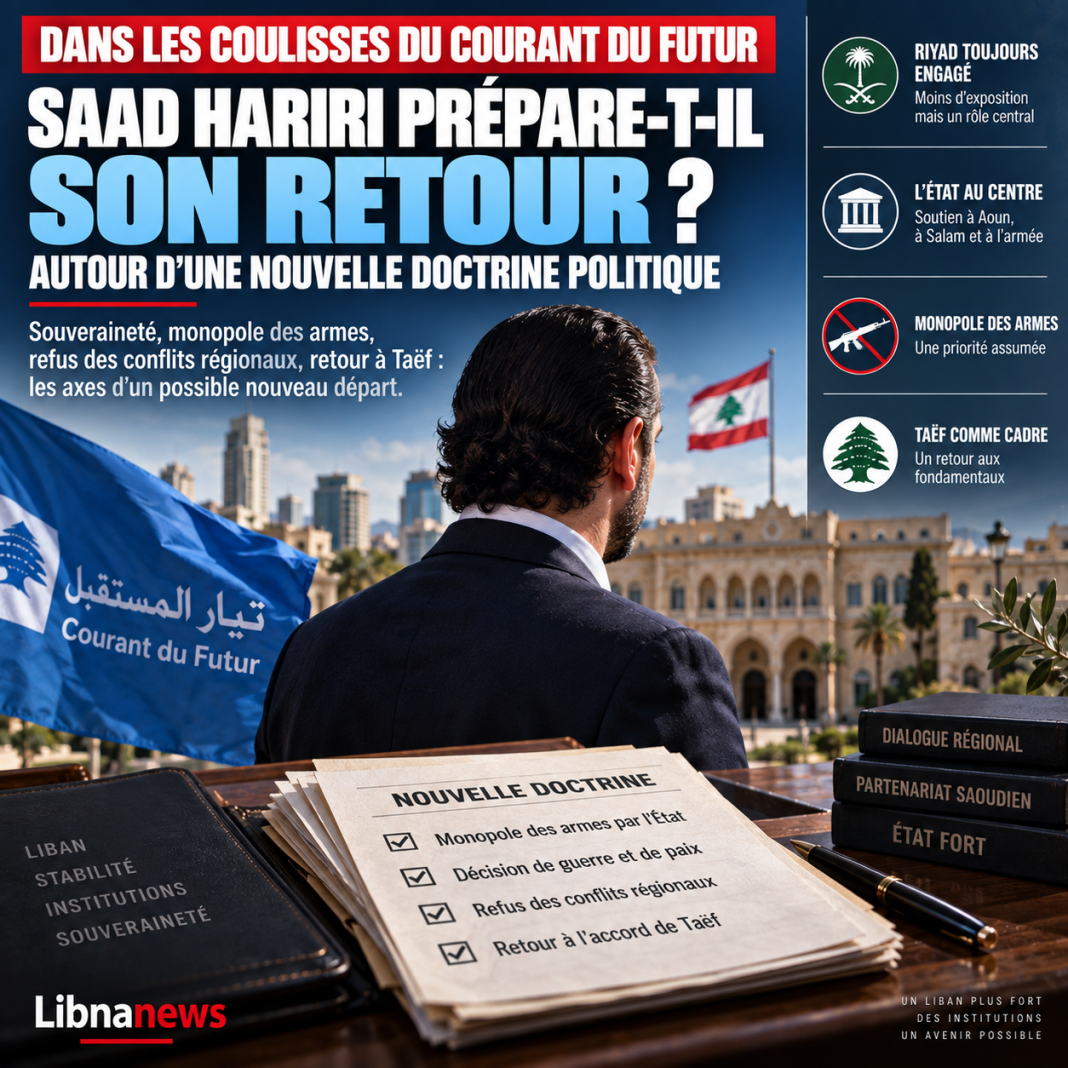
Internal sources report that a political congress is being prepared and that a new doctrine should focus on the state monopoly of arms, the decision on war and peace, the rejection of external conflicts on Lebanese territory and the implementation of the Taif Agreement. The same sources present the past break with Saudi Arabia as a period to be exceeded.
It would be premature to infer a full recovery from the old relationship between Riyadh and Saad Hariri. The available sources do not support this. But the convergence of themes is notable. The future speech of the current would be precisely in line with the priorities currently put forward by the institutions supported by Riyadh.
The kingdom could thus find itself confronted with a political landscape different from that which it had left: a presidency, a government, an army and potentially a great Sunni current converging on the need to put the military decision under the authority of the State.
This does not mean the return of the old « Saudi policy to Lebanon ». On the contrary, this could mark the transition to a new formula.
Less visible but potentially more structuring influence
The question is therefore probably not whether Saudi Arabia is « returning » to Lebanon. The available information suggests that it did not actually come out. What has changed is the nature of his presence.
Riyadh seems less interested in permanent occupation of the political scene than in the institutional outcome of the current phase. Joseph Aoun enjoys his support. Nawaf Salam too. The army is the main instrument around which the new security architecture can be built. Hezbollah’s weapons remain the decisive issue. International financing can become the lever for accelerating the process.
But the kingdom advances in an environment where every Lebanese decision is linked to a regional issue. Yemen, Iran, Israel, the United States and the post-FINUL are now in the same equation. Riyadh must therefore choose not only what he wants to get in Lebanon, but also the pace at which he wants to get it.
That’s where his discretion becomes interesting. It doesn’t necessarily look like an absence. It can be a policy that awaits the time when returns will have to be converted into money, equipment and decisions.
The real test will therefore not be the number of Saudi officials appearing in Beirut. It will come when the international conference to support the army will have to allocate contributions and Lebanon’s partners will specify their conditions. At that time, it will be possible to measure much more accurately the role Riyadh intends to play.
For behind the financial question is a more important political question:is Saudi Arabia ready to finance the rise of the Lebanese State before it has settled the arms issue, or does it now consider that this rise in power and the monopoly of arms must progress together?
The answer will determine whether the current Saudi discretion is that of an actor who moves away, or that of an actor who waits for the balance of power to be mature enough to engage its main levers.