





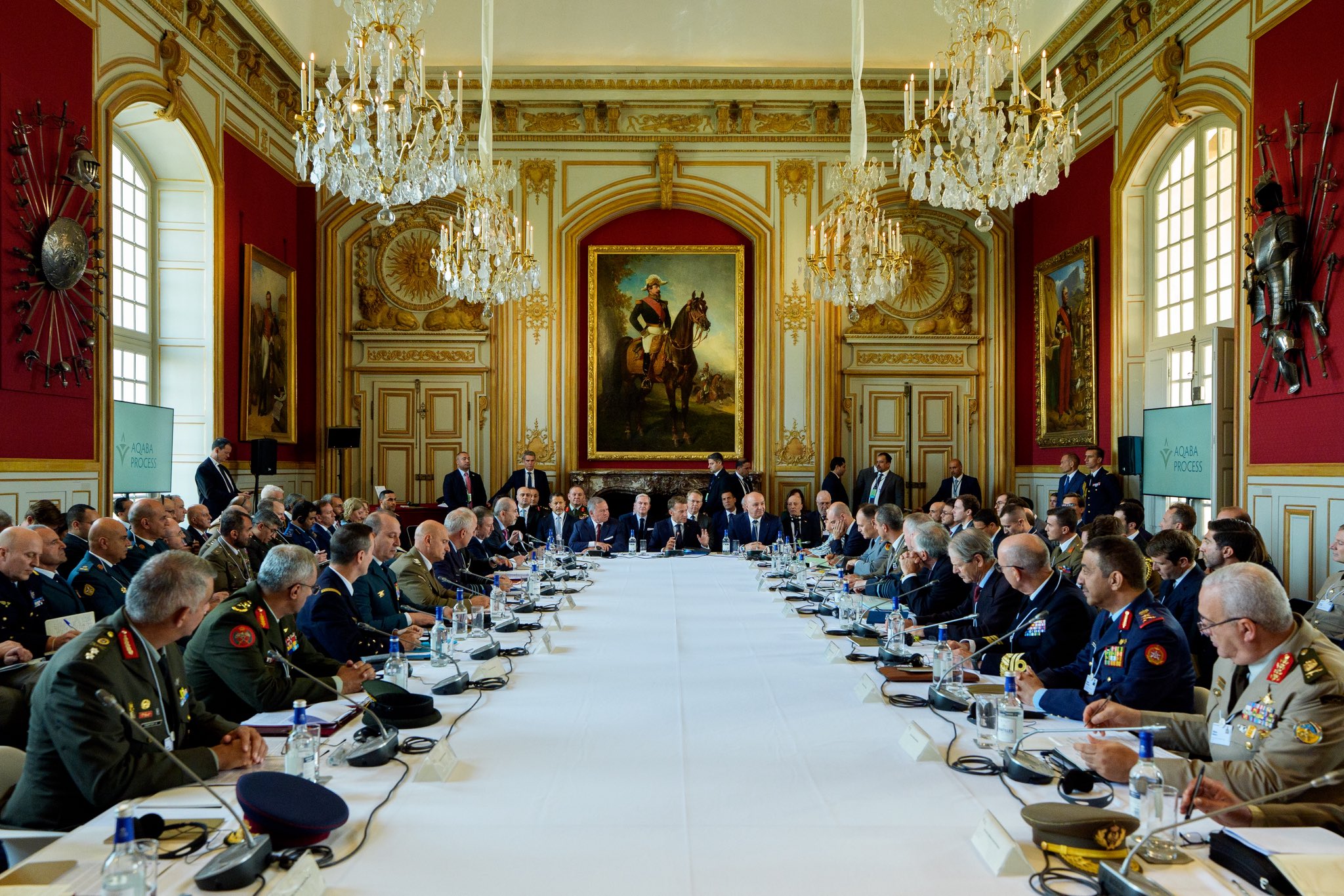
Lebanese President Joseph Aoun, his French counterpart Emmanuel Macron and King Abdullah II of Jordan met Thursday, September 17, 2026 in Paris to coordinate their action in favour of Lebanon, with the priority of strengthening the Lebanese army and the Internal Security Forces. The tripartite meeting at the National Invalid Hotel preceded an international preparatory meeting to identify the needs of Lebanese military and security institutions. The three leaders also addressed regional escalation, the situation in South Lebanon and ways to avoid a security vacuum after the scheduled end of the Finul mandate.
The Paris rendezvous must prepare a wider international conference to support the Lebanese army and security forces. Joseph Aoun asked that the discussions lead to a clear roadmap and timetable. The Lebanese President presented the strengthening of these institutions as essential to the exercise of State sovereignty over the entire territory.
Aoun, Macron and Abdullah II gathered at the Invalides
The meeting between the three heads of State took place before the opening of the preparatory meeting organized within the framework of the Aqaba process, an initiative launched by King Abdullah II of Jordan.
Discussions focused primarily on mechanisms for increasing cooperation and coordination between France, Lebanon and Jordan.
Paris and Amman seek to mobilize more partners around Lebanese security institutions. Beirut, for its part, wants to transform this diplomatic mobilization into concrete commitments allowing the army and the Internal Security Forces to increase their capabilities.
The three leaders stressed the importance of the new meeting of the Aqaba process in France. This framework should enable Lebanon’s partners to collectively assess the needs of its army and then coordinate their assistance.
The issue goes beyond the mere financing of the armed forces.
Lebanon must increase the capabilities of its army when it is called upon to exercise greater responsibilities in the south of the country. At the same time, the termination of the mandate of the United Nations Interim Force in Lebanon raises the question of the security organization following its departure.
It is in this context that France, Jordan and Lebanon want to prepare a coordinated international response.
Support to the Lebanese Army at the centre of the meeting
The priority of the Paris meeting is the operational capabilities of the Lebanese army.
Joseph Aoun defended a long-term approach. Lebanon, he explained at the preparatory meeting, is not looking for a succession of ad hoc aids or temporary solutions.
Beirut wants cooperation to enable military and security institutions to plan their needs and develop their capabilities sustainably.
This distinction is important. International aid to the Lebanese army has often enabled the institution to maintain its functioning despite the financial collapse of the country. The Paris meeting now seeks to go beyond this urgent logic.
Needs include equipment, logistics, training and operational capacity development.
In preparing for the meeting, the Lebanese Presidency had indicated that the objective was to provide the army with the means and resources necessary to carry out its responsibilities effectively. Priorities must be defined on the basis of the action plan and the needs identified by the military institution itself.
The Internal Security Forces are also part of the arrangements.
Beirut’s reasoning is that strengthening ISPs allows for a better division of security responsibilities. An internal police force with sufficient resources can take on its own tasks and prevent the army from being mobilized on tasks that are far removed from its military priorities.
Joseph Aoun asks for a roadmap
The Lebanese President requested that the meeting not remain at the stage of political declarations.
He hoped that the process would lead to a road map for the future international conference and a clear timetable for its organization.
Joseph Aoun proposed the establishment of a transparent mechanism to identify priorities, monitor commitments made by partners and verify that aid actually reaches the sectors where it is needed.
The President presented the Aqaba process as a framework for bringing together Lebanon’s partners around common objectives.
Above all, it has placed the military question in the broader question of State authority.
For Joseph Aoun, the army and the various security services carry out different but complementary missions. The State cannot impose its authority over the whole territory on a lasting basis without military and security institutions capable of being present there.
The Lebanese Head of State claimed that Lebanon had chosen to entrust the protection of its sovereignty, security and stability to its official institutions.
He asked international partners to accompany this direction.
Macron wants to build military capabilities
Emmanuel Macron also placed the Lebanese army at the centre of the proposed arrangement.
The French President considers its strengthening essential to enable the Lebanese State to exercise its full authority in the South.
Paris links several elements: the withdrawal of Israeli forces from the occupied Lebanese territories, the deployment of Lebanese forces and the development of the necessary capabilities to ensure long-term security.
Emmanuel Macron thus defended an Israeli progressive withdrawal accompanied simultaneously by a strengthening of the Lebanese army.
The French logic is to prevent a withdrawal or a change in the international system from creating a security vacuum.
The French President said that support for the army should enable him to take full responsibility for the Lebanese State’s responsibilities in the South.
He also announced his intention to continue his contacts with US President Donald Trump to ensure compliance with Israel’s commitments under the arrangements under discussion.
This dimension places Washington at the centre of the equation, even though the Paris meeting is politically carried by France, Jordan and Lebanon.
South Lebanon at the heart of the discussions
Prior to the tripartite meeting, Joseph Aoun had met Emmanuel Macron at the Élysée.
The Lebanese President arrived at the French presidential palace at 8.30 a.m. Paris time, or 9.30 a.m. in Beirut.
This bilateral meeting enabled the two Presidents to address the situation in Lebanon, in particular developments in the South.
Joseph Aoun and Emmanuel Macron discussed efforts to end Israeli attacks and negotiations involving Lebanon, the United States and Israel.
The Lebanese President briefed his French counterpart on the situation on the ground and the challenges of the period following the presence of the Finul.
Beirut insists on one principle: Lebanon’s commitments cannot produce lasting stability if Israeli violations continue and Lebanese territories remain occupied.
Joseph Aoun therefore asked Lebanon’s partners to work towards the full implementation of the commitments made and to consider the sovereignty and territorial integrity of the country as principles that cannot be applied selectively.
Paris is already preparing for the post-Final
The question of the Finul is one of the most important dossiers of the Parisian appointment.
The UN mission in southern Lebanon is approaching the end of its mandate. The prospect of its withdrawal obliges international partners to reflect now on the mechanism that can accompany the Lebanese army after this deadline.
Emmanuel Macron expressed his reservations about the end of the UN mission. However, it considers it necessary to prepare the following period in practice.
France is working with Italy on possible scenarios.
Joseph Aoun welcomed the initiative undertaken by Emmanuel Macron with the President of the Italian Council Giorgia Meloni to prepare the post-Final.
Discussions include the possibility of an international presence different from the current mission. However, the contours of a possible new device are still to be determined.
Paris insists on one point: an international force must not replace the Lebanese army.
Its role would be to support the national military institution, while it would itself exercise the responsibilities of State sovereignty.
Discussions therefore focused on the missions that could be entrusted to a future international mechanism, its status, composition and how it would work with Lebanese forces.
American, European and Arab representatives in Paris
The preparatory meeting was not limited to the delegations of France, Lebanon and Jordan.
Representatives of the United States, Canada, Arab countries, the European Union and international organizations also participated.
The American delegation included General Joseph Clearfield, who led the military coordination group on Lebanon, as well as the American ambassador to Beirut, Michel Issa.
This participation extends the scope of the meeting.
The objective is precisely to avoid a multiplication of bilateral aid without coordination. The partners must have a common assessment of the military needs and identify the areas in which each can intervene.
The Paris meeting is therefore not yet the major donor conference sought by Beirut.
It is a preparatory step.
Participants should identify needs, discuss future military missions and prepare commitments that can then be discussed in a broader international format.
Abdullah II calls for rapid strengthening of the army
King Abdullah II stressed the urgency of supporting the Lebanese army.
The Jordanian sovereign considers that international partners have a collective responsibility to strengthen the institution and enable it to carry out its tasks.
Jordan plays a special role in this sequence since the Paris meeting is part of the Aqaba process.
This initiative, launched by Abdallah II in 2015, was originally conceived as a framework for international coordination on security and counter-terrorism issues. The meeting in Paris adapts this format to the specific needs of Lebanon.
Amman also has significant military cooperation with several Western countries.
France and Jordan took advantage of the King’s visit to Paris to strengthen their bilateral defence partnership. Both countries have signed a military cooperation agreement.
In their joint statement, Paris and Amman confirmed their commitment to support the Lebanese Armed Forces, assess their needs and improve coordination among the partners providing assistance.
Gaza and regional escalation also discussed
The Aoun-Macron-Abdallah II meeting was not limited to Lebanon.
The three leaders discussed regional escalation and called for intensified international efforts to achieve sustainable de-escalation.
The situation in the Gaza Strip, the West Bank and East Jerusalem was mentioned.
Joseph Aoun defended a broader approach to regional security.
The Lebanese President considered that the security of the various countries of the Middle East was interdependent. He called for a regional strategy based not only on security cooperation but also on joint energy projects and economic and political cooperation.
This regional dimension also explains Jordan’s presence in the Parisian format. Amman is directly involved in several regional issues and has close relations with Washington, Paris and Beirut.
But the Lebanese case remained the main operational subject of the day.
French-Lebanese reconstruction, energy and cooperation
The bilateral meeting between Joseph Aoun and Emmanuel Macron also helped to address issues beyond military support.
The Lebanese President recalled the importance of a conference on reconstruction.
Beirut hopes that the international mobilization for its security institutions will be accompanied by support for the reconstruction of areas affected by clashes and military operations.
Joseph Aoun and Emmanuel Macron also discussed economic and energy cooperation.
Topics covered include the resumption of oil and gas exploration activities in Lebanese offshore blocks.
The two Presidents agreed to maintain contacts on these issues.
However, the economic aspect remains distinct from the immediate objective of the 17 September meeting: to define how Lebanon’s partners can effectively strengthen its army and security forces.
Paris wants to move from intentions to concrete needs
The 17 September meeting is thus a preparatory step rather than a final financial commitment conference.
Participants must transform a widely shared political will into a list of needs and cooperation mechanisms.
For the Lebanese army, there are many needs: equipment, logistics, training, intelligence, surveillance, mobility and specialized capabilities.
The challenge is all the more important as the institution must simultaneously maintain internal security, strengthen its presence in the South and prepare to assume more responsibility after the Final.
Support for ISPs responds to the same reasoning. By strengthening the internal security forces, the partners want to enable the army to concentrate more resources on its military missions.
The Franco-Lebano-Jordan meeting provides the political framework for this mobilization.
The next step will be to transform the preparatory work in Paris into an international conference capable of obtaining precise commitments. Joseph Aoun asked for a timetable and a roadmap. The partners must now determine the date of this conference, the means they are ready to commit and the mechanism that will accompany the Lebanese army as it approaches the end of the mandate of the Final.