

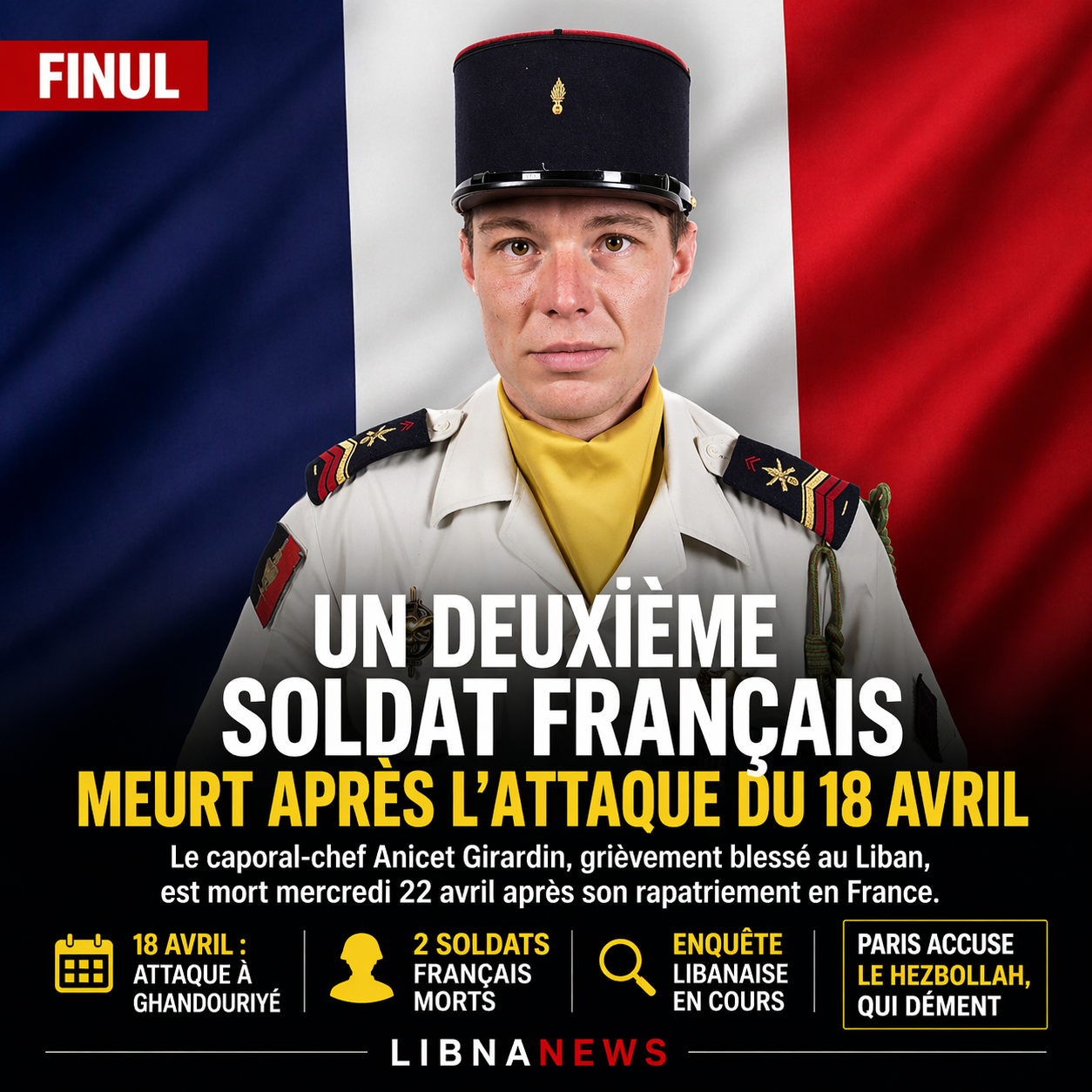
Master Corporal Anicet Girardin, a French military member of the Finul who was seriously wounded in Lebanon during the 18 April attack on a French convoy, died on Wednesday 22 April as a result of his injuries, the day after his repatriation to France. The announcement was made by Emmanuel Macron on the X network. The French Head of State stated that the non-commissioned officer belonged to the 132nd Cynotechnical Infantry Regiment of Suippes.
This death occurred four days after the attack on a group of French soldiers of the United Nations Interim Force in Lebanon, in the area of Ghandouriyah, in the south of the country. A first French soldier, Florian Montorio, was killed in the same attack. Three other soldiers were wounded, two seriously. Anicet Girardin was one of those serious injuries.
The French authorities accuse Hezbollah of being responsible for this attack. Emmanuel Macron had spoken on 18 April of a beam of elements pointing towards the Shiite movement. The Finul had also referred to a deliberate attack by non-State armed actors, and then indicated that the first elements gave rise to suspicion of Hezbollah. The Shiite movement denied any involvement. In a statement, he called for the results of the Lebanese Army investigation to be awaited before assigning responsibility for the attack.
At this stage, no arrests were announced. The Lebanese Army reported that it had initiated an investigation to establish the circumstances of the attack and to arrest the persons involved. Lebanese judicial officials also reported that the military court was following the case in coordination with the army intelligence services in order to identify the attackers. But, at the time of the announcement of the death of Anicet Girardin, no Lebanese authority had reported that authors had been arrested or officially identified.
An attack on 18 April in southern Lebanon
The attack occurred on Saturday 18 April in the Ghandouriyah region of southern Lebanon. According to the versions given by Finul, by the French authorities and by Lebanese officials, a French patrol was travelling in the area as part of a mission related to demining and the reopening of access to a UN position isolated by the fighting. The convoy was then targeted by short-range small arms fire.
Florian Montorio was killed during the attack. France identified this first dead soldier as a non-commissioned officer of the 17th Regiment of Parachute Engineers of Montauban. Three other French soldiers were injured. Two of them had been described as seriously affected. It was one of those serious injuries, Anicet Girardin, who died Wednesday morning after being repatriated to France the day before.
The attack occurred at a particularly sensitive time. It took place less than two days after the entry into force of the 10-day truce between Lebanon and Israel under American mediation. This truce did not end all violence. Since its entry into force, Israel and Hezbollah have accused each other of violations. Destruction and field operations continued in several areas of southern Lebanon, and the border remained very tense.
In this context, the death of a first French soldier on 18 April and the death of a second, four days later, immediately placed the security of the Finul at the centre of diplomatic and military concerns. France is one of the main contributors to the UN mission in Lebanon. The attack on his contingent therefore had a special impact in Paris, Beirut and within the United Nations.
Hezbollah denies, Lebanese investigation continues
In the first few hours after the attack, the French authorities pointed to Hezbollah. Emmanuel Macron claimed that everything indicated the responsibility of the Shiite movement. Finul condemned a deliberate attack on peacekeepers. At the same time, Hezbollah publicly rejected these accusations. The movement said it had no connection to the facts and called for caution in assigning responsibilities.
The Lebanese official position did not resume the French accusation against Hezbollah. The Beirut authorities first stressed the need to open investigations and identify the perpetrators. The Lebanese army, in its communiqué, condemned the incident against the Finul patrol in the Ghandouriyah area and stated that it was conducting the necessary investigations to determine the circumstances and arrest the perpetrators.
The military court was also seized. According to Lebanese judicial officials quoted in the international press, investigations continue with the army’s intelligence services. At this stage, this means that the authors’ trail is still being exploited, but no definitive public identification has yet been made known. Neither has there been any announcement of arrests.
This lack of public progress after four days is one of the most monitored elements of the case. Paris asked Lebanon to assume full responsibility for the security of the Finul and to identify the perpetrators. Beirut, for its part, promised rapid investigations, but the Lebanese authorities have so far not communicated names, groups formally challenged or conclusive results.
Reactions of Lebanese officials
The President of the Republic, Joseph Aoun, condemned the attack on 18 April. He offered his condolences to Emmanuel Macron and ordered the immediate opening of an investigation. According to the Lebanese presidency, he also affirmed that Lebanon would spare no effort to prosecute those involved and bring them to justice. In his statements, he stressed the role of Finul in Lebanese territory and the fact that, in his view, it was acting in the service of peace and stability in its area of deployment to the South.
Prime Minister Nawaf Salam also condemned the attack. In a message published that same day, he spoke of an attack on members of the French contingent of La Finul and stated that he had given strict instructions for an immediate investigation to clarify the circumstances of the incident and prosecute the perpetrators. He also suggested that such an act undermined Lebanon’s relations with friendly countries that supported the country.
The Speaker of the Chamber, Nabih Berri, also reacted. In a statement issued by his office, he condemned the attack on the patrol of the French contingent of Finul in southern Lebanon. He praised the sacrifices made by the UN mission over the years, particularly by the French contingent, and expressed his condolences to the Commander of the Finul, General Diodato Abagnara.
The Lebanese Armed Forces issued a separate communiqué. It denounced the incident, affirmed its continued close coordination with the Finul in this sensitive phase, and announced an investigation to establish the circumstances of the facts and arrest the persons involved. Institutionally, it was the Presidency, the Government, the Presidency of Parliament and the army that all condemned the attack and promised investigations.
The Lebanese reactions were accompanied by exchanges with the French side. Emmanuel Macron met Joseph Aoun and Nawaf Salam after the attack. According to the National Information Agency, he asked them to guarantee the safety of the Finul soldiers. Paris maintained the same line after the announcement of the death of Anicet Girardin, recalling that those responsible should be identified and prosecuted.
A Finul already hit several times
The 18 April attack on French soldiers is not an isolated incident in the recent history of the Finul. Since the resumption of the war in early March, peacekeepers have been affected on several occasions in southern Lebanon, under conditions involving both Israel and Hezbollah, as appropriate.
The worst precedent concerns the Indonesian contingent. Three Indonesian peacekeepers were killed on 29 and 30 March in two separate incidents. The first occurred on 29 March near Adchit al-Qusayr. A projectile hit a position in the Finul. A preliminary United Nations investigation concluded that it was a 120 mm shell fired by an Israeli Merkava tank. One Indonesian soldier was killed and another seriously injured in this episode.
The following day, on 30 March, two other Indonesian soldiers were killed when an explosion destroyed their vehicle near Bani Hayyan. According to preliminary findings made public by the United Nations, this second explosion was caused by an improvised explosive device most likely placed by Hezbollah. Two other contingent members were injured. The United Nations then referred to unacceptable facts and called for the prosecution of those responsible.
Indonesia has publicly called for a thorough United Nations investigation into the deaths. A few days later, dozens of states signed a declaration at United Nations headquarters condemning attacks against peacekeepers in Lebanon and calling for better protection of the mission. These steps put the issue of Finul’s security in an international context long before the attack on the French contingent.
Incidents with the Israeli Army
In addition to the loss of life suffered by the Indonesian contingent, Finul has also reported several incidents directly involving the Israeli army in recent weeks. On 4 April, Reuters reported that Israeli forces had destroyed 17 surveillance cameras linked to the mission headquarters in Naqurah. Finul officials reported that the equipment was targeted by what they described as a laser device.
On 7 April, the United Nations again reported another incident involving the Israeli army. According to Reuters, a logistic convoy from the Finul was blocked and one of its soldiers was briefly detained. The mission then denounced a flagrant violation of international law. According to the same dispatch, the Israeli army had opened an investigation into this episode.
On 12 April, Finul issued a statement indicating two new incidents near Bayada. She claims that Israeli soldiers twice struck the mission’s vehicles with a Merkava tank. In one of the two cases, significant damage was caused to peacekeepers ‘ equipment. The mission also reported that, during the same period, so-called warning shots had affected or damaged clearly marked United Nations vehicles.
These incidents have added to an already deteriorating climate for the international mission. Over the course of April, Finul increased its warnings about restrictions on its freedom of movement, the proximity of fighting and the increasing risks to its troops. The 18 April attack on the French convoy therefore occurred in a sequence where the UN mission was already exposed to repeated violence.
The « yellow line » context
The facts are also taking place in the new context of Israel’s « yellow line » in South Lebanon. On 18 April, the Israeli army used this term for the first time, claiming to have established an operational reference line in southern Lebanon, comparable to that already used in the Gaza Strip. In its communications, the Israeli army explained that its forces were operating south of the line and that they considered any rapprochement considered dangerous as a threat.
Two days later, on 20 April, Israel further warned the people of southern Lebanon not to enter a strip of territory near the border and not to approach the Litani area. Reuters reported that the Israeli army thus consolidated its presence in a band of 5 to 10 kilometres inside Lebanese territory, which it presents as a security buffer zone.
For the Finul, this new reality further complicates the movements on the ground. The mission had already explained that some of its positions, access roads and logistics circuits had become more difficult to access due to fighting, destruction and restrictions. The « yellow line » is therefore part of a context where the international mission is trying to continue its patrols, evacuations and demining missions in an increasingly fragmented space.
It was in this context that the French convoy was attacked in Ghandouriya, while participating in a mission to reopen access to a position in the Finul. The area is one of those where the mission tries to maintain movement despite destruction, exchange of fire, Israeli presence and the risk of ambushes or explosives.
The United Nations and France after the death of Anicet Girardin
Even before the death of Anicet Girardin, UN Secretary General Antonio Guterres had condemned the attack on the French contingent on 18 April. He recalled that attacks against peacekeepers were unacceptable and called for the perpetrators to be brought to justice. The Finul also stressed the serious nature of the attack and the need to ensure the protection of its personnel throughout its area of operation.
On the French side, Wednesday’s announcement gives a heavy balance to the ambush of Ghandouriya. Two French soldiers have now died as a result of this single attack: Florian Montorio, who was killed on the spot on 18 April, and Anicet Girardin, who died on 22 April after his repatriation. Two other soldiers were injured in the same action.
France has not changed its position on responsibilities. In his public communication, Emmanuel Macron continues to talk about an attack by Hezbollah fighters. The Shiite movement maintains its denial. Between these two positions, the Lebanese investigation remains officially open without public outcome at this stage.
The death of Anicet Girardin comes as France simultaneously tries to support Beirut before the new meeting planned in Washington between Lebanese and Israeli representatives. It also intervenes at a time when the security of the Finul has again become a central diplomatic subject, at the crossroads of the fragile ceasefire between Israel and Hezbollah, the Israeli military presence in southern Lebanon, repeated incidents with United Nations troops and growing demands from several States to strengthen the protection of the mission.




