

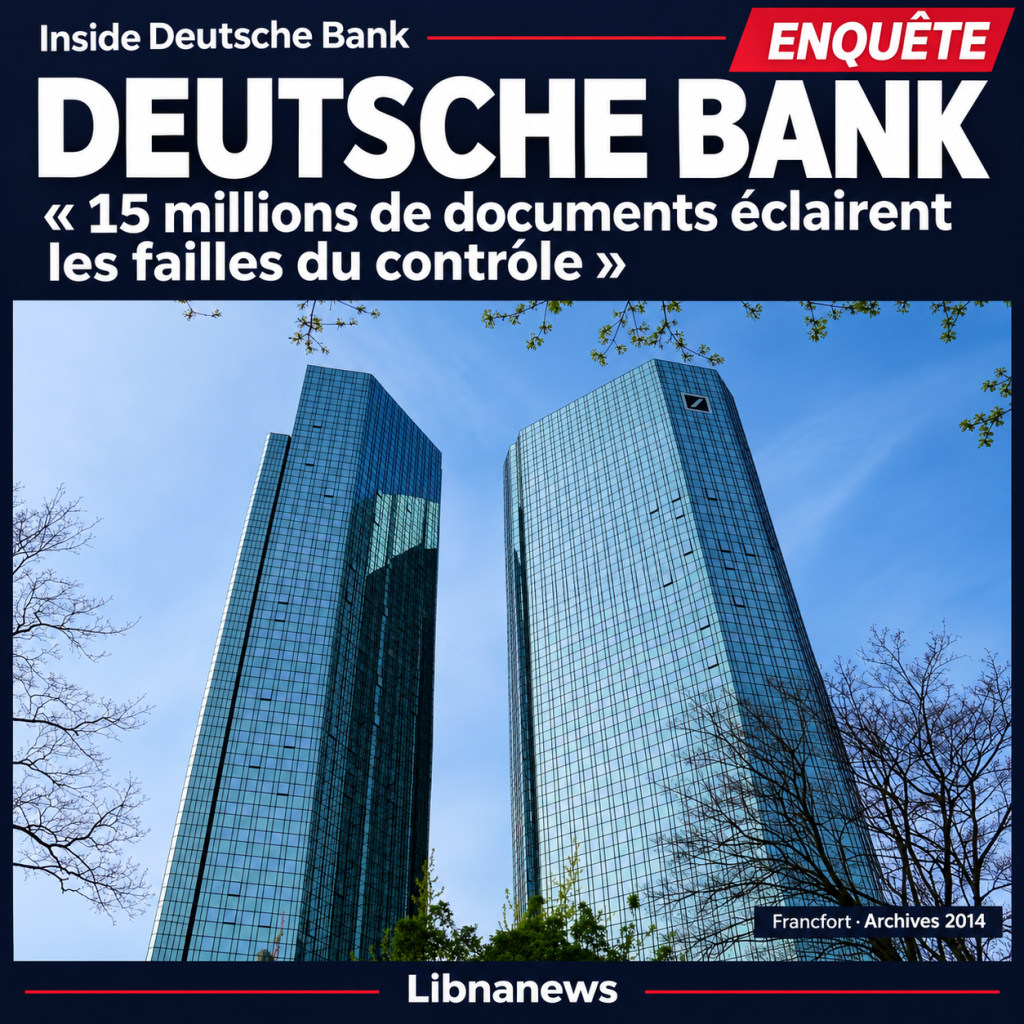
An international survey published on 17 November 2026, based on more than 15 million internal files, puts Deutsche Bank’s controls at the centre of the debate. The revelations relate to the treatment of clients at risk, Russian activities and the relationship with Jeffrey Epstein. The bank opposes these accusations the seniority of the files and the €7 billion invested in its control mechanisms between 2019 and 2025.
The « Inside Deutsche Bank » file asks a specific question: what happens to alerts when a customer returns a lot of money? The survey consortium describes situations in which commercial requirements have weakened the application of internal rules. This reading of the archives is challenged by the institution, which claims to have changed profoundly. New journalistic revelations add to old and documented regulatory sanctions; They alone do not constitute new convictions.
E-mails, audits and internal decisions
The corpus has covered the Bank’s activities since the early 2010s. Two whistleblowers entrusted him to journalists Josy Joseph and Khadija Sharife, then he was shared with more than 200 journalists from more than fifty editorials. The work, coordinated by the South African organisation Barracuda, has received technical support from the Data and Research Center in Germany.
Files include e-mails, internal investigations, meeting records and sanctions monitoring documents. They allow investigators to reconcile warnings and subsequent decisions. However, the consortium points out that there is no evidence of infringement in these archives: many clients cited in the documents are not the subject of any evidence of unlawful activity.
Epstein: an accepted relationship despite risks
The investigation returns to the entry into contact with Jeffrey Epstein in 2013 and the monitoring of his operations. Deutsche Bank acknowledges to the consortium that having accepted as a customer constituted an error. She regrets this relationship and has cooperated with the supervisory authorities, the investigative services and the US Congress.
The regulatory precedent is established independently of the new leak. In its July 2020 agreement with the bank, the New York State Financial Services Department detailed the shortcomings of Epstein’s follow-up. In particular, it found that conditions imposed by a reputational risk committee had not been properly communicated to the teams concerned. Movements were thus appreciated in relation to the customer’s habits rather than the particular risks associated with his profile.
This case illustrates a concrete weakness: classifying a high-risk client does not protect the institution if it does not change the questions asked, the audits performed, or the operational decisions. A procedure may exist on paper and remain ineffective when it fails to reach those who carry out or monitor transactions.
Russia, a market that questions bank arbitrations
The authors of Inside Deutsche Bank also describe persistent tensions around Russian activities. They believe that the desire to maintain lucrative relationships has on several occasions taken precedence over the concerns of compliance teams. These assessments relate to separate periods and transactions, which should be examined separately rather than merged into a single charge.
In January 2017, the New York financial regulator had already imposed a $425 million fine on Deutsche Bank for a « mirror » transaction. According to its findings, approximately $10 billion had been transferred from Russia through purchases and sales of shares coordinated between several of the group’s locations.
The mechanism consisted of buying Russian roubles in Moscow and then selling the same securities, for the same quantities and prices, through a related counterparty through London. The seller, often located in an offshore jurisdiction, was paid in dollars. The regulator noted the lack of legitimate economic justification and serious gaps in customer knowledge. He also imposed an independent auditor and corrective measures.
The new challenge is to measure what has changed after these sanctions. The archives can inform the practices of some teams and resistance to reforms. However, establishing additional responsibility implies identifying new facts, their dates and applicable obligations, without presenting the 2017 fine as a decision made today.
Networks detected after the transfer of funds
Among the new cases described, the consortium cites a 2019 internal investigation into an alleged money laundering network linking companies to Cyprus, the United Kingdom, Hong Kong and Ukraine. Investigators claim that fragmentary signals were detected, but that their reconciliation took about three years. Deutsche Bank replied that it examined unusual activities, made the required reports and cooperated with the authorities.
Another internal review, called Project Cali, involved payments related to the adult entertainment sector for women in Colombia. According to the investigation, the bank eventually filed 230 suspicious statements and banned payments from the companies concerned. The institution presents this historical review as the source of targeted corrections and a broader review of the risks of its correspondent bank. A statement of suspicion requires investigation; it does not constitute a judicial finding of money laundering.
When recruitment serves business relationships
Governance is not limited to monitoring transfers. Another precedent concerns the recruitment of relatives of foreign public officials. In August 2019, the US Securities and Exchange Commission announced an agreement of more than $16 million with Deutsche Bank on this subject.
According to the regulator’s findings, employees had recruited relatives of officials in Asia-Pacific and Russia to obtain or retain business and other benefits. These candidates were outside the normal selection process. The agreement, concluded without recognition or contestation of the findings, concerned accounting records and internal controls. The ESA had taken account of the corrections made and the bank’s cooperation.
The economic problem is that of a private advantage granted to facilitate a business relationship. Recruitment, credit or financial benefit can then become the instruments of the same commercial dependence. It is precisely in order to prevent such conflicts that control teams must have an authority independent of those whose remuneration depends on the income generated.
Deutsche Bank claims EUR 7 billion in corrections
In its statement of 17 November, Deutsche Bank states that the cases referred to go back several years, sometimes nearly two decades. She indicated that she had reviewed them, where relevant, and worked with regulators. It claims a transformation under the direction of Christian Sewing and amounts to €7 billion its direct investment in control systems between 2019 and 2025.
The bank also highlights a change in its risk management and internal culture. On computer security, she said she had not found any evidence of compromise of her current environment or of access to account data, login identifiers or payment data after testing with a specialist company. This statement concerns the current security; It does not in itself challenge the content of each historical record.
The cost of monitoring is measured before the sanction
The expenses announced by Deutsche Bank are a measurable effort, but their effectiveness depends on their results: ability to reconcile operations, deal with alerts and interrupt a relationship when the risk becomes excessive. For a large international bank, control cannot be reduced to a succession of documents collected when an account is opened.
Regulatory precedents show why. Information may be available in one service without changing the behaviour of another. An alert can be closed without understanding the transaction network. The independence of control is then judged at the time when its conclusion requires a waiver of income. The revelations of November 17 put this refusal capacity in the foreground, in front of a bank that ensures that it has turned the page.
Archive illustration: Deutsche Bank headquarters in Frankfurt, 1 April 2014. Photo: Kiefer. /Wikimedia Commons,CC BY-SA 2.0. Composition and titration Libnanews, under the same license.






Comments