

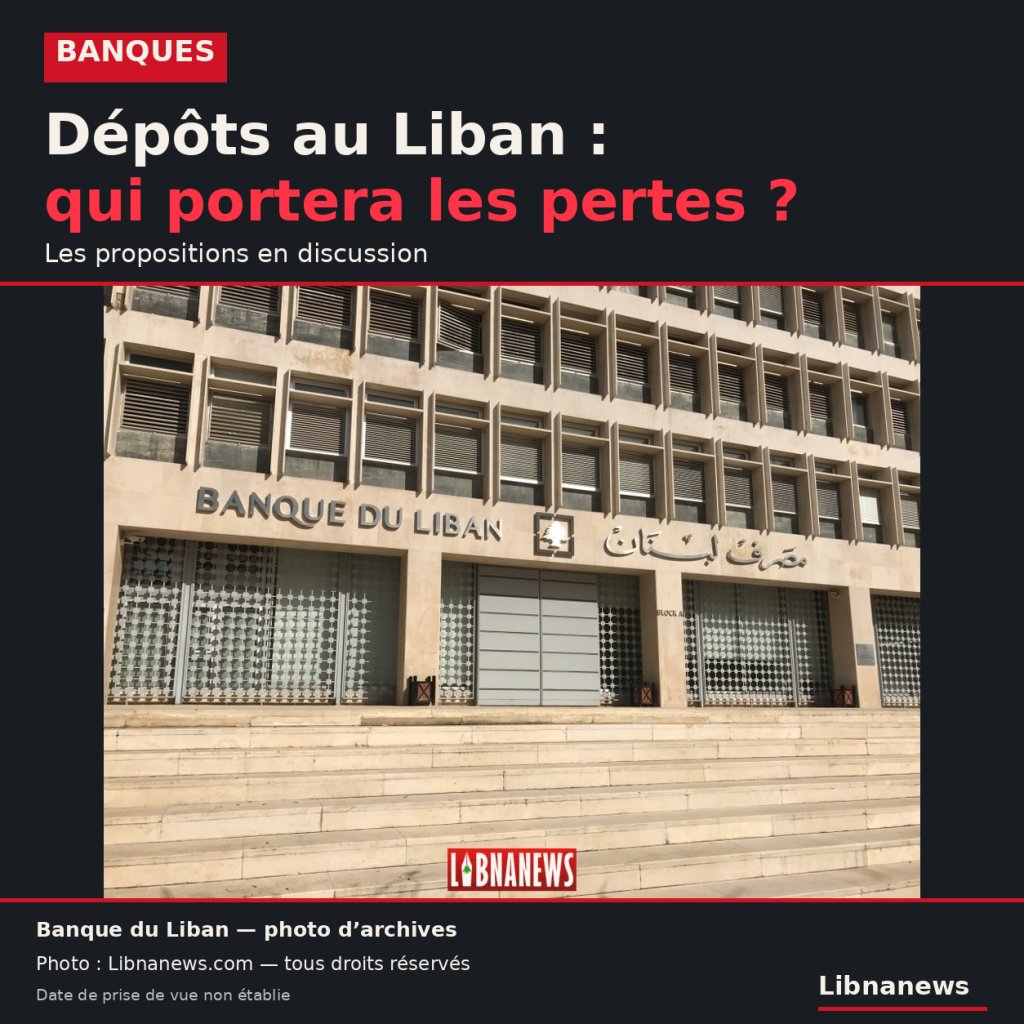
The order in which losses would be absorbed remains at the centre of discussions on bank deposits. Sources close to the negotiations with the International Monetary Fund point to possible flexibility on two points. The first concerns the treatment of deposits that are classified as non-regular. The second is how to calculate and repay $100,000 per depositor. These exchanges are not a definitive agreement with the IMF. They relate to mechanisms whose effects would depend as much on the amount recognized as on the order of the transactions and the payment period.
The proposals attributed to the Governor of the Bank of Lebanon, Karim Suaid, raise a central question: some formulae would reduce the contribution of banks and the central bank by reducing the claims recognized to depositors. Interests also appear in an accounting question. Who should be charged the sums already repaid: banks or the Bank of Lebanon?
Clear certain deposits before mobilizing capital
In particular, discussions have stalled on the hierarchy of losses. In the IMF approach, bank capital must be mobilized before deposits are reached. The proposal presented by Karim Souaid would modify this sequence by first treating certain deposits as non-regular. Their removal would therefore take place before bank losses were absorbed.
The order would change the amount remaining to be distributed. If some of the deposits disappear at the beginning of the transaction, the bonds to be financed will decrease. The cost to the banks and the Bank of Lebanon would then be reduced. This sequence focuses on one of the main issues in the negotiation: it is not enough to discuss the total loss; it is also necessary to determine which claims are recognized before their allocation.
However, the non-regular filing qualification remains essential. This qualification does not automatically mean that the funds are of illegal origin. The criteria applicable to each account remain decisive in the mechanisms discussed. For an applicant, the consequences would depend precisely on these definitions and the procedures used.
One hundred thousand dollars: the calendar changes the scope of the amount
The second debate concerns the proposed $100,000 per depositor. Based on the information available on the negotiations, the exchanges relate to a combination of the amount, duration and account of the repayments already made. The formula referred to provides $60,000 over four years, followed by payment of the balance for another three years. Payments under circulars 158 and 166 would be included in the calculation.
Such a formula would therefore not amount to an immediate additional $100,000 to each beneficiary. Part of the money could be already collected. The rest would be spread over time. The amount displayed does not in itself indicate the cash available to the depositor each year.
This would cost applicants. Their funds have been blocked since the crisis and a new timetable would extend the wait. A deferred payment does not have the same economic value as an amount immediately available, even if its nominal amount remains unchanged.
The discussions also referred to a reduction in certain amounts to be settled, from $21 billion to $15 billion after the processing of the deposits concerned. This reduction and staggering would give banks more time to rebuild their capital and generate profits. Depositors would bear part of the cost in the form of reduced claims or delayed refunds.
Conversions that would change the nature of claims
Other mechanisms are mentioned for outstanding amounts. Some deposits could be converted into bank shares without voting rights. Others would be converted into pounds at a rate of 15,000 pounds per dollar. These assumptions are part of the proposals discussed; they do not constitute definitive repayment conditions.
The transition from a deposit to an action would change the nature of the right held. The depositor would not simply receive his money available in cash. He would hold a title whose prospects would depend on the bank, without having a voting right. The difference is substantial between an amount announced as returned and the means actually granted to its holder.
The treatment of balances remains linked to that of small claims and to the required contributions from institutions. A reduction made at the beginning of the process can alleviate the amount remaining to be financed. A late repayment can then spread the burden over several years. It is the articulation of these mechanisms, rather than individual ones, that would determine the actual contribution of the different actors.
Three billion already paid to the centre of an imputation conflict
A letter from Karim Souaid to the Association of Banks on 23 October concerns a more precise accounting operation. Referred to as 1/676, she requested a reclassification of $3 billion related to payments in Circulars 158 and 166. The period covered is from March 2025 to October 2026.
According to the figures reported, the Bank of Lebanon paid $3,373 billion during this period. It presents three billion as originally coming from its own resources and 373 million from the minimum reserves. It calls for the three billion to be classified in these reserves, while recognizing them as its contribution to the repayment of deposits.
Banks defend another reading. They wish, according to the information available on their position, that these payments be charged to their own contribution, since the funds concerned come from their investments with the central bank. The disagreement therefore does not concern only the registration of a past transaction. It concerns the calculation of what each party would be deemed to have already paid, and then what it should still bring.
This issue is directly related to the distribution of losses. Recognizing an amount as a contribution from the central bank or banks may change the balance of the bonds allocated to each. Payments already received by depositors thus become part of the negotiation on the financing of future refunds.
Negotiations continue without final agreement announced
A Parisian meeting between Karim Souaid, Rothschild and several large banks is also reported. Bank Audi, BLOM, Byblos, Bank of Beirut and the Lebanese-French Bank are among the institutions mentioned. The presence of these establishments does not mean that an agreement involving the whole sector has been concluded.
The signs of flexibility given to IMF representatives by sources close to the negotiations do not warrant formal approval of the detailed mechanisms. The arrival of Fund representatives in Lebanon is announced from 9 November. The points to be examined remain the order of loss absorption, the definition of the deposits concerned, the timing of repayments and the respective contribution of the banks and the central bank.
Sources
Al Akhbar, November 2, 2026, page 4.





Comments