

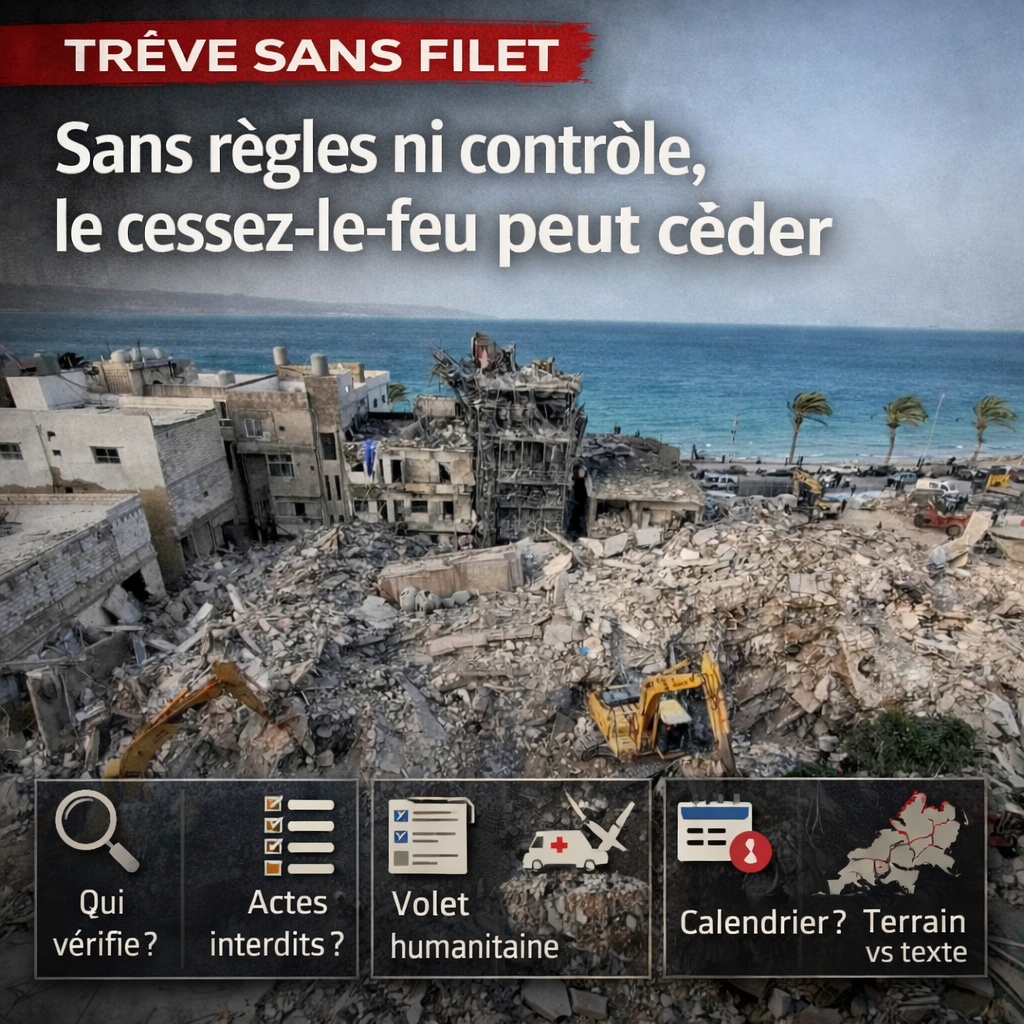
A announced truce is not a stabilized truce
A 10-day ceasefire can have an immediate political effect. It can reduce tension, suspend strikes, reopen diplomatic breathing and provide people with a brief respite. But it does not become a solid mechanism. Between an advertisement and stabilization, there is a vacuum. It is precisely in this vacuum that the real fate of the sequence opened on April 17, 2026 is played. For a truce does not hold by force alone the words that proclaim it. It is based on the existence of an implementation architecture: rules, guarantors, procedures, shared red lines, verification methods, responses to violations, a clear hierarchy of humanitarian priorities and minimum political coherence between the actors concerned.
However, everything indicates that the announced cease-fire is based first on political impetus, not on a sufficiently detailed implementation mechanism. That doesn’t mean it’s empty. This means that it is fragile by construction. When a truce is brought to a very high level but enters into force in a space still covered by recent bombardments, destruction of infrastructure, displaced populations and contradictory readings of its meaning, it immediately becomes dependent on the ground. The problem is therefore not only military. It is institutional. Who’s checking? Who’s the referee? Who finds a violation? Who decides whether a strike is a breach of truce or self-defence? Who protects civilians during the application period? As long as these issues remain unclear, the field continues to take advantage of the political text.
The first architecture defect is the absence of a visible verification mechanism
A lasting truce requires at least a credible monitoring mechanism. Without him, each side becomes judge of the other’s conduct. In this case, the weak point appears immediately: the announcement of the ceasefire has been clear, but the monitoring mechanisms are much less so. In the sequence described, there is no visible structure capable of transforming political statements into shared facts. It opens up a dangerous space. The slightest explosion, the least shot, the least localized operation can be interpreted in two opposite ways. For one, this is a violation. For the other, a one-time response, a prevention measure or a justified response.
This blur is all the more risky because the front concerned is not just a clear line between two perfectly hierarchical armies. It involves the Lebanese State, the Israeli army, Hezbollah, external mediators and several regional actors who are already trying to establish the legitimate narrative of the ceasefire. In such a context, the lack of independent verification turns the truce into a narrative object as much as it is a military object. Each camp can say that it respects the agreement while accusing the other of having already emptied its meaning. This is exactly how ceasefires break down: not always by a large visible rupture, but by an accumulation of disputed facts without an indisputable arbitrator.
The second defect lies in the ambiguity of permitted or prohibited acts.
A solid architecture doesn’t just say that you have to stop the fire. It defines what this means in practice. Are airstrikes stopped anyway? Are surveillance flights maintained? Is a targeted operation considered a breakdown? Are troop movements frozen? Do overflights, interceptions, preventive fire, so-called limited response, secret operations fall within the scope of prohibition or exception? A truce that does not explicitly answer these questions lets each actor build his own version of the text.
This is one of the major dangers of the current sequence. Several actors have already sought to impose their reading of the ceasefire. Some view it as a complete pause of hostilities. Others treat it as a conditional suspension that does not prevent ad hoc actions against threats deemed immediate. Still others refuse to interpret it as a unilateral limitation of their response capacity. When these readings coexist from the first hours, the truce enters into force in an indeterminate state. But the terrain hates indetermination. He quickly turned it into incidents, accusations and boundary tests.
The problem is not theoretical. A truce without a precise definition of prohibited behaviour becomes an interpretative truce. And an interpretative truce rarely survives long in a theatre where distrust is extreme. Even when no camp officially wants the general resumption of fighting, ambiguity is enough to reactivate the confrontation by fragments. A strike considered defensive by some to be offensive to others. A patrol deemed normal here becomes provocative there. The text no longer protects reality. He becomes his powerless comment.
The third weak point is the absence of a humanitarian and logistical element that can be immediately opposed
A truce is not only made for staff. She must have a quick civilian translation. It is often on this ground that its credibility is played out. If the inhabitants cannot return, if the roads remain closed, if the destroyed bridges are not bypassed, if the water, electricity and communication networks remain paralysed, then the ceasefire retains a diplomatic existence but loses its social substance. But the time of 17 April 2026 comes after heavy destruction, partially isolated areas and still precarious returns. Under these conditions, a serious architecture should have provided, from day one, a minimum of practical mechanisms: secure access to the affected areas, coordination of relief, mapping of practical axes, reparation priorities and guarantees of the temporary or sustainable return of the inhabitants.
The absence of such a component creates another risk. It lets society judge the truce by what it does not change. A family that still cannot reach its home, a village that remains cut off, a private area of electricity or water, a road that remains impassable have no concrete reason to consider that the ceasefire really exists. The agreement enters into their lives not as an improvement, but as a distant declaration. At that time, the social terrain also became corrosive. He doesn’t break the truce with weapons. It lacks credibility through the daily experience of lack of change.
A short truce normally requires stronger, no lighter architecture
The ten-day period should have led the actors to overburden the cease-fire as guarantees, not to leave it unclear. The shorter a truce is, the more institutional density it needs. A short period of time means that any incident can immediately poison the sequel. It also means that each camp can be tempted to treat this period as a simple tactical airlock, a time of observation, readjustment or repositioning, rather than a commitment to actually change its conduct. In this context, the truce is held only if its brevity is compensated by tighter rules, more permanent contacts and faster procedures.
There is no indication that this density was installed with the required sharpness. The truce has a strong political value, but it appears to be lighter than necessary in operational terms. It is a structural weakness. A ten-day period may be sufficient to create a start of changeover if it is very framed. It can also collapse within 48 hours if it is merely a commitment in principle crossed by competing lines of interpretation. The short duration therefore does not reduce the need for architecture. It’s increasing.
Competing narratives undermine implementation even before the first evaluation
Another difficulty is that the truce does not have a unified political narrative. Everyone wants to be the author, the interpreter or the main beneficiary. For some, it confirms the return of the Lebanese State as a central actor. For others, it results from a balance of power imposed on the ground. For others, it can only be understood through discussions between Washington and Tehran. This dispersal of narratives is not only media. It produces practical effects. For the way an actor tells the truce influences how he feels allowed to apply it.
If a camp sees the ceasefire as a simple tactical pause, it will first seek to preserve its freedom of action. If he sees it as a political victory, he will refuse any gesture that seems to reduce that gain. If he sees a transition to something else, he will try to accelerate the continuation. The problem is that these logics do not converge automatically. An implementation architecture is used precisely to contain this diversity of readings. It allows to isolate the practical mechanism of competing narratives. When she misses, stories go back to the field and contaminate her.
That’s what makes the sequence so vulnerable. The ceasefire is not only subject to real fire. He was subjected to a war of interpretation. And this war of interpretation may suffice to block the most elementary mechanisms, from the mere finding of violation to the organization of a minimal civil return. A truce without architecture can’t resist weapons. She is even less resistant to rival narratives.
The Hezbollah issue makes blur even more dangerous
No credible architecture can ignore the issue of Hezbollah. However, the ceasefire comes into force, while the role, obligations and room for manoeuvre of the movement remain at the centre of tensions. If one of the camps considers that the agreement explicitly includes Hezbollah in a strict suspension of any action, while the other refuses that this inclusion be interpreted as an operational immunity for Israel, the risk of collision is immediate. A robust architecture should have specified this point to the maximum. Not necessarily publicly in all its details, but at least in practical management mechanisms.
Otherwise, the terrain remains subject to a highly unstable principle: everyone believes in respecting the truce while retaining a different definition of what it allows against Hezbollah. This is an almost untenable situation. Either ambiguity quickly leads to an incident. Either it produces a series of limited hooks which, put to an end, destroy residual confidence. In both cases, the absence of architecture becomes decisive. Not because it creates conflict, but because it prevents absorbing the inevitable shocks of a truce in a hostile environment.
Without a concrete timetable on the ground, the truce remains suspended in the vacuum
An implementation architecture is not only used to monitor. It is also used to sequence. What should happen during the first 24 hours? What are the priorities of the third and fifth days? When is the level of respect assessed? Who decides to extend, amend or redefine the device? Without this minimum of common temporality, the truce remains suspended in the void. She doesn’t have a trajectory. It has only one starting point and a theoretical end date.
This is a serious weakness. A ten-day truce without a specific agenda could become a mere countdown. Everyone’s waiting. Everyone’s watching. Each test. Nobody really builds the suite. However, a ceasefire is likely to survive the ground only if it quickly produces verifiable effects: a net drop in strikes, possible occasional returns, reopening of certain axes, minimum coordination between mediators and local actors, and a credible prospect of an extension or transformation of the framework. In the absence of this sequencing, the terrain resumes its brutal autonomy. The truce ceases to be a process. She’s back for a while.
It can survive, but on one condition: to be quickly transformed into a mechanism
The answer to the question is therefore nuanced. No, a truce without implementation architecture does not survive long in the field if it remains in this state. Yes, it can still survive if it is quickly transformed into a more dense mechanism than the initial announcement. This requires at least six elements. First, a visible verification system or, failing that, accepted by the main actors. Secondly, a much clearer definition of prohibited acts and possible exceptions. Then an immediate humanitarian component, with partial security of returns and access to affected areas. It also requires an incident management channel, capable of absorbing the first shocks without collapse of the device. We still need a start on a timetable, even a minimal one, to get the truce out of the pure provisional. Finally, we need implicit agreement on one essential thing: no actor should seek to obtain by ambiguity what he did not get by war.
Otherwise, the land will impose its law. He will take unrepaired destructions, contradictory red lines, competing narratives and turn them into a gradual resumption of confrontation. A truce doesn’t always die of a big crash. She often dies of a lack of structure. The one of 17 April 2026 has real political significance. But to survive the field, it must now become something other than a strong announcement. It must become a method.




