

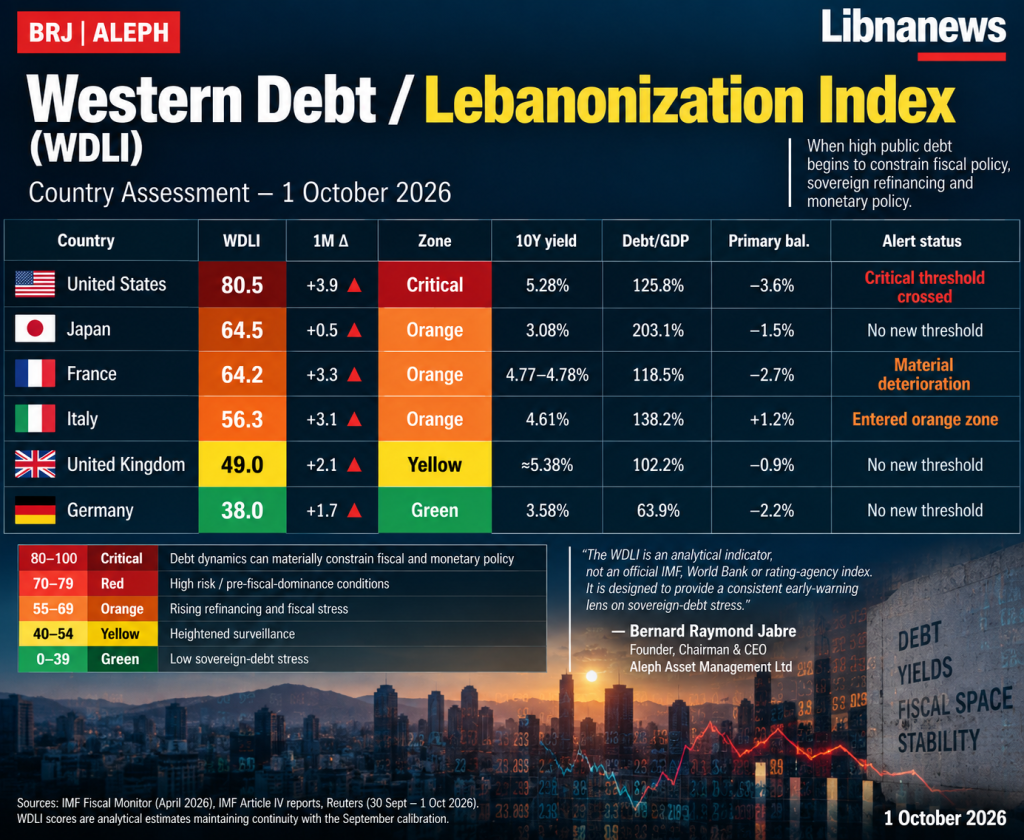
Western Debt / Lebanonization Index (WDLI)
Definition and Country Assessment — 1 October 2026
| Executive summary. The WDLI is a 0–100 analytical stress index designed to track when high public debt begins to constrain fiscal policy, sovereign refinancing and, ultimately, monetary policy. At 1 October 2026, the United States is the only country in the critical zone, France and Japan are in the upper orange zone, Italy has newly entered the orange zone, the United Kingdom remains under heightened surveillance, and Germany remains the least stressed of the six economies. The common deterioration in September came mainly from sharply higher long-term sovereign yields. |
1. What is the WDLI?
The Western Debt / Lebanonization Index (WDLI) is a composite analytical indicator that scores sovereign-debt stress from 0 to 100. It is not an official IMF, World Bank or rating-agency index. The underlying macro-fiscal inputs are public data; the scoring framework is an analytical construction intended to provide a consistent early-warning lens.
The word “Lebanonization” is used here as a mechanism, not as a claim that Western economies will replicate Lebanon. It describes a progression in which persistent primary deficits, a high debt stock, large refinancing needs and rising interest costs can gradually reduce fiscal room and increase the pressure on a central bank to take public-debt sustainability into account.
Core variables
• Debt / GDP: the size of the existing public-debt stock.
• Primary balance: whether the government is adding to debt even before interest payments.
• Gross financing needs (GFN): the deficit plus debt that must be refinanced; a key rollover-risk measure.
• Interest burden: the amount of fiscal resources absorbed by debt service.
• Marginal sovereign yield: the rate at which new long-term borrowing is priced.
• Nominal GDP growth and r–g: the relationship between the interest rate on debt (r) and nominal economic growth (g).
Debt dynamics ≈ Primary deficit + (r − g) × Debt / GDP
How to read the score
| WDLI score | Zone | Interpretation |
| 0–39 | Green | Low sovereign-debt stress |
| 40–54 | Yellow | Heightened surveillance |
| 55–69 | Orange | Rising refinancing and fiscal stress |
| 70–79 | Red | High risk / pre-fiscal-dominance conditions |
| 80–100 | Critical | Debt dynamics can materially constrain fiscal and monetary policy |
Rollover risk is the danger that maturing debt must be refinanced at much higher rates or under less favorable market conditions. Fiscal dominance is a more advanced condition in which the scale and cost of government debt become an important constraint on monetary policy. The WDLI is designed to identify the transition toward those conditions before a full sovereign crisis occurs.
2. WDLI snapshot — 1 October 2026
| Country | WDLI | 1M Δ | Zone | 10Y yield | Debt/GDP | Primary bal. | Alert status |
| United States | 80.5 | +3.9 | Critical | 5.28% | 125.8% | −3.6% | Critical threshold crossed |
| Japan | 64.5 | +0.5 | Orange | 3.08% | 203.1% | −1.5% | No new threshold |
| France | 64.2 | +3.3 | Orange | 4.77–4.78% | 118.5% | −2.7% | Material deterioration |
| Italy | 56.3 | +3.1 | Orange | 4.61% | 138.2% | +1.2% | Entered orange zone |
| United Kingdom | 49.0 | +2.1 | Yellow | ≈5.38% | 102.2% | −0.9% | No zone crossing |
| Germany | 38.0 | +1.7 | Green | 3.58% | 63.9% | −2.2% | No zone crossing |
Data note: debt and primary-balance figures are 2026 estimates/projections from the latest available IMF country reports; market yields are around 29 September–1 October 2026. The WDLI scores are analytical estimates maintaining continuity with the September calibration, not official statistics.
United States — WDLI 80.5 | Critical
The United States is the clearest deterioration in the six-country set. The 10-year Treasury yield moved to roughly 5.28% after reaching about 5.31%, while the IMF projects general-government gross debt near 125.8% of GDP and a primary deficit of about 3.6% of GDP in 2026. The combination of a large debt stock, persistent primary deficits, greater reliance on shorter-dated issuance and a sharp rise in marginal funding costs increases rollover sensitivity. The IMF’s U.S. debt-sustainability analysis explicitly highlights large gross financing requirements and exposure to market-functioning and refinancing risks. The WDLI therefore moves above 80, the critical threshold. Fiscal dominance is not a current institutional fact, but the fiscal constraint on monetary policy is becoming materially more relevant.
France — WDLI 64.2 | Orange
France shows one of the fastest deteriorations in Europe. The 10-year OAT rose to about 4.77–4.78% at the end of September, with the spread over the German Bund around 120 basis points. IMF projections put gross public debt near 118.5% of GDP in 2026 and the primary balance around −2.7% of GDP. The problem is therefore not simply the debt stock: it is the combination of a persistent primary deficit, weak nominal growth, rising interest costs and a materially higher risk premium. France has not crossed the red WDLI threshold, but the September deterioration is large enough to justify a clear watch alert. Rollover risk remains manageable, yet each year of refinancing at higher OAT yields gradually raises the budgetary interest burden.
Japan — WDLI 64.5 | Orange
Japan remains structurally vulnerable because of the extraordinary size of its public debt. The IMF’s revised comparable measure places gross government liabilities at roughly 203% of GDP in 2026, while the 10-year JGB has risen to around 3.08%. Japan still benefits from a large domestic investor base, long-standing financial depth and a relatively low average interest rate on the existing debt stock. The principal danger is therefore slow-motion rollover: as very low-coupon debt matures, it is replaced by debt carrying materially higher yields. The September score increase is modest, so there is no new alert, but the medium-term fiscal-dominance risk remains meaningful because the Bank of Japan must normalize policy against an exceptionally large sovereign-debt stock.
Italy — WDLI 56.3 | Orange
Italy has crossed into the orange WDLI zone. The 10-year BTP ended September around 4.61%, while public debt is projected near 138.2% of GDP. The important mitigating factor is Italy’s positive primary balance, estimated around +1.2% of GDP in 2026, which distinguishes it from France and the United States. This means the current risk is primarily one of refinancing cost rather than an uncontrolled primary deficit. With an average debt maturity around seven years, the higher market yield is transmitted gradually rather than immediately. The orange-zone crossing is therefore an alert, but not a signal of imminent debt distress.
United Kingdom — WDLI 49.0 | Yellow
The United Kingdom remains below the orange threshold, but funding costs are high. Ten-year gilt yields are around 5.38%, and a late-September auction priced 10-year debt at the highest yield seen in decades. General-government gross debt is projected around 102% of GDP in FY2026/27. The UK’s key protection is debt structure: relatively long average maturity slows the pass-through of current yields to the effective interest rate. The risk is therefore a prolonged erosion of fiscal space rather than an immediate rollover event. No new WDLI alert is triggered this month.
Germany — WDLI 38.0 | Green
Germany remains the least stressed country in the group. The 10-year Bund yield has risen to around 3.58%, but the debt ratio remains comparatively low at about 64% of GDP in 2026. Germany is running a primary deficit as fiscal policy expands through defense and public investment, yet its starting debt position gives it substantially more room than the other countries in the sample. The September bond sell-off raises funding costs, but neither rollover risk nor fiscal dominance is currently close to the levels implied by the higher WDLI zones. No alert is triggered.
3. Overall interpretation
The September 2026 deterioration is important because it is increasingly a price-of-debt problem rather than only a stock-of-debt problem. Across the major developed markets, long-term yields have risen sharply. When this occurs alongside high debt and persistent primary deficits, the cost of refinancing starts to migrate from financial markets into the government budget. The WDLI is intended to measure that migration.
| Alerts at 1 October 2026: United States — critical-zone crossing above 80. Italy — entry into the orange zone above 55. France — no zone crossing, but the deterioration in yields and risk premium is large enough to warrant a material-deterioration alert. No new alert for Japan, the United Kingdom or Germany. |
Sources and methodology note
• International Monetary Fund, Fiscal Monitor, April 2026 — “Fiscal Policy under Pressure: High Debt, Rising Risks”, including Table A23 on structural fiscal indicators and gross financing needs.
• IMF 2026 Article IV country reports for the United States, France, Japan, Italy and the United Kingdom; IMF 2025 Article IV country report for Germany published in February 2026.
• Reuters bond-market reporting, 30 September–1 October 2026, for the global sovereign sell-off and U.S./Japanese benchmark yields.
• European sovereign-market observations around 30 September 2026, including French OAT, German Bund, Italian BTP and UK gilt yields.
• WDLI scores are an analytical synthesis. Because the scoring weights are not an official statistical standard, they should be interpreted as a consistent monitoring framework rather than as measured probabilities of default.
Bernard Raymond Jabre
Founder, Chairman & CEO – Aleph Asset Management Ltd
Financial Analyst | Risk Manager | Market Cycle Specialist
bjabre@aleph.bz
WDLI — Analytical framework | 1 October 2026
Prepared for analytical monitoring purposes

Comments