

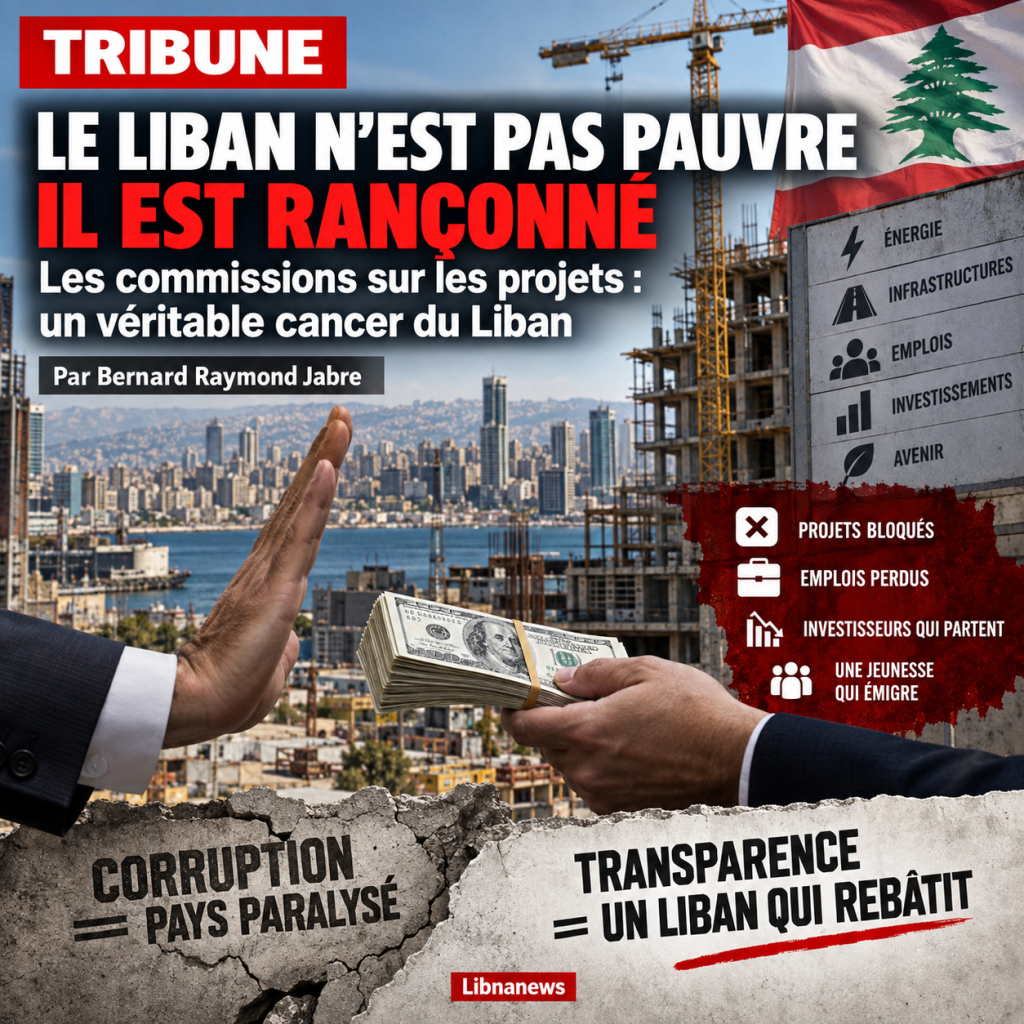
Commissions requested on projects are a real cancer in Lebanon
Lebanon is not just a victim of the crisis.
He’s a victim of a system.
A system in which too many projects, too many investments, too many authorisations, too many markets seem to have to go through an issue that has become almost banal:
« How much do I take? »
Perhaps this is one of the sentences that destroyed Lebanon the most.
For behind this little phrase are power plants that are not being built, roads that are still dilapidated, infrastructure that is ageing, investors leaving, jobs that never arise and young people who emigrate.
Lebanon does not lack only money.
Lebanon is too often ransomed before money comes.
Commission no longer a « local use »
We must stop hypocrisy.
A legitimate, transparent, declared commercial commission corresponding to a genuine service is one thing.
An amount claimed because a political, administrative or intermediary official can block or unblock a public decision is another.
It’s called a bribe. A retrocommission. Corruption. Traffic influence.
And the international world no longer tolerates such practices as they used to be.
Large European, American and British companies are now operating under extremely strict anti-corruption legislation. They must explain their intermediaries, document their payments, identify their beneficiaries, justify their fees and monitor their partners.
The occult payment to a public official is no longer only morally condemnable. It can become a major criminal risk.
And this is where the behaviour of some Lebanese officials becomes economically suicidal.
Who asks 10% can lose 100%
Imagine an investment of $200 million.
An intermediary claims 10% to « facilitate » the project.
In his mind, he probably thinks he’ll make 20 million.
But the international investor refuses. The project disappears.
Lebanon does not lose 20 million. He’s losing 200 million.
He’s losing construction. He’s losing jobs. He loses subcontractors. He loses tax revenues. He’s losing technology. It loses the economic activity created around the project. He mainly loses the confidence of the next investor.
That’s why occult commissions are not just stealing.
They are a machine to destroy national investment.
The real scandal then begins
But there is an even more serious problem.
Who needs to vote on anti-corruption laws? The deputies.
Who needs to strengthen controls? Political power.
Who should impose transparency? Political power.
Who should give justice the means to prosecute the beneficiaries of occult commissions? Political power again.
And then we come to the essential question: what happens if those who have to delete the system benefit themselves from the system?
Why would a politician who earns money through commissions voluntarily vote for a law that destroys his own source of income? Why would he vote for full transparency of his heritage? Why would he want to know the real beneficiary of each company? Why would he accept fully independent justice? Why would he remove the intermediaries he benefits from?
Here’s the trap. And it’s huge.
When the person who has to write the law has a financial interest in not changing the law, corruption becomes institutional.
She’s not just stealing the state anymore. It protects politically the mechanism for continuing to steal it.
That’s the real cancer
Lebanon’s cancer is not just the corrupt who takes money.
It is the system that allows the corrupt to retain the power necessary to prevent reform that could sanction it.
The circle becomes perfect: corruption produces money; money produces influence; influence protects power; power blocks reforms; and lack of reform allows corruption to continue.
That’s the mechanics we have to break.
Lebanon should apply a rule of absolute simplicity
Any elected, minister, senior official or public official should be absolutely prohibited from receiving, directly or indirectly, remuneration for a project over which he or she exercises public influence.
Public contracts should be accessible. The beneficial owners of the companies should be identified. Paid intermediaries should be reported. Conflicts of interest should be public. Public officials should declare their assets before and after their mandate. And any unexplained increase in wealth should be subject to a real and independent investigation.
Above all, anyone who denounces a bribe should be protected.
Today, too often, those who refuse the system are penalized while those who use it prosper. That logic must be reversed.
A Member does not own his office
We must remember an elementary truth.
A deputy does not have his seat. A minister does not own his ministry. A Director General does not have his administration. A party does not have a part of the state.
The public service is not a commercial franchise. It does not give any right to charge a commission from the Republic.
The public official temporarily administers something that belongs to the citizens. Nothing more.
Next investor must hear another sentence
When a foreign company wants to build a solar power plant, a water network, a factory, a data center, a digital infrastructure or a transport system in Lebanon tomorrow, it should no longer hear: « Who do you know? »
She should no longer hear: « Who is your intermediary? »
And above all, she should never hear: « What is our share? »
She should hear: « This is the law. Here are the rules. This is the call for tenders. Everyone is treated the same way. »
On that day, Lebanon will start attracting money again.
Because capital is not afraid of risk. He can calculate it. What he hates is arbitrary.
The question must now be asked publicly
With every major project mysteriously blocked in Lebanon, a question should become automatic: why is this project blocked?
Who opposes it? Who better control his attribution? Which intermediaries were involved? Who was to be paid? Who is the real economic beneficiary?
And above all, who would lose money if the rules became completely transparent?
Perhaps we will begin to understand why some reforms are so difficult to vote for.
Lebanon doesn’t need a miracle
He needs to end a system.
Lebanon has entrepreneurs. He owns engineers. He has a huge diaspora. He owns universities. He owns capital. It has an exceptional geographical position. It still has an extraordinary rebound capacity.
What is missing is simpler: a State where no one can sell the State’s signature.
The real economic battle in Lebanon is there.
It does not oppose the right to the left. It does not oppose one community to another. It contrasts those who regard the State as a common good with those who regard it as a source of private income.
And one day you’ll have to choose.
Either Lebanon continues to be a country where some take a commission on each project.
Or it finally becomes a country where each project helps rebuild the nation.
Because by taking a percentage from everything, some seem to have forgotten a basic reality: one cannot forever take 10% of a country that has gradually been reduced to zero.
Bernard Raymond Jabre
Page




