

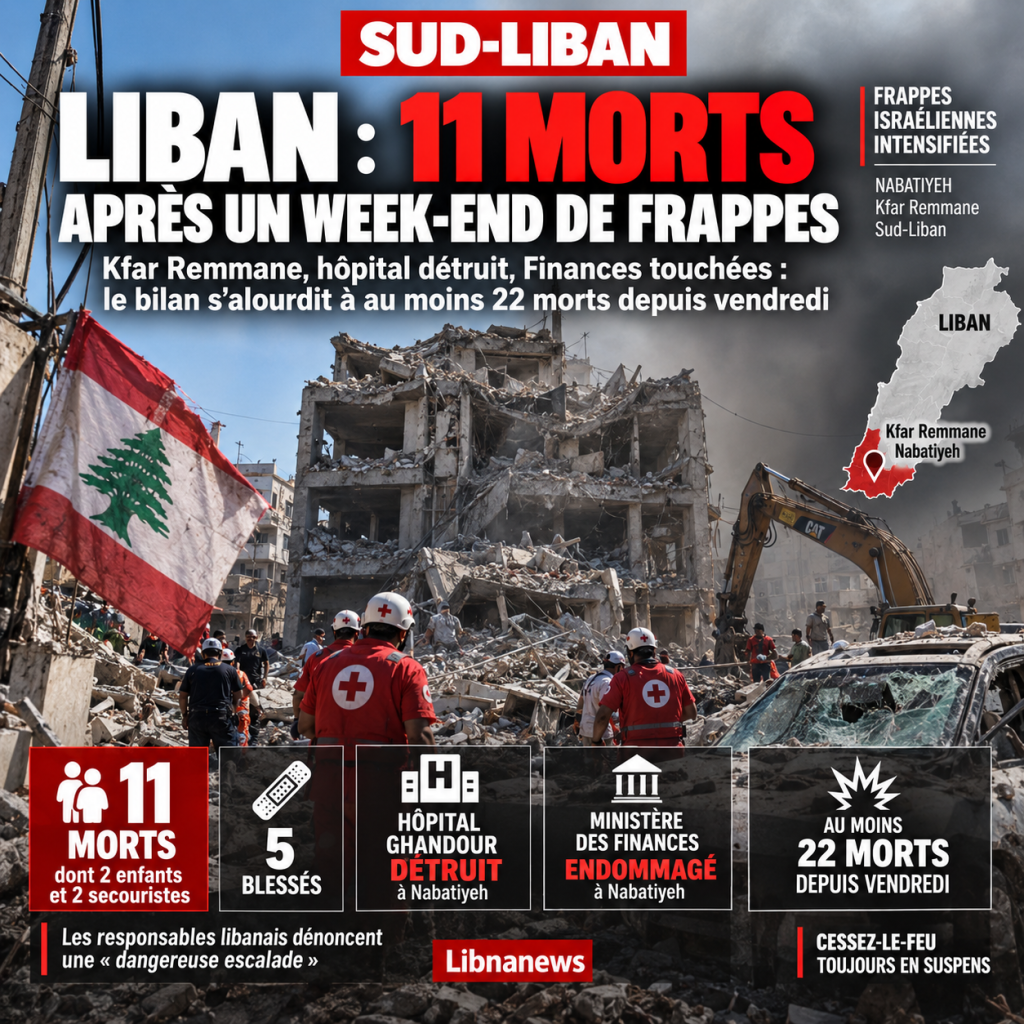
Eleven people, including two children and two relief workers, were killed on the night of Sunday 6 to Monday 7 September in Kfar Remmane, Nabatiyah District. An Israeli first strike destroyed a residential building shortly after midnight, killing nine people and wounding five others. A second drone attack targeted a civilian vehicle and killed two rescue workers. These bombings, carried out without warning of the prior evacuation reported, constitute the most deadly episode of a weekend marked by a sharp intensification of Israeli strikes in southern Lebanon. On Sunday, seven people had already been killed, while Ghandour Hospital was destroyed and Finance Ministry premises were damaged in Nabatiyah.
Kfar Remmane, eleven dead in the middle of the night
The Kfar Remmane sequence now focuses attention on Lebanon because of its human impact and the nature of the targets affected. According to information provided by the Lebanese National Information Agency, the residential building was struck just after midnight. Nine people died in the building, including two children, and five others were injured. Shortly thereafter, an Israeli drone struck a civilian vehicle in the same town. Two rescue workers on board were killed. The Israeli army had not issued an online warning before these two attacks and had not yet provided a detailed explanation of the objectives on Monday morning.
The contrast is all the more marked as an evacuation warning was issued a few hours later for a building located in another southern town. The Israeli army then claimed to want to strike Hezbollah installations. In Kfar Remmane, no comparable measure had preceded the strikes that killed the eleven people. This difference feeds questions about targeting conditions and the presence of civilians at the time of attacks. It intervenes when Israel claims to use surveillance and precision ammunition to reduce the risk to the population.
Three days of Israeli bombing in Lebanon
Monday’s attack extends a series of bombings started Friday, September 4. On that day, several Israeli strikes had hit parts of southern Lebanon, particularly in the Nabatiyah area. The final report from the Lebanese Ministry of Health reported four deaths and 23 injuries. Women, children and rescue workers were among the injured. Israel had claimed to have targeted Hezbollah weapons depots following a drone attack against its soldiers, without a warning of evacuation prior to the strikes.
The situation deteriorated again on Sunday 6 September. Seven people were killed in various Israeli attacks in the South. Two men died in a town located on the edge of the area occupied by Israeli forces. In Arab Salim, two women were killed and six injured, including two girls. A separate drone strike in Nabatiyah al-Tahta resulted in three deaths. The Israeli army claimed to have acted in response to two Hezbollah explosive drones directed against its forces in southern Lebanon.
Ghandour hospital destroyed in Nabatiyah
Beyond the human impact, Sunday’s strikes marked the minds of the infrastructure in Nabatiyah. Ghandour Hospital, located in Nabatiyah al-Fawqa, was destroyed. The facility did not host patients or personnel at the time of the attack. Israel confirmed that it had targeted the site and claimed that a Hezbollah command centre was operating in a building formerly used as a hospital. According to the Israeli army, members of the movement involved in artillery and surveillance missions were operating there.
However, the destruction of the hospital was a further damage to a health infrastructure for the Lebanese authorities. The Ministry of Health denounced the strike and recalled the protection of health facilities under international humanitarian law. The fact that Ghandour was no longer in operation at the time of the bombing prevented an additional human impact, but its destruction reinforced the feeling of an extension of the strikes to civilian infrastructure and services in the Nabatiyah region.
The Ministry of Finance also affected
In the same sequence, the regional premises of the Ministry of Finance suffered significant damage. The Ministry reported that the building of the Regional Directorate of Finance and Agriculture Services, located near the site, had been affected by the blast and effects of the bombing. Doors and windows were destroyed, offices damaged and files dispersed. Dozens of nearby shops and cafes have also suffered damage.
Finance Minister Yassine Jaber asked the departments concerned to put the files and documents in security immediately and to ensure the continuity of administrative work. He then stated that the employees were unharmed, the strike having taken place before their arrival. Taxpayers in the Nabatiyeh region had to be able to file their files temporarily with the Saida financial services in order to avoid interruptions. Jaber described the attack on facilities directly serving citizens as an attack on state institutions.
Aoun, Berry and Salam denounce climbing
The destruction caused a reaction to the summit of Lebanese institutions. President Joseph Aoun denounced on Sunday a « dangerous escalation » and considered that the strikes now affected civil administrations, health structures and services provided by the State. He held Israel responsible for this development and called on the United States and the international community to intervene to stop the attacks. For the Presidency, the attack on public buildings gave an additional dimension to the ceasefire violations reported for several weeks.
The Speaker of Parliament, Nabih Berry, also responded to the deaths in several localities, the destruction of Ghandour Hospital and the damage suffered by the Ministry of Finance. He accused Israel of not respecting any of the ceasefire options and called on Lebanese political forces to consider the situation in the South as a national responsibility. Berry also denounced the continued destruction of houses and villages in Nabatiyah, Marjayoun, Bint Jbeil and Tyre.
Prime Minister Nawaf Salam also contacted the mayor of Nabatiyah to assess the extent of the damage and the situation of the population. He claimed that the strikes would not alter the government’s willingness to support the return of residents and ensure the continuity of public services. Salam also spoke with Yassine Jaber about the Ministry of Finance, stressing the need to avoid any interruption of services to citizens.
The Lebanese public reactions thus converge on two points: the human impact and the damage to civil and State infrastructures. The government and institutional leaders are calling for a stronger international response, while the June ceasefire reduced the intensity of the fighting without stopping the strikes. Israel continues to operate in an area of the South that it presents as a safe area and continues attacks north of it. Hezbollah claims that the intensification of Israeli operations is aimed at exerting pressure on Beirut in the context of discussions conducted under American mediation.
At least 22 dead since Friday
In three days, the balance sheet grew rapidly. Four people were killed on Friday, seven Sundays and eleven in the night from Sunday to Monday. At least 22 deaths have been recorded since Friday in the various bombardments. The figure illustrates the acceleration of violence, but the central event on Monday remains Kfar Remmane, where nine people were killed in a residential building and two rescue workers in a civilian vehicle.
On Monday morning, relief and damage assessment continued in the Nabatiyah area. The Israeli army had still not explained precisely the objectives of Kfar Remmane’s two strikes or answered questions about the lack of prior warning. After the destruction of a hospital, the damage inflicted on a public administration and the seven deaths on Sunday, the eleven victims of the night confronted the region with a new human assessment while the modalities for the implementation of the ceasefire remain outstanding.




