





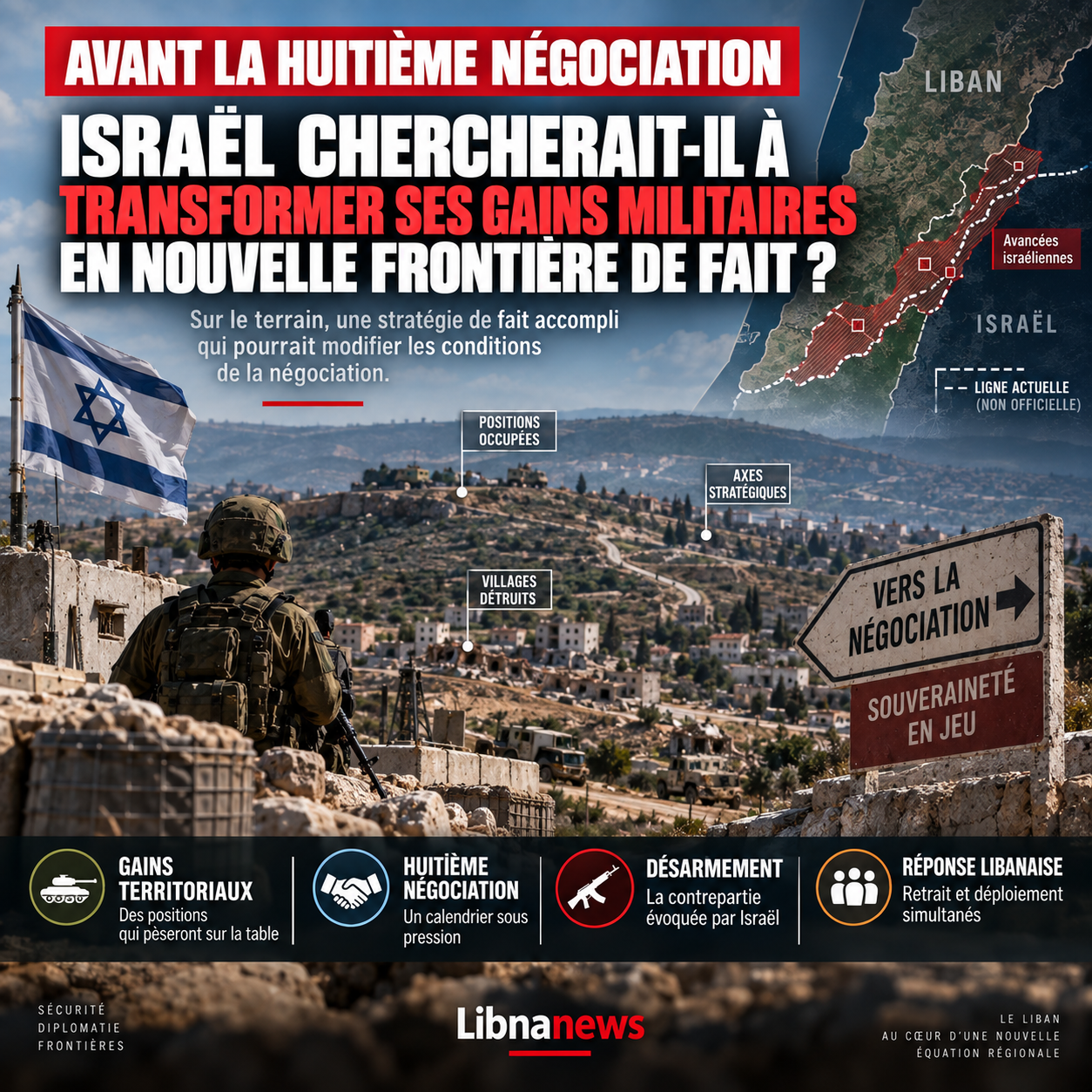
A few weeks away from the eighth negotiating session between Lebanon and Israel, information from Lebanese political sources gives a special reading of Israeli operations in the South. According to these sources, Israel would seek to use the period prior to this appointment to gradually consolidate a military « fait accompli » and build a security cordon. The objective of this strategy would be to change the conditions of the negotiation: to reach the table not only with claims, but with positions already occupied whose evacuation could then become a counterpart. This interpretation is not an official recognition of an Israeli plan. It is based on the analysis of political sources cited by a media source on September 18, 2026. But several facts reported on the same day give sufficient material to seriously examine this hypothesis.
The problem is not just the extent of the Israeli advance. It concerns the possible transformation of a military occupation as a temporary instrument of negotiation. In this configuration, the terrain and diplomacy cease to be two distinct sequences. Military operations prepare for negotiation and then negotiate to set the terms of withdrawal. This is precisely what Beirut fears: that the time separating two meetings will allow Israel to create a new reality which the Lebanese negotiator will then be obliged to discuss.
The « eighth session » becomes a military as well as a diplomatic deadline
The political sources responsible for this information use precise wording. They describe an Israeli will to exploit the « temporal window » before the next political deadlines, including the eighth negotiating session scheduled for the following month, in order to reduce the possibilities of de-escalation and gradually build up a security cordon. The aim of this exercise would be to increase pressure on the Lebanese negotiator to accept certain Israeli conditions at the table.
This reading allows you to look at operations in the South differently. A position occupied for a few hours does not have the same political value as a preserved, fortified and linked to other positions. A succession of local advances can eventually produce territorial continuity. From that point on, the question is no longer just military operations: whether a new security geography is being built must be determined.
Lebanon then faces a problem of timing. The more the negotiations are spaced, the more the terrain can evolve between two meetings. The next appointment does not necessarily take up the file where the previous one left. Military positions have changed, further destruction may have taken place and conditions for the return of inhabitants may deteriorate.
The ratio of diplomatic force is changing at the same time.
This is one of the most concrete elements of the file. If Israel withdraws before the negotiation, Beirut negotiates on security mechanisms. If he remains in additional positions, Beirut must also negotiate their evacuation. Land control thus produces an additional subject for which Israel can set the political price.
The disarmament of Hezbollah appears to be the desired counterpart
The same political sources directly link this territorial pressure to the Hezbollah weapons file. The Israeli message described in their information would be as follows: operations will continue and territorial control will expand if the Lebanese army fails to disarm Hezbollah.
Two levels must be distinguished here. The existence of Israeli pressure on the weapons issue is widely visible in public positions. On the other hand, the existence of a specific plan to construct a safety cord before the eighth session is a matter of information attributed to political sources. The two elements must not be confused.
But their combination is revealing. If Israeli withdrawal is linked to progress on disarmament, each position in the South becomes potentially a lever. Israel can argue that it does not yet have the guarantees to allow its departure. Lebanon can reply that the occupation itself prevents the State from exercising its authority normally and provides Hezbollah with an argument to retain its weapons.
This contradiction is at the heart of the current negotiations.
Beirut wants to establish a sequence in which the cessation of attacks and Israeli withdrawal allow the army to take control of the territory. Israel is seeking guarantees that the withdrawal will not be followed by a return of Hezbollah’s military capabilities. The debate therefore no longer focuses solely on the final objective. It is about the one who must make the first movement.
Lebanese position: withdrawal and deployment must progress together
Joseph Aoun used the Paris meeting to defend a logic of simultaneousity. Lebanon claims to have taken the decision to strengthen State authority and to entrust the protection of the territory to military and security institutions. But the President considers that the full implementation of this approach cannot be separated from the end of Israeli attacks and the withdrawal of the occupied territories.
Emmanuel Macron took over a similar sequence. The French President referred to a progressive Israeli withdrawal accompanied simultaneously by the assumption of the land by the Lebanese State and its army. This formulation is important because it seeks precisely to prevent one of the parties from demanding the full performance of the obligations of the other before initiating its own movement.
In this model, an Israeli position is evacuated and the Lebanese army deploys. The extension of State control and withdrawal are progressing at the same time. This could theoretically reduce the risk of a security vacuum and provide Israel with guarantees of replacement of its forces.
However, it requires a particularly precise verification mechanism. Who confirms that the army actually controls the area? How to establish that no parallel armed structure is resettling? What happens if Israel considers that a commitment is not fulfilled when Lebanon considers that it has fulfilled its obligations?
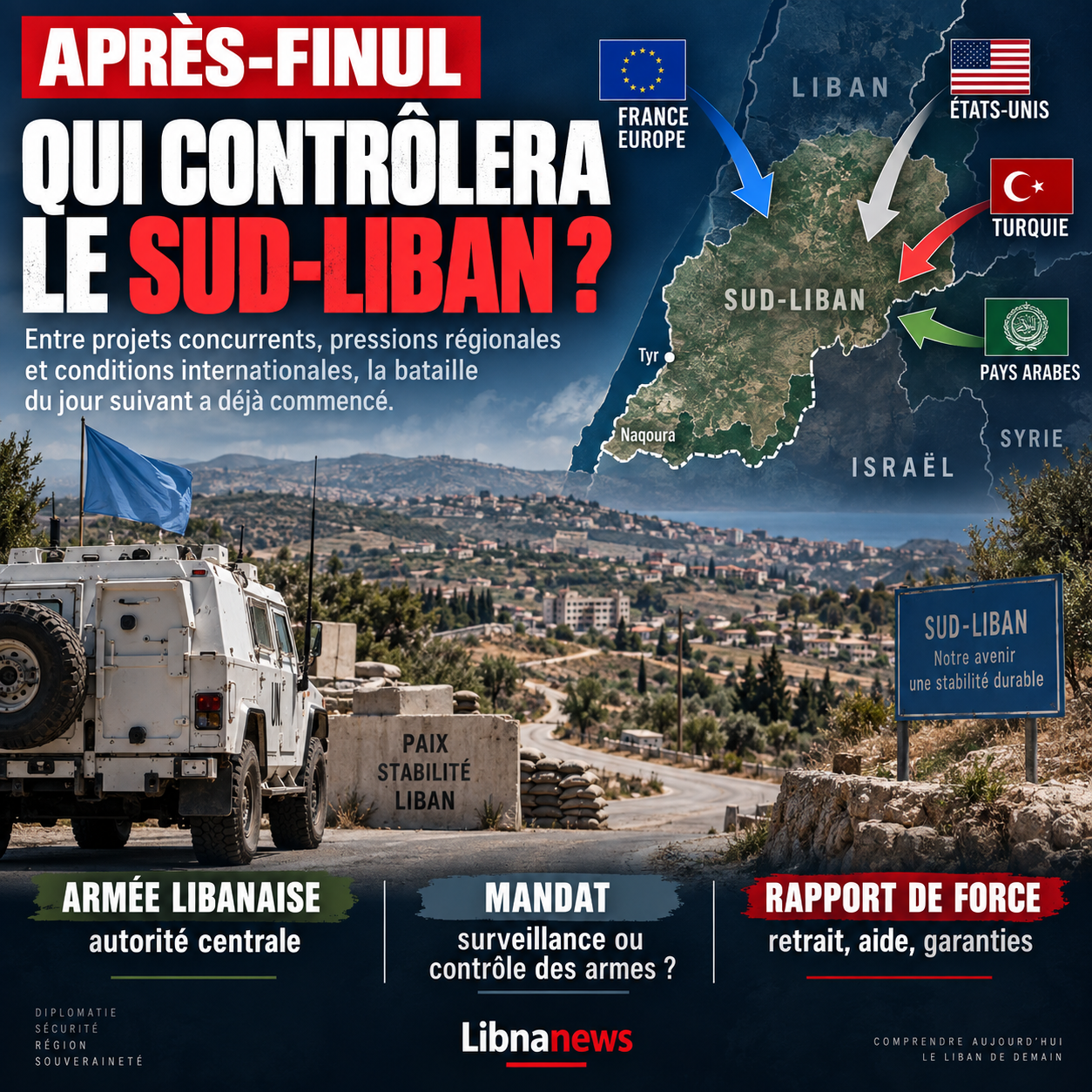
These questions explain why the discussion on the future international presence after UNIFIL is directly linked to the eighth negotiation. The mechanism to monitor the South could become the technical arbiter of this parallel progression.
Creating a safety cord would change the nature of the negotiations
The concept of « security cordon » used by political sources deserves special attention. It does not necessarily mean, at this stage, that Israel has decided to officially recreate a system comparable to those of the past. The information available does not allow for a formal Israeli decision of this nature. Rather, they describe a gradual accumulation of positions that could eventually produce a comparable result on the ground.
The difference is important. An officially announced cordon would immediately cause a major diplomatic crisis. A step-by-step device can be presented as a temporary consequence of operational requirements. However, if these positions remain occupied long enough, their provisional character gradually loses substance.
The mechanism is known in territorial conflicts: occupation creates a new reference. The discussion no longer concerned the situation that existed before the operation, but the conditions for returning to that situation. The person controlling the land then acquires a trading asset.
For Lebanon, the danger would be that future sessions would be devoted less to the implementation of an existing agreement than to the negotiation of concessions needed to obtain what was already supposed to be acquired: withdrawal.
The Lebanese authorities therefore insist on the order of the discussions. They want to ensure that the issue of occupation is not absorbed by the issue of weapons and that withdrawal becomes a reward as Israeli demands are executed.
Does time work against the Lebanese negotiator?
The political sources referring to the eighth session specifically emphasize the time factor. Every week without complete stabilization allows the continuation of military operations, destruction and movements. It can also delay the return of the inhabitants and complicate reconstruction.
This civilian dimension is important because a safety cord is not built solely with military positions. It also consolidates when space becomes difficult to live in. If the inhabitants cannot return sustainably, if the houses are destroyed and if the infrastructure remains exposed, the separation between the military line and civilian life widens.
An area emptied of its population becomes easier to treat as a safe space.
However, it would be excessive to state, from the only available sources, that every destruction is deliberately involved in a demographic plan. The information does not demonstrate a systematic intention of this nature. On the other hand, the territorial effect is real: the more an area is destroyed and dangerous, the more difficult its return to normal life becomes.
This gives the reconstruction schedule strategic importance. Restoring roads, services and homes is not just an economic problem. It is also a way of restoring a civilian presence and thus challenging the sustainable transformation of certain areas into military spaces.
The Lebanese Army is placed at the centre of an almost impossible equation
The Israeli pressure described by the sources largely targets the army. It must be able to take over the positions evacuated, ensure territorial control and give foreign partners guarantees of the absence of non-State weapons. But it must fulfil this mission without becoming a force engaged in an internal confrontation likely to threaten its cohesion.
That is precisely why the debate on its financing is inseparable from the negotiation. The institution needs surveillance, mobility, drone control, communications and logistics capabilities. However, these needs must be funded at a time when some donors want to see progress on the arms issue.
Israel has a clear temporal advantage here. Her army is acting with the capabilities she already has. The Lebanese Armed Forces must still receive some of those necessary to implement the future arrangements.
If the two movements are not synchronized, the imbalance may worsen. Israel can consolidate its positions faster than Lebanon strengthens its military machinery.
The eighth session would then arrive in a more unfavourable environment in Beirut than the previous one.
A negotiation where each position can become a currency of exchange
This is probably the key to reading confidential information published on September 18. The current battle is not just about Israel’s ability to move forward or Hezbollah’s ability to resist. It concerns the transformation of territorial control into a diplomatic currency.
A military position has tactical value when it is used to monitor a road, valley or axis. It acquires political value when it can be returned in exchange for a commitment. The longer the negotiations continue, the more important this second function becomes.
For Israel, the interest of such a strategy would be to have several levels of withdrawal rather than one. Each step could be linked to a separate security requirement: military deployment, control of an area, dismantling of an infrastructure or setting up a monitoring mechanism.
For Lebanon, accepting this logic entails a risk: gradually turning its own territory into a transaction. But totally refusing it can prolong the occupation.
The Lebanese margin of manoeuvre will therefore depend greatly on the ability of mediators, mainly Washington and Paris, to have a sequence recognized in which withdrawal does not become an Israeli concession but remains an obligation accompanied by security guarantees.
The eighth session could reveal whether the fait accompli worked
The next meeting will therefore be of less interest for the statements that will accompany it than for its agenda. If the eighth session focuses on the withdrawal schedule, the replacement mechanisms by the army and mutual guarantees, it will mean that Beirut’s logic of simultaneity retains an important place.
If, on the contrary, the discussion begins with the conditions that Lebanon must fulfil before any further Israeli evacuation, the balance of power will have evolved in a different direction. The positions acquired on the ground would have contributed to the relocation of the negotiating centre.
That is precisely what political sources who speak of a progressive security cordon fear.
Their analysis is not yet proof of an Israeli plan officially agreed. However, it provides a coherent hypothesis to understand the combination of military operations, pressure on the Lebanese army and diplomatic calendar.
The stakes of the coming weeks will therefore be very concrete. It will be necessary to observe not only how many positions Israel occupies, but which, for how long and with what level of fortification. It will also be necessary to monitor the locations where the Lebanese Armed Forces deploy, as well as the proposed international mechanisms to verify such deployment.
For the real battle before the eighth session could be played before the negotiators even sit around the table. If the terrain changes sufficiently between two appointments, the next negotiation begins with new rules.