






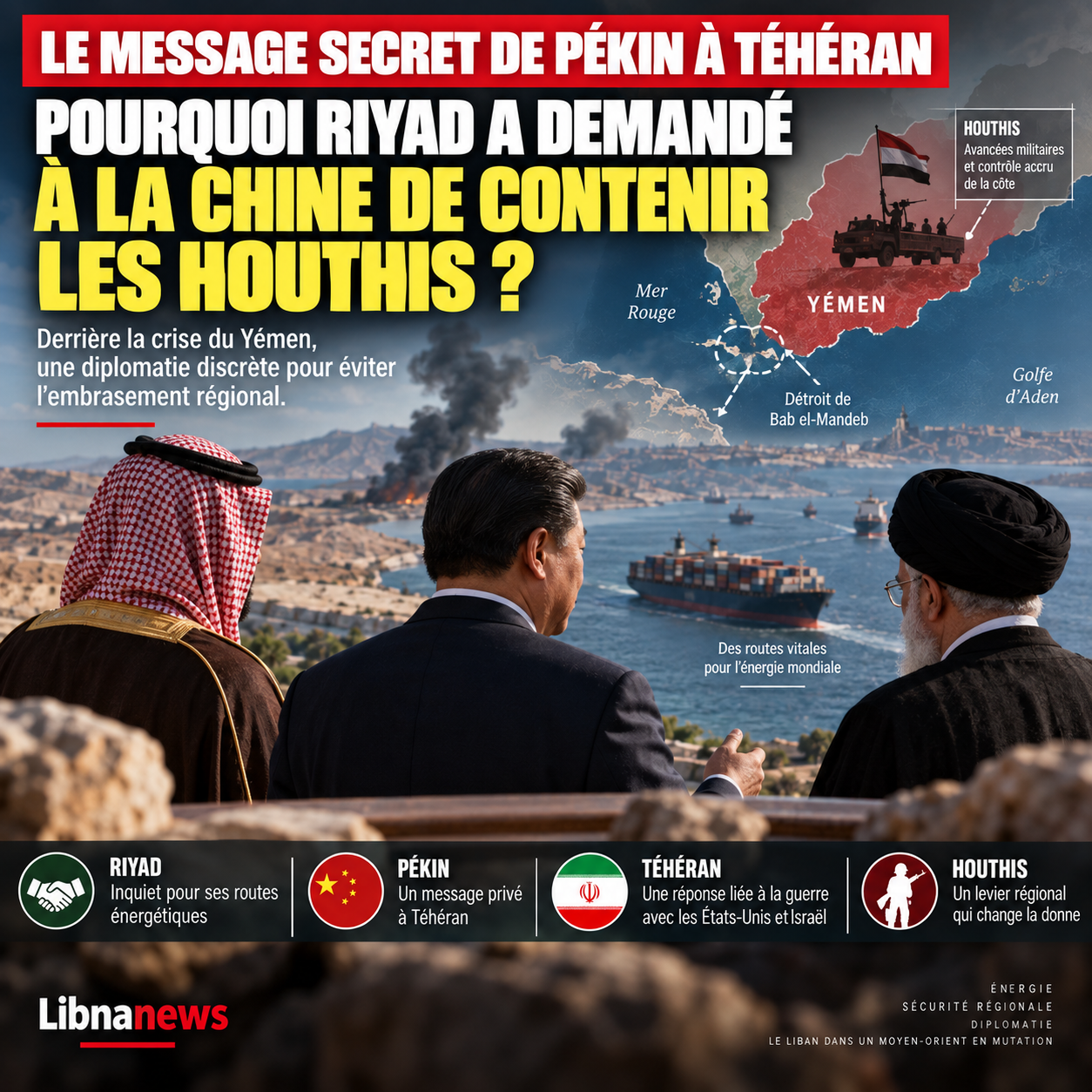
A discreet diplomatic approach sheds light on the change in power caused by the new Huthie offensive in Yemen. According to three informed Iranian sources cited on 18 September 2026 by media sources, Saudi Arabia turned to China following the rapid advance of the Houthis on the Red Sea coast and around the Bab al-Mandeb Strait. Beijing would then have asked, in private, Tehran to use its influence on the Yemeni movement to prevent a further extension of the war. The Iranian response would have been just as political: regional stability could not be separated from the end of the war waged against Iran by the United States and Israel.
The interest of this information far exceeds the existence of a confidential message between three capitals. It shows Saudi Arabia using Beijing as a channel to Tehran at a time when its energy export routes are simultaneously threatened in the east and west. It also reveals the limitations of the Chinese role: Beijing can speak to Saudis, Iranians and other actors in the region, but there is no guarantee that Tehran can or will immediately get the Houthis to behave as desired. Finally, the Iranian response transforms a Saudi demand for Yemen into a negotiating element over the entire regional war.
So the real issue is not whether China suddenly becomes the new arbiter of the Middle East. It is much more concrete:Riyadh sought an interlocutor capable of transmitting to Tehran that the haughty advance around Bab al-Mandeb had just crossed a strategic threshold.
Riyadh did not contact Beijing for a simple Yemeni mediation
The chronology reported by the three Iranian sources is essential. The Saudi approach comes after the rapid progress of the Houthis along the Red Sea coast and around Bab al-Mandeb. The issue is therefore not primarily the control of new Yemeni localities. It concerns the ability of the movement to weigh on one of the most important sea crossings in the region, even though traffic in the Strait of Ormuz is already severely disturbed.
This simultaneousity explains Saudi concern. The kingdom has two large maritime facades and its energy model depends on the possibility of retaining several export routes. When Ormuz’s exit from the Gulf becomes uncertain, the western coast and the Red Sea automatically become more important. But if Bab al-Mandeb also becomes an area under heavy military pressure, the advantage of this geographical diversification is reduced.
A media source also describes a particularly tense situation: Ormuz is severely disturbed in the east, the export mechanism to the Red Sea has been hit and the Houthis are simultaneously increasing their pressure from Yemen. The Saudi problem is therefore no longer that of protecting the national territory against drones or missiles. It concerns the security of the energy architecture of the kingdom.
It is in this context that China’s choice makes sense. Beijing is not simply a country with good relations with Iran. It is also a power whose economic security depends directly on the stability of the Gulf and Red Sea energy routes. Riyadh could therefore present the problem to him not as a request for political alignment against Tehran, but as a defence of a common interest: to prevent two essential sea crossings from simultaneously becoming active fronts.
China delivered two speeches: one in public, one in private
Iranian sources make an interesting distinction between China’s public position and the behind-the-scenes message. Publicly, Beijing called for restraint, dialogue and the restoration of navigational safety. Nothing unusual in this diplomatic language. In private, however, the demand would have been more specific: Iran should use its influence with the Houthis to prevent the enlargement of the conflict.
The Chinese Ministry of Foreign Affairs then confirmed part of the reasoning, without publicly confirming the exact content of the secret approach. Beijing stated that it did not want to see regional tensions spread to Yemen and the Red Sea and considered that further deterioration of stability would not serve the interests of any party.
This formulation allows to understand Chinese motivation without having to assume a change of alliance. Beijing does not necessarily ask Tehran to break up with the Houthis. It seeks to prevent the regional pressure strategy from directly threatening the trade routes on which the Chinese economy depends.
The difference is important. China maintains a strategic relationship with Iran, but it also imports massively Gulf energy. It therefore has an interest of its own, which is not confused with Riyadh’s or Tehran’s.
The reported approach thus shows a Chinese diplomacy much more transactional than the general language on stability might suggest. When its energy roads are threatened, Beijing is no longer content to call all parties to restraint. He identifies the actor he considers capable of influencing the situation and makes a specific request.
But Beijing would not threaten Iran
A detail provided by the three Iranian sources is particularly revealing. Chinese officials did not make any explicit threats against Tehran. Nor would they suggest that China would use its economic weight to punish Iran if Iran refused to act on the Houthis.
This absence of a threat allows us to measure the limits of the message.
China has considerable economic leverage over Iran, but openly using it would transform the nature of their relationship. Beijing would move from strategic to coercive. Nothing in the available information indicates that he wishes to cross this threshold.
Thus, the approach is more like a warning based on common interests: the extension of the war to the Red Sea would ultimately harm China, but also Iran if it caused further internationalization of the conflict.
This method also allows Beijing to retain its role as interlocutor. A public threat reportedly reduced his ability to speak in Tehran. A confidential request, on the contrary, leaves Iran a margin of manoeuvre and allows it to respond politically without giving the impression of having given way.
That’s exactly what Tehran seems to have done.
The Iranian response immediately moves Yemen’s discussion to Washington and Israel
According to Iranian sources, Tehran replied that regional stability and peace were conditioned by the end of the war waged against Iran by the United States and Israel. This response deserves careful consideration as it does not directly respond to Chinese demand.
Beijing asks to contain the Houthis. Tehran is responding to the regional war.
This amounts to refusing to treat Bab al-Mandeb as an isolated case. For Iran, the huthy pressure is repositioned into a whole comprising confrontation with Washington and Israel, tensions in the Gulf and different regional fronts. De-escalation in Yemen is thus linked to wider de-escalation.
This position can be interpreted in two ways, without it being possible to decide between them from the only available sources. Tehran can sincerely consider that the different fronts have become interdependent and that local stabilization is impossible as long as the main war continues. But this response can also enable it to turn Chinese demand into a lever: if Riyadh wants to reduce the houthy threat, it must help create the conditions for an exit from the regional confrontation.
In both cases, Iran refuses to let China compartmentalize the crisis.
This response also reveals an important point on the relationship between Tehran and the Houthis. Chinese, Saudi and Iranian sources all implicitly speak of an Iranian influence. But influence does not necessarily mean direct command. The three Iranian sources also acknowledge that it was unclear whether Tehran would effectively address Chinese concerns.
The question of the real degree of Iranian control therefore remains open.
Houthis now have their own strategic leverage
The military evolution of the past few weeks makes it more difficult to read the Houthis as a simple instrument automatically executing Iranian decisions. Their advance on the Red Sea coast gives them their own interests. Control or the ability to threaten the vicinity of Bab al-Mandeb increases their weight in Yemen, but also their value in any regional negotiations.
This distinction is fundamental. The more a player acquires territory and autonomous capacity, the more the political cost of an externally imposed concession increases. Even if Tehran has an important influence, asking the Houthis to give up a militaryly acquired lever can be more difficult than asking them to reduce fire on time.
The fighting reported around Taez, Lahj and areas near Bab al-Mandeb also shows that the front is still active. Government forces have claimed the resumption of certain positions in the mountains overlooking the straits. The Houthis continue their own operations. The two sides therefore dispute a space whose value far exceeds Yemeni geography.
Control of this area means being able to threaten or secure traffic between the Indian Ocean, the Red Sea and the Suez Canal. That is precisely what explains the Chinese diplomatic intervention.
Saudi approach also reveals the limits of its channels with Tehran
Another aspect is worth noting: why would Riyadh need to go through Beijing to convey his concern to Iran?
The available sources do not provide the answer. They only indicate that Saudi Arabia sought Chinese aid and that Beijing subsequently addressed Tehran. The total absence of direct Saudi-Iranian channels should therefore be avoided.
But Chinese choice has its own logic. A message sent directly by Riyadh could have been interpreted as a threat or a sign of weakness. Transmitted by Beijing, it becomes a concern shared by a power Iran needs economically and diplomatically.
China thus brings additional value to the message. It does not ask Tehran to act solely to protect Saudi Arabia. It makes him understand that the instability around Bab al-Mandeb is beginning to affect Chinese interests.
Mediation therefore changes the nature of the application.
This is probably the main reason why information is important. Beijing does not only act as a communication factor between two opponents. It modifies the Iranian calculation by adding its own interests to those of Riyadh.
Islamabad appears as a second channel
China is not the only intermediary involved. Pakistan’s Defense Minister said that Islamabad had sent a Saudi message to Tehran about the concerns caused by the Huthi attacks. Pakistan is also engaged with Saudi Arabia and Turkey in a defence agreement concluded in Mecca in August.
This data shows that Riyadh does not rely on a single channel. China brings its economic weight and relationship with Tehran. Pakistan has a special relationship with Saudi Arabia while maintaining ties with Iran. Turkey also participates in regional security consultations.
The existence of several intermediaries indicates that Saudi concern is serious enough to justify diplomacy at several levels. It also shows that Riyadh seeks, at least in this phase, to contain escalation through communication before widening confrontation.
This method is all the more significant since attacks now have consequences within the kingdom. The debris of an intercepted drone in Taif killed a Yemeni resident and injured a Saudi woman and a Pakistani resident. Confrontation is therefore no longer merely maritime.
China primarily protects its own energy security
The temptation would be to present the Chinese approach as evidence of a new role as Beijing mediator in the Middle East. That would be too fast. The information available allows a more precise conclusion: China intervenes when the extension of the war directly threatens its economic interests.
Bab al-Mandeb and Ormuz are two critical points of global energy circulation. When both are simultaneously under pressure, Chinese vulnerability increases. Beijing therefore does not need to take sides in the conflict to consider certain developments unacceptable.
This position gives him a peculiarity that Washington does not possess. The United States is directly engaged in confrontation with Iran. Their ability to mediate with Tehran is therefore reduced. China, on the contrary, can speak to Iran while maintaining major economic relations with the Gulf monarchies.
Riyadh seems to have wanted to exploit this position precisely.
But the episode also shows the limit of Chinese power. Beijing can transmit a request and recall its interests. It cannot automatically impose de-escalation. The Iranian response demonstrates this: Tehran listens to China, but also uses the conversation to recall its own conditions.
Regional negotiations begin to appear behind the battle of Bab al-Mandeb
The confidential information from the three Iranian sources finally reveals a wider mechanics. The Yemeni battle began to produce diplomacy beyond Yemen. Riyadh speaks in Beijing. Beijing is talking to Tehran. Islamabad also transmits messages. Tehran responded by bringing the discussion back to Washington and Israel. The security of Bab al-Mandeb thus became linked to the regional war and the Strait of Ormuz.
This interdependence can increase risks, but it can also create an opportunity for negotiation. When several actors discover that an additional extension of the conflict threatens their interests simultaneously, the pressure for an arrangement increases.
China has a particular advantage here: it does not need a comprehensive political settlement of the Yemeni conflict to produce a useful result. A reduction in attacks on maritime routes and Saudi territory would already be sufficient to protect some of its interests. Tehran could also find a way to partially respond to Beijing without abandoning all its regional positions.
But the Iranian response shows that the price of such a de-escalation will probably not be zero. Iran is seeking to include the Houthi issue in a much broader war negotiation.
This is why Beijing’s secret message is less a sign of an already successful mediation than of a major change:the progress of the Houthis around Bab al-Mandeb has reached a level where Saudi Arabia no longer seeks only to contain the movement militarily. It now mobilizes powers capable of speaking directly in Tehran.
The follow-up will depend on the real Iranian response, not just diplomatic. If the intensity of the houthy operations decreases, the Chinese approach may have produced a first effect. If it continues, Beijing will have to choose between accepting the limits of its influence or increasing pressure on an Iranian partner whose he obviously does not want to become an adversary.