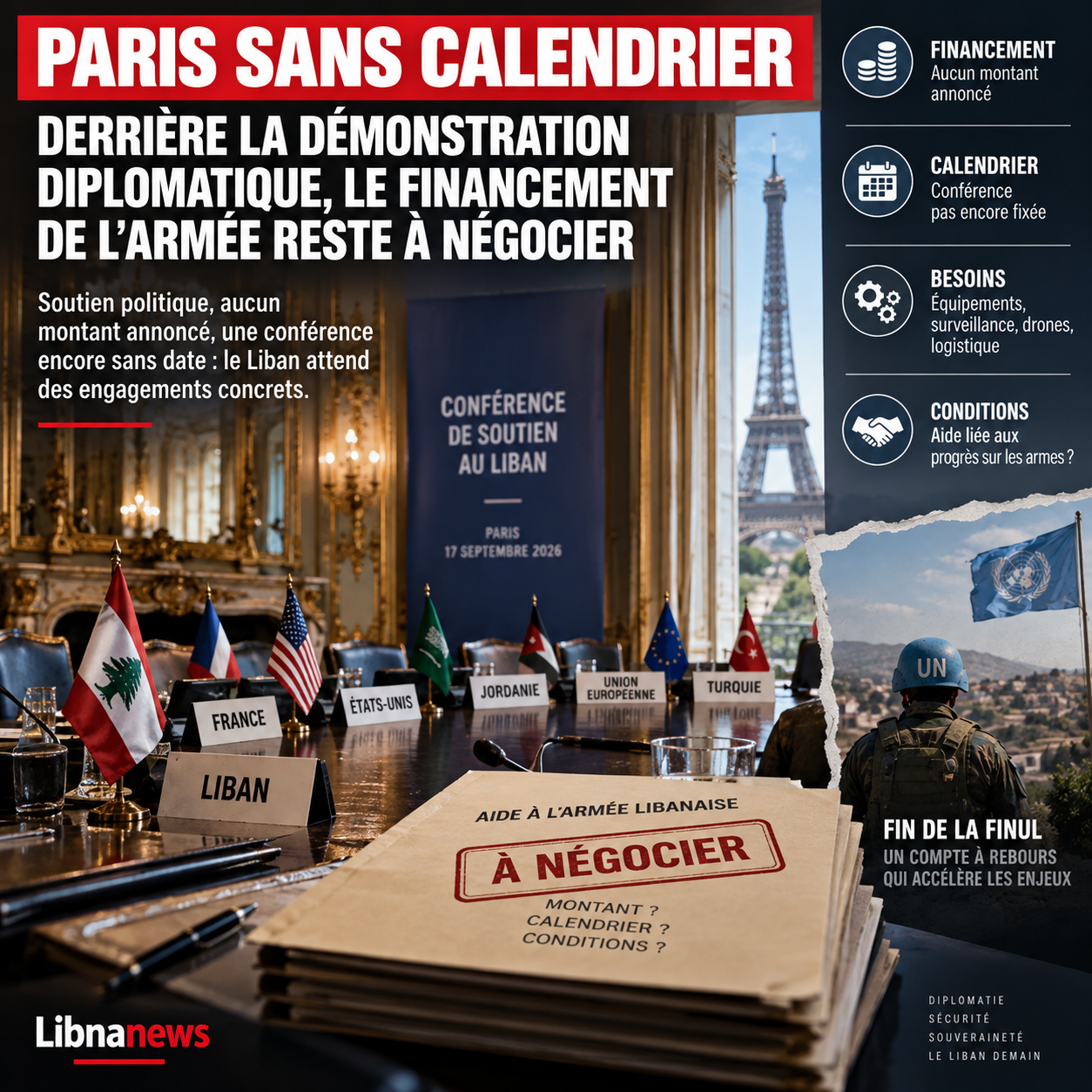






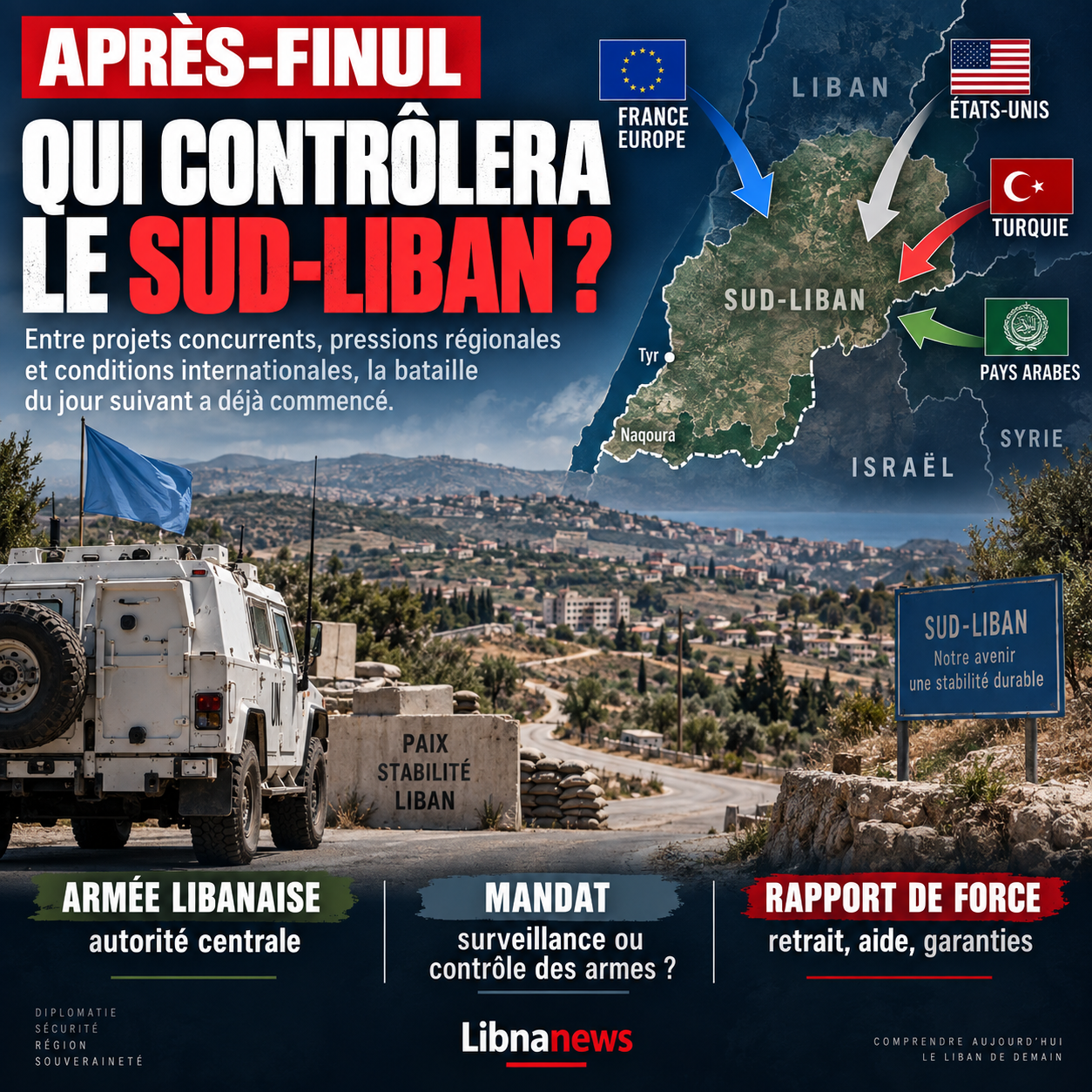
The Paris meeting on support for the Lebanese army gave the image of a consensus: strengthening the military institution, preparing for the end of UNIFIL and avoiding a security vacuum in the South. The behind-the-scenes information published on September 18, however, draws a much less consensual picture. Several competing projects are discussed for the next day. Paris and Rome are working on a European presence. Ankara reportedly proposed a multinational Muslim-dominated force. Washington is looking for much more precise safeguards on arms control. Finally, Israel intends to retain a decisive control over the nature of the arrangement that could settle near its border.
The challenge is therefore no longer simply to replace UNIFIL. It is to knowwho will really control the security system of the South after his departure. Behind this issue is also the future role of the army, the Israeli withdrawal schedule, the fate of Hezbollah’s weapons and the place France, the United States and the regional powers will retain on the Lebanese file.
Paris wants to prevent the departure of UNIFIL from also meaning its own erasure
France started preparing the post-FINUL with Italy. This work is no longer a simple diplomatic hypothesis. Joseph Aoun and Emmanuel Macron discussed it directly in Paris. In particular, a European civil and military formula is being examined within the framework of the European security and defence policy. At the same time, discussions have been held on the international framework to avoid a vacuum between the departure of the current force and the rise of the Lebanese army.
Emmanuel Macron publicly established the French doctrine: the international force must not be replaced by another force that would exercise the responsibilities of the State. The army must become the main actor. An outside presence could remain to support her. This distinction is essential because Paris does not only defend the continuity of a foreign presence. France seeks to organize a gradual transfer of responsibility to Beirut, while maintaining around the army a mechanism capable of providing material and operational assistance.
But diplomatic sources cited by a media source describe a more confrontational negotiation. According to them, Paris would like to make support for the army and the preparation of the post-FINUL the two instruments of its return to the foreground in the Lebanese dossier. This strategy would meet American and Israeli reserves. The disagreement would not simply concern the flag of the soldiers who would remain in the South. It would concern their mission.
This is probably the most important point in the whole case. A mission to assist the army in monitoring a border is not comparable with a force to verify the implementation of disarmament. In the first case, the Lebanese State retains the initiative. In the second, an external actor acquires control over an issue that directly affects the internal political balance.
The mandate of the future force is the true point of break
According to information from diplomatic sources, Israel would not want to find an international mechanism after UNIFIL limited to observing violations. It would seek more binding guarantees. A possible successor force should be able to effectively verify the implementation of the security arrangements and the absence of Hezbollah military infrastructure in the areas concerned.
Such an evolution would profoundly alter the nature of the international presence. Checking the absence of weapons requires intelligence, surveillance and access to the ground. The next step is to determine what happens when a suspicious facility is discovered. Is information transmitted only to the Lebanese army? To participating States? In the United States? Israel through an international mechanism? Can a mission request access to a site? Is the army the only one allowed to enter?
No definitive answer to these questions appears in the available information. That is precisely what makes the discussions important. The future mandate could decide on the balance of power even before the composition of the mission was known.
Lebanon, for its part, is seeking to maintain strong international legitimacy for any arrangements to replace UNIFIL. This preference is not only diplomatic. A mission with international coverage offers more guarantees to its personnel and theoretically limits the possibility that a State alone imposes its rules. It also allows Beirut to defend the principle that the army remains the sovereign authority, while the foreign presence performs an assistance function.
The problem is that this approach does not automatically meet Israel’s demand for verifiable safeguards. This is where the two logics clash.
Support for the army could be conditioned on what it is asked to achieve
Another background information sheds light on the difficulty. Diplomatic sources report a link between the United States and Saudi Arabia between substantial military aid and the implementation of government decisions on the concentration of weapons in the hands of the State. This is not, in the documents available, a written and officially announced condition. It should therefore be regarded as an assigned information, not as a formal decision.
But this information allows us to understand why Paris insists so much on the need to strengthen the army first. France would favour a gradual approach. The idea is simple: asking the army to take over a much larger space, gradually replacing an international force and simultaneously dealing with the weapons file requires additional means even before the results can be achieved.
The paradox is obvious. Some partners may ask the State to demonstrate its ability to impose its authority before providing any assistance necessary to achieve this.
The Paris meeting also identified very concrete needs. These included air surveillance, drone control, spare parts, territorial control and capabilities to allow the army to expand its deployment on a sustainable basis. King Abdullah II called for these gaps to be filled quickly. It also linked the strengthening of the army to its ability to deal with the issue of arms concentration in the hands of the State.
The debate on financing is therefore not secondary. It is one of the keys to the balance of power. Those who finance the new capabilities of the army necessarily gain an influence on the priorities they want to see implemented.
Israel could use military calendar to influence negotiations
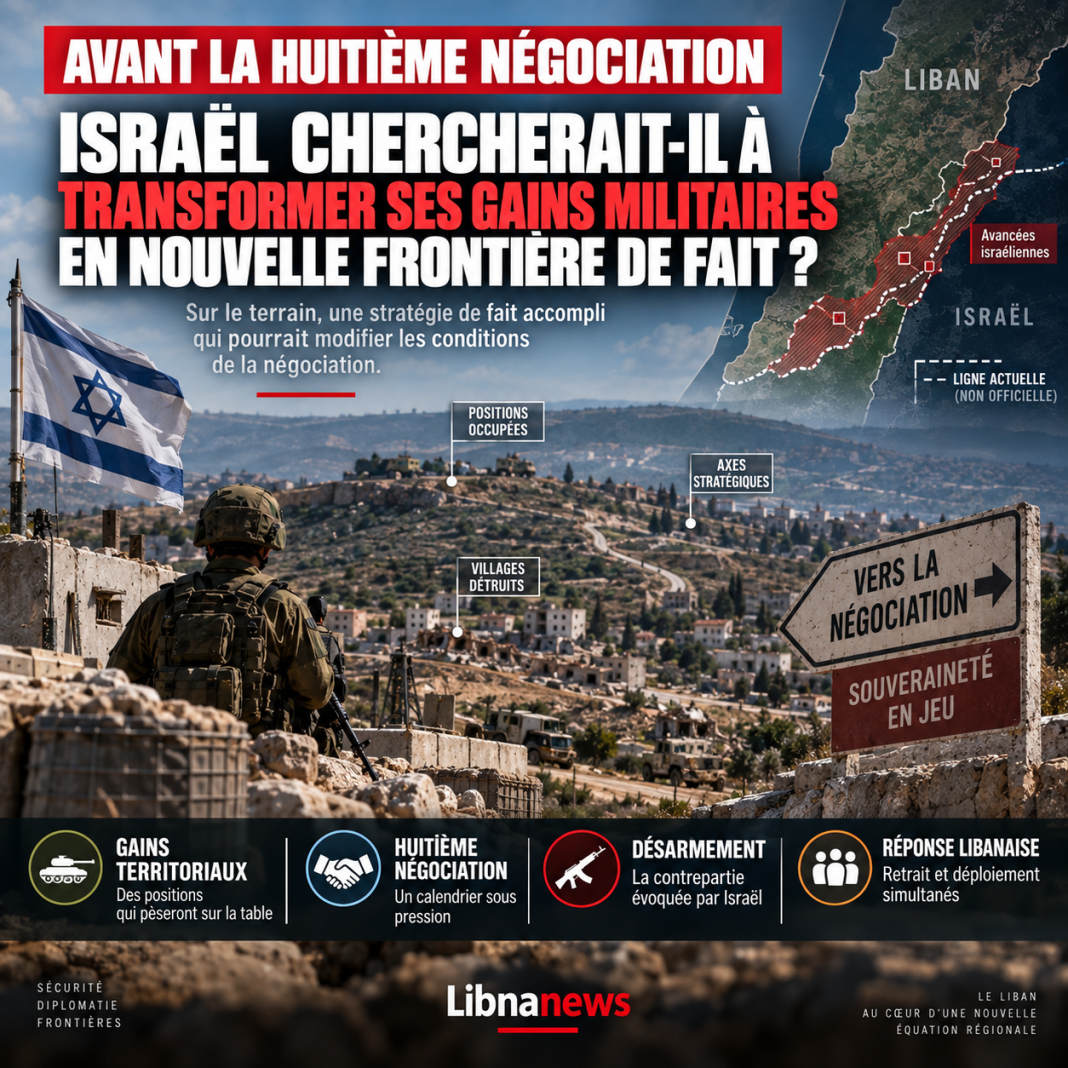
Additional information from political circles links this diplomatic battle to field operations. According to these sources, Israel would seek to use the period prior to the eighth negotiating session to improve its position before the next meeting. The aim would be to gradually consolidate a security reality in certain parts of the South and to reach the table with a more favourable balance of power.
This reading gives another meaning to military operations. Each advance or position retained would not only be a tactical event. It could become an element of negotiation. The more Israel controls points as a new diplomatic phase opens, the more things it has to return in exchange for guarantees.
This logic also explains the Lebanese insistence on withdrawal. Beirut refuses to treat arms control as an isolated obligation while part of the territory remains occupied. Joseph Aoun reminded Paris that Lebanon had made commitments, but that their full implementation could not be separated from the cessation of attacks and Israeli withdrawal.
The sequence becomes decisive. Israel may request guarantees before withdrawing. Lebanon calls for withdrawal to enable the State to exercise its full authority. Some donors want results on weapons before committing more assistance. The army is asking for the means to carry out these missions. Each actor thus conditions his movement to that of another.
This mechanism can produce endless negotiations.
Turkey has put on the table a solution that changes the nature of the problem
In this context Ankara would have put forward a very different proposal from the European project. According to political sources, Turkey would like to participate in the post-FINUL framework and would have proposed a multinational force, including Egypt, Pakistan, Indonesia and Malaysia, with the possibility of involving other Arab countries.
This proposal is not trivial. It responds to one of the weaknesses of an exclusively European mechanism: its political acceptability. A force composed of Arab and Muslim countries could be more difficult to present in Lebanon as a Western arrangement designed primarily to satisfy Israeli demands. It would also give Ankara a direct role in the security balance of the Levant.
However, the same sources indicate that Israel rejects this hypothesis, precisely because it does not want Turkish forces to settle near its border. If this opposition is confirmed, the Turkish proposal reveals a fundamental constraint: the composition of the future mission will depend as much on regional geopolitics as on the needs of the Lebanese army.
Hezbollah’s position adds another dimension. Political sources point to greater flexibility in the movement towards a formula that includes Turkey and Muslim countries as opposed to a Western force. Again, this is not a formal Hezbollah agreement on a finalized project. But this data shows that the choice of contributors could be used to reduce domestic political resistance to a new mechanism.
The result is a particularly difficult triangle to solve. An acceptable force for Israel can hardly be acceptable to Hezbollah. A formula considered less problematic by Hezbollah can be rejected by Israel. The Lebanese Government must find between the two a mission sufficiently legitimate to function without itself becoming a new ground for confrontation.
Saudi Arabia remains on file, despite a more discreet public presence
Informed sources also contradict the idea of a Saudi withdrawal from the Lebanese file. Riyadh would remain engaged with the State, Joseph Aoun, Nawaf Salam and the army. Its current discretion would be more linked to regional priorities, particularly in Yemen, than to the abandonment of Lebanon.
This is important for post-FINUL. A transformation of the army to the scale envisaged will require funding that France probably cannot assume alone. The United States can provide some of the equipment and assistance. The Gulf countries have the financial capacity to give the project a completely different dimension.
The Saudi role could therefore become decisive when the general discussions were to be converted into quantified commitments. But if the political conditionality reported by some diplomatic sources is confirmed, Riyadh would not only be a lessor. He would also be involved in defining the sequence: aid, extension of State authority and processing of the weapons file.
It is precisely for this reason that the Paris meeting should not only be read as a support conference. It is the beginning of negotiations on the very conditions for such support.
The real risk: a transition where no one accepts the same « next day »
The difficulty of post-FINUL is ultimately less due to the absence of projects than to their partial incompatibility. Paris and Rome are working on a European solution. Ankara is putting forward a multinational formula with Muslim dominance. Washington wants strong enough security guarantees. Israel is seeking a mechanism to prevent the rebuilding of Hezbollah’s capabilities. Lebanon wants the army to remain the central authority and refuses an external mechanism to replace national sovereignty.
These positions can still be reconciled, but this requires answering very concrete questions that remain open. Who will monitor the areas evacuated by Israel? Which country will provide air surveillance capabilities? Will the future presence have access to information collected by the army? Will she be able to verify certain sites herself? Who will finance its operation? What will happen if his comments and those of the Lebanese authorities disagree? Above all, will the Israeli withdrawal precede the deployment of the new device or will it progress in parallel with it?
It is around these questions that the real battle is played.
France wants to avoid two simultaneous losses: that of UNIFIL and that of its historical influence on the Lebanese case. The United States has the Israeli lever and a large part of the military resources needed for the army. Israel wants to transform the transition into a lasting guarantee against Hezbollah. Turkey is looking for a strategic gateway. Saudi Arabia has a financial and political capacity that could become decisive. As for Lebanon, it must obtain sufficient assistance from all without allowing any of these actors to define the South alone.
The post-FINUL is therefore not yet a plan. It’sa negotiation on power. Power of the army in the territory, power of a possible international mission to control what happens, power of donors on the conditions of their aid and power of Israel to link its withdrawal to the guarantees it demands.
The decisive question is therefore not what uniform will replace peacekeepers. It is to determinewho will check what, on whose behalf, and with what consequences. It is on these few very concrete parameters that will decide whether the end of UNIFIL really marks the return of the Lebanese State to the South, or simply the transition from one international control system to another.