

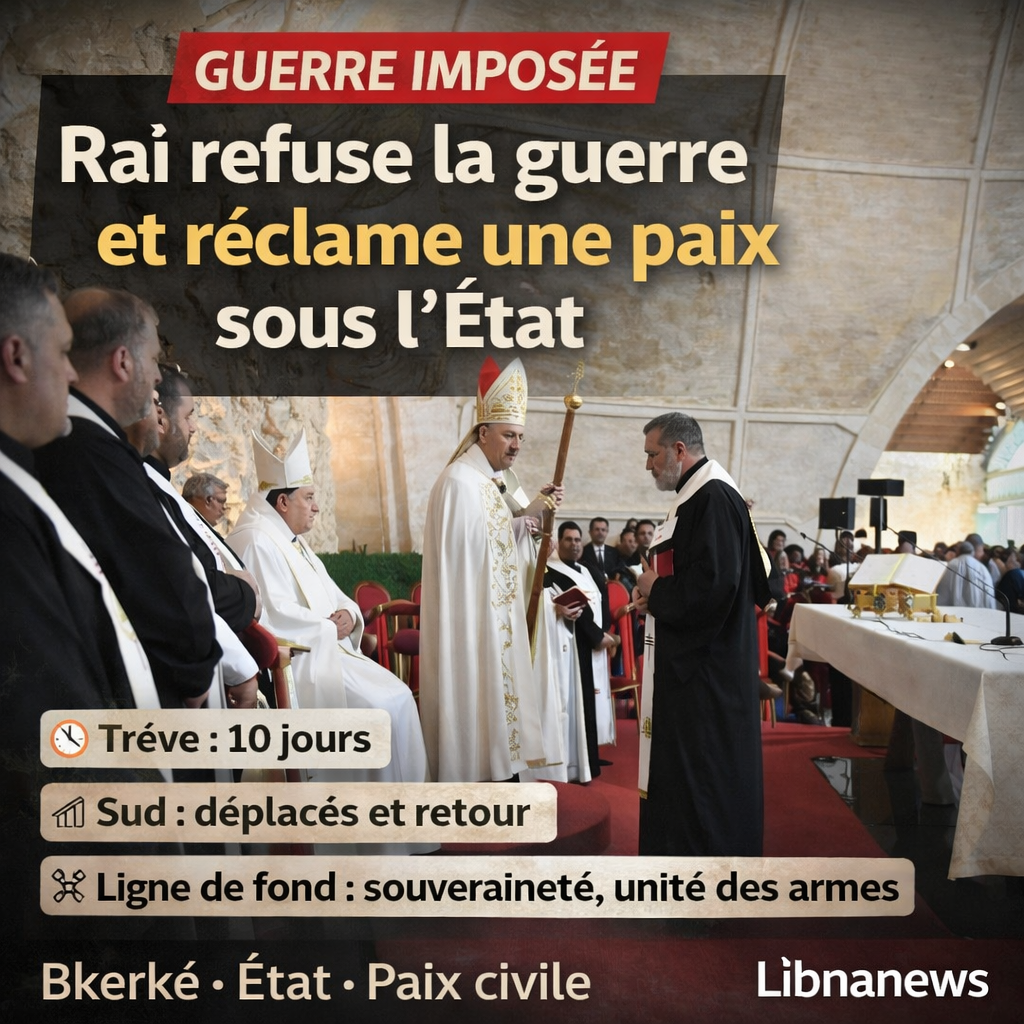
Maronite Patriarch Béchara Rai put the Lebanese debate back on Sunday on a ground that war has often relegated to the background: that of the state, sovereignty and civil peace. In Bkerké, during a mass organized under the sign of solidarity with the displaced people of the South, Béchara Rai denounced « this imposed war », deemed rejected by both the population and the State, and affirmed that peace could neither be decreed by force nor consolidated by weapons alone. In a Lebanon suspended from a ten-day truce that is still fragile, his speech goes far beyond the pastoral framework. It is part of a political sequence that intersects the issue of the ceasefire, the return of the inhabitants to ravaged localities, the resumption of negotiations and the redefinition of the State’s role throughout the territory.
At first reading, the statement seems to be faithful to an ancient line of Bkerké: refusal of war, priority given to state authority, defence of living together and call for a political outcome. But the moment changes its scope. The country emerged from several weeks of intense fighting between Israel and Hezbollah. A 10-day truce came into effect on 16 April under American mediation. It must begin, in theory, a broader phase of negotiations. At the same time, thousands of internally displaced persons have begun to return to the southern and southern suburbs of Beirut, often to discover houses destroyed or uninhabitable. The patriarch thus speaks in a country that is not only afraid of a resumption of strikes. He speaks to a society that fears that the war will leave behind a political vacuum, a moral divide and a new confrontation over the definition of sovereignty.
Bkerké’s scene wasn’t anything unusual. The liturgy brought together a wide range of religious, social and institutional actors, including the Apostolic Nuncio, ecclesial leaders, representatives of charitable associations, elected representatives and delegations from dozens of southern localities. This composition gave the ceremony a wider scope than just a time of prayer. She made homily a public address to a country scattered between mourning, fatigue and uncertainty. Moreover, the patriarch placed at the center of his speech the inhabitants of the border regions, presented as a « wall » of the country, not as a sacrificed periphery.
This choice of vocabulary matters. By calling the inhabitants of the South a « wall of the nation », Béchara Rai takes up a strong expression that aims to reintegrate the border into the common national imagination. He does not speak of an area left to his military logic alone. He speaks of a component of the country, exposed, injured, but fully embedded in the continuity of the state. This move is not just rhetorical. It seeks to prevent the fate of border localities from being confiscated solely by stories of war, resistance or regional security. The patriarch brings the issue back to a civilian level: that of the inhabitants, rights, human presence and public protection.
Béchara Rai places peace under state authority
The political heart of the homily lies in a formula now central to the Lebanese debate: peace must be built « under the banner of the State alone », with the protection of sovereignty over the whole territory and « unity of arms ». By this expression, Béchara Rai is not content to call at the end of the fighting. He reintroduces the issue of the monopoly of military and security decision-making. In today’s Lebanon, such a reminder has immediate scope. The truce announced on 16 April provided for the recognition of Lebanese security forces as the sole responsibility for national sovereignty and defence, while paving the way for direct negotiations facilitated by the United States.
The patriarch does not quote this text in detail, but his message clearly falls within the same field of tension. On the one hand, the Lebanese State seeks to resume the political initiative in a diplomatic phase that it wants to frame. On the other hand, Hezbollah has already rejected any reading of the truce that would weaken its military legitimacy or pave the way for unilateral treatment of the issue of its weapons. In this context, when Béchara Rai pleads for the unity of arms, he speaks less of an abstract principle than of a central post-war friction point. His speech resonates as a reminder of institutional doctrine: no lasting peace can settle if the decision on war and peace remains broken.
This line is not new to Bkerké. For years, the Maronite patriarchate has defended the idea that Lebanon cannot stand without active neutrality, strong institutions and clear state authority. But what is new today is the density of the context. On 17 April, President Joseph Aoun himself stated that it was necessary to move from a cease-fire to « permanent agreements » preserving the rights of the Lebanese, territorial unity and national sovereignty. He also assured that Lebanon must decide for itself and no longer be « an arena for the wars of others ». The convergence of tone between Baabda and Bkerké does not mean the complete identity of approaches, but it draws the same red line: war must not lead to a new erasure of the state.
The term « unit of arms » deserves to be read with precision. In the Lebanese lexicon, it is not just about military coordination. It refers to the hierarchy of decision-making and the legitimacy of the use of force. Béchara Rai does not propose a vague compromise formula here. It recalls that sovereignty is not divided according to the circumstances and that the State, if it wants to protect its citizens, must be recognized as the ultimate authority over the entire territory. This insistence is all the more significant as the current truce leaves a number of sensitive issues outstanding, including the Israeli withdrawal from the southern areas and the precise framework for future negotiations.
A homily built around the south displaced and bruised
The other essential dimension of speaking is its human anchor. Béchara Rai did not speak of the South as a mere strategic theatre. He spoke to delegations from 63 localities in Bkerké to pray for the victims, the wounded and their families. This detail gives a concrete depth to his homily. It shows that his intervention is part of a time when the question of return, accommodation, aid and reconstruction already weighs on daily life. According to reports that since the truce came into effect, many residents returning to their villages or neighbourhoods have recovered destroyed homes, cut-off infrastructure and an environment that often makes any sustainable stay impossible.
The patriarch thus highlights a reality that the strategic debate sometimes tends to erase: there is a civilian population in Lebanon that cannot live in a permanent suspension regime. When he asserts that those who have remained in their villages or who still remain there in anguish are entitled to security, help and preservation of their presence, he translates into moral and political language a very concrete demand. He’s not just asking for compassion. It recalls an obligation of protection, based in its view on international law, duty and standards.
This approach has an important effect on the reading of the conflict. It withdraws part of its abstract grandeur from war to bring it back to its real cost. The inhabitants of the South are no longer presented as heroic silhouettes lost in the decoration of the forehead. They are citizens whose continuity of life has been broken. In this sense, Bkerké’s homily is not merely condemning war in the name of a moral ideal. It rejects it in the name of its concrete consequences: displacement, destruction, uncertainty, exhaustion and breakdown of the ordinary link between the person and his or her place of life.
The choice to celebrate a « day of love and solidarity » goes in the same direction. It is not a liturgical slogan detached from context. It is a way of putting national solidarity back before the sorting of memberships. In Lebanon in recent months, the question of the South has often been read through partisan affiliations, regional calculations and military power relations. On the contrary, Béchara Rai tries to produce a common language, centred on victims, displaced persons and local communities. Again, the gesture is political. He seeks to reopen a national space above the camp stories.
The imposed war, a heavy expression of meaning
The most cited phrase in the sermon is also the most delicate: « this imposed war » would be rejected « by the people » and « by the State ». Apparently, the sentence is simple. In fact, it concentrates an entire reading of the Lebanese moment. To talk about an imposed war is to suggest that the country did not sovereignly choose this sequence. That is to say, Lebanon has been drawn into a logic that goes beyond it, or that has been decided outside the common national framework. This expression echoes President Aoun’s recent remarks that Lebanon should no longer be a playground for outside actors or the arena of wars that are not his own.
But Béchara Rai adds an even sharper element: this war would be refused not only by the population, but also by the State. It means that, at the highest level of national legitimacy, there exists a refusal to see the country locked in a lasting confrontation. The sentence is also used to draw a dividing line. On one side, a state, a society, citizens, religious and civil institutions that want to get out of the war cycle. On the other hand, a logic of conflict that persists and claims to speak in the name of national protection while exposing the country to new ravages.
This is not a nominative designation. The patriarch does not explicitly cite Hezbollah. But in today’s climate, allusion is clear for much of the political scene. It aims less to enter into partisan controversy than to recall a principle: no force, whatever its proclaimed legitimacy, can permanently substitute its own logic for that of the state without producing a crisis of sovereignty. It is in this precise place that the homily joins the substantive debate on the future of Lebanon after the truce.
The caution of tone does not erase the firmness of the substance. Béchara Rai is not looking for verbal escalation. He doesn’t dramatize the national divide. It advances by measured formulations, but each door. To say that peace is not built either by violence or by force is also to contest the idea that the only accumulation of military means would eventually produce a stable order. To say that war is rejected by the state is to question the claim of any armed actor to confuse his strategy with the national interest.
A religious word that takes on a civic function
The very structure of the homily deserves attention. The patriarch starts from the Gospel account of the disciples of Emmaus, a journey of disappointment and repetition, to gradually reach the Lebanese situation. This choice is not fortuitous. It allows him to move from the spiritual register to a public speech without turning the sermon into partisan discourse. The image of a road where it is believed that everything is over, before a new meaning appears, serves as a bridge between the Easter liturgy and the national moment. The message is clear: the country must not read the destruction present as a fatality without a solution.
This rhetorical device has a double effect. It first gives the audience a language of consolation. The displaced, the bereaved families, the inhabitants who return to destroyed houses understand that their ordeal is not denied and that it is part of a horizon of meaning. But it also allows the patriarch to politically reformulate hope. The return to common life, in its words, does not involve an abstract miracle. It requires institutional mediation, serious negotiations, a state framework, restoration of sovereignty and a peace project.
This is where the religious word takes on a civic function. In Lebanon, religious authorities have often served as a body of community resonance. Béchara Rai, on the other hand, tries here to speak as guardian of a broader principle. It is not just addressed to the Maronites or to the Catholic institutions present in Bkerké. He speaks of Lebanon as a political entity threatened by fragmentation. This explains the balance of his discourse: a concrete compassion for the inhabitants of the South, but also a clear defence of the single state framework.
This civic dimension is reflected in the presence around him of charitable and social organizations. The post-war period will not only be a matter of diplomacy or security. It will also be based on community support, care, shelter and moral reconstruction networks. By giving these actors visibility within the celebration itself, Bkerké suggests that another hierarchy of emergencies should prevail: to help, repair, relocate, treat, rebuild the social bond before allowing the logic of the camps to reconfigure the landscape alone.
What Bkerké says about the ongoing negotiations
Béchara Rai calls for the ten-day truce to become a stop to war and then a « permanent, comprehensive and just » peace, achieved through serious dialogue and diplomatic negotiations. The formula is important. It validates the principle of a negotiated exit, down from the discourses that pose war as the only effective grammar. It is also in line with the current situation, when the agreement announced on 16 April is opening up a phase of discussions facilitated by Washington between Lebanon and Israel.
The patriarch, however, takes care to frame this perspective. He does not speak of normalization, abandonment, or peace imposed from outside. He insists on seriousness, selflessness and justice. This vocabulary is essential in a country where the very idea of direct negotiation with Israel causes immediate fractures. By recalling that peace is not « forced », Béchara Rai tries to hold two difficult demands together: to leave the military cycle without turning diplomacy into a new national humiliation.
The formula can also be read as a warning to mediators. A lasting peace cannot result from a simple tactical arrangement or from a text written away from the ground. It must be politically acceptable in Lebanon, credible on sovereignty, practical on security and socially sustainable for the people who pay the price of war. From this point of view, Bkerké’s homily joins a broader feeling in the country: the fatigue of war does not efface neither the sensitivity to national dignity nor the mistrust towards solutions conceived without local anchor.
The security environment further reinforces this caution. Despite the truce, the climate remains unstable. Residents returning to the South said they feared a resumption of bombing. Areas are devastated. Incidents have already pointed out that the ceasefire does not remove tensions or opposing readings of its implementation. In these circumstances, the call of Béchara Rai to a built peace is nothing of an abstract formula. It refers to the need for concrete mechanisms, guarantees and a political framework that is not enough only to suspend fighting.
The South as a post-war moral and political test
Bkerké’s sermon finally offers a deeper reading key: post-war will judge the fate reserved for the South. The patriarch does not treat this area as one of many. It makes it a test of national credibility. If people can return without security, reconstruction and political horizon, then peace will remain an empty word. If, on the contrary, the South becomes again an area of right, life and protected presence, Lebanon can begin to speak seriously about national reconstruction.
In this perspective, solidarity is not a moral supplement. It becomes a political method. Helping displaced people, supporting municipalities, rebuilding houses, reopening services, guaranteeing movement and restoring public authority are all actions that say what the state is. Béchara Rai does not formulate this programme in technocratic form. But his logic leads there. A credible peace is measured in the daily lives of those who return, not the mere vocabulary of the chancelleries.
The afternoon speech, delivered by the President of Caritas Lebanon, extended this logic by recalling the presence of Catholic institutions among the inhabitants of border villages, both in the localities and in places of displacement. Here again, the continuity between religious, social and national is clearly apparent. It does not replace the State. She reminds him of what he must be able to assume.
In the end, Béchara Rai delivered less a sermon of circumstance than a political framing of Lebanese time. He refuses to let the country get used to war. It also refuses to sell a provisional truce as a lasting peace without rebuilding sovereignty. Between the fatigue of the fighting, the fragility of the negotiations and the return of the displaced to a devastated South, it brings into circulation a simple but decisive idea: peace exists only if it protects the inhabitants, restores the State and gives Lebanon the capacity to decide for itself, while the next test will already be in the strength of the ceasefire, in the withdrawal expected in the South and in the real possibility of transforming a precarious suspension of weapons into a tenable political order.




