






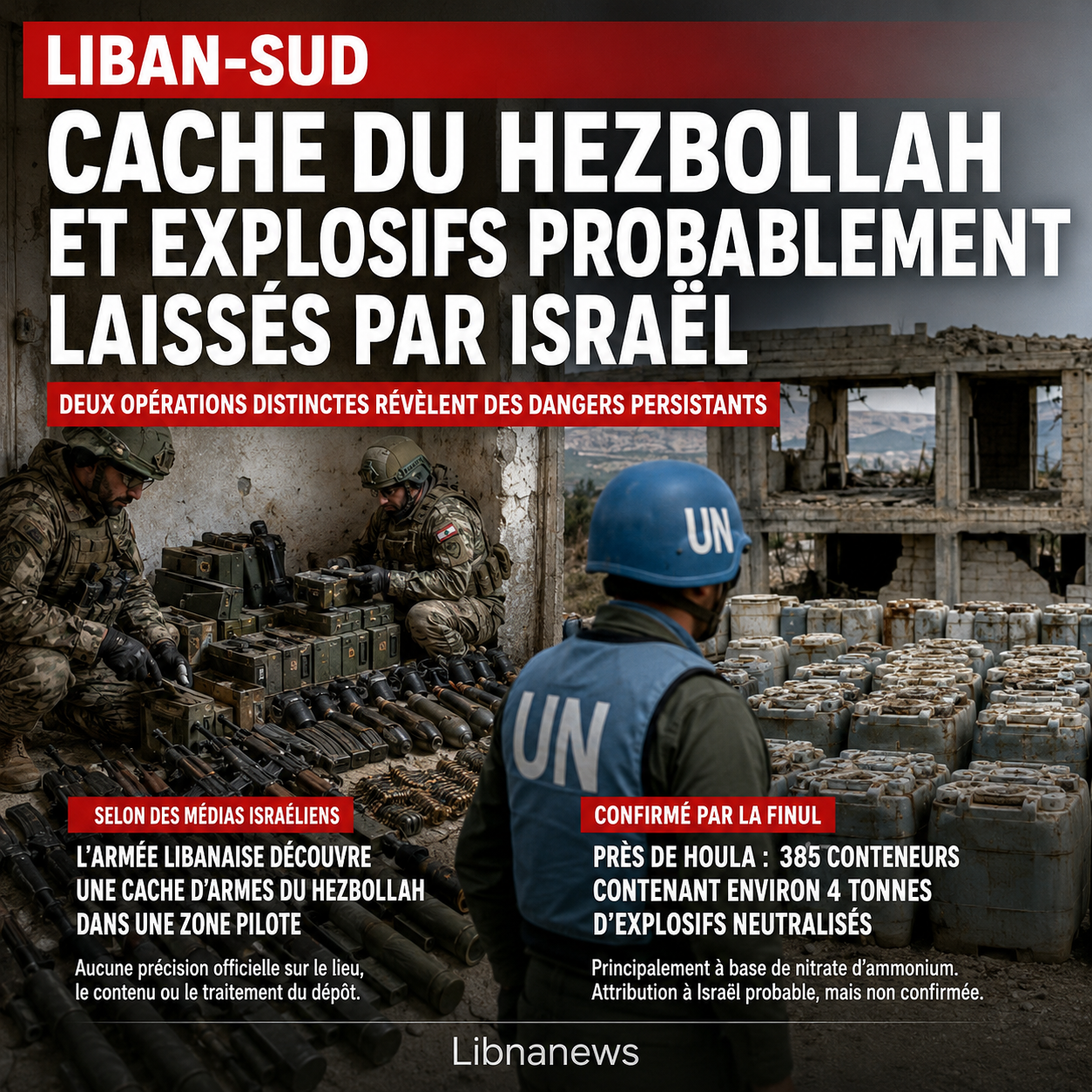
In South Lebanon, two separate operations revealed, within a few days, the remaining dangers in areas affected by fighting and military occupation. According to Israeli media reports, the Lebanese army has discovered a Hezbollah weapons cache in one of the pilot areas where it has just deployed. Near Houla, the United Nations Interim Force in Lebanon announced that it had neutralized approximately four tons of explosive material found in an abandoned building. The first discovery remains reported by Israeli sources and has not yet been detailed by Beirut. The second was confirmed by UNIFIL, which, however, did not formally assign the deposit to Israel.
Two operations reported in South Lebanon
The discovery of the Hezbollah weapons cache was reported to have taken place during a Lebanese Army operation in one of the areas covered by the pilot phase. This arrangement accompanies the gradual withdrawal of Israeli soldiers and the redeployment of Lebanese forces to several southern localities. The exact location of the cache was not communicated.
Israeli public television presented the operation as the first such discovery since the start of the pilot phase. She reported that the coordination mechanism involving the United States, Lebanon and Israel had been informed. Israeli sources also confirmed the existence of the depot, without providing images, inventory or operational reports.
The Lebanese army had not issued, at the time of the information being circulated, a statement specifying the nature of the weapons, their quantity or their condition. It was therefore not possible to know whether the site contained small arms, ammunition, explosives or heavier equipment. There was also no public element to determine whether the cache was still in use.
At the same time, UNIFIL released an operation near Houla. On 2 July, peacekeepers were conducting a routine check on a route when they discovered 385 abandoned containers in a building. According to the UN mission, these containers contained approximately 4,000 kilograms of explosive material, mainly ammonium nitrate compounds.
Hezbollah weapons cache in a pilot area
The discovery reported by the Israeli media comes at the beginning of a test phase for the Lebanese army. In pilot areas, the military must take a position after the Israeli withdrawal, check roads, inspect buildings and search for weapons, underground infrastructure and unexploded ordnance.
The programme should allow the gradual return of State authority to the sectors concerned. It is based on successive steps. Israeli forces are leaving a defined area. The Lebanese army then deploys, secures the ground and controls the installations. Residents may return when the authorities consider that the minimum conditions are met.
Zawtar al-Gharbiyeh was one of the first tests of this mechanism. The Lebanese army entered after the withdrawal of Israeli troops. The soldiers began inspecting the town, which was heavily damaged, while residents were trying to return to their homes. However, the authorities warned that several sectors remained dangerous.
The weapons cache attributed to Hezbollah may have been discovered in this context, but the exact area has not been confirmed. The available information also does not establish whether the weapons were seized, destroyed or placed under military control. This clarification will be necessary to measure the actual scope of the operation.
The Israeli media stressed the unprecedented nature of this discovery. According to their presentation, it would demonstrate that the coordination mechanism allows the Lebanese army to identify Hezbollah facilities. However, this assessment comes from sources engaged in monitoring the scheme. It was not publicly taken up by the Lebanese authorities.
What the Lebanese Army has not yet confirmed
Thus, several elements remain pending. The first concerns the identification of the site. Without precise location, it is impossible to verify its proximity to dwellings, a road, a military position or an old front line.
The second relates to the contents of the cache. An abandoned ammunition reserve does not have the same meaning as a recently supplied operational depot. The date of storage, the condition of the equipment and the possible presence of fuses may change the assessment.
The third concerns the treatment of weapons. A security operation can lead to their transport, destruction on the spot or their transfer to a specialized unit. The Lebanese army has not yet explained what procedure would have been followed.
Finally, there were no reports of arrests or persons present at the scene. It was not indicated whether the site was maintained, closed or accessible at the time of intervention. Hezbollah had also not publicly commented on the initial information.
These reservations do not invalidate the fact reported. However, they limit its scope until a Lebanese report has been published. In such a sensitive case, the distinction between confirmed discovery, reported attribution and political interpretation remains essential.
UNIFIL discovers 385 containers near Houla
The UNIFIL operation is described in more detail. The Blue Helmets discovered the containers on 2 July in a building near Houla, a border town in Marjeyoun district. The Mission announced the disposal of the depot on 28 July.
Explosives specialists examined the containers before rendering the materials inert. UNIFIL did not report an explosion. She presented the intervention as a preventive measure designed to eliminate a risk to soldiers, residents and those expected to travel in the area.
The volume recovered was significant. The 385 containers represented approximately four tons of explosives. UNIFIL clarified that they were mainly composed of ammonium nitrate-based substances, without publishing more complete chemical analysis.
The building was in an area that had been under Israeli control. An Israeli media reported that the products were probably left by Israeli forces. However, UNIFIL did not include this assignment in its announcement. It did not specify whether the containers were marked to establish their origin.
Therefore, the identity of the owner of the deposit remains unconfirmed. The circumstances of its installation and the intended function of the materials were not made public. It is not established that they were intended for military use, destruction or other purposes.
Explosives possibly left during the occupation
The location of the depot explains the suspicions about its origin. Hula and surrounding areas were affected by Israeli operations and a prolonged military presence. Access to certain sectors was severely restricted during this period.
The presence of 385 containers in an abandoned building nevertheless raises a separate question of their allocation. Whatever their source, the materials posed an immediate risk. They could be moved, handled or exposed to fire. Their proximity to a civilian community reinforced this danger.
To formally assign the deposit, an investigation should examine the packaging, batch numbers, entries, residues and composition of the products. No such results were reported. The Israeli deposit should therefore be understood as a probable attribution reported by the press, not as an official UNIFIL conclusion.
The UN mission was limited to the facts observed. His teams found the containers during a route check. They assessed the hazard, secured the building and neutralized the substances.
This intervention is part of the regular operations of peacekeepers to identify ammunition and hazardous materials. These operations are increasing as patrols regain access to areas long exposed to fighting.
Cities still dangerous for the inhabitants
The two discoveries illustrate the difficulties encountered in the villages of the South Lebanon. Stopping or decreasing fighting is not enough to make the localities habitable. Roads, houses and agricultural land must be inspected before normal life resumes.
The teams are looking for unexploded shells, rockets, mines, charges and weapons depots. They must also check damaged buildings, some of which may collapse. Water and electricity networks remain shut down in several sectors.
In Zawtar al-Gharbiyeh, residents began to return after the Lebanese army deployed. They discovered a devastated locality. According to the mayor quoted by a news agency, a significant part of the 500 houses were destroyed or damaged. Only a few families had returned to the village in the first days.
The return is therefore carried out under surveillance. The military inspects access and asks civilians not to enter certain areas. Demining operations still need to be carried out. Combatant bodies must also be recovered in certain areas.
In Houla, the neutralization of the four tons of explosives removed a specific threat. It does not mean that the whole village and its surroundings has been controlled. Other buildings, roads or land may still require verification.
The role of the coordination mechanism
The coordination mechanism must accompany the Israeli withdrawal and the deployment of the Lebanese army. The United States mediates between two countries that do not have diplomatic relations and remain officially in a state of war.
Information on troop movements, incidents and field discoveries can be transmitted through this channel. In the case of the cache attributed to Hezbollah, Israeli media claimed that the mechanism had been warned.
This transmission does not constitute public confirmation by each party. She only indicated that the information had been communicated to the monitoring representatives. Lebanon did not broadcast its own version of the event.
The mechanism should also consider difficulties encountered during withdrawals. An incident had already been reported near Zawtar al-Sharqiyah, where Israeli soldiers had fired warning shots near Lebanese soldiers. No injuries were reported.
These incidents demonstrate the fragility of operations. The limits of the pilot areas are not always visible on the ground. Roads linking two localities can cross areas still controlled by Israel. The Lebanese military must therefore coordinate their movements while continuing inspections.
The disarmament of Hezbollah at the heart of the system
The pilot areas were designed to test the return of the Lebanese army to areas evacuated by Israel and the absence of weapons from Hezbollah. Israel demands that the movement cannot resume its position after the departure of its troops.
Hezbollah refuses to address the issue of its arsenal independently of the Israeli withdrawal. Its officials claim that weapons remain necessary as long as Lebanese territories are occupied and Israeli operations continue.
The Lebanese government seeks to avoid direct confrontation. It favours the gradual deployment of the army in the transferred areas. This method allows him to regain control of specific localities without launching a general operation against Hezbollah.
The discovery of a weapons cache puts this method to the test. If the information is confirmed, the army will have to specify how it processed the deposit. Hezbollah’s reaction will also help to determine whether the movement accepts inspections and the withdrawal of its equipment in the pilot areas.
Discussions are to continue on August 4 in Italy, under American mediation. They will include expansion of the scheme and further Israeli withdrawals. The balance sheet of the first operations should be included among the items examined.
Four tonnes of ammonium nitrate under surveillance
Ammonium nitrate is commonly used in agriculture and in certain industrial activities. It can also be used to manufacture explosives when associated with other substances. Its danger depends on the exact composition, storage and environment.
In an abandoned building, such a quantity requires specialized intervention. Fire, contamination or improper handling can cause an accident. Teams must isolate the site before examining each container.
UNIFIL did not indicate whether the four tons were immediately likely to explode. She called them explosive materials and decided to make them inert. This operation avoided their transport through a still unstable area.
The reference to ammonium nitrate remains particularly sensitive in Lebanon since the explosion of the port of Beirut in August 2020. The quantities found near Houla are not in common with those stored in the port. Situations cannot therefore be compared directly.
The case nevertheless recalls the importance of controlling stocks of hazardous materials. In an area marked by troop movements, abandoned products can become a threat to civilians or be recovered by armed groups.
Two files, two levels of confirmation
The Hezbollah cache and Hula repository must be presented with different levels of certainty. The first discovery is reported by Israeli media, which cite diplomatic and security sources. The Lebanese authorities have not yet published the details.
The second is confirmed by UNIFIL. Its date, location, number of containers and approximate mass of material were communicated. However, their attribution to Israel has not been formally established.
This distinction avoids two errors. The first would be to present the Hezbollah cache as a fully documented fact while several information is lacking. The second would be to say that the four tons belonged to Israel without definitive public evidence.
The two events, however, remain bound by their context. They concern areas of southern Lebanon where the Lebanese army and UNIFIL are trying to secure access after months of fighting and Israeli military presence.
They also show that the hazards do not come from a single category of equipment. Teams meet with stockpiled weapons, explosive materials, unexploded ammunition and potentially trapped buildings.
Future inspections in the South
The Lebanese Army must continue its search in the pilot areas. New sectors could be transferred if negotiations progressed. Each deployment will require controls prior to the return of residents and the commencement of construction.
UNIFIL will continue to verify the routes used by its patrols. Its specialized units may intervene when a deposit, ammunition or dangerous substance is discovered. They will have to coordinate their operations with Lebanese forces.
The local authorities are calling for an acceleration of reconstruction. Villages need clear roads, repaired networks and accessible public buildings. This work depends directly on the completion of the inspections.
The release of a Lebanese Army communiqué on the Hezbollah cache would be the next expected step. It would provide information on the location of the discovery, the contents of the repository and the measures taken.
In Houla, the origin of the 385 containers remains to be established. UNIFIL has not announced any additional public investigation. In the field, its teams continue patrolling an area where each abandoned building can still reveal weapons, ammunition or explosives.
Editorial elements
Exact number of body words: 2,512 words
Keyword:hezbollah weapons cache
Keywords Secondary SEO:
- lebanese armed forces
- israeli explosives
- UNIFIL in South Lebanon
- explosive deposit in Houla
- pilot areas in Lebanon
- ammonium nitrate
- israeli withdrawal
Description:
The army reportedly found a Hezbollah cache while UNIFIL neutralized four tons of explosives probably left by Israel.
Extract:
Two operations in South Lebanon revealed the persistence of stockpiles of weapons and explosive materials in areas affected by the fighting. According to Israeli media reports, the Lebanese army has discovered a Hezbollah weapons cache in a pilot area. Near Houla, UNIFIL confirmed that it had neutralized approximately four tons of explosives, mainly ammonium nitrate. Their assignment to Israel remains probable, but has not been formally established by the UN mission.
Five alternative titles
- South Lebanon: Two weapons depots discovered
- Hezbollah weapons and explosives near Hula
- Army finds weapons, UNIFIL explosives
- South Lebanon: weapons and explosives in two sectors
- A Hezbollah cache discovered in the South
References and links
- The Times of Israel, « UNIFIL troops neutralize 4 tones of explosives likely left by Israel in south Lebanon village », 28 July 2026:
https://www.timesofisrael.com/liveblog entry/unifil-troops-neutralize-4-tons-of-explosives-likely-left-by-israel-in-south-lebanon-village/Times of Israel) - Associated Press, report on the return of residents to Zawtar al-Gharbiyeh, 29 July 2026:
https://apnews.com/article/21ec1cae5cfc2b8b2c31873287686340AP News) - Reuters, « Residents enter shaded south Lebanon town after Israel withdrawal », July 24, 2026:
https://www.reuters.com/world/middle-east/residents-enter-shatered-south-lebanon-town-after-israeli-withdrawal-2026-07-24/Reuters) - Reuters, « Lebanese army enters south town after Israel withdrawal, in first test of US-brokered deal », July 21, 2026:
https://www.reuters.com/world/midddle-east/lebanese-army-deploys-southern-town-after-israeli-withdrawal-official-says-2026-07-21/ (Reuters) - Reuters, « Lebanon, Israel to hold next talks in Italy on August 4 », 22 July 2026:
https://www.reuters.com/world/midddle-east/lebanon-israel-hold-next-talks-italy-august-4-lebanese-official-says-2026-07-22/Reuters) - Libnanews, « Pilot zone: Israel shoots near the Lebanese army », July 2026:
https://libnanews.com/zone-pilot-israel-tire-pres-de-larme-lebanese/Libnanews, The Media Citizen of Lebanon) - Libnanews, « In the background of the framework agreement, the Lebanese army facing the South Test », July 2026:
https://libnanews.com/in-the-backstage-of-the-framework-lamer-lebanese-face-to-southern-test/Libnanews, The Media Citizen of Lebanon)