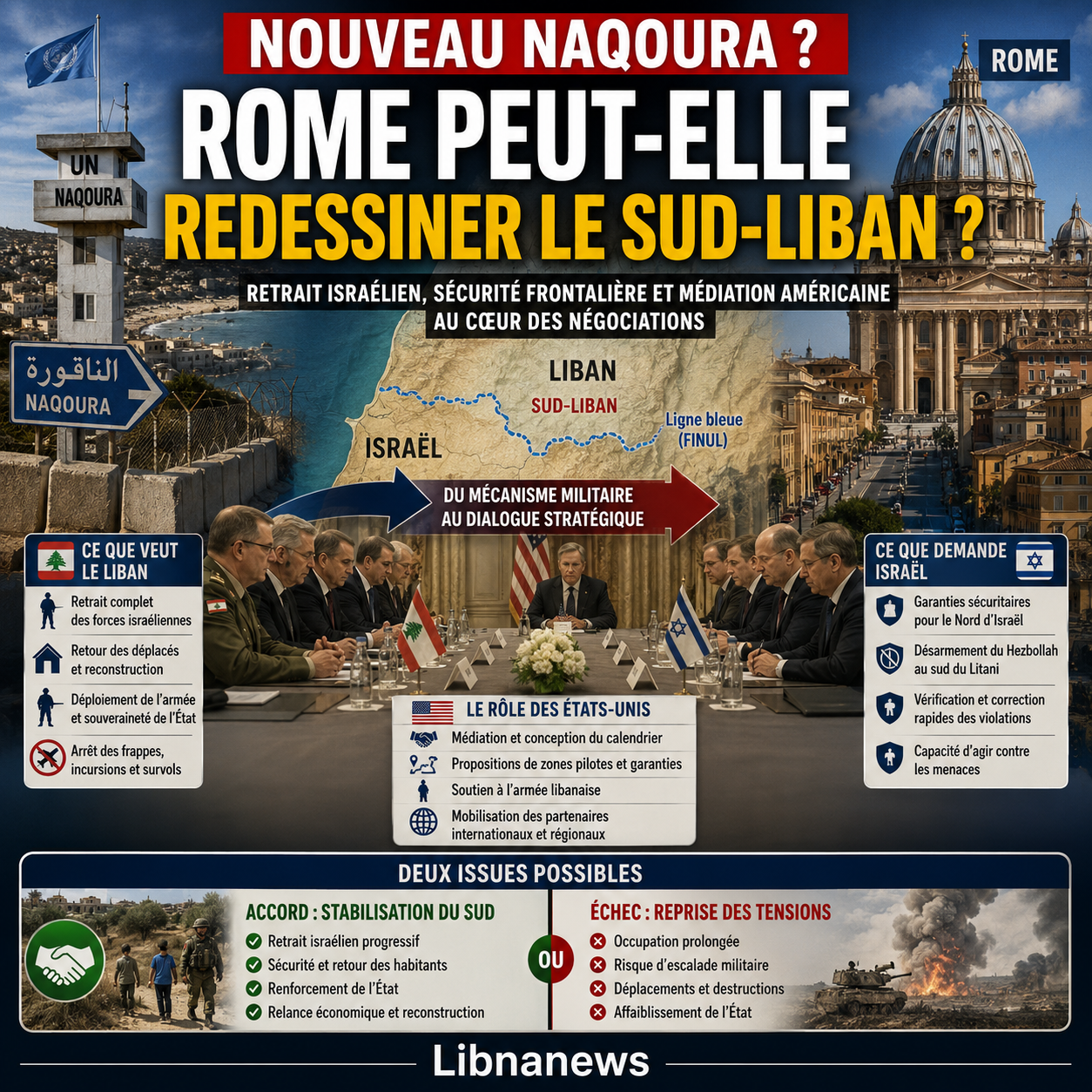
The shift of negotiations between Lebanon and Israel to Rome marks a change of method as well as a change of scenery. For nearly two decades, Naqoura embodied a dialogue closely supervised by the United Nations. The Lebanese and Israeli military found themselves there without political normalization, under the authority of the United Nations Interim Force in Lebanon. Rome now hosts broader discussions. They cover Israeli withdrawal, the deployment of the Lebanese army, the disarmament of armed groups and border security.
Can the Italian capital become the new Naqoura? Comparison remains imperfect. Naqoura was a permanent incident management mechanism. Rather, Rome appears to be a strategic negotiating space, organised under American leadership. The first sought to prevent a local escalation. The second attempts to set the conditions for a new order in South Lebanon. This displacement raises a central question: do the parties negotiate a simple stabilisation of the border or a lasting transformation of their relations?
From the 1949 Armistice to the Naqoura Mechanism
The border dialogue between Lebanon and Israel does not start with recent crises. It is based first on the Armistice Convention signed in 1949, after the first Arab-Israeli war. This text does not establish peace. It organizes the cessation of hostilities and confirms a line of separation. Lebanon continues to consider that it remains legally in a state of war with Israel. This situation explains the extreme caution surrounding each official contact.
The 1978 Israeli invasion then turned southern Lebanon into a lasting international issue. The Security Council establishes UNIFIL to confirm the Israeli withdrawal, restore peace and assist the Lebanese State in restoring its authority. The force headquarters is moving to Naqoura. The town gradually became a diplomatic and military crossing point, despite the wars, occupations and successive presence of several armed organizations.
After the Israeli withdrawal of 2000, the United Nations trace the Blue Line. It is used to verify withdrawal, but it does not constitute a definite international boundary. Several sectors remain contested. Disagreements include land points, agricultural areas, dominant positions and the Shab’a farms sector, whose status also includes Syria. These ambiguities feed into regular incidents.
The 2006 war gave Naqoura a more structured function. Resolution 1701 provides for the cessation of hostilities, the strengthening of UNIFIL and the deployment of the Lebanese army south of the Litani River. It also states that no weapon should be present in this area without the agreement of the Lebanese State. After the conflict, a tripartite mechanism regularly brings together UNIFIL, the Lebanese army and the Israeli army.
This mechanism does not resolve political disputes. It deals with violations, military movements, work near the Blue Line and risks of confrontation. His strength lies in his continuity. Even during periods of tension, representatives can transmit messages and limit misinterpretation. His weakness lies in his mandate: Naqoura manages symptoms without resolving the causes of the conflict.
Previous maritime negotiations
Naqoura also hosts discussions on the maritime border from 2020. These negotiations remain indirect. Delegations occupy separate spaces and US mediators transmit proposals. The agreement concluded in October 2022 defines exclusive economic zones and paves the way for the exploitation of gas resources. It proves that a technical compromise remains possible without a peace treaty.
This precedent directly influences the current framework. It shows that a sensitive case can be isolated from the general conflict, processed under American mediation and then translated into an operational arrangement. However, the earthly issue is more complex. It affects villages, military positions, the return of displaced persons, the sovereignty of the state and the arsenal of Hezbollah. Each concession therefore produces immediate internal political effects.
The clashes opened after October 2023, followed by successive wars and ceasefires, reduced the effectiveness of the Naqoura regime. The destruction of infrastructure, massive displacement and occupation of Lebanese sectors have changed the scale of the problem. The priority is no longer just to avoid accidental shooting. It consists of organizing the withdrawal of forces, controlling devastated territories and preventing the reconstruction of an armed front.
Why? Rome changes the previous framework
Rome first offers a physical distance to the theatre of operations. In Naqoura, delegations meet a few kilometres from the military positions. Each incident may suspend the dialogue. The Italian capital further protects the discussions from immediate tensions. It also facilitates the presence of political leaders, diplomats, experts and American representatives who will deal with several issues at the same time.
The Italian choice also has a symbolic dimension. Italy has a long history of participating in UNIFIL and experiencing the balance of southern Lebanon. It maintains ongoing relations with Beirut, Israel, Washington and the European institutions. Rome can therefore provide an environment accepted by both parties, without appearing as the political owner of the mediation. The United States continues to lead the process.
The location mainly changes the nature of the exchanges. In Naqurah, the Lebanese army speaks to the Israeli army under UN control. In Rome, discussions combine military, territorial and political dimensions. The Israeli withdrawal may be linked to the deployment of the Lebanese army. This deployment may depend on the dismantling of armed installations. International aid may, in turn, depend on verification mechanisms.
This system is based on a sequencing logic. A pilot area must demonstrate that each party can meet its commitments. Israel withdraws from a defined sector. The Lebanese army enters, secures the villages and prevents the return of an autonomous armed presence. Auditors note the action taken. The model can then be extended to other areas. In theory, this method reduces the risk of an overall agreement that cannot be applied.
In practice, it creates a strong asymmetry. Lebanon must prove its ability to control the ground before it can achieve a wider withdrawal. Israel retains a margin of appreciation on the threat and timing of its movements. Beirut is concerned that a temporary mechanism may turn an occupation presented as temporary into a permanent presence. Israel claims, on the contrary, that a withdrawal without guarantees would allow Hezbollah to return.
Rome, a new centre or a temporary stage?
Rome does not yet have the institutional characteristics of Naqoura. No permanent secretariat manages incidents on a daily basis. No specific international mandate defines its functioning. The cycles are convened by the United States as required. The Italian capital therefore serves as a diplomatic platform, but not yet as a stable mechanism. Its sustainability will depend on the results achieved.
If negotiations produce maps, schedules and control procedures, Rome could become the place where strategic decisions are made. Naqoura would then retain an execution role. UNIFIL, the Lebanese army and the Israeli army would translate the agreements into local measures. A division of labour would appear: Rome for the political compromise, Naqoura for military coordination.
However, this architecture requires a clear articulation with the United Nations. Lebanon is based on resolution 1701 and the principle of sovereignty. Israel emphasizes security guarantees and freedom to act against threats. The United States is attempting to bring these approaches closer together through a verification mechanism. The marginalization of UNIFIL would undermine the international legitimacy of the process and deprive the ground of an experienced intermediary.
Negotiations in southern Lebanon: Beirut demands
The first Lebanese demand remains the complete withdrawal of Israeli forces from national territory. Beirut refuses that this withdrawal be presented as a reward after the performance of Lebanese obligations. The authorities invoke sovereignty, the Blue Line and international resolutions. They also call for the cessation of strikes, incursions, demolitions and overflights that prevent the normal return of the inhabitants.
Lebanon also wants a clear timetable. A general promise is not enough, as previous agreements have often given rise to conflicting interpretations. The government is looking for dated steps, recognized maps and a procedure for disputed areas. He wants to avoid any local withdrawal being renegotiated against a new security condition.
Another priority is the return of internally displaced persons. Many villages in the South have suffered considerable destruction. Demining, road rehabilitation, water, electricity and housing reconstruction must accompany any military arrangement. Without these measures, a formal withdrawal does not restore civilian life. Evacuees could remain empty, vulnerable and dependent on external decisions.
Beirut finally calls for lasting support for the army. It must control an extended territory with limited resources. It needs equipment, monitoring, mobility and funding. Deployment cannot be based solely on units displaced from other regions. It requires a permanent presence, fixed posts and cooperation with the inhabitants.
However, the issue of Hezbollah’s weapons is a major challenge for the State. The government claims to want to exercise the monopoly of force. But a coercive operation against the Shiite movement could lead to internal confrontation. The authorities therefore favour a national political decision and a gradual process. They officially refuse that Israel alone determines the pace or modalities of disarmament.
Israel’s demands: guarantees and neutralization of Hezbollah
Israel places the security of its northern communities at the centre of the negotiations. Its stated objective is to prevent Hezbollah from restoring positions, weapons depots and firing capabilities near the border. Israeli officials consider that resolution 1701 did not prevent the rearmament of the movement after 2006. They therefore call for more stringent safeguards than the previous framework.
The Israeli position combines withdrawal with verifiable results. The Lebanese army must enter the evacuated areas, inspect the infrastructure and prevent any non-State military presence. Israel hopes that violations will be promptly detected and corrected within a specified time frame. In the absence of Lebanese action, it seeks to preserve a capacity for intervention, which Beirut considers a direct attack on its sovereignty.
Israel also calls for the treatment of disputed land points. These areas sometimes have a tactical value greater than their area. A hill, road or promontory can control access to several villages. Negotiators must therefore distinguish between legal delimitation, military security and temporary arrangements. A poorly defined agreement could move the confrontation without removing it.
Part of the Israeli debate concerns the depth of the security zone. Some officials find it insufficient to withdraw Hezbollah north of the Litani River. Medium- and long-range missiles can be launched from other regions. This reading greatly expands negotiations. It no longer concerns only southern Lebanon, but the entire arsenal and military structure of the movement.
This demand runs counter to the Lebanese political power balance. Hezbollah refuses to treat its weapons as a mere border matter. It presents them as an element of national defence and links their future to Israeli threats. Without internal agreement in Lebanon, any formula imposed from outside the country may remain theoretical. However, Israel believes that unverified political commitment is no longer sufficient.
United States, mediators and calendar architects
Washington is not just a facilitator. The United States designs sequencing, offers pilot areas, brings cards together and seeks financial guarantees. Their influence on Israel allows them to obtain limited withdrawals. Their support for the Lebanese army also gives them leverage in Beirut. This dual relationship places American diplomacy at the centre of every stage.
The maritime precedent strengthened this position. The American emissary then turned incompatible claims into a practical compromise. However, the land record requires more than one line on a map. There is a need to integrate present forces, inhabitants, destruction, weapons and regional rivalry between the United States and Iran. The Ombudsman must therefore act on several levels simultaneously.
The American method favours reciprocal but not necessarily simultaneous commitments. Each measure must trigger the next one. This model seeks to prevent one party from running everything while the other temporises. However, it requires an arbitrator capable of certifying progress. However, the verification criteria remain sensitive. Who will decide that an area is cleared of weapons? Who will decide a disagreement on a tunnel, depot or position?
Washington is also seeking to mobilize partners. Italy can provide field knowledge and contribute to monitoring. France retains historical and military interest in Lebanon. The United Nations has an operational presence. Arab countries could finance reconstruction. Success will depend on consistency between these actors, as competing guarantees would complicate implementation.
The American role finally has a regional dimension. An agreement in southern Lebanon would reduce a major front and limit the risk of a new war between Israel and Hezbollah. It could also open a broader debate on relations between Lebanon and Israel. Beirut, however, remains far from normalisation. The authorities described the discussions as a means of recovering the territory and protecting the population, not as a traditional peace process.
What a successful negotiation would change
An agreement would first allow the withdrawal of Israeli forces and the gradual return of the Lebanese State to the sectors concerned. The army would become the main security actor south of Litani. Residents could return subject to mine clearance and reconstruction. The border would remain disputed on some points, but the settlement mechanisms would reduce the risk of confrontation.
Success would also strengthen Lebanese institutions. The State could demonstrate that it negotiates, obtains a withdrawal and ensures security without abandoning its claims. This would change the debate on Hezbollah’s weapons. The movement would be under increased pressure to integrate its strategy into a national decision. The process would remain conflicting, but it would take place more in institutions than on the border.
Economically, stabilization would facilitate the reconstruction of the South. International financing would remain conditional on political and administrative guarantees. Farmers would need access to land. Municipalities should restore essential services. Investors would expect a lasting reduction in military risk. An agreement signed but regularly violated would therefore not suffice to revive activity.
Rome could then become a regular speaker. Negotiators would address issues beyond military competence: contentious issues, prisoners, reconstruction, guarantees and the future of the ceasefire. Naqoura would maintain day-to-day management. The new system would not completely replace the old one. It would expand by separating the political decision from operational implementation.
Failure would open a period of high uncertainty
Failure can take many forms. Negotiations may be interrupted on the withdrawal schedule. They can also produce text without any applicable mechanism. A pilot area can operate for a few weeks and then block from the first violation. In each case, the parties would accuse the other of not complying with its commitments and resume unilateral measures.
For Lebanon, failure would prolong the occupation, displacement and economic destruction of the South. It would weaken the government against those who consider diplomacy unnecessary. Hezbollah would invoke the absence of withdrawal to maintain its weapons. The Lebanese army would find itself exposed between international demands, the expectations of the inhabitants and the risk of internal confrontation.
For Israel, lack of agreement would mean maintaining an expensive presence in a hostile environment. Northern localities would remain dependent on a strengthened military apparatus. Any attack could result in a response, then a further escalation. A prolonged occupation would not necessarily guarantee the disappearance of the threat. On the contrary, it could promote new forms of resistance.
The decisive question will therefore be less the choice between Rome and Naqoura than the relationship between the two. Rome can define a compromise, but it does not control the ground. Naqoura can transmit orders and prevent incidents, but it does not sever political choices. The next cycle announced from 4 to 6 August 2026 must specify this articulation, the pace of withdrawals and the extension of the pilot zones. It is on these technical documents, still under negotiation, that the real transformation of South Lebanon will be played out.