





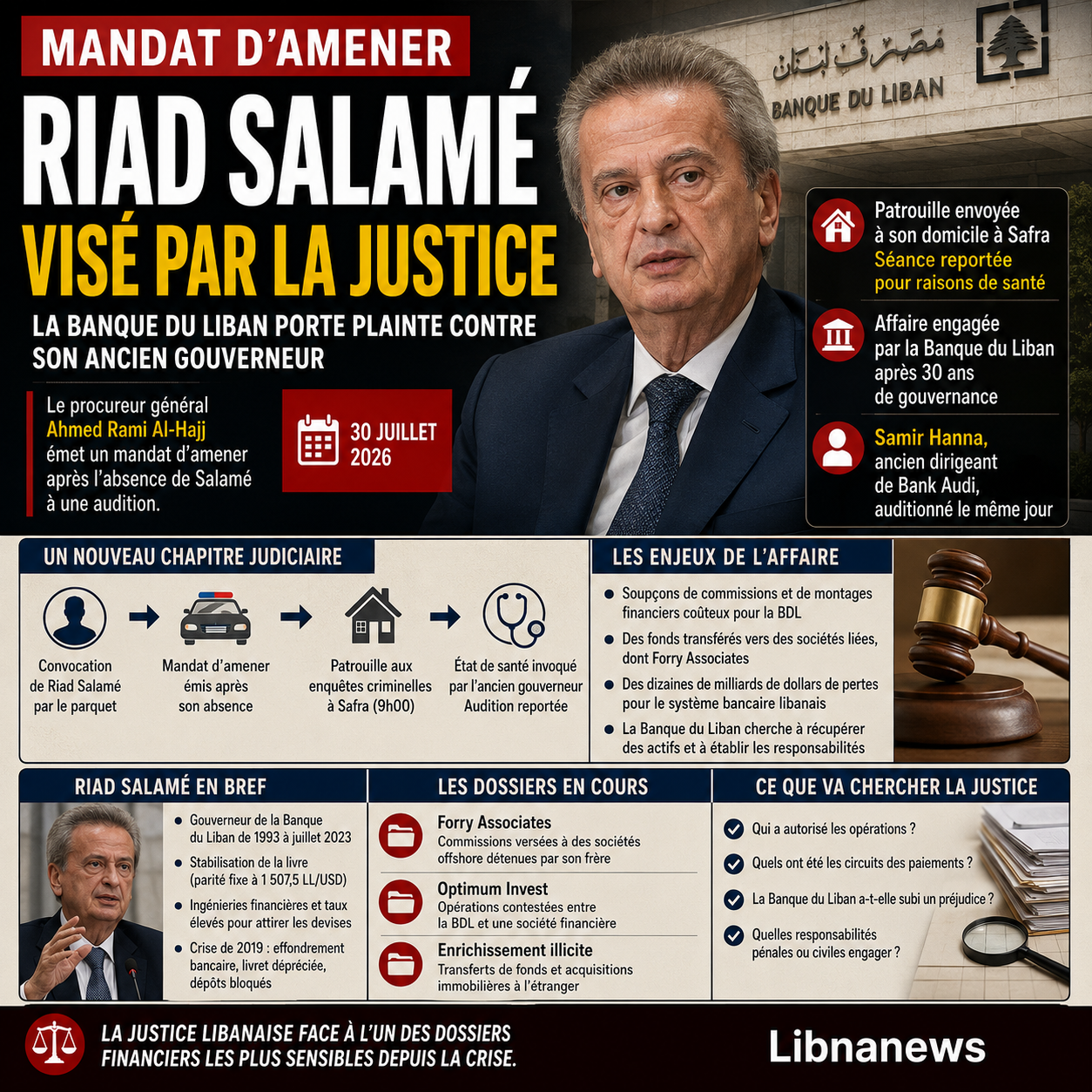
The Attorney General of the Court of Cassation, Judge Ahmed Rami Al-Hajj, issued a warrant on Thursday 30 July 2026 to bring against Riad Salamé. The former Governor of the Bank of Lebanon did not appear at a hearing related to a complaint filed by the institution he led for 30 years. A patrol returned to his home in Safra, but the session was eventually postponed after invocation of health reasons. This procedure opens a new chapter in the review of financial transactions conducted under its mandate.
Patrol sent to Riad Salamé’s home
On Thursday morning, Lebanese justice tried to have Riad Salamé taken to the Beirut courthouse. The Attorney General of the Court of Cassation, Ahmed Rami Al-Hajj, had summoned the former Governor of the Bank of Lebanon to question him in a new financial case.
Riad Salamé did not show up at the scheduled time. The magistrate then drafted a mandate to bring and instruct the security services to ensure the execution. At approximately 0900 hours, a criminal investigation patrol went to his home in the coastal town of Safra, north of Beirut.
The measure did not at this stage constitute a conviction or even a detention order. A warrant allows the court to have a person brought before the magistrate when the judge does not respond to a summons. The follow-up depends on the examination, the elements of the file and the decision taken by the prosecutor.
Initial information referred to refusal or forbearance. A judicial source then told a news agency that the former governor had been unable to travel for health reasons. The meeting scheduled for 30 July has therefore been postponed.
This chronology remains important. It distinguishes the initial decision of the prosecutor, taken after the absence of Riad Salamé, from the evolution following the displacement of the investigators. It does not mean that the procedure is abandoned. The hearing must be reprogrammed or organised in a manner compatible with the state of health invoked.
Bank of Lebanon case
The case examined by the prosecution is the result of a complaint lodged by the Bank of Lebanon. The institution now acts against the person who directed it between 1993 and July 2023. This configuration marks a major break in the judicial treatment of the legacy of Riad Salamé.
For several years, investigations against the former governor were mainly initiated by foreign magistrates, associations or judicial authorities. The Bank of Lebanon had taken a more cautious stance. It is now involved in several procedures aimed at tracing financial flows and seeking possible responsibilities.
The complaint considered by Ahmed Rami Al-Hajj also concerns Samir Hanna, former head of Bank Audi. He presented himself Thursday at the Courthouse and was awaiting the start of his interrogation. His presence contrasted with the initial absence of Riad Salamé.
The information available links the case to suspicions of funds from the Bank of Lebanon and of fees allegedly paid in connection with financial transactions. However, the exact qualifications must be established by the courts. The persons concerned benefit from the presumption of innocence until a final decision has been given.
The complaint was filed under the direction of Karim Suhaid, who took over the Bank of Lebanon in April 2025. The new governance seeks to examine some old transactions and recover amounts it considers likely to have been collected at the expense of the institution.
This approach is part of a broader movement. The central bank has launched or supported several actions against former officials, intermediaries and private institutions. It tries to establish the role of each actor in the financial arrangements used in the years preceding the banking collapse of 2019.
Samir Hanna questioned in the same file
The convening of Samir Hanna gives the case a banking dimension that goes beyond the responsibility of the former governor. The former head of Bank Audi is one of the main players in the Lebanese financial sector in recent decades.
Bank Audi has long held a central position in state financing and operations with the Bank of Lebanon. Like other large commercial banks, it has placed a significant portion of its resources with the central bank and in public debt.
These relations intensified during the years when the authorities were trying to support the Lebanese pound and attract foreign currency. Institutions received high returns in exchange for complex deposits or transactions. The Bank of Lebanon used these contributions to defend currency parity, finance external needs and maintain the functioning of a system that became dependent on capital inflows.
The current procedure must determine whether certain transactions have exceeded the normal scope of these relationships. She also asked whether private persons had obtained an unfair advantage from operations financed by the central bank.
Samir Hanna’s presence before the prosecutor does not prejudge his responsibility. The interview is intended to collect his version, examine the available documents and compare his answers with those of other persons concerned.
In particular, justice must distinguish between bank business decisions, monetary policy choices and possible personal transactions. This separation is a central issue. The system was based on close links between the central bank, private institutions, the state and major capital holders.
Thirty years as head of central bank
Riad Salamé led the Bank of Lebanon for three decades. Named in 1993, it has long enjoyed a reputation for stability. He assumed his duties at the beginning of the reconstruction that followed the civil war.
His main apparent success was the stabilization of the Lebanese pound. Starting in the late 1990s, the currency remained stowed to the dollar around £1,507.5. This has facilitated trade, reassured some depositors and allowed banks to attract capital from abroad.
However, the model was based on growing foreign exchange requirements. Lebanon was much more important than it was exporting. The state had persistent budget deficits and a high debt. The banks collected the deposits and then placed a significant part of the funds with the Treasury or the Bank of Lebanon.
To maintain this pattern, the monetary authorities proposed attractive interest rates. As of 2016, they also launched operations known as « financial engineering ». These were aimed at strengthening the central bank’s foreign reserves and consolidating bank balance sheets.
These mechanisms have delayed the public appearance of the crisis. They also increased the cost of maintaining the system. When capital inflows slowed, the Bank of Lebanon and commercial banks lost the ability to meet all withdrawal requests.
In the fall of 2019, institutions began imposing restrictions. Applicants could no longer freely dispose of their money. However, the country had not adopted any general legislation regulating capital control.
The collapse then led to a massive depreciation of the pound, high inflation and rapid impoverishment of the population. The financial system has lost several tens of billions of dollars. Their distribution between the state, central bank, banks and depositors remains at the heart of economic negotiations.
The proceedings against Riad Salamé are multiplying
The mandate to bring on 30 July should not be confused with the other files concerning Riad Salamé. The former Governor is the subject of several separate procedures in Lebanon and Europe.
Some investigations concern Forry Associates, registered in the British Virgin Islands and owned by his brother Raja Salamé. Commissions were allegedly charged on transactions between commercial banks and the Bank of Lebanon before being transferred to the company.
European investigators suspect that a portion of these funds then circulated through several accounts and used to acquire real estate. Riad and Raja Salamé challenged these charges. The former governor claims that his wealth comes from, among other things, income obtained prior to his entry into the central bank and private investments.
Other procedures relate to transactions with Lebanese financial companies. Riad Salamé was arrested in September 2024 in a case involving operations between the Bank of Lebanon and Optimum Invest. He denied any malfeasance.
In April 2025, a judicial decision opened the way for his indictment in proceedings involving possible illicit enrichment and transfers of funds from the central bank to private accounts. His defence denounced irregularities and an investigation carried out too quickly.
The case examined on Thursday by Ahmed Rami Al-Hajj has its own procedural basis. It is the result of an action by the Bank of Lebanon and involves Samir Hanna. The amounts, operations and liabilities sought should therefore not be automatically confused with those of the Forry case or Optimum Invest case.
This increase in investigations makes judicial follow-up complex. It also increases the risk of presenting suspicions as established facts. Each case follows its timetable, remedies and rules of jurisdiction.
Why Bank of Lebanon changes position
The action undertaken by the central bank reflects institutional developments. After the departure of Riad Salamé in July 2023, the interim was performed by the first vice governor, Wassim Mansouri. He had announced a limitation on state monetary financing and a stricter policy on the use of reserves.
Karim Souhaid’s appointment in 2025 opened a new phase. The Bank of Lebanon seeks to restore its credibility to depositors, government and international partners. It must also respond to requests for information from European courts.
For the central bank, forming a party in certain procedures can serve several purposes. It can access coins, support asset recovery and assert that it considers itself a victim of alleged irregular operations.
However, this position raises an issue of institutional responsibility. The contested decisions were taken on behalf of the Bank of Lebanon, sometimes with the involvement of its internal bodies or banking partners. An institution cannot therefore limit the examination to the actions of one person if the mechanisms involved several levels of decision-making.
Investigations will need to specify which officials have signed contracts, validated payments or audited accounts. They will also have to determine whether the monitoring bodies have the necessary information.
The role of the Central Council of the Bank of Lebanon, the Bank Control Commission, the auditors and the political authorities could thus be examined. A complete reconstitution requires the study of internal documents and validation circuits.
A case related to the issue of bank losses
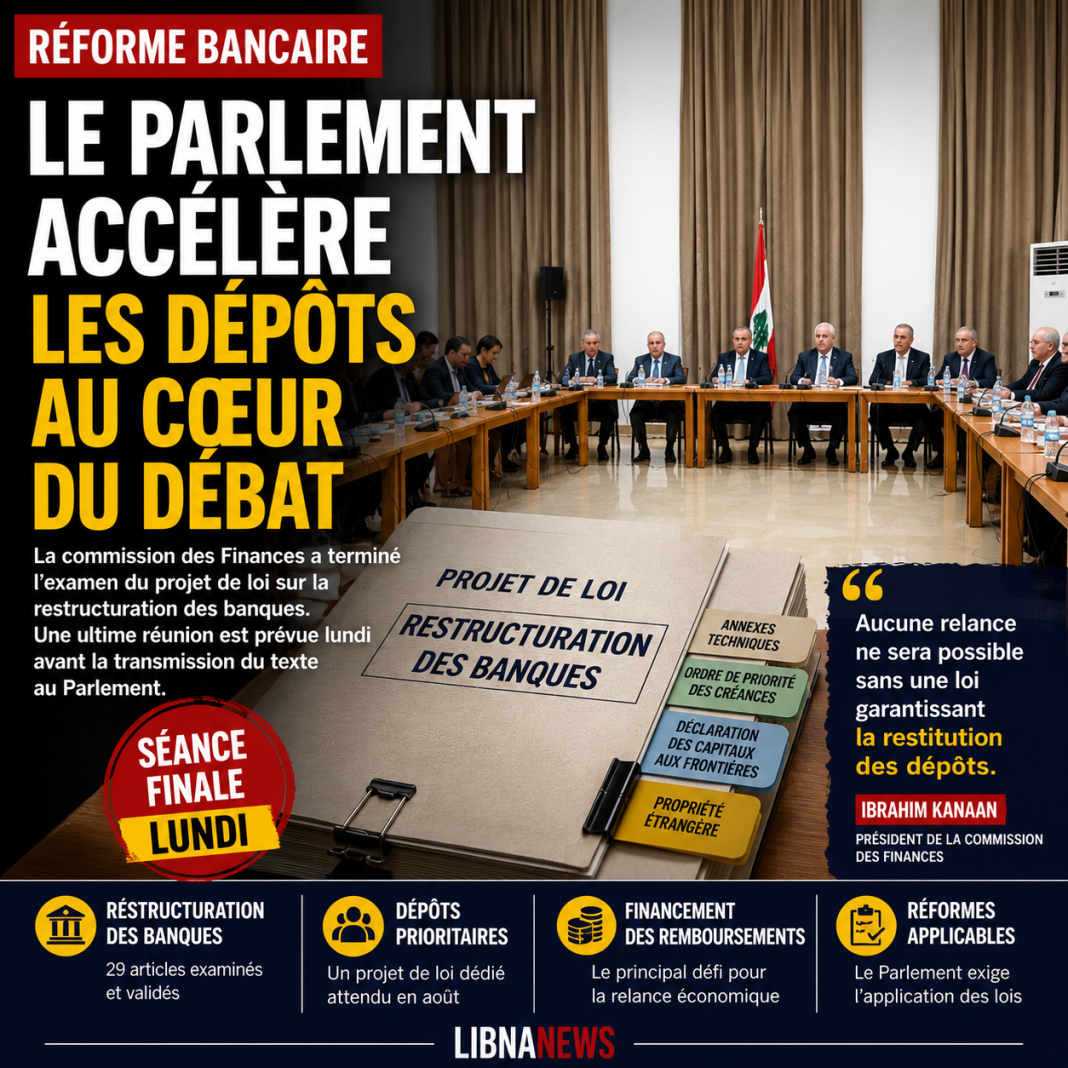
The procedure against Riad Salamé comes as Lebanon is still trying to resolve its banking crisis. Since 2019, much of the dollar deposits have remained blocked. Withdrawals are subject to ceilings or to mechanisms that have often resulted in loss of value.
Depositors request that those responsible for the collapse contribute to the repayment of assets. The banks, for their part, refuse to bear the losses they attribute to the State and the Bank of Lebanon alone.
The government still needs a credible restructuring strategy. This involves recognizing losses, recapitalizing viable institutions and treating insolvent banks. It must also define a clear hierarchy for the repayment of deposits.
In this context, judicial investigations have an economic impact. Recovery of assets is probably not enough to fill the overall financial deficit. However, it can help reduce losses and restore accountability.
Procedures can also help to understand how the funds flowed. Citizens still have little detailed information on operations prior to the collapse. Several audits and reports have described weaknesses in governance, but access to data remains partial.
A rigorous judicial investigation can identify the beneficiaries, intermediaries and institutions concerned. However, it must move forward without political selection and protection for certain actors.
Banking secrecy in the face of the demands of justice
Lebanon has long applied a particularly strict bank secrecy. Adopted in 1956, the scheme had helped attract regional capital. It also complicated investigations into suspicious flows and illicit enrichment.
The legislative changes adopted since the crisis have expanded the scope for lifting this secrecy. Judges, supervisory authorities and certain bodies can now request more information in defined procedures.
However, the implementation of these reforms remains crucial. A law will only be effective if the institutions transmit the documents and the authorities have the means to analyse them.
Cases related to Riad Salamé often involve several jurisdictions. Accounts, companies and property are located in different countries. International judicial cooperation is therefore becoming indispensable.
The French, Swiss, German, Luxembourg and other European authorities have worked on various aspects of the flows attributed to the former governor and his entourage. Seizures or freezing of assets have been decided in several jurisdictions. The persons concerned continue to challenge charges or the qualification of funds.
The Bank of Lebanon can now seek recognition as a victim in order to recover certain assets in the event of a final judicial decision. The outcome will depend on evidence, cooperation among States and appeals.
A Test for the Independence of Lebanese Justice
The case is also a test for the Lebanese judicial system. Several financial investigations have been slowed down by conflicts of jurisdiction, recourse or political pressure.
Judges have sometimes been prevented from continuing their investigations after complaints were filed against them. Others encountered difficulties in obtaining bank documents or interviewing certain personalities.
The procedure led by Ahmed Rami Al-Hajj will therefore be observed beyond the convening of 30 July. The challenge lies in the continuity of the investigation, the equal treatment of the persons concerned and the publication of precise information on the decisions taken.
The mandate to bring in shows that the prosecution intends to enforce its summons. Its incomplete execution, however, because of the medical argument advanced, requires a new stage. Justice will have to check the health elements produced and set the conditions for an effective hearing.
She should also indicate whether Riad Salamé would be interrogated at the courthouse, his home or a medical institution. A previous development in another case had already led the prosecution to consider an interrogation at home because of his state of health.
None of these terms exempt the former governor from answering judicial questions. They must only guarantee respect for the procedure and its rights.
Expected responses on financial channels
Riad Salamé’s interrogation should focus on the decisions taken during his term of office, the contracts concerned and the flow of payments. Investigators will likely seek to determine who authorized the operations and what criteria.
Samir Hanna’s hearing must provide the point of view of the commercial bank. It may specify the services rendered, the commissions paid and the final beneficiaries of the contested transactions.
Statements should be compared to statements of accounts, contracts, emails and minutes available. In complex financial cases, testimony alone is rarely sufficient. Documentary chronology plays a central role.
The procedure will also have to determine whether the Bank of Lebanon has suffered direct harm. This question determines the possibility of claiming reimbursements or damages. It may also guide the criminal qualifications selected.
The postponement of the meeting does not address any of these items. He only rejects their examination. The prosecution now has to set a new date and decide how to guarantee the presence of Riad Salamé. The evolution of his state of health, the continuation of the interrogation of Samir Hanna and the documents produced by the Bank of Lebanon will determine the next stage of this case.