

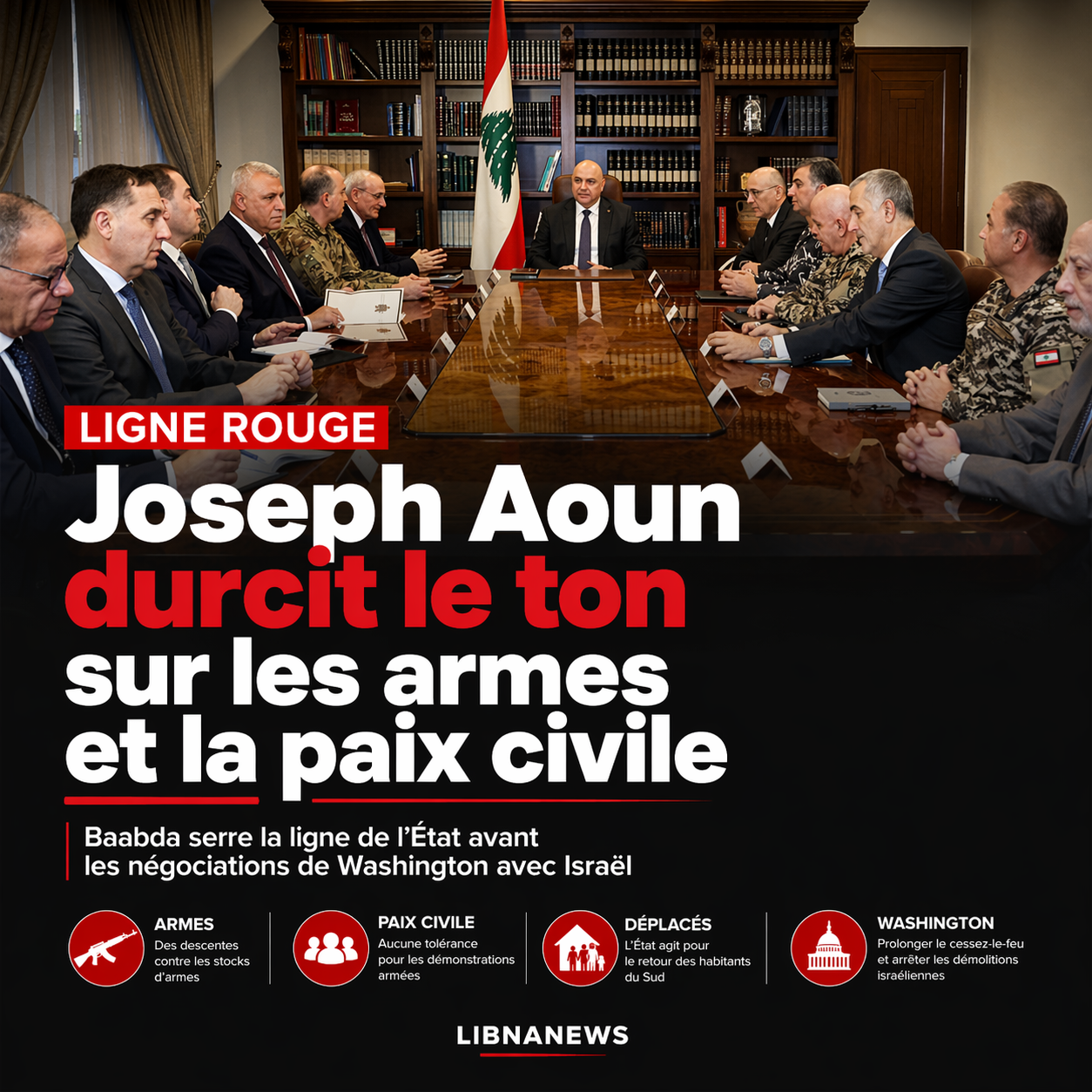
On Wednesday 22 April, President Joseph Aoun chose to speak with one voice on two fronts which in Lebanon cannot be dissociated. The first is inside. It concerns security in the capital, arms control, the return of displaced persons and the prevention of a drift towards the fitna. The second is diplomatic. It aims at the preparatory discussions planned in Washington on the extension of the ceasefire with Israel, the cessation of Israeli demolitions in southern villages and, beyond that, the framework that Beirut intends to defend in the forthcoming negotiations.
In the space of a few hours, Joseph Aoun tightened his tone on internal security while reaffirming his choice of negotiation. In Baabda, he chaired a security meeting with a very clear message: no one will be allowed to obstruct the measures decided by the State, and civil peace is now a red line. Then, before a delegation of the Democratic Rally, he stressed the need for a unified Lebanese position to strengthen the delegation called upon to defend the country’s interests against Israel. Between the two sequences, it is the same logic that appears: to restore the authority of the state inside so as not to get weakened outside.
The moment is not unusual. The ten-day ceasefire achieved under American mediation remains fragile. Mutual accusations of violations have increased since its entry into force. Hezbollah resumed firing north of Israel on Tuesday, in response to what it describes as Israeli violations. Israel, for its part, maintains a military presence in a strip in southern Lebanon and continues to destroy several border localities. In this context, the presidential speech could not remain general. It was to link the security emergency to Beirut, the issue of arms, the return of displaced persons and the diplomatic battle in Washington.
Joseph Aoun wants to take his hand inside
By presiding over a security meeting at Baabda Palace, Joseph Aoun gave clear direction to military and security aircraft. It called for a tougher implementation of the measures decided by the Council of Ministers in Beirut, an increase in the number of staff deployed in the capital as well as in other regions, as well as better coordination between the various departments. The message was not simply technical. It meant that the state now considers the present phase a period of high sensitivity, where any lack of coordination, armed demonstration or delay in the execution of decisions can have a major political effect.
This emphasis on coordination is not insignificant. Lebanon has lived for years in a landscape where security responsibilities can be fragmented, competing or slowed down by political balances. By requesting that the aircraft be complementary and integrated, the Head of State wants to project the image of a functioning decision centre. It is a signal addressed to citizens, displaced persons, parties and foreign partners. A country negotiating under pressure cannot give the impression of a dispersed state apparatus.
The strongest part of his intervention was on weapons. Joseph Aoun called for increased raids on weapons stocks in the light of information provided to the relevant services. He also stressed the prohibition of armed demonstrations, regardless of their origin. This point deserves to be stressed. The President did not limit his message to a particular political or denominational category. He used a broad formula, targeting any party seeking to impose his presence by visible force. In today’s Lebanon, this generality is in itself a political act.
The Head of State knows that the weapons file remains the most flammable point in the country. He therefore did not choose direct rhetorical confrontation with Hezbollah. He opted for a formula of general sovereignty: no stockpile of weapons out of control, no tolerance for armed demonstrations, no damage to internal stability. This method allows him to reaffirm the authority of the State without immediately turning the issue into a face-to-face. This is a difficult balance, but it corresponds to the line followed by the Lebanese authorities for several months: moving towards a gradual restoration of state centrality without causing internal deflagration.
Civil peace as a red line
Perhaps the most important political sentence is this: no one is allowed to obstruct the implementation of security procedures or to undermine stability, since the preservation of civil peace is a red line. This expression is not a slogan of circumstance. In Lebanon of 2026, it reactivates a deep memory. When a president speaks of civil peace as an absolute limit, he speaks to a country haunted by the history of civil war, by community fractures and by the still latent fear of an internal shift.
This fear has regained strength with the war opened on the southern front since 2 March. The massive displacement of populations, the bombings, the cleavages on Hezbollah and the unprecedented discussions with Israel have revived fracture lines that many believed were contained. Several testimonies gathered in recent days by the international press indicate widespread anguish: that of seeing regional tensions turn into domestic conflict in Lebanon. Joseph Aoun’s warning is clearly against this risk. It means that, for power, internal security is not limited to street police or the circulation of weapons. First, it concerns the prevention of a breakdown of the national link.
The President also took care to combine this orderly speech with a tribute to the measures taken on the ground by the army to reopen the roads, repair the bridges and facilitate the return of the displaced to their villages in safer conditions. Again, the choice of words is revealing. It is not enough to talk about prohibition and firmness. It must be shown that the State also acts to reconnect the territory, restore traffic and make possible a gradual return of the inhabitants. In a country marked by the displacement and erosion of infrastructure, reopening a road or repairing a bridge is already an act of sovereignty.
From Beirut to Washington, one battle of credibility
The second sequence of the day illuminates the first. In receiving a delegation from the Democratic Rally, Joseph Aoun did not talk about the next preparatory meeting in Washington. Above all, he has set the political framework within which he wants to include Lebanese diplomacy. In his view, the positions marked by national rationality must be able to accompany the negotiating process which will begin after the ceasefire has been consolidated. This formula is important. It means that the President does not see the negotiation as an isolated episode, but as a path that requires a minimum of internal cohesion.
The core of his message was clear: the Lebanese camp should not leave any internal breach to the Israeli delegation. He therefore called on the Lebanese to react with a form of national unity, in order to strengthen the negotiating team and prevent Israel from exploiting internal divisions to achieve its objectives. This reading corresponds exactly to the situation. Lebanon is approaching the Washington sequence with a state weakened by war, an unstable truce, part of its territory still under Israeli military pressure and a burning internal debate on Hezbollah, weapons and the very form of discussions with Israel.
In this context, the President does not seek to deny the differences. He knows they exist. Nabih Berri expressed his refusal to face-to-face with Israel. Hezbollah is critical of the choice of discussions. Walid Jumblatt, on the other hand, supports a clear agenda focused on Israeli withdrawal. Nawaf Salam tries to defend a negotiating line without tipping into an open confrontation with Hezbollah. Joseph Aoun, in the middle of these positions, tries to produce a minimum coherence: negotiate, but without yielding; speaking, but without any flaw; seeking a sustainable framework, but starting from a long and stable truce.
It was with this in mind that he announced that the Ambassador of Lebanon in Washington, Nada Hamadé Mouawad, would represent Beirut at the preparatory meeting scheduled for Thursday, 23 April in the US State Department. It must impose two immediate requirements: to extend the duration of the ceasefire agreement and to bring Israel’s demolition operations in southern villages and localities to an end. Both requests summarize the Lebanese position of the moment. Before any further negotiations take place, time and the facts on the ground must be stopped.
Refusal to negotiate under demolition
This priority is essential. Lebanon considers that it cannot seriously enter into a new phase of negotiations while Israel continues to demolish homes in the South, maintains its troops in a border strip and forcibly imposes a new territorial landscape. The extension of the ceasefire is therefore not a procedural formality for Beirut. It is a political condition. It aims to prevent negotiations from taking place while the military power ratio continues to change to the detriment of Lebanon.
Joseph Aoun said in very clear terms: Lebanon will not go towards negotiations by granting, trading or abandoning anything other than what fully serves the national sovereignty and interests of all Lebanese. This formula seeks to reassure several audiences at once. She talks to skeptics who see negotiation as a risk of humiliation. She also talks to foreign partners who are looking for a readable State interlocutor. Finally, she spoke to Israel, indicating that Lebanon would not travel to Washington as a country willing to endorse imposed realities.
This rhetorical choice is all the more important as the regional atmosphere remains deeply unstable. The truce with Israel is linked, in the background, to the wider open sequence with Iran and American efforts to compartmentalize the fronts. Washington claims to separate the Lebanese file from the Iranian file. On the ground, however, tensions remain correlated. The incidents on the southern border, the deep Lebanese strikes and the difficulties surrounding the ceasefire show that no scene is completely autonomous. By insisting on Lebanese sovereignty, Joseph Aoun also tries to subtract the country from this logic of a simple annexed front.
Why Joseph Aoun takes on the choice of dialogue
The President is aware of the political cost of his choice. He even explicitly acknowledged it. He said that he had adopted the option of negotiation because past experience had shown that wars produced only death, destruction and displacement. He added that he knew from the outset that this orientation would raise objections, suspicions and accusations. This passage is central. It shows that he no longer seeks to wrap his choice of a blurred language. He assumed that the dialogue with Israel, even in a limited framework, was encountering deep-rooted reflexes in part of the country.
But Joseph Aoun returns the argument. In his view, negotiation is not a sign of weakness. It is the safest choice for Lebanon and for Lebanese, regardless of their membership. This is a way of opposing realism to the overbid. The President does not promise a spectacular diplomatic breakthrough. He simply said that, in the current balance of power, persisting in the logic of war would expose the country to more deaths, destruction and displacement. This speech is addressed as much to Hezbollah as to other political forces, even if it does so without naming them in front of them.
The scope of this positioning must be measured. Since the beginning of the crisis, part of the Lebanese debate has opposed two visions. The first considers that no lasting outcome is possible without leaving the cycle of regional wars and without restoring a centrality in the decision of war and peace. The second considers that Israel only gives way to force and that any negotiation in a moment of imbalance may lead to a gradual surrender. Joseph Aoun clearly placed himself in the first camp, while trying to prove that he did not sacrifice the sovereignty or interests of the South.
His continued contact with Nabih Berri, Nawaf Salam, Walid Jumblatt and several other Lebanese officials is in this direction. The President wants to show that he does not decide alone and that he seeks to surround his efforts with as wide a political coverage as possible. In a fragmented Lebanese system, this method has its limits. It does, however, reduce the perception of a lonely initiative and turn bargaining into collective responsibility.
Political majority against the fitna
Joseph Aoun also insisted on a point that the power clearly considers essential: according to him, the majority of political forces are aware of the gravity of the current phase and stand firmly against the fitna and against any violation of civil peace. Again, the assertion is not annoyed. It aims to produce a climate. The president knows that the rumor of an internal shift can be almost as dangerous as incidents themselves. To say that the main forces reject sedition is to try to loosen a psychological tension that is now going through the country.
This dimension of perception counts enormously. Lebanon is emerging from weeks of bombing, mass displacement, economic pressure and controversy over the choices of the state. In such an atmosphere, any armed incident, any sectarian statement or any unverified flow of information can fuel disproportionate fears. In recalling that national consciousness also has a role to play in preventing the fitna, Joseph Aoun does not only speak to the parties. He speaks to opinion relays, the media, militant networks and a population saturated with tension.
The message of the Head of State can be summed up as follows: security devices must do their part, but society must also prevent the climate from deteriorating in narrative warfare, identity auctions or proximity clashes. In Lebanon today, this articulation between security and national consciousness is not decorative. It corresponds to a reality: public order is not only played in barracks and police stations. It also plays a role in how communities perceive the crisis and represent their interests.
The file of the displaced, at the center of the equation
Another constant of the presidential comments is displacement. Joseph Aoun has taken care to recall that the State takes charge of the internally displaced and works on their return to their villages and localities according to security conditions. He also stressed that the State supports the people of the South who have remained on their land and continues to support them in building resilience. This insistence is not only humanitarian. She’s political.
The return of internally displaced persons is one of the most concrete tests of the credibility of the ceasefire and State authority. As long as roads remain damaged, bridges are to be repaired, Israeli operations continue and security remains precarious, return is partial, hesitant or symbolic. A State that negotiates without being able to guarantee a minimum of conditions of return appears to be weakened. Conversely, every family returning, every road reopened, every village reconnected becomes a visible proof of the power’s ability to transform the truce into a daily reality.
This issue is all the more central as Lebanon has more than 1.2 million internally displaced persons since the beginning of the war in March, according to the officials and institutions following the case. This figure is enormous for a country of this size. It means that humanitarian emergency, logistics, accommodation, reopening of services and minimal reconstruction are not secondary issues. They are now at the very heart of political stability. When Joseph Aoun connects security, civil peace and the return of the displaced, he does not juxtapose subjects. He describes a single battle of national support.
A Presidency seeking to impose a course
What emerges from April 22, is less a spectacular announcement than a desire to set a line. Joseph Aoun does not claim that Lebanon has already regained full control. Nor does he say that the Washington negotiations will soon lead to a lasting outcome. On the other hand, it tries to structure the Lebanese moment around three simple principles: security firmness inside, refusal of the fitna, and uncompromising negotiations on sovereignty.
This line has a virtue. It gives a legible framework at a time when public speech can easily become contradictory. But it also has a cost. It assumes that the State will be able to effectively enforce the announced measures, limit armed demonstrations, control reported stockpiles of weapons, support displaced persons and preserve a minimum of political unity until the Washington sequence. It is precisely on that capacity that Lebanon is expected, inside and outside.
The president is also aware of this when he says that responsibility is common because all Lebanese are in the same boat and that he must be taken to the shore of safety. This final image is not an empty consensus formula. It says something very concrete: in the present state of the country, no authority, not even the Presidency, can claim to be managing such a dense sequence alone. Security, negotiations, internally displaced persons, internal cohesion and the report to Israel are now a single national issue.
That is why the Baabda security meeting and Washington preparations should not be read separately. The first is to show that there is still a State capable of prohibiting, coordinating and repairing. The second objective is to show that the same State has a position, conditions and a red line in the negotiations. Between the two, Joseph Aoun seeks to convince that Lebanon can still speak with one voice, even fragile, at a time when Nada Hamadé Muawad is preparing to bring to Washington the most immediate Lebanese demand: to prolong the ceasefire, to stop Israeli demolitions and finally to create a space for negotiation does not mean suffering.




