

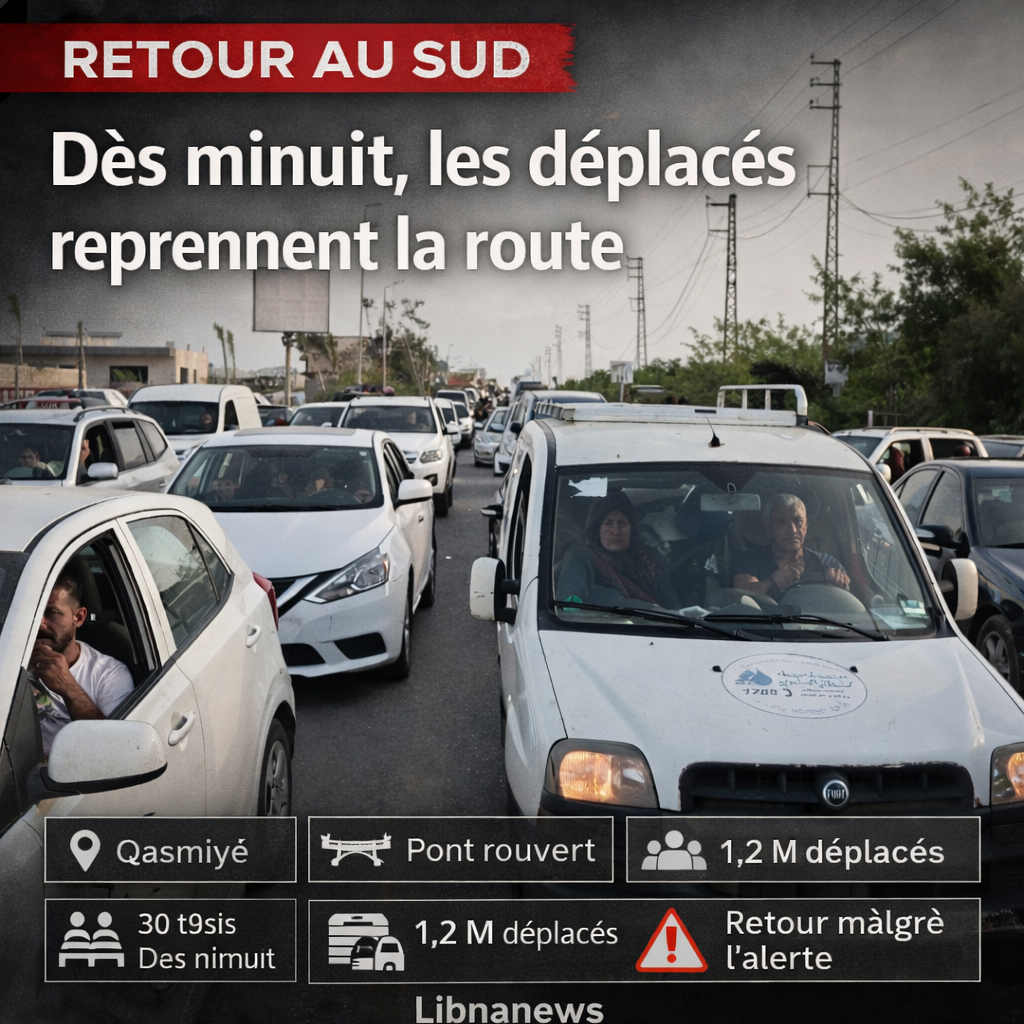
Upon the entry into force of the cease-fire at midnight Lebanese time, the movement for the return of displaced persons began in Lebanon. Despite calls for caution by the authorities, families returned to their villages in the south in the very first hours of the day. The most visible sign of this return was observed on the Qasmiyé axis, where a massive traffic jam formed around the partially reopened bridge. Behind these lines of cars, it is all the human history of this war that reappears: at least 1.2 million displaced according to recent UN estimates, more than 2,000 dead and more than 7,000 injured, saturated accommodation centres, and a population that tries to return even before peace is fully guaranteed.
The return started before daybreak
The central point of this morning is not only the truce itself. This is the speed at which some of the displaced wanted to turn the diplomatic announcement into a concrete gesture. As soon as the cease-fire came into effect, families began to prepare, load their cars and resume the road to the South.
In a country where internal exile has affected almost every region since the beginning of the war, this movement had nothing to say. He saw himself on the axes, at the crossing points, in the lines of vehicles and in the immediate pressure exerted on the infrastructure still standing.
This return was not born with an official slogan encouraging the inhabitants to return without delay. On the contrary. The Lebanese authorities have multiplied the calls for detention. The army asked the inhabitants to postpone their return to the villages and localities in the South, due to the reported violations in the early hours of the truce and the persistent risks on the ground.
Other officials adopted the same tone, reminding that security had to pass before the emotional momentum of return. But the movement was stronger than the instructions. After weeks of bombing, destruction and wandering, the cease-fire caused an immediate reflex.
In the minds of many displaced persons, it was not just a matter of taking over a dwelling. It was about checking what was left of it. Incoming, under these conditions, often means something other than going home. This means returning to a neighborhood, a street, a building, a field, a shop or a school whose exact state is still unknown.
The return of internally displaced persons to Lebanon on this first morning was therefore both collective and deeply intimate. Collective, because the roads filled very quickly. Intimate, because each vehicle had a different story: a family that wants to find its home, a father who wants to see if the workshop still holds, a mother who seeks to measure the damage, relatives who come back to recover papers, clothes, medicines, or simply see from their eyes.
Qasmiyé, the bottleneck of return
The place that best symbolizes this morning is undoubtedly Qasmiyé. According to official dispatches published in the morning, the Qasmiyé bridge, partially reopened after rehabilitation work, has been the scene of a massive traffic jam since midnight.
Army elements were deployed there to organize traffic. Other military equipment worked in the area to fill holes around the bridge, widen the passage and facilitate the return of displaced persons to their villages.
This logistical detail alone summarizes the situation in the country. The return is not on a normal road. It is done through a work partially destroyed, repaired in emergency, still crowded, still fragile, and already saturated by the flow of cars.
The return movement therefore does not require intact infrastructure. It is carried out through an injured territory, where the war continues to weigh into the simplest act: crossing a bridge.
Qasmiyé is not a secondary place. The day before, this bridge was already a vital issue since it was one of the last links between Tyre and Saida, thus between the South and the rest of the country. The fact that it becomes, as early as midnight, the main point of traffic congestion of the return of displaced persons has an almost emblematic value.
It shows that the truce did not open a fluid space, but a narrow passage, repaired in haste, under military control and immediately submerged by the cars. In that morning, the return of displaced persons to Lebanon took the form of a funnel. Many wanted to go home. Few ways were really feasible.
Traffic was concentrated where a passage remained possible. This explains the rapid formation of major congestion around Qasmiye. The bridge was not a simple axis among others. It has been the physical materialization of a country that tries to return to itself by too narrow an opening.
The fact that the army had to organize both traffic and widen the passage gives the measure of urgency. The return of the families preceded the full restoration of the land. In other words, the state did not first reopen perfectly safe roads and then allow a return. He had to manage in real time the popular pressure of an already launched movement.
A stronger return than warnings
The first lesson of this morning is this paradox. The more cautious the authorities called for, the more immediate the desire to return seemed. This gap is not difficult to understand. Prolonged displacement quickly uses a population.
The collective centres, the schools transformed into shelters, the makeshift housing of relatives, the rooms rented at high prices, the uncertain journeys and the daily waiting end up producing a fatigue that turns the slightest signal of acclaim into a departure.
The war has displaced an out-of-standard human mass in Lebanon. Recent humanitarian estimates converge on an order of magnitude greater than one million people. UN assessments published in recent days raise the threshold of at least 1.2 million internally displaced persons, including more than 140,000 in collective centres.
For its part, the International Organization for Migration mentions more than one million people uprooted by the conflict and more than 141,000 still present in collective structures on the eve of the truce. These figures say a lot. They first show that the displacement has gone beyond border villages. It has touched an immense part of the country.
They then show that the return, when it begins, cannot be marginal. Even a partial movement immediately produces visible effects on roads, bridges, gas stations, transit cities and security services.
Finally, they show a deeper political reality. When more than one million people were thrown on the roads in a few weeks, the ceasefire becomes not only a diplomatic event. It becomes a question of human geography.
The first test of an agreement is no longer just stopping the strikes. It is also the way the displaced respond. In this particular case, they reacted immediately. The return therefore began before all guarantees existed.
This decision, taken at the level of families more than at the level of institutions, says the power of the accumulated uprooting. In a country already exhausted by the economic crisis, displacement is not just a spatial displacement. It’s a social fall. Leaving your village or neighbourhood is often a loss of both a roof, income, family anchor and a daily relationship.
Back, even in the midst of the ruins, becomes a necessity more than a choice.
The human weight of war behind car lines
The road to return cannot be understood without recalling the human cost of war. According to the latest cumulative report from the Ministry of Public Health’s Emergency Health Operations Centre and relayed this morning by an official news agency, the attacks recorded since 2 March resulted in 2,196 deaths and 7,185 injuries until and including 16 April.
These figures serve as an indispensable context here. They explain why the return is both so desired and so feared. Every car that takes the road to the South carries more than one family. It also carries the shadow of these balances.
In many cases, returning does not mean finding an intact place. This means returning to an area where neighbours were killed, relatives were injured, buildings collapsed, roads were cut, first aid workers worked under fire, and entire neighbourhoods changed their faces.
The number of wounded adds another dimension to this morning. Over 7,000 injured means thousands of broken or suspended trajectories. This means families who cannot come back together because a parent is still hospitalized, because a child has to continue to care, because an injury prohibits travel or because a family member is missing.
The return of internally displaced persons to Lebanon cannot therefore be reduced to an image of cars on a road. It’s also a grieving scene. mourning of the dead, mourning of destroyed houses, mourning of the ordinary life interrupted. Many families return with the hope of getting back on their feet. But this hope arrives in spaces where losses are already inscribed in the landscape.
This also explains the emotional strength of a traffic jam like Qasmiyé’s. In other circumstances, a stopper is merely an inconvenience. Here it becomes the visible sign of an injured country trying to reconstruct itself. The slowness of cars says both the impatience of return and the material state of destruction left by war.
From accommodation centres to the South Road
The movement observed since midnight does not leave anywhere. Since the beginning of the war, tens of thousands of internally displaced persons have been accommodated in collective centres, including schools, public buildings, emergency facilities and improvised structures. Others were accommodated by relatives in overcrowded apartments, loaned premises, or makeshift solutions.
On the eve of the cease-fire, collective structures were still under heavy pressure. Recent humanitarian figures indicate that more than 140,000 people were still there. This means that the first morning of truce did not only trigger a return movement from private housing. It also affected the entire ecosystem of emergency accommodation.
The return thus puts two opposite realities in tension. On the one hand, reception centres are a vital net for those who have nothing left. On the other hand, they embody a suspended, precarious and temporary life. As soon as a window opens, even if fragile, many families seek to extract it.
This is not necessarily because the return conditions are good. This is often because waiting conditions have become too heavy. In this context, the morning of April 17 cannot be read as a simple change of traffic on some roads in the South.
It potentially marks the beginning of a wider shift, that of a gradual shift from the emergency reception phase to a phase of partial, fragmented, uneven and often risky returns. The term of return should also be handled with caution.
For some, it means returning to a house that is still habitable. For others, it means accessing a destroyed area, then leaving immediately. For others, it means going back and forth during the day to measure the damage before deciding whether a relocation is possible. This morning, the roads saw traffic not only one category of return, but several forms of return superimposed.
Why the focus should stay on the return
In the cover of the truce, it is tempting to focus all attention on violations, diplomatic declarations or regional calculations. They’re important. But the most immediate reality this morning is also played elsewhere: in the behaviour of the displaced. It is their movement that gives the truce its first visible translation.
The return of internally displaced persons to Lebanon is the first social test of the ceasefire. If families remain massively motionless, this means that the truce has not yet convinced. If they resume the road despite warnings, it means that a part of society wants to force the transition from war to post-war, even without full guarantees.
That’s exactly what seems to have happened since midnight. The road signs, the lines around Qasmiyé, the enlargement work, the military management of traffic and the political messages welcoming the inhabitants who are returning to their villages all show the same: the ceasefire immediately triggered a return movement, even partial, even cautious, even uncertain.
This point is central because he commits the next. If the truce holds, this movement could grow very quickly. If it fluctuates, these same roads could become those of a new exodus. Return is therefore not only a human fact. It is also an indicator of the real strength of the agreement.
For the moment, the symbol remains that of a country that returns even before receiving full and complete permission to believe in calm. The authorities are asking to wait. Families are still moving forward. The roads are not ready. They still fill themselves. Bridges are fragile. Yet they become vital crossing points. All morning stands in this contradiction.
A country that returns to destroyed roads
Qasmiyé’s scene finally illuminates a deeper dimension of the moment. Lebanon does not return from a war with intact infrastructure and a rested state. He returned with closed roads, damaged bridges, requested first aid workers, housing centres still full, human balances that continued to grow, and an army forced to manage security, traffic and damage at the same time.
The return of displaced persons to Lebanon therefore begins in a landscape of permanent urgency. This makes it both an event of hope and a brutal revealing of the fragility of the country. Hope is seen in the stubbornness of families to return to the South. The fragility is seen in the fact that this hope must be expressed through a bridge repaired in haste, in the middle of a massive traffic jam and under the persistent shadow of a still contested truce.
At 10 a.m. this morning, the heart of history is not only that displaced people return. It is because they are already returning, when the security conditions are not fully stabilized, the infrastructure remains damaged, and the main crossing point documented by official dispatches is already saturated.
This return says both the fatigue of an displaced people, the strength of attachment to the places left, and the weakness of a ceasefire framework that has not yet succeeded in providing a simple path to home.




