

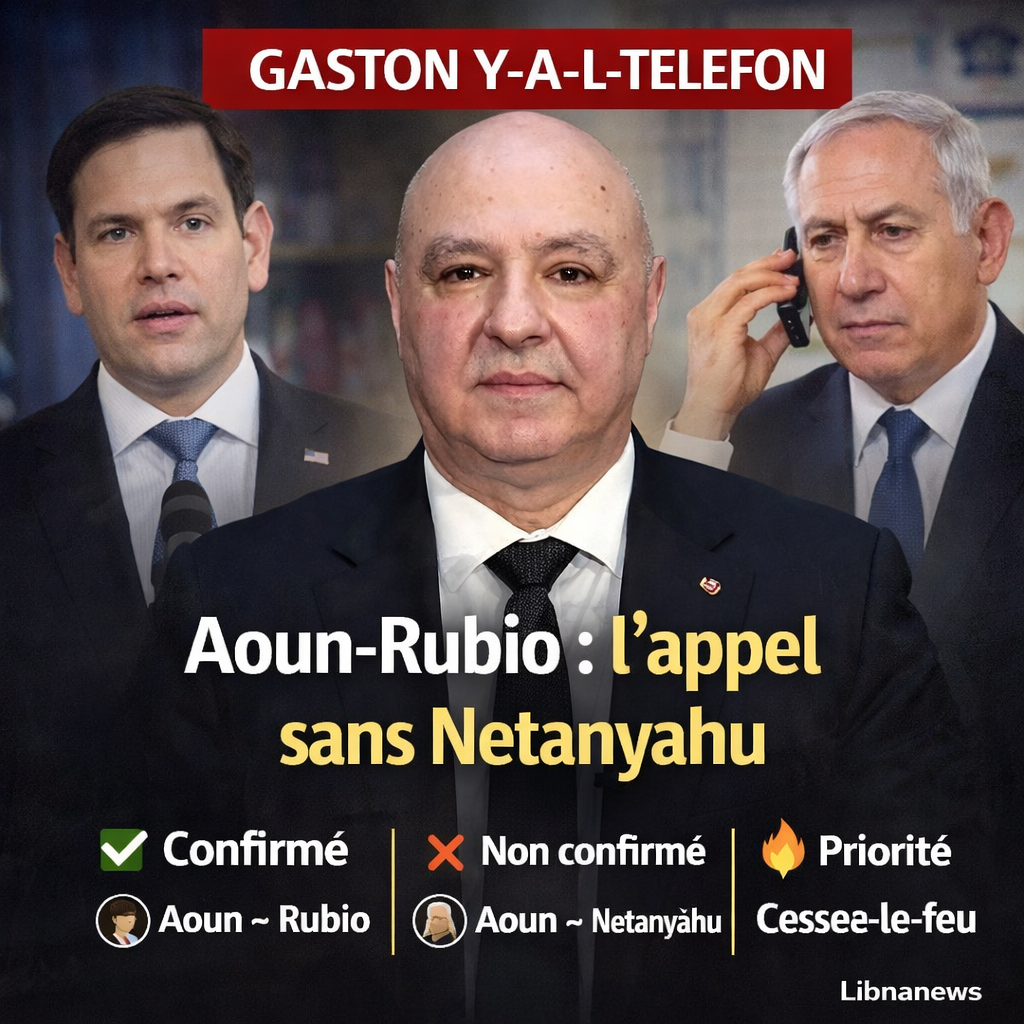
In Lebanon, diplomacy often advances through denials rather than announcements. Thursday’s Aoun-Rubio sequence offers a new illustration. What has been officially confirmed is a telephone exchange between Lebanese President Joseph Aoun and US Secretary of State Marco Rubio. What has not been confirmed, on the other hand, is the more spectacular scenario mentioned by Donald Trump, who said that Lebanese and Israeli leaders would talk to each other during the day. Between the two versions, the gap is political. He says a lot about how Washington is trying to stage a regional dynamic and how Beirut is trying to control its pace, vocabulary and scope.
The starting point is simple. The Lebanese presidency announced that Joseph Aoun had received a call from Marco Rubio and that he had thanked Washington for his efforts towards a ceasefire with Israel. The wording is sober. It remains focused on the Lebanese priority of the moment: to stop the strikes, to alleviate the military pressure on the South, to create a useful diplomatic opening and to avoid the country being dragged further into a regional sequence that it does not control. This communiqué does not refer to a direct exchange with Benjamin Netanyahu, a three-party appeal, or a historic breakthrough between the two Heads of State or Government.
It was precisely this silence that attracted attention. A few hours earlier, Donald Trump had suggested that direct contact between Israeli and Lebanese leaders was expected. In Israel, a minister of the security cabinet had even told the radio that Benjamin Netanyahu should speak to the Lebanese President. But on the Beirut side, the official line remained quite different. A Lebanese official said that there was no information on such a call, while the presidential report was limited to the conversation with Rubio. Officially, the only conversation recognized at this stage is therefore that between Joseph Aoun and the head of American diplomacy, without Lebanese validation by a third party.
The first teaching of this sequence is institutional. In Lebanon, when the Presidency publishes such a precise account of a conversation with Washington and does not add anything about Israel, this omission is not neutral. It means that no contact with Benjamin Netanyahu has been politically validated or deemed appropriate to announce. In the Lebanese system, especially in times of war, the lack of mention sometimes counts as much as the mention itself. If Joseph Aoun had wanted to endorse the idea of a direct exchange with the Israeli Prime Minister, the presidency could have done so, if only indirectly. She didn’t.
Aoun-Rubio: a confirmed call, no more
This caution is consistent with Baabda’s logic for several days. The Head of State reiterates that the cease-fire must be the natural entry into any direct negotiations with Israel. The formula is important. It means that official Lebanon now accepts the idea of a diplomatic channel, but provided that it is preceded by a cessation of hostilities. It’s not just a semantic nuance. It is a political line designed to contain both American pressure, Israeli demands and internal objections, including those of Hezbollah and its allies. In such a context, a direct Aoun-Netanyahu call announced from Washington or Jerusalem even before a ceasefire appeared to be a risky acceleration.
The second is more diplomatic. The gap between Trump’s words and Lebanese communication shows that there is not yet a common story about the real state of contacts. Washington wants a dynamic. Lebanon wants to avoid the sudden. Israel seeks to politically value the idea of a contact at the top, because it accredits the story of a historic opening torn up under military pressure. Beirut, on the other hand, obviously refuses to endorse this story until the framework is stabilized. This does not mean that no channel exists. This means that the Lebanese power does not want to be seen as entering into a sequence of normalization or political dialogue with Israel at the very moment when the bombings continue.
In this context, the strongest information remains negative: officially, Joseph Aoun did not speak to Benjamin Netanyahu. The rest is either American announcements, Israeli comments, or diplomatic expectations that are still floating. This asymmetry suffices to make the episode a case of a school of contemporary diplomacy in the Middle East: the same moment produces several competing narratives, each adapted to a different audience.
Why Beirut refuses to go too fast
Lebanese restraint is not only due to protocol prudence. It responds to a very heavy political constraint. In Lebanon, a direct appeal between the President of the Republic and the Israeli Prime Minister would not be seen as a mere technical gesture. It would be read as a major signal, loaded with internal consequences. The country remains officially in a state of war with Israel. Recent discussions in Washington have already generated strong criticism, particularly from Hezbollah, which sees it as a political capitulation and a shift towards normalization imposed under bombs. In this climate, direct contact at the unprepared top, or only announced by others, would immediately revive internal fractures.
Joseph Aoun knows that. He also knows that his presidential authority, if strengthened since his arrival in Baabda, is not enough to neutralize the symbolic burden of such a gesture. The President has institutional legitimacy, an image of sobriety and real international support, notably from the United States and several European capitals. But it governs a fragmented country, where Israel’s question continues to cross all political, religious and regional sensitivities. Control of the timetable is therefore essential. It’s not just a matter of communication. It is a condition of political survival.
Beirut’s prudence also responds to a strategic calculation. Official Lebanon seeks to have a position of principle recognized: it does not enter into direct talks with Israel as if it were an ordinary issue. It does so under the compulsion of war, with an immediate objective of ceasefire, Israeli withdrawal and the return of internally displaced persons. If he suggested that an Aoun-Netanyahu call could be held naturally, without a clear preliminary step, this line would be weakened. Lebanon would then appear to be engaged in a broader, more political, perhaps even more sustainable process, while the State is trying to limit the current openness to a logic of security de-escalation.
A more concrete element must be added to this. On the ground, there is no indication at this stage of a shift towards appeasement. Fighting continues in southern Lebanon. Israel continues to affirm that it wants a lasting change in the military configuration south of the Litani. Hezbollah does not recognize the ongoing talks and has not given any sign of support for a negotiated dynamic. In these circumstances, formalizing a call between Aoun and Netanyahu without any apparent counterpart on the ground would have exposed Baabda to a simple criticism: to discuss at the summit while the war continues.
Washington seeks success, Lebanon seeks framework
The divergence between Trump’s announcement and Lebanese communication also says something about the American method. Donald Trump, since his return to power, also governs by narrative. He seeks to produce visible sequences, striking gestures, unblocking images. An appeal between Israeli and Lebanese leaders, for the first time in decades, would be exactly the type of scene he likes to value: spectacular, unexpected, personalized. It does not matter, therefore, whether the framework is still fragile or whether local political conditions are not met. The essential is to create the impression of a movement.
Marco Rubio, for his part, works in a more classical register, but the objective is not very different. The head of US diplomacy wants to show that the United States has reopened a channel that has not existed for years between Beirut and Israel. It also wants to consolidate the idea that Washington remains the indispensable player in any exit from the crisis in Lebanon, including as Pakistan tries to play a role in the Iran-American talks and Tehran re-insists to include Lebanon in any regional ceasefire logic. In this perspective, each contact counts. Even a Rubio-Aoun call can be presented as a step towards a wider process.
Lebanon does not have exactly the same interest. Beirut is not trying to sell a picture of diplomatic breakthrough. He first seeks to contain war. The Lebanese power needs the United States because they are the only ones who can talk to Israel with a minimum of leverage. But he doesn’t want to be absorbed by American dramaturgy. This difference explains the difference in tone. Trump talks about an event. Aoun talks about a ceasefire. Rubio wants to create a process. Baabda wants to prevent this process from escaping politically.
That is why the confirmed call between Joseph Aoun and Marco Rubio is important, but in a narrower sense than that suggested by Washington. It does not prove that a Lebanese-Israeli summit is in immediate preparation. Above all, it proves that the US administration continues to push Beirut to move forward on the path of contacts, while accepting that the Lebanese presidency is keeping control of what it formalizes or not.
Netanyahu, great official absentee
In all this sequence, Benjamin Netanyahu’s name occupies a paradoxical place. It is at the centre of American and Israeli announcements, but absent from the only Lebanese official report published on the day. This absence is politically heavy. It means that, from Baabda’s point of view, there is no need at this stage to include Netanyahu in the officially recognized conversation. The message is clear: the Lebanese Presidency admits a dialogue with Washington, not a validated contact with the Israeli head of government.
This line doesn’t just say something about Lebanon. She also says something about Netanyahu. For the Israeli Prime Minister, the idea of an appeal with Joseph Aoun would have had an obvious political benefit. It would have shown the Israeli public that Israel is not only conducting a military campaign, but also imposing a diplomatic reconfiguration in Lebanon. It would have reinforced the story of a weakened Hezbollah, a Lebanese state pushed to negotiate and a north front on the road to progressive normalization. That such a call was not confirmed by Beirut therefore deprives Jerusalem of a significant symbolic gain.
This also sheds light on the reasons for the overbidding in the Israeli communication. On several occasions Israeli officials have sought to present the open discussions in Washington as the beginning of a historic change. For Israel, the challenge is not just to talk in Lebanon. It is to transform these contacts into a political validation of its strategy, which combines military pressure, the demand for Hezbollah disarmament and the search for a direct relationship with the Lebanese State. Joseph Aoun’s refusal, or at least his reluctance, to formalize an exchange with Netanyahu shows that this strategy is still limited: Lebanon is ready to explore a diplomatic path, but it refuses to endorse Israel’s dramaturgy too quickly.
What the episode reveals
Finally, the case goes beyond the content of the appeal. It reveals the real state of the Lebanese scene. On the one hand, the state wants to exist. He wants to show that he speaks in Washington, that he can defend a ceasefire agenda, that he is not silenced by war or by non-State armed actors. On the other hand, he knows he can’t go too fast. He knows that a poorly calibrated step on Israel can immediately turn into an internal crisis. The Lebanese power is therefore in a classic but difficult position: it must give signs of initiative without crossing the symbolic thresholds that the political system is not ready to absorb.
This tension is visible throughout Joseph Aoun’s communication since the beginning of the sequence. The President supports diplomatic efforts. It welcomes the American action when it seeks a ceasefire. He states that this truce must be the natural entry into direct negotiations. But he doesn’t want to validate the fast stories of a historical conversation at the top. This consistency should be noted. It shows that Baabda does not say no to diplomacy, but she still wants to choose form, time and language.
In a hollow, the episode also highlights the fragility of the presidential mandate in a time of war. Joseph Aoun is not powerless. He speaks to the Americans, Europeans, the British, and seeks to make a state pole exist. But its margin remains limited by three constraints: the continuation of Israeli operations, Hezbollah’s refusal to enter into this logic, and the American tendency to accelerate the scene faster than the Lebanese system can digest it. It is in this triangulation that the call to Rubio is recorded.
The result is clear. At the end of this day, the political fact is not that a Lebanese president spoke in Netanyahu. The political fact is exactly the opposite: despite the American and Israeli announcements, Beirut’s only conversation was between Joseph Aoun and Marco Rubio. The rest is still in the field of pressures, intentions, leaks or tested scenarios. And in the current sequence, this distinction already suffices to redraw the hierarchy of narratives.




