

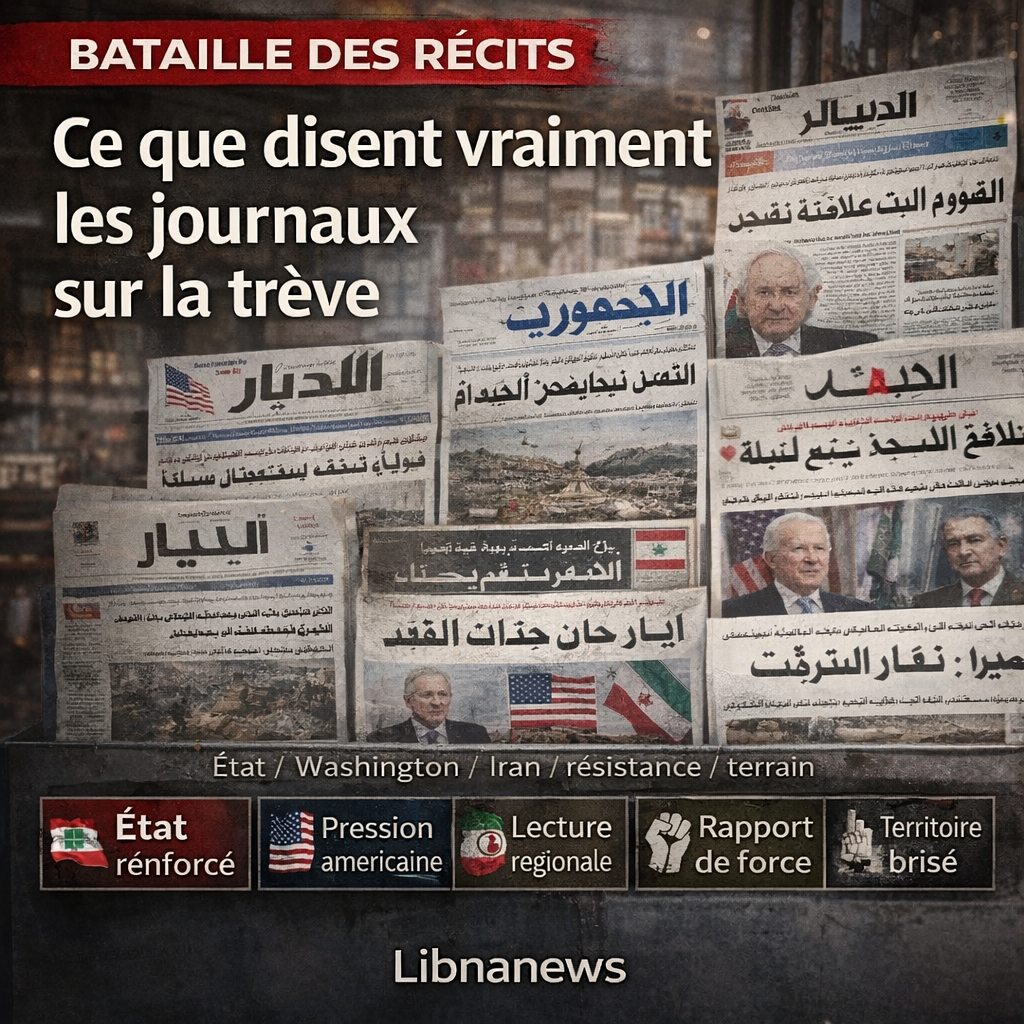
One event, several stories
The announcement of the 10-day ceasefire between Lebanon and Israel produced an immediate impression of clarity. In appearance, the fact is simple: fighting must stop, a diplomatic window opens, and Washington presents itself as the central actor of this de-escalation. However, as soon as newspapers of the day are read, this apparent simplicity cracks. The agreement does not mean the same according to the wording. It does not have the same origin, not the same scope, not the same guarantees, and especially not the same political consequences according to the view adopted.
Some titles present it as a rare opportunity to place the Lebanese state at the centre of the game. Others describe it as a tactical pause without real depth. Still others see it primarily as a by-product of the Washington-Theran discussions, or a temporary arrangement exposed to an immediate return of violence. This contrast is not secondary. He says a lot about the nature of the moment. There is no single media truth about the truce. There is a battle of framing, and this battle begins in the early hours.
Reading newspapers together thus helps to better understand what is really being played. The ceasefire is not just a military fact. It’s a disputed political object. It serves to say what the Lebanese state is today, what Washington wants, what Tehran is looking for, what a part of the region fears, and what every inner camp wants to do with the sequence.
For Al Joumhouriyat, the truce enshrines a return to politics and strengthens the presidency
In Al Joumhouriyat, the truce is read as a moment of institutional consolidation. The newspaper insists that the essential thing is not only the cessation of the fighting, but the place occupied by the Lebanese presidency in the exchanges that preceded the announcement. The tone is clear: Lebanon would no longer be just a land on which others decide. He would, at least in part, become a recognized political player in the production of crisis exit.
This reading gives a special weight to Joseph Aoun. The newspaper presents the president as one who tries to move the file from the military field alone to that of state legitimacy. In this vision, the ceasefire is not just a technical stop to the fire. It is becoming the beginning of a take-over by the institutions, and more precisely by the Presidency. Even the idea of future negotiations is being addressed in this context. This would not be an improvised leap towards normalisation, but a controlled transition to a discussion that would be put back into state forms.
This editorial choice is important because it makes the truce a credibility test for Lebanese authority. If the sequence holds, the Presidency can say that it has managed to bring the conflict back into the political realm. If it fails, it is all this promise of state refocusing that will be weakened. Al Joumhouriyat does not deny the risks, but he chooses to see 17 April as a moment of institutional affirmation before being a mere diplomatic episode.
For Ad Diyar, the truce opens up a time of dangerous questions
Ad Diyar takes a more worried look, almost immediately suspicious. The paper does not treat truce as an acquis. He presents it as entering an even more risky phase, because it moves the conflict without solving it. In this reading, the suspension of hostilities does not mark the exit of a danger. Instead, it opens up a time for tougher, more sensitive and more explosive questions for Lebanon.
The first point raised concerns the refusal of direct contact between Joseph Aoun and Benjamin Netanyahu. Where others see it as evidence of institutional firmness, Ad Diyar reads above all the evidence of an American attempt to push Lebanon towards premature political scenography. The newspaper insists on the pressure to obtain an image of direct dialogue, and on the Lebanese president’s refusal. The truce thus appears as a ground of struggle on the very form of the sequence: stop fighting, yes; Forcible symbolic tipping, no.
But the newspaper look goes further. It links the ceasefire to a confrontation of regional trajectories. Lebanon, according to this reading, would enter an area of high tension between several attempts at alignment. On one side, American pressure. On the other hand, the weight of Iran and the reactions of several regional actors. The truce is therefore not seen as a stabilizing compromise. It is described as a narrow crossing line between several risks. Where Al Joumhouriyat sees an opportunity for the state, Ad Diyar first sees a mined field.
For Asharq Al-Awsat, the truce is part of a larger regional chessboard
Asharq Al-Awsat takes a broader, more geopolitical look. The newspaper does not deny the importance of the ceasefire on the Lebanese level, but it immediately introduces into a regional environment dominated by discussions between Washington and Tehran, the role of Pakistan, and the repositioning of powers involved in the region. Lebanon, in this reading, is not isolated. It is a piece of a larger game.
The newspaper also highlights the fact that Washington wants to give the truce a political extension, notably by evoking a possible meeting between Joseph Aoun and Benjamin Netanyahu. At the same time, he pointed out that Iran remained wary of American intentions, even when the channels of discussion remained open. The truce is thus read both as an American initiative and as an episode embedded in a broader regional negotiation, which no one is yet in control of the outcome.
Another aspect of this is the issue of arms and state authority. The newspaper also reports a Saudi reading that the cessation of fighting must be accompanied by a reaffirmation of the state monopoly of force. This gives the truce an additional meaning. It is not just an immediate security issue. It also becomes, in some regional speeches, an opportunity to put on the table the future architecture of Lebanese sovereignty.
For Al Quds Al Arabi, the agreement exists, but its scope remains contested
Al Quds Al Arabi adopts a more descriptive line in form, but very attentive to the underlying tensions. The newspaper treats the truce as a real fact, with a clearly announced date, duration and public framework. But it immediately shows that this agreement is not politically homogeneous. One of the most significant points is the fact that Hezbollah is presented as respecting the ceasefire while refusing the idea that Israel would have, during this period, freedom of action against it.
This precision changes a lot. It shows that the truce is not interpreted as a unilateral suspension of response capabilities. It is accepted as a framework for de-escalation, but on a disputed basis. The chord is therefore real, but its meaning is not locked. Each party is already trying to fix its own reading.
Al Quds Al Arabi also restores very well the simultaneously fragile and decisive character of the sequence. On one side, there is the official announcement and the American story. On the other hand, there are the reserves, the limits, the red lines and the anger of some Israeli circles. This tension gives the newspaper an intermediate position. He does not celebrate the truce as a historical advance. Nor does he reduce it to a pure illusion. Rather, it shows that it exists in an active state of protest.
The truce is useful for Al Liwa
Al Liwa The newspaper takes note of the announcement, highlights the central role of American contacts and reports favourably on the reaction of Nawaf Salam, who presents the ceasefire as a Lebanese priority. But this recognition is accompanied by a very clear warning: the agreement is far from secure. He remains exposed to risks, possible repeated hostilities, and to all the ambiguities of a text that suspends without resolution.
This caution is indicative of a realistic political reading. Al Liwa It does not minimize the importance of the sequence. But he refuses to present it as a consolidated turning point. In this approach, the central question is not only that of advertising. This is the ability to hold in time. The truce is valid by its real mechanisms, not by its mere communication effect.
This is also what makes the journal interesting in comparison. Where some titles favour the battle of geopolitical or institutional narratives, Al Liwa As long as this response remains uncertain, the ceasefire remains a useful but unstable object.
For Al Akhbar, the truce first validates a ratio of force imposed by the resistance
Al Akhbar offers a much more combative framing. Where other newspapers insist on American mediation, the return of the state or the fragility of the balance, Al Akhbar reads the sequence as a demonstration of the American and Israeli retreat against the cost of confrontation. The ceasefire is not presented as a pardon granted to Lebanon or as a victory for conventional diplomacy. It is interpreted as the product of a balance of power which eventually imposed a pause on the opponent.
In this vision, the refusal of direct contact with Benjamin Netanyahu is not a matter of diplomatic subtlety. It is a normal minimum for an assaulted State. The truce does not first open a debate on negotiation for this newspaper. Above all, it confirms that the war did not allow Israel to impose its political will on Lebanon. The stake is important because it completely reverses the order of the story. It would not be mediation that produces the suspension of the fighting. It would be resistance that forces the mediations to align with a reality that they do not control entirely.
This reading has a direct effect on the post-treve. It makes any attempt to use the cease-fire as an immediate lever to reopen the issue of weapons or Hezbollah’s place much more difficult. For Al Akhbar, the sequence does not justify a rapid recentralization of sovereignty around the state alone. First, the effectiveness of the balance of power that made the break possible is enshrined.
For Al 3arabi Al Jadid, the truce remains inseparable from the human and territorial cost of war
Al 3arabi Al Jadid reads the sequence from the field. The newspaper does not stop at the only diplomatic announcement. It recalls that the truce comes after very intense fighting, the destruction of essential infrastructure and the isolation of a part of the South. This scoping profoundly changes the perception of the agreement. The question is no longer just what has been announced. It becomes: in what social, territorial and human state does this agreement enter into force?
This approach is valuable because it reintroduces the materiality of war in a moment dominated by political discourse. A ceasefire is not only valid in the text that proclaims it. It is also worth the territory he leaves behind. If bridges are destroyed, if villages are isolated, if people cannot return sustainably, then the truce remains suspended from its ability to produce concrete effects. Al 3arabi Al Jadid does not dispute the diplomatic importance of the moment, but he refuses that it covers the social reality of the country.
In this reading, the truce has a profoundly conditional value. It is not judged solely on its sponsors, communiqués or possible political extensions. It is also about its ability to reopen the space of daily life, traffic, return and repair.
What this diversity of stories really says about the agreement
Comparing these newspapers reveals a simple reality: there is not a dominant narrative of the ceasefire, but several superimposed regimes of interpretation. For Al Jumhouriyat, the truce can strengthen the state. For Ad Diyar, it opens an area of great political danger. For Asharq Al-Awsat, it is only regionally understood. For Al Quds Al Arabi, it exists but remains contested in its scope. It is useful but precarious for Al Liwa. For Al Akhbar, it first devotes a ratio of force imposed by resistance. For Al 3arabi Al Jadid, it remains inseparable from the broken territory on which it applies.
This dispersion is not a read-out defect. It is the sign that the agreement itself is incomplete. The clearer a ceasefire is, the more the narratives converge on its nature, its guarantees and its meaning. Here, the stories diverge because the political text of the moment remains open. The cessation of fighting is announced, but its real architecture is not stabilized. Its interpretation is therefore already part of the balance of power.
This is probably the clearest lesson of this cross-press review. The truce of 17 April is not only a diplomatic event. He’s a teller. It reveals how every press stream reads Lebanon today: as a state trying to return, as a land disputed by regional powers, as a space of resistance, as a country suspended from guarantees still lacking, or as a territory socially and materially bruised. What the newspapers really say, basically, is that the deal exists. But his political truth remains to be conquered.
References
Journals of the corpus of 17 April 2026: Al Jumhouriyat, Ad Diyar, Asharq Al-Awsat, Al Quds Al Arabi, Al Liwa




