

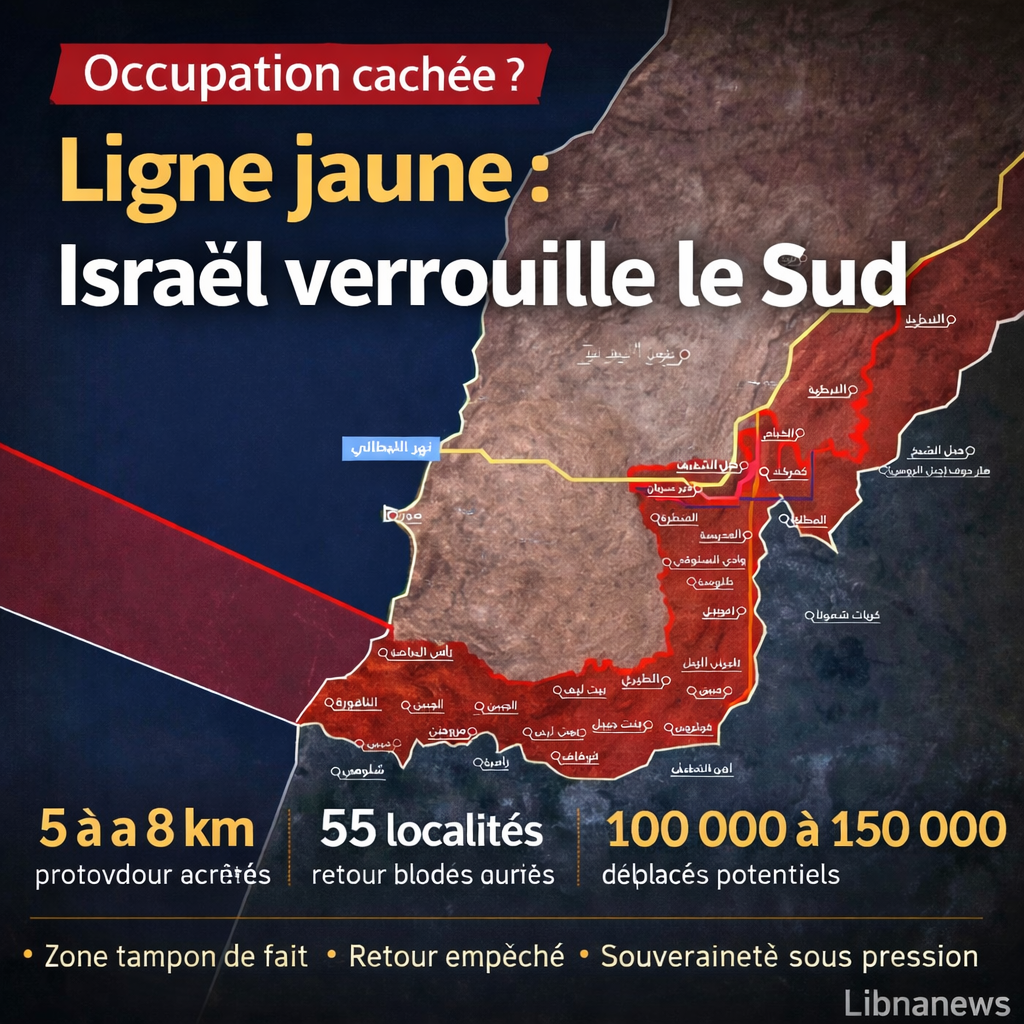
The yellow line Israel claims to have established in southern Lebanon is neither a recognized border nor a boundary resulting from an agreement between Beirut and Tel Aviv. It is a unilateral military line, imposed inside Lebanese territory, which the Israeli army presents as an advanced line of defence designed to prevent a direct threat against northern Israeli localities. On the ground, this yellow line is mainly used to sanctify a band conquered during the ground offensive, to maintain troops there, to restrict the return of the inhabitants and to preserve freedom of fire against any movement deemed suspicious.
The yellow line therefore changes the very nature of the ceasefire which entered into force on 16 April. In theory, the truce had to open a sequence of de-escalation, allow a gradual return of the displaced and create a negotiating space. In practice, Israel is trying to turn its military gains into a lasting achievement. The debate is no longer just that of stopping the fire. It now deals with a more serious issue: which will decide, in southern Lebanon, the civilian life, the return of the inhabitants, the reconstruction and control of the territory.
What the yellow line is
The yellow line has no international legal status. It does not replace the Blue Line, the recognized border or the framework of resolution 1701. It corresponds to a security zone decided by Israel alone, along the lines already used in Gaza. In the Israeli communication, this band must prevent the approach of fighters, weapons or teams that may threaten the cities of northern Israel. In military reality, it defines a space where the Israeli army considers that it can still manoeuvre, strike, demolish and prohibit the normal return of civilians.
The depth of this line is not uniform. In several sectors, it seems to follow a logic of relief, road control, height domination and valley monitoring. The available assessments place it globally between five and eight kilometres within Lebanese territory, with variations depending on the area. So she doesn’t draw a regular tape. It embraces an operational logic based on the ability to observe, cut the axes, hold the high points and prevent any rapid redeployment in contact with the border.
The very term yellow line is not insignificant. It refers to a de facto separation between an area which the Israeli army believes must directly control and the rest of the territory. It’s not an annexation yet. Nor is it a mere one-off presence. It’s a locking mechanism. The harder the line, the more it produces a new reality: empty or half empty villages, roads under surveillance, destroyed houses, prevented returns and partially suspended Lebanese sovereignty in the most sensitive part of the South.
What the yellow line is for
Military Ice Against Hezbollah
The first objective is military. Israel wants to keep Hizbullah fighters away from direct contact, reduce the threat of anti-tank missiles, limit ambush, and prevent short-range infiltration or hand-wounds. The yellow line works like a security ice. The longer the area is held, emptied or dominated by fire, the more Israel believes it reduces its immediate vulnerability along its northern border.
This logic is part of an Israeli reading of the conflict that the previous status quo failed. For Israeli officials, allowing Hezbollah to reoccupy the border villages quickly, placing observers, depots, tunnels or firing positions in them would be tantamount to reconstitute the threat of the signed truce. The yellow line therefore aims to break this possibility now, before any wider negotiations.
A shooting and demolition zone
The second objective is tactical. Once the line is drawn, the Israeli army provides a space for movement, search, destruction and engagement. It can continue with earth-moving operations, open tracks, demolish houses, identify support points and treat as a threat any displacement it deems abnormal. This makes it possible to prolong the ground offensive in a light form, even during the truce.
This is one of the most sensitive points. For a ceasefire ceases to be a mere cessation of fighting when an army claims that it can still fire, destroy and reorganize the ground inside the neighbouring country. The yellow line thus transforms the truce into an armed pause under Israeli control, not in return ordered to minimal stability.
A political lever for negotiations
The third objective is political. By keeping forces inside southern Lebanon, Israel is giving itself a lever for the next phase. The message is clear: no complete withdrawal without guarantees on the removal of Hezbollah, on the security architecture of the South and on the ability of the Lebanese State to prevent a military reconstitution near the border. The yellow line then becomes a trading card.
This dimension explains why the course already weighs on the Lebanese debate. This is not just a field measure. It is a balance of power that the Israeli army seeks to convert into a diplomatic advantage. The longer the presence lasts, the more the cost of returning to the previous situation increases for Lebanon.
Why the yellow line upsets the ceasefire
The ceasefire announced on 16 April ended 46 days of open war, but it did not resolve the main disputes. The issue of Israeli withdrawal remained unclear. The role of Hezbollah south of the Litani remains intact. The State monopoly of force remains at the heart of the discussions. The yellow line comes into this vacuum, and it makes it more dangerous.
In theory, a truce must reduce civil uncertainty. Residents need to know whether they can return, move around, reopen their shops, repair their homes or attend school. The yellow line produces the opposite effect. It establishes a grey area in which civilians do not know what is allowed, what is impossible and what can become fatal in a matter of minutes.
It also creates a heavy asymmetry. Israel claims that it can continue to act within this band for its security. Hezbollah, on the other hand, refuses to allow a ceasefire to become an Israeli freedom of action on Lebanese soil. This divergence is not secondary. It alone may be sufficient to break the truce through a succession of local incidents.
Lebanese reactions
Denial of any territorial loss
The official Lebanese response is organized around three constant ideas: refusal of any transfer of territory, demand for Israeli withdrawal and return of State authority throughout the South. The Lebanese Presidency has stated that no future agreement should undermine national rights or territorial integrity. This line aims to prevent an improvised military line during the war from becoming, in fact, a new reference on the ground.
This position does not mean that Beirut already has the means to impose it. But it sets a political limit. Lebanon can enter into a diplomatic sequence. He cannot recognize a security band created unilaterally by force.
Caution of the Lebanese Army
The Lebanese army has adopted a more operational tone. It called on the inhabitants to exercise extreme caution and delay their return to the villages of the South due to violations after the ceasefire came into force, intermittent bombings and the danger still present on the ground. This attitude reflects a concrete reality: for the Lebanese military institution, the war did not turn overnight into practical peace.
This language of caution may seem hard for families who want to see their homes as soon as possible. But he’s telling the truth of the moment. As long as a foreign army remains deployed in several areas, as long as the roads are damaged, as long as the unexploded ordnance remains and as long as the ceasefire rules are interpreted differently by each camp, the massive return remains objectively dangerous.
Political concern in Beirut
On the political side, the yellow line revives an old Lebanese fear: that of the return of a de facto occupied band to the south of the country. Even if the current situation does not exactly reproduce the old pattern of Israeli occupation, the image of an empty space of its inhabitants, gridded by the Israeli army and subtracted from normal state control is enough to awaken this memory. For part of the political class, therefore, the yellow line is less a temporary device than an attempt to reshape southern Lebanon for a long time.
The reactions of Hezbollah
Hezbollah totally rejects the idea that a ceasefire can leave Israel free to move on Lebanese territory. The movement affirmed that the presence of Israeli troops in Lebanon would give the country and its people the right to resist. This message is central. It means that for Hezbollah, the yellow line is not a technical detail, but a strategic fracture line.
The party also refused that the truce should serve to freeze a new security order without Israeli withdrawal. In its reading, any prolonged presence of Israel in the villages or on the heights of the South would be an occupation under another name. It therefore reserves the right to respond to violations. This speech does not automatically imply an immediate resumption of total war. But it still maintains the possibility of a local response, of hang-ups or of gradual escalation.
Hezbollah finally holds another, more political reasoning. He considered that Israel was seeking through negotiation what it had not achieved completely by the offensive. In other words, the yellow line would be used to impose a new framework on Lebanon, weaken the legitimacy of the resistance and push Beirut to accept a redefinition of security in the South under strong military pressure. This explains the very hard tone of the movement since the announcement of this line.
What will become of the inhabitants of the villages concerned?
The human question is the heaviest. Because behind the yellow line there are not only military maps, doctrines and communiqués. There are residents, schools, agricultural lands, houses, shops, cemeteries, family networks and a local life that cannot function in a prohibited or semi-prohibited area.
For these inhabitants, three scenarios are emerging.
The first is that of immediate non-return. Families living in communities within or on the immediate edge of the yellow line do not now have sufficient guarantees to return in a sustainable manner. Some may try a short visit. Others can come back a few hours to see the damage. But a stable return, with night on the spot, a resumption of activity and a resumption of social life, remains largely out of reach in many sectors.
The second is the return without habitability. Several families who returned to the South after the truce discovered houses destroyed, looted or uninhabitable. Water is lacking, electricity remains cut off in several areas, roads are damaged and safety is not ensured. In these circumstances, returning to the village does not necessarily mean stopping being displaced. We can have come back without actually finding a place to live.
The third is that of prolonged displacement. This is the most likely scenario for a significant portion of the population in the border band. As long as the yellow line remains in place, as long as Israel maintains its forces and as long as no clear withdrawal mechanism is adopted, many families will remain in Tyre, Saida, Nabatiyah, Beirut or reception centres. Some will alternate between one-off visits and accommodation elsewhere. Others will wait weeks. Still others risk going into long-term displacement, with all its social effects.
Inventory of affected villages
Two levels must be distinguished. On one side, the Israeli army speaks of about fifty-five Lebanese towns and villages where the inhabitants would not be allowed to return immediately. On the other hand, the map published publicly and read locally shows a more limited set of clearly identifiable localities. At this stage, the complete list of the fifty-five localities does not appear fully in the public documents consulted. The inventory below therefore corresponds to the locations visible on the yellow line map and its immediate edge, not to an official exhaustive list of the fifty-five.
Visible locations on the map
On the maritime facade and in the western sector appear Naqurah, Ras al-Naqurah, Tayr Harfa, Jebbayn, Marwahin, Ramiyah, Beit Lif, al-Tairi, Kounine, Ainata, Bint Jbeil, Ain Ebel, Aytaroun, Maroun al-Ras, Yarin, Aïta al-Shaab and Rmeich.
In the central and eastern sector also include Mays al-Jabal, Blida, Hula, Tallousa, Qantara, Deir Seryan, Yohmor, Kfarkela, Khiam, Odaisseh and Majidiyeh. The map also mentions points that are not all villages as such, such as Wadi al-Sluqi, Jabal al-Shaqif or Ras al-Naqoura. This shows that the device follows as much a topographical logic as a communal logic.
This inventory is already significant. It includes highly exposed border villages, but also deeper or more structural localities in the life of the South. The mere fact of seeing Bint Jbeil, Khiam, Kfarkela, Mays al-Jabal, Aïta al-Shaab or Maroun al-Ras shows that the yellow line does not concern a few isolated points. It bites on a dense human, agricultural and urban fabric for the South Lebanon scale.
How many people are at risk of remaining displaced?
Here we must speak with caution. Lebanon does not have a recent general census. The real population of villages varies greatly according to the seasons, emigration, old departures to Beirut or abroad and more recent movements. In addition, many municipalities have a population of much higher origin than their permanent resident population. There is therefore no consolidated official figure at this stage to indicate how many people the yellow line will permanently prevent returning.
Nevertheless, a reasonable order of magnitude can be advanced. According to Israeli indications, the route concerns about fifty-five localities. It includes several important centres, such as Bint Jbeil, Khiam, Mays al-Jabal, Kfarkela, Aïta al-Shaab, Rmeich and Maroun al-Ras, along with small and medium-sized villages. If the non-return is maintained beyond the next few days, a conservative estimate places between one hundred and one hundred and fifty thousand people who could remain displaced in Lebanon solely because of this no-return band.
This range is not an official figure. This is an estimate of work. It crosses the known size of several localities in the area, the announced depth of the area, the number of villages concerned and the absence of normal conditions of return. It can evolve upwards if Israel de facto expands the ban beyond the strict yellow line, or if the destruction renders a larger space uninhabitable than the military band alone.
It may also change downwards if the line is rapidly shrinking, if practical arrangements allow for partial returns and if families reinvest some less exposed localities. But right now, for part of southern Lebanon, the displacement is not being completed. He’s changing his nature. It moves from emergency to prolonged displacement.
The concrete consequences
A local social and economic crisis
The first effect is humanitarian. The harder the ban on return, the more families sink into the interim economy. Rents must be paid, loved ones should have a place to live in collective centres, children should be stopped from school, care should be delayed, help should be more dependent on help and psychological fatigue should be increased. Long-term displacement uses household resources much faster than a short shock.
The second effect is economic. A large part of the communities concerned live in agriculture, small businesses, family transfers and community activities. When the inhabitants do not return, the fields remain in wasteland, the crops are lost, the workshops close, the small services disappear and the municipalities see their capacities collapse. The cost is not only measured in destroyed buildings. It is also measured in interrupted life circuits.
A South emptied of its civilian life
The third effect is territorial. If the inhabitants do not return, the yellow line does not separate only two military spaces. She’s redrawing the human map of the South. Villages can be transformed into fields of ruins, shooting zones or armed presence. A de facto border then settles inside Lebanese territory.
This is a decisive point. Because South Lebanon cannot be reduced to a sacrificial margin. It is an area of residence, work, social and national belonging. Allowing a permanently empty or semi-empty strip to settle would mean accepting a profound distortion of Lebanese geography.
Additional political pressure on Beirut
The fourth effect is political. The yellow line reinforces all internal tensions around sovereignty, the role of Hezbollah and the ability of the state to take over. Part of the Lebanese see evidence that Israel wants to impose a new buffer zone. Another sees it as a direct consequence of war and the persistence of weapons outside State control. In both cases, the line feeds the internal polarization instead of absorbing it.
It also places power before immediate responsibility. If Beirut wants to challenge this band, it must do so diplomatically, safely and humanitarianly. He must defend sovereignty. He must arrange relief for the displaced. It must also prevent a local vacuum from benefiting either from a more sustainable Israeli installation or from an uncontrolled resumption of fighting.
Will the yellow line reactivate the war?
The risk is real, but it must be precisely formulated. The yellow line alone does not mean that the general war will resume in the next few hours. On the other hand, it greatly increases the likelihood of a gradual resumption of hostilities if three conditions are combined: prolonged Israeli maintenance, repeated incidents in the area and a decision by Hezbollah to stop containing its response.
The first danger factor already exists. Israel claims that it will continue to act south of this line and reserves the right to eliminate any immediate threat. The second one is also visible. Despite the truce, violations, fire and great nervousness remained on the ground. The third depends on Hezbollah, which reiterates that it will not tolerate a lasting Israeli presence inside Lebanon under cover of a ceasefire.
The most likely short-term scenario is not necessarily that of an instant total war. Rather, it is that of a very unstable grey zone: point strikes, limited exchanges of fire, targeted destruction, cross accusations and prevented civilian return. But that is precisely how the truces are deteriorating. They don’t always collapse in one night. They are eroded by the terrain, ambiguity and accumulation of incidents.
In essence, the yellow line raises an even simpler question than the major strategic discourses: can a ceasefire stand if dozens of Lebanese villages remain, in fact, under ban on return and under Israeli fire? The whole follow-up will depend on the answer to this question, the ability of Beirut to achieve a real decline, and the speed with which the people of the South can, or cannot, turn the road back into a real return.




