





Rumour denied at the top of the state
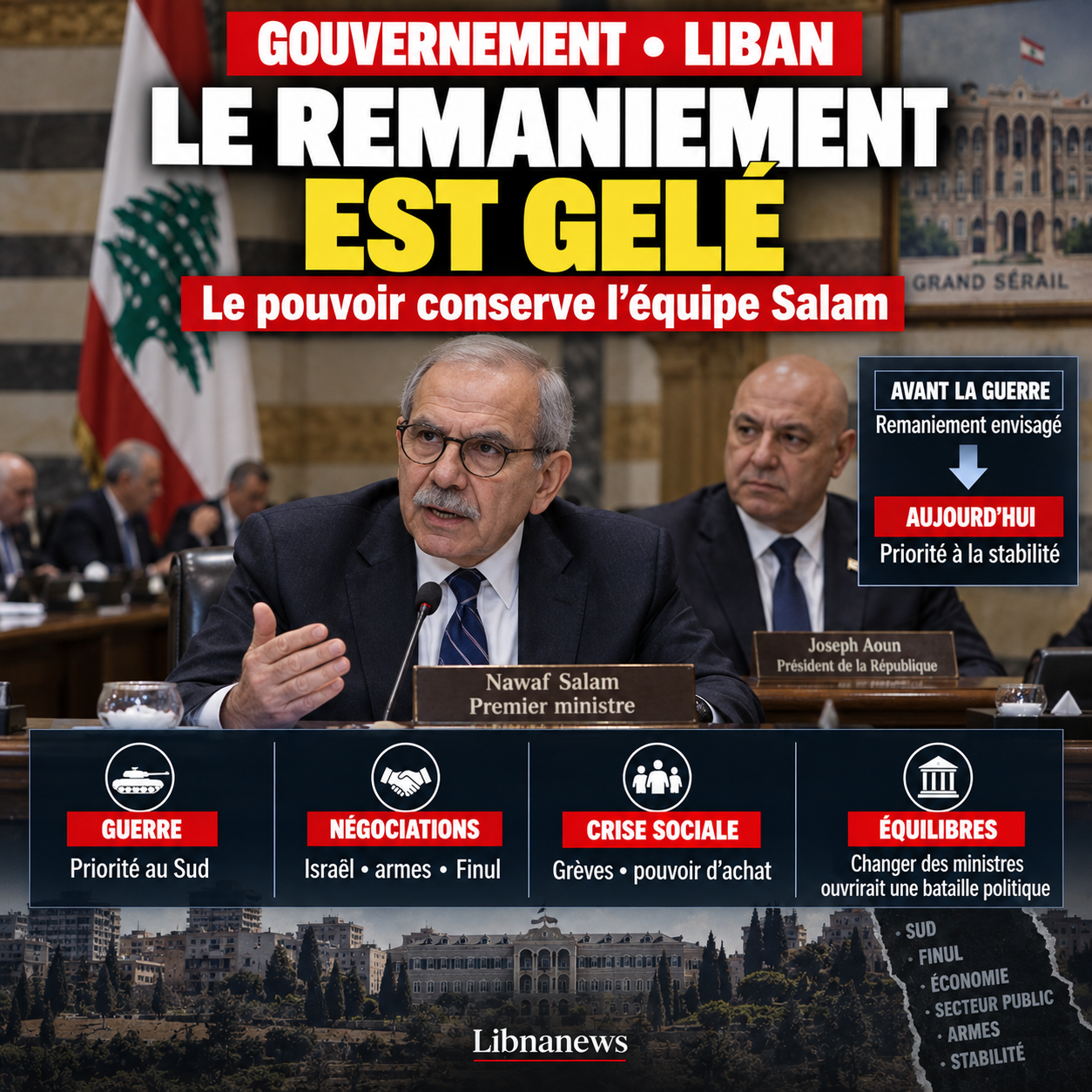
The scenario of a reshuffle of the Government of Nawaf Salam would not be discussed between the Presidency of the Republic and the Grand Serail, nor within the framework of a political initiative sufficiently advanced to lead to the replacement of several ministers. Reports of imminent changes in some portfolios, sometimes accompanied by names of potential successors, are categorically denied by a prominent Lebanese official source. According to this version, no one would have formally seized Joseph Aoun of a proposal for redrafting and no such discussion would be initiated with Nawaf Salam.
The denial is all the more interesting as the idea is not presented as entirely imaginary. A government change had been considered before. The period before the war had been a period of reflection, which had increased in scope after the extension of the mandate of the Chamber of Deputies. At that time, the goal was to take advantage of the extended political period to inject « new blood » into the ministerial team. The hypothesis therefore responded to a logic different from that which dominates today: improving the functioning of the government, renewing certain figures and adapting the executive to a political sequence that has become longer than expected.
The war changed that calculation. The priorities of the government have shifted southward, negotiations with Israel, the deployment of the army, the issue of arms, reconstruction, the social crisis and the preparation of the post-Final era. A reorganization that might appear a few months earlier as an instrument for government stimulus is now seen as an operation that could open up more problems than it would solve. So the question is no longer just which ministers could be replaced. It is to determine whether Lebanon can afford a political battle around the composition of the government at a time when the executive must manage several existential issues simultaneously.
This development explains the current paradox. Criticisms against some ministers and government action have not disappeared. Social anger is increasing. MEPs blame the executive for its insufficient responses. Differences within the government team themselves sometimes appear publicly. However, these weaknesses do not mechanically lead to a reshuffle. Instead, in the current context, they reinforce the preference for continuity.
The project existed before the war
The clarification that the reshuffle was envisaged before the war makes it clear that the current rumour is based on an old political project. After the extension of the parliamentary mandate, the institutional calendar had changed. The government had a potentially longer period of action and some officials considered that a partially renewed team could give new impetus to the executive.
The phrase « injecting new blood » sums up the logic that prevailed then. It was not necessarily about overthrowing the government or changing its overall direction. Rather, the assumption was to change certain personalities, correct weaknesses in several ministries and give a new dynamic to a team that would remain in office longer than expected.
Such an operation would also have allowed some political tensions to be addressed without opening a complete government crisis. In Lebanon, the modification of a limited number of portfolios can theoretically offer a compromise between maintaining the Government structure and the willingness of several forces to review their representation. But what seems simple on paper quickly becomes complex as soon as it is necessary to determine which ministers leave, who replaces them and how to preserve political and religious balances.
The war has made this equation much more risky. Any change of minister can now be interpreted through the great fractures of the moment: attitude to negotiations with Israel, relationship with Hezbollah, politics towards Iran, monopoly of arms, cooperation with the United States or even management of the social crisis. A replacement that would have previously raised a logic of government performance can now be described as a political victory or defeat of a camp.
This is precisely what power seeks to avoid. Maintaining the current team prevents parallel negotiations on internal balances as the state is already trying to negotiate the Israeli withdrawal and the future security architecture of the south.
War has completely changed the hierarchy of priorities
Since the regional escalation, the executive has been operating under pressure far beyond ordinary government management. The first file is that of the territory. Lebanon is seeking further Israeli withdrawals while deploying the army to the evacuated areas. The United States is making part of its support conditional on concrete progress in the exercise of state authority. Israel continues to raise the issue of Hezbollah’s military capabilities. At the same time, negotiations must determine whether a new phase will be initiated before or after the Israeli elections.
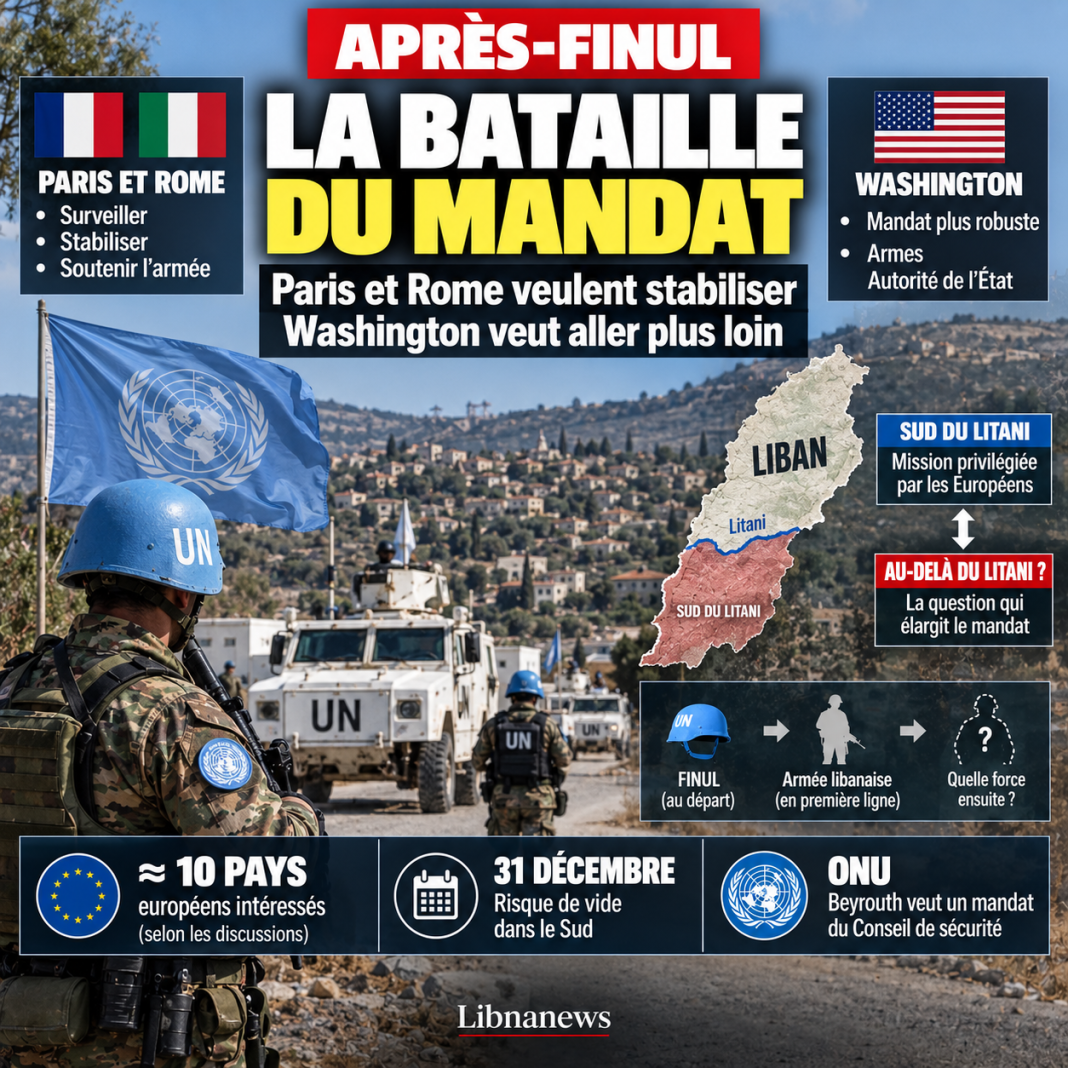
To this equation adds the planned end of the mission of the Finul. Lebanon must prepare a new international framework without knowing what formula would be adopted. A Franco-Italian initiative is being studied. A dominant European force is mentioned. The use of strengthened international observers is another avenue. None of these scenarios has yet been decided, and each raises questions about the mandate, area of action and protection of foreign military personnel.
The government must simultaneously manage its relationship with Iran. The meeting between Nawaf Salam and Masoud Pezeshkian in New York showed that the Prime Minister is seeking to rebuild a state-to-state relationship with Tehran, based on sovereignty and non-interference. It clearly linked this relationship to the priority given to Israeli withdrawal and the extension of State authority throughout the territory.
The relationship with Syria is also entering a new phase. Nawaf Salam and Ahmad al-Sharaa discussed the revision of the agreements between the two countries, the reactivation of the Joint High Commission and projects to link electricity, railways and energy. Again, the government is working on issues that require administrative and political continuity.
Changing the departmental team in this phase would require some departments to interrupt or reorganize their files at a time when negotiations are particularly sensitive. The issue of reshaping can therefore no longer be considered solely in terms of the individual performance of ministers. It must be compared with the political and administrative cost of redistribution of portfolios.
However, government tensions exist
The abandonment of the reshuffle does not mean that the government operates without differences. The New York sequence provided a revealing example. The meeting between Nawaf Salam and the Iranian President was reportedly preceded by disagreements in the Lebanese delegation. The Prime Minister would have accepted Iran’s request to hold the meeting despite the reservations of Foreign Minister Youssef Raggi. Salam would finally have decided personally in favour of the meeting.
This episode, if placed in the question of reshaping, shows why some rumours may appear credible. Line differences exist. They sometimes concern such sensitive issues as Iran. However, the current political decision seems to be to manage these disagreements within the team rather than resolve them by replacing ministers.
This approach allows Nawaf Salam to preserve his authority as head of government. In the Iranian episode, he would not have changed the composition of his team to impose a direction. He would have simply exercised his power of arbitration and decided that the meeting should take place. Institutional functioning thus becomes a means of containing differences without causing a crisis.
However, there are limitations to this method. The more public the disagreements become, the more observers can interpret each dispute as a prelude to ministerial change. The circulation of replacement names then feeds into real conflicts, even when no reshaping procedure is initiated.
The present denial aims precisely to cut short this mechanics. Differences should not be automatically translated into replacement scenarios. The Presidency and the Grand Serail can continue to work with ministers who do not always share the same tactical appreciation, as long as the broad guidelines remain set by the institutions.
A social crisis that could have justified a revival of the team
The internal context could, however, provide arguments for the proponents of a reorganization. The social situation is deteriorating rapidly. Public sector officials are entering a new phase of strikes. The purchasing power continues to rise in prices. The cost of energy, transport, food, private electricity and housing puts considerable pressure on households.
Available estimates show the extent of the problem. For a four-person family renting accommodation in Beirut or its suburbs, housing, food, electricity, water and transportation costs alone can reach about $1,400 to $1,500 per month. However, this calculation excludes education, hospitalization, medicines, clothing, telecommunications, Internet access and many current expenditures.
The average income used in one of the private sector surveys is around $560 per month for Lebanese workers who remain in employment. Even with two incomes of this level in the same household, the family does not reach the amount necessary to cover the five essential expenses studied. The deficit thus appears even before school or medical expenses.
President Joseph Aoun himself was alerted to the seriousness of the situation. A note from the Economic, Social and Environmental Council states that social tensions are at a level that can compete with the security and strategic risks facing the country. Proposals include the creation of a national economic and social dialogue involving the State, political forces, economic representatives, trade unions and social actors.
In an ordinary political period, such an accumulation of difficulties could have provided a simple argument: to change some ministers to give the feeling of a new impetus. But the answer seems different. The government prefers to ask for new policies from the existing team rather than rebuild the government balance.
Public sector becomes a political bomb
The situation in the public sector increases this pressure. Abbas Halabi describes the administrative structure as a « huge time bomb ». His analysis is particularly severe: the problem would not be addressed because of the religious, political and clientelistic considerations that prevent real restructuring.
This crisis is not just about the level of wages. It affects the very organisation of the administration. The State must respond to the deterioration of the purchasing power of its employees without triggering a new inflationary spiral or creating budgetary burdens that it cannot finance on a sustainable basis. It must also prevent social movements from paralyzing already fragile services.
The proliferation of strikes can therefore become a direct threat to the government. Yet, again, the strategy does not seem to involve a change of team. The reasoning is probably that replacing a minister does not regulate the financing of salaries or the structural imbalances of the administration. A fiscal crisis does not disappear with a new portfolio holder.
Rather, power is trying to save time to build a financial response. This also explains the importance attached to discussions with the International Monetary Fund and external aid. The social issue has become inseparable from financial reforms and the restoration of international confidence.
This reality, paradoxically, makes the redesign less useful. A new team would not have additional resources. It should immediately face the same demands, budgetary constraints and international deadlines.
Changing the government would open a battle over balance
However, the most sensitive problem remains political. Once the principle of reshaping is accepted, each force would seek to know what functions are involved. A limited change could quickly become a general negotiation on government representation.
Lebanon is already in a period of strong tensions around Hezbollah, Iran, negotiations with Israel and state sovereignty. Replacing a minister associated with a particular sensitivity could be interpreted as a line change. The choice of his successor would immediately trigger a battle on the balance between the different forces.
The question would not be limited to parties. Confessional balances should also be preserved. Each portfolio has an institutional and symbolic weight. The replacement of a minister could therefore require a series of compensations that would transform a technical operation into a national political negotiation.
The Presidency of the Republic and the Grand Serail have no obvious interest in opening this building today. Their priority is to maintain a common decision-making capacity on major issues. The fact that the reshuffle was not even discussed between the two Presidencies is therefore a significant factor. It states that the stability of the executive is, for the time being, considered more important than its renewal.
The status quo is not worth satisfying
To exclude the reshuffle does not mean, however, that the government benefits from a white-seing. There are many parliamentary criticisms. At the government action session, several ministerial responses were deemed insufficient by MPs. Social, economic and security issues remain open.
The government must also demonstrate that institutional stability produces results. If he invokes war and negotiations to avoid a change in his composition, he cannot use those same circumstances to justify inaction in the interior indefinitely. Continuity therefore becomes an obligation of result.
The question is particularly clear on the economy. Households face an increase in the cost of private services which offset the absence or inadequacy of public services. They pay electricity from generators, buy water, directly finance an increasing share of their medical expenses and take on extremely expensive transport. At the same time, indirect taxes and additional duties weigh on consumption.
The executive must therefore respond to a contradiction: it wants to retain its composition to ensure continuity, but this continuity will be judged on its ability to improve a daily situation that is deteriorating. The abandonment of the reorganization removes the argument of a period of adjustment related to the arrival of new ministers. The current team remains fully responsible for ongoing cases.
The overhaul is frozen, not necessarily buried
The current decision must finally be placed in its timetable. The project had existed before the war. It was abandoned when priorities changed. There is therefore no reason to conclude that a reorganization is definitively excluded until the end of the government’s mandate.
A stabilisation of the front, progress in negotiations with Israel or clarification of the post-Final could change the calculation again. A worsening of the social crisis or a major failure in a ministry could also put the subject on the table. The idea has already existed and could reappear if the circumstances become favourable again.
For now, however, the message is unambiguous. The names circulating do not correspond to an institutional process initiated. No agreement is being prepared between Baabda and the Grand Serail to replace several ministers. The former project of partial renewal of the team was overtaken by the war and the resulting emergencies.
The government status quo is therefore less a result of general satisfaction than a risk calculation. Opening up the government today would add complex domestic negotiations to the ongoing territorial, military, financial and diplomatic negotiations. The power is currently choosing to retain the existing team and manage its tensions internally.
This decision, however, places Nawaf Salam and his ministers at an increased demand. They can no longer count on the prospect of a redesign to give the image of a new start. The recovery will have to come from the decisions themselves: progress in the south, response to strikes, reform of the administration, financial negotiation, support for the army and improvement of services. It is now on these results, not on a change of face, that the next phase of the government will take place.