





Paris confirmed international support, but not yet the means
The preparatory meeting in Paris on support for the Lebanese army sent two seemingly contradictory messages. The first is positive: despite the regional war, Lebanon’s financial difficulties and disagreements on the Hezbollah issue, the military institution continues to benefit from an important international interest. Participation in the meeting shows that foreign partners still regard the army as the central player in the future Lebanese security architecture.
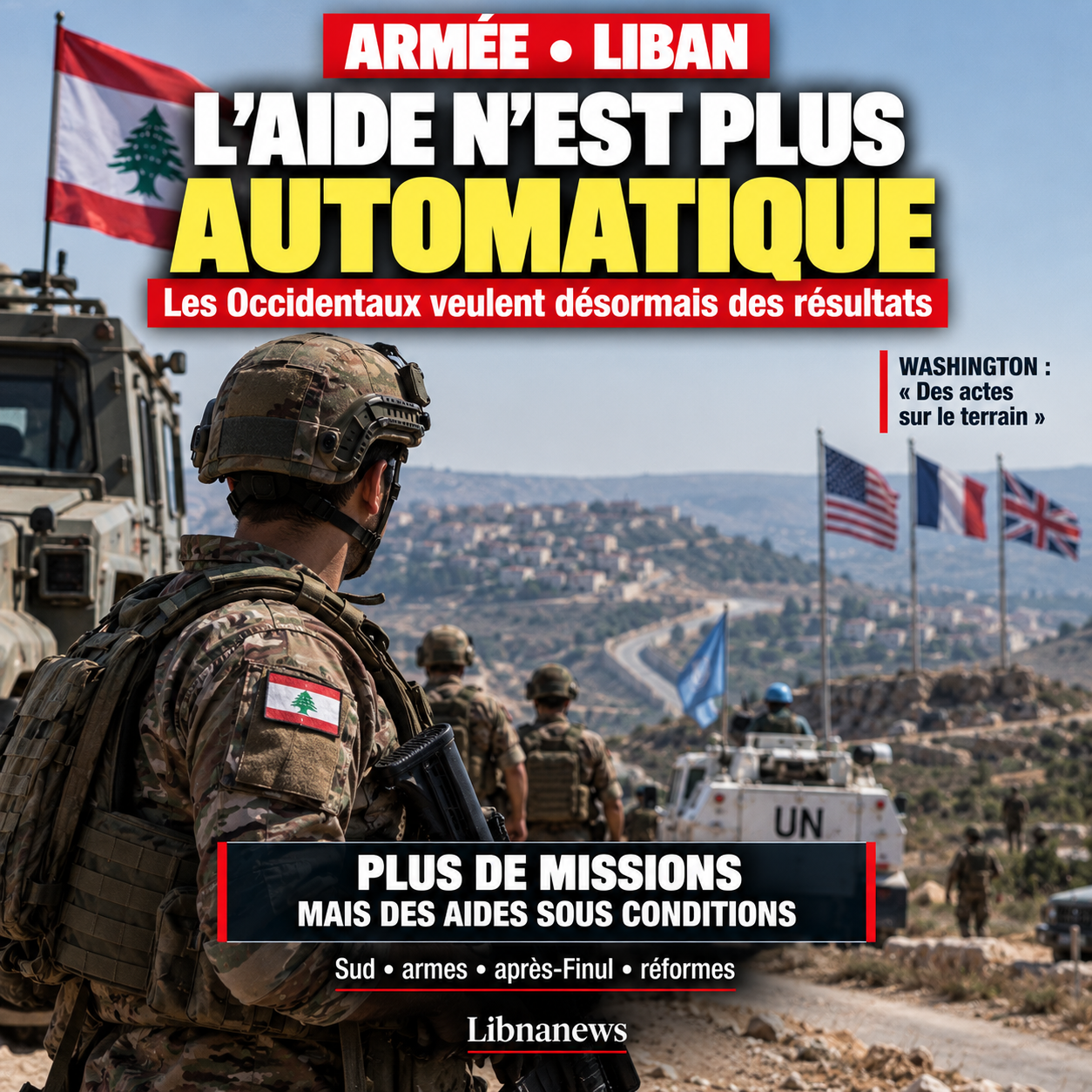
The second message is more demanding. Diplomatic mobilization did not immediately produce the material results that Beirut could expect. International aid is no longer considered to be independent of State action. Several Western capitals now want to see concrete results on the ground before increasing their support. The financing of the army is thus linked to issues that far exceed its military needs: arms monopoly, deployment of state authority, administrative and economic reforms and, for some partners, progress towards an agreement with the International Monetary Fund.
This is precisely at a time when the missions requested from the army are increasing. It must take control of areas evacuated by Israel, ensure the security of returning populations, consolidate the state’s presence in the south, prepare the transition after the end of the year and contribute to the implementation of the political decision to monopolize weapons. It must carry out these tasks as the country goes through a fiscal and social crisis that directly affects the military and their families.
The problem is therefore no longer simply to find donors. It involves understanding what international partners want in exchange for their support. Military aid is gradually becoming an instrument of political transformation of the Lebanese State.
Washington wants actions on weapons, not just statements
The most demanding messages come from Washington. Visitors to the U.S. capital report that government officials consider that Lebanon’s arms monopoly commitments have not yet produced enough concrete changes.
American reasoning contrasts official statements with reality observed on the ground. The Lebanese authorities claim to want to extend State authority, deploy the army and place weapons under its exclusive control. Washington asks where the operational translation of these commitments is.
The American questions include Hezbollah’s military deposits and positions in the south. Why doesn’t the army move faster to these sites? How does the State intend to apply the principle of arms monopoly in practice? What steps are planned and on what schedule?
These questions do not stop south of the Litani. American officials also question the presence of weapons in the Beirut area. Their reasoning is that these weapons cannot be justified by a function directly linked to border confrontation with Israel. The question therefore becomes internal: why does an organization have an independent military capability in the capital if the objective is really to reserve arms to the state?
This geographical extension is essential. It shows that Washington does not consider deployment to the south as the outcome of the process. The south is a first step. The aim is to transform the Lebanese security system at the national level.
» Stability is no longer enough as an argument
The Lebanese authorities have long invoked the preservation of internal stability to justify a gradual approach to the arms issue. The argument is based on a reality: direct confrontation between the army and Hezbollah could provoke internal clashes and endanger the cohesion of the military institution itself.
This caution no longer fully convinces Washington. In the reported exchanges with American officials, a criticism is clear: making security stability a top priority could lead to temporarily maintaining calm at the cost of a lasting weakening of sovereignty.
American reading is almost the opposite. It considers that stability based on the coexistence of several armed authorities remains fragile. Even if it avoids immediate confrontation, it could prepare for a more serious crisis in the future. Sovereignty must therefore become the priority, even if it accepts limited friction during the transition.
This difference in doctrine is considerable. Beirut thinks in terms of preventing an internal confrontation. Washington is reasoning in terms of building a state monopoly on force. The two objectives are not necessarily incompatible, but they do not impose the same pace.
The army finds itself directly in the midst of this contradiction. He is asked to be the instrument of a transformation that political power wants to lead without civil war. Foreign partners want results to verify that this transformation is real.
The first test of the south did not convince Israel
The question of aid is also linked to the evaluation of the first experimental zones envisaged in the negotiations with Israel. After an Israeli withdrawal, the army must enter the evacuated area and impose State authority.
Israel transmitted to the United States a negative assessment of the first experiment. According to his version, several Hezbollah members and cadres were able to return to the area after the Lebanese army deployed. Beirut rejects these accusations and considers that they seek to discredit the mechanism in order to slow down Israeli withdrawals.
The army itself responded in detail to Israeli claims. This disagreement is not just a communication battle. It directly influences the confidence of foreign partners in the state’s ability to control the recovered sectors.
If Washington accepts the Israeli version, it can ask the army for additional measures before exerting pressure to obtain a further withdrawal. While the Lebanese arguments are considered convincing, the responsibility for blocking is shifting more towards Israel.
The project of a new experimental area around Kfar Tebnit and d’Ali al-Taher is therefore also becoming an assessment of the army. An Israeli withdrawal followed by undisputed control by the regular forces would give the institution a very strong argument for further support.
Conversely, any dispute over the control of the sector may be used to further tighten the conditions attached to the aid.
The army must do more as the Finul prepares to leave
The contradiction becomes stronger with the programmed end of the Finul. For almost 48 years, the international force has provided much more in the south than military personnel. It provides patrols, surveillance, liaison between the parties, logistical capabilities and a permanent international presence.
The Lebanese Army affirms that it can assume its responsibilities after the departure of the peacekeepers. This is politically indispensable: the sovereignty of the country cannot depend forever on a foreign force.
But taking over the primary responsibility does not mean being able to instantly absorb all the functions performed by the Finul. The need for people, vehicles, communications, intelligence, surveillance, fuel and infrastructure will necessarily increase.
The timetable is particularly difficult. The army must strengthen its presence in the south while the Israeli withdrawal is not over. It must prepare for the disappearance of an international force while no replacement device is yet permanently stopped. It must simultaneously respond to the requests for Hezbollah weapons.
It is precisely at this point that aid becomes more conditional.
The paradox is obvious: the international partners ask the army to prove that it can perform more missions before guaranteeing all the means necessary for these new responsibilities.
The future international force will probably not replace the identical Finul
The problem is compounded by the uncertainty surrounding the post-Final period. A Franco-Italian initiative seeks to constitute a mainly European force. Some 10 countries have reportedly indicated their willingness to participate. Asian States could also join the mechanism.
But there is no indication that this future force will have the same size or capabilities as the Finul. The contributing States want to limit the risks. Above all, they hesitate to accept a mandate that could place their military in direct confrontation with Hezbollah.
France and Italy favour a mission of surveillance, support and support to the army. Washington wants an architecture more linked to the effective application of state authority. The divergence on the mandate therefore remains important.
If the future international presence is lighter, the Lebanese army will necessarily have to absorb part of the missions now assumed by the Final.
This evolution mechanically increases financial needs. Regular forces will need to be able to patrol more, occupy new positions, monitor evacuated areas and ensure a permanent presence in villages where residents must return.
The conditionality of aid therefore comes exactly when military spending is expected to increase.
The Lebanese soldier also suffers the social crisis
It is impossible to examine the military’s capabilities without looking at the economic conditions of its members. The military lives in the same country as the civil servants and suffers the same explosion in the cost of living.
The basic expenses of a family of four renting in Beirut or its suburbs can be between $1,400 and $1,500 per month for only five items: housing, minimum food, electricity, water and transportation. This amount does not include education or medical expenses.
This comparison does not mean that all military personnel live in Beirut or exactly support this budget. However, it enables us to measure the economic environment in which the institution must maintain its staff, motivation and availability.
The wage issue therefore becomes an operational issue. A soldier concerned about the financing of housing, school or family care is evolving under very different conditions than an army with stable pay and strong social protection.
The command regularly insists on the cohesion of the institution and on the need not to weaken the morale of the military through rumours and attacks. This cohesion is indeed one of the main assets of the State. But it cannot be regarded as acquired independently of material conditions.
International partners who ask the army for more attention must also take this reality into account.
Paris: many participants, few immediate results
The Paris preparatory meeting precisely illustrated this new logic. The number of participants confirmed the international interest in the army and stability of Lebanon. But the lack of spectacular financial decisions has also shown that partners now want more than just a presentation of needs.
International aid is no longer described as « free ». Donor countries want to involve them in results.
This evolution first affects security. The partners want to see the deployment of the army and the effective exercise of State authority.
But it quickly overflows into the economy. Several Western capitals now link their security support to administrative and financial reforms. The agreement with the International Monetary Fund also appears in this equation.
The reasoning is that the army cannot be sustainably financed by foreign donors if the Lebanese State does not rebuild its own finances. Aid can support a transition. They must not become a permanent substitute for a functional public budget.
In principle, this logic is consistent. In practice, it creates an immediate difficulty: financial reform takes time while military needs are urgent.
The agreement with the IMF is on the military record
The link between the Monetary Fund and military support may seem surprising. Yet he is increasingly present in Western discussions.
Since 2019, the collapse of the banking system and public finances has reduced the state’s capacity to normally finance its institutions. The army was able to continue operating partly thanks to foreign support. This dependency is not sustainable indefinitely.
The partners therefore want Lebanon to deal with the financial hole, restructure banks, reform public finances and regain normal access to international financing.
The assumption of an agreement with the Fund in March thus takes on a security dimension. An agreement would not only provide financial resources. It would serve as a signal to donors: Lebanon finally accepts a reform architecture that allows us to envisage commitments over several years.
But this condition exposes the army to the blockades of other institutions. If Parliament delays a banking law, if banks oppose the distribution of losses or if the government fails to adopt certain reforms, military support can indirectly suffer the consequences.
The military institution thus becomes dependent on decisions that it does not control at all.
A conditionality that goes beyond the responsibilities of the army
This is probably the main problem of the new aid model. Part of the conditions correspond directly to military missions: deployment, territorial control, border security and cooperation with the future international presence.
Others come under political power: decision on the arms monopoly, dialogue with Hezbollah, timing and management of negotiations with Israel.
Still others are purely economic: bank restructuring, administrative reform, budget and agreement with the Monetary Fund.
The army can therefore perform its own tasks properly without all the necessary conditions for the release of certain aids.
This distinction is important to avoid assigning responsibility for possible failure. The army applies political decisions. It cannot alone decide the disarmament of an organization with significant political and parliamentary representation. It does not vote on banking laws and does not negotiate the allocation of financial losses.
Demanding results from the state is one thing. Another is to make military capabilities dependent on results from other institutions.
The risk of a vicious circle
The new doctrine of aid can produce a particularly difficult circle.
Partners are asking for more results to provide more resources. But some of these results require more resources.
In order to control the evacuation areas sustainably, the army needs personnel, vehicles and equipment. To monitor a larger territory after Finul, it needs additional capacity. In order to prevent the return of armed groups to the resumed areas, it must be able to maintain a dense and permanent presence.
If resources arrive only after the demonstration of these capacities, the institution must succeed in the transition with insufficient means.
The problem becomes even more acute if Israel uses the shortcomings found to justify maintaining its positions. A material weakness of the army could then produce a twofold effect: slowing down the Israeli withdrawal and further reluctance by donors.
This is precisely the scenario that Beirut must avoid.
Command responds through cohesion and preparation
In this context, the military command strongly insists on unit preparation and internal cohesion. During an inspection of the commando regiment in Roumieh, General Rodolphe Haykal focused on operational readiness, specialized training and military cohesion.
He also rejected attempts to weaken morale through rumours and accusations.
This message has an obvious internal dimension. The army must remain unified while the political issues surrounding it are extremely polarizing. Any Hezbollah arms operation could be interpreted immediately through community and partisan divisions.
The command must therefore avoid the institution being perceived as the army of one camp against another. Its effectiveness depends precisely on its ability to maintain national legitimacy.
This constraint also explains why Washington’s desired transformation cannot be conducted solely according to military logic. The political decision must precede the action of the army. Without clear institutional coverage, a coercive operation could expose the army to an internal conflict of which it would itself become the issue.
London confirms its support, but insists on state authority
The visit to Beirut of the British High Adviser on Defence in the Middle East and North Africa, Vice-Admiral Edward Ahlgren, illustrates this combination of support and demand.
His discussions with Joseph Aoun, Defence Minister Michel Menassa and Army Commander Rodolphe Haykal reaffirmed the British partnership with the military institution. London underlines its role in securing borders, stability in the south and de-escalation efforts.
But the British message also places the army in a precise political architecture. It is presented as the legitimate defender of Lebanon, while the government must strengthen the authority of the State and assume full responsibility for security.
This formulation joins the general Western consensus. Support for the army remains very much because the partners want to make it the only legitimate military institution.
The aid is no longer intended solely to preserve the army. It must help to gradually change the relationship between the State and other armed structures.
Israeli withdrawal becomes indispensable to the credibility of this doctrine
This international strategy, however, has a condition that Western partners cannot only ask Lebanon: Israel must also withdraw.
If the army expands its deployment and the state takes action on the weapons issue as Israel maintains its occupation and continues its operations, the political balance of the process becomes difficult to defend.
For Beirut, reciprocity is essential. Each state’s advance must produce a territorial advance. This is precisely the meaning of the new experimental zone envisaged around Kfar Tebnit and d’Ali al-Taher.
An Israeli withdrawal followed by a successful deployment of the army would demonstrate that the mechanism is working. It would also reinforce the argument of foreign partners calling on Lebanon to build on its institutions.
Conversely, if Washington imposes increasing conditions on the Lebanese State without obtaining corresponding withdrawals from Israel, Western doctrine will lose some of its credibility among the Lebanese.
Without Israeli withdrawal, Western conditionality becomes politically untenable
Western support for the army is based on an equation that can only work in both directions. Washington is asking Lebanon to take action on the arms monopoly. U.S. officials question the lack of a clearer progression towards some Hezbollah military depots and sites in the south. They even raise the issue of arms in Beirut, considered to be more of an internal power relationship than a border confrontation with Israel. At the same time, several capitals now link their aid to concrete state results.
But Beirut awaits an equally concrete counterpart: the Israeli withdrawal. The Lebanese authorities cannot defend a long-term policy of fulfilling growing security requirements while Israel retains its positions and continues its operations. This is all at stake in the new experimental zone envisaged around Kfar Tebnit and d’Ali al-Taher. Washington promised to push Israel to withdraw from it. The Lebanese army would then immediately take control of the area.
This operation will be decisive. If the withdrawal takes place and the army controls the area sustainably, Washington will have an argument to ask for more from Beirut. If Israel does not move despite Lebanese commitments, American pressure will become increasingly unbalanced.
The precedent of the first experimental zone already shows the difficulty. Israel told the Americans that several Hezbollah members and executives had been able to return to the area. Lebanon contests this version and the army responded to Israeli accusations. Behind this dispute is an essential question: who decides that one step has been successful and that the conditions are met to move on to the next? If Israel has a right of veto invoking Lebanese inadequacies each time, the withdrawal may be postponed indefinitely.
The army may pay for blockages that it does not control
Western conditionality is mainly a problem of responsibility. Some of the requirements relate directly to the army: deployment, control of evacuated areas, surveillance of the territory, security of the border. Others report to the Council of Ministers and to the political power, including the treatment of Hezbollah weapons. Still others have virtually nothing military: bank restructuring, administrative reform and agreement with the International Monetary Fund.
However, several Western capitals now link these issues. Security support depends on the action of the State, but also on its ability to carry out economic reforms. This means that the army can properly carry out its tasks and, despite everything, suffer the consequences of a parliamentary blockade on banks or political failure on the distribution of financial losses.
The paradox is all the stronger as the army will have to replace some of the capabilities now brought by the Final. The international force has been present for 48 years. His departure means more Lebanese patrols, more surveillance, more positions to be held and additional requirements for vehicles, fuel, communications and personnel.
The future international presence will probably be lighter. The Franco-Italian project is still under discussion and some ten European countries have expressed their willingness to participate. But the contributing States do not want a mission that could put them directly in front of Hezbollah. The Lebanese army will therefore necessarily recover a larger part of the burden.
It is precisely when its responsibilities increase that funding becomes more difficult to obtain.
Paris revealed the new rule: first the results
The preparatory meeting in Paris should be read from this perspective. International participation confirmed that the army remains considered the essential institution of Lebanese stability. But the lack of immediate financial results has shown that the old aid model is coming to an end.
The partners no longer want to finance an institution independent of the country’s political evolution. They demand results on sovereignty, weapons and reforms. Help becomes a lever.
This development can be defended from the donor perspective: no foreign state wants to finance indefinitely the army of a country incapable of reforming its public finances. But the timetable is a problem. Banking restructuring and agreement with the Fund may take months. The end of the Finul and the needs of the south are immediate.
The army is therefore caught between two clocks. The military clock demands resources now. The political and financial clock makes these means conditional on reforms whose content and timing it does not control.
The social crisis is now entering the military equation
Finally, there is a factor that international discussions often underestimate: the Lebanese military is facing the same crisis as the rest of the population.
Available figures give the order of magnitude. A family of four people renting an apartment in Beirut or its suburbs may need $1,400 to $1,500 per month only for housing, minimum food, electricity, water and transportation. School and health are not even understood.
The cohesion of the army has resisted monetary collapse, political crises and successive wars. But this cohesion has a cost. The military must be remunerated, their families insured, units financed and equipment maintained. The institution cannot be asked to extend its territory of action on a long-term basis while considering that its morale will compensate for the lack of resources.
General Rodolphe Haykal insists precisely on operational readiness, training and cohesion. During his inspection of the commandos regiment in Roumieh, he also rejected rumours and accusations that might weaken the morale of the military. This speech shows that command identifies cohesion as a strategic issue, not just an internal issue.
The real test is no longer the donor conference
The question is not, in the end, how many countries will participate in an army conference. The real test will take place on three very concrete dossiers.
The first is Kfar Tebnit and Ali al-Taher. If Washington gets the Israeli withdrawal and the army actually takes control of the area, the logic of reciprocity works.
The second is after Finul. If international partners reduce their presence, they will have to finance some of the additional capabilities they are requesting from the Lebanese army. It would be contradictory to abolish thousands of international soldiers while denying Lebanon the means to resume their essential functions.
The third is the distinction between the responsibilities of the army and those of political power. The military institution cannot become hostage to Parliament’s delays in banking reforms, nor can it be entrusted solely with the political resolution of the Hezbollah issue.
The new Western doctrine can strengthen the state if it is based on real reciprocity: more Lebanese authority, more support for the army and more Israeli withdrawals. If it is reduced to an accumulation of conditions addressed to Beirut before each aid and withdrawal, it will have the opposite effect.
The army would then end up with more territory to be controlled, more missions to be completed and fewer guarantees of the necessary means. This is precisely the imbalance that the international support conference will have to avoid.