






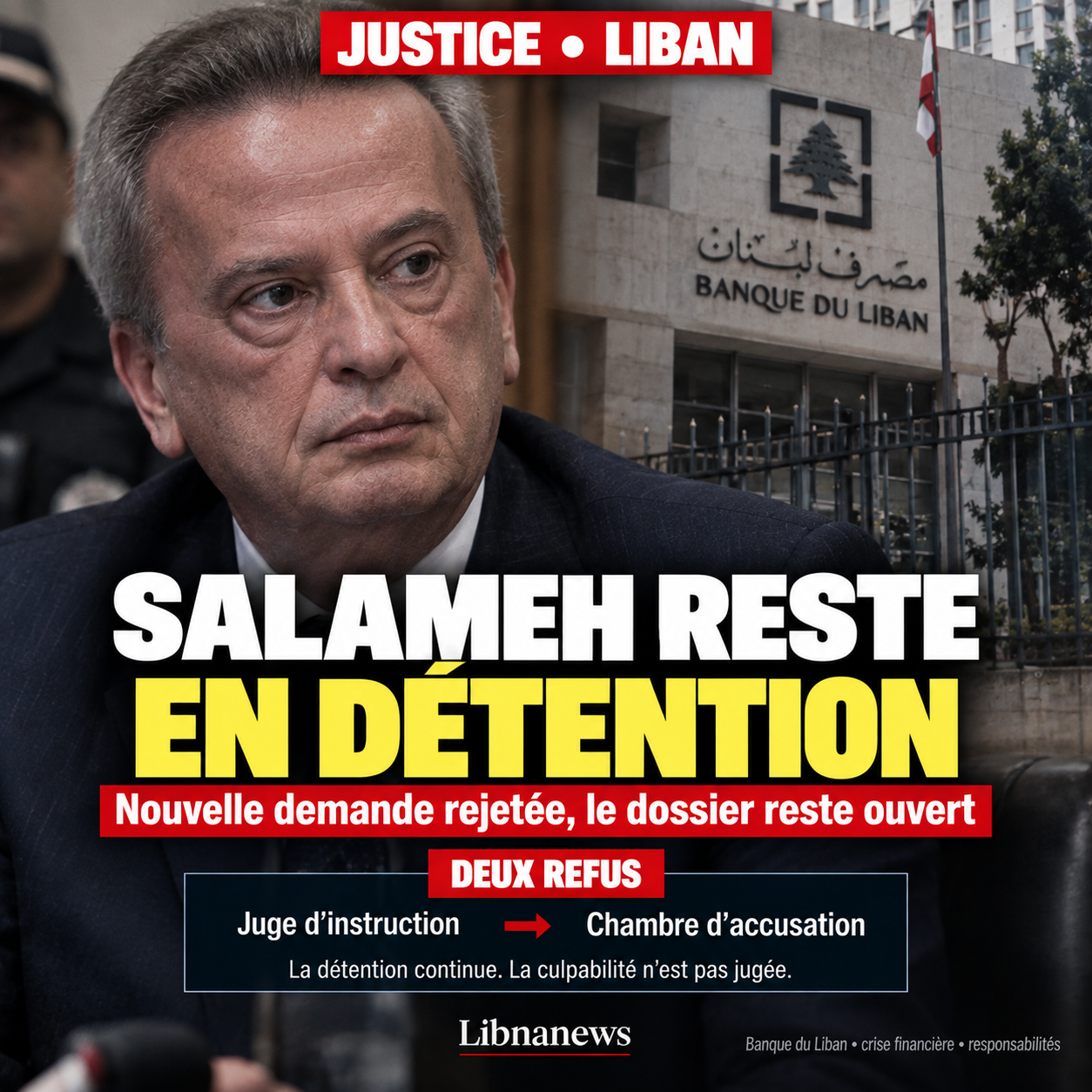
A new attempt at release that fails on two levels
Riad Salameh remains in custody. His lawyer filed a new application for release before the first investigating judge Rola Othman. The magistrate refused to accept it. The defence then challenged this decision before the indictment chamber, but this second step did not allow the former governor of the Bank of Lebanon to leave prison. The original decision has therefore been effective and Salameh remains incarcerated.
This sequence is brief in its form, but important in its scope. First, it shows that the defence continues to use procedural means to challenge continued detention. It shows above all that, for the time being, the courts seized did not consider that the arguments presented justified release. However, the available evidence does not give details of Rola Othman’s legal motivation or that of the indictment chamber. It would therefore be risky to attribute to magistrates specific reasons which are not set out in the documents.
The new failure comes in a very particular context. Salameh is not a former ordinary official. He led the Bank of Lebanon for three decades, from 1993 to 2023. Its name is thus associated with a period of the Lebanese economic model: stabilization of the pound, financing of the state, development of a hypertrophied banking sector, and then increasing use of mechanisms to attract currencies before the financial collapse.
His continued detention therefore had a considerable symbolic burden. But this dimension must not blur judicial analysis. The detention of a former governor is neither a final judgement on his role in the country’s collapse nor a comprehensive judicial response to the losses of the financial system. The criminal responsibility of a person must be established in specific procedures, based on specific facts and legal qualifications.
This is precisely the difficulty of the Salameh case: its name is at the crossroads of individual judicial cases and a much larger collective financial catastrophe.
Thirty years at the head of the Bank of Lebanon weigh on each procedure
Riad Salameh led the central bank for an exceptionally long period. When Lebanon took office in 1993, it emerged from the civil war and sought to rebuild its economy, infrastructure and currency. When he left his post in 2023, the banking system was paralysed, the pound lost most of its value and depositors no longer normally had access to their savings.
This trajectory explains why every judicial development affecting him is immediately interpreted through the balance sheet of the crisis. Yet justice cannot sue a former governor for a general economic situation. It must examine specific transactions, establish financial flows, identify beneficiaries and verify whether infringements have been committed.
This distinction is fundamental. The Lebanese collapse results from a set of institutional responsibilities. The State has accumulated considerable debt and persistent deficits. Governments have delayed reforms. Parliament adopted budgets and fiscal policies. The Bank of Lebanon led monetary policy and financed part of the system. Commercial banks have massively invested depositor resources with the state and central banks. Bank shareholders have benefited for years from a particularly profitable sector.
Reducing this whole architecture to one person would therefore prevent understanding the crisis. But the opposite argument would be just as misleading: the collective nature of the disaster cannot prevent the judicial review of possible irregular individual transactions.
The Salameh file is exactly at this intersection. Justice must isolate the facts that could engage its personal responsibility without transforming the trial of a former governor into a substitute for the political trial of an entire system.
The real problem: distinguishing judicial records from financial collapse
This distinction becomes even more important as Lebanon moves towards banking restructuring. The country is now seeking to address an estimated financial shortfall of about $70 billion, or more according to the methods used. This sum represents an order of magnitude without common measure with an individual criminal case.
The losses mainly result from the accumulated imbalance between the liabilities of the banking system and the assets actually available. Banks had received deposits from their customers. A very large proportion of these resources have been placed with the Bank of Lebanon. The central bank itself financed the state, supported the currency and used various mechanisms to attract currencies. When capital inflows ceased, the entire structure lost its ability to function normally.
This mechanism explains why depositors should not wait for Riad Salameh to automatically repay their accounts. Even a possible final conviction in a given case would not reappear several tens of billions of dollars.
The recovery of assets possibly related to offences could be of judicial and financial importance. It could also satisfy a liability requirement. However, it cannot replace bank restructuring, loss recognition and the definition of a deposit repayment mechanism.
Confounding the two levels would create a dangerous illusion: that the missing money would be somewhere on some private accounts and that it would be enough to recover it to solve the crisis. The financial dimensions of the disaster make this assumption impossible.
The banking system is still trying to settle a loss of about $70 billion
The contrast between the individual dossier of the former governor and the magnitude of the crisis is evident in the current discussions with the International Monetary Fund. Lebanon is still negotiating how to allocate an estimated loss around $70 billion between the State, the Bank of Lebanon, banks, their shareholders and depositors.
This battle has been going on for several years. By April 2022, a preliminary agreement had been reached with the Fund for a programme of approximately $3 billion over 46 months. It was to be preceded by essential reforms: banking restructuring, changes in bank secrecy, capital control, valuation of large banks, debt strategy and loss treatment.
Four years later, the heart of the problem is still unresolved. The reason is not simply technical. Recognizing losses requires determining who is responsible for them.
If shareholders absorb losses first, some bank owners may lose all or a very large part of their holdings. If the state assumes an excessive share, the bill is transferred to taxpayers and future generations. If public assets are mobilized, assets belonging to all Lebanese are used to repair losses in a financial system that not all have benefited in the same way. If applicants absorb too much, the injustice already created since 2019 is institutionalized.
It is this battle that Lebanon has still not decided. The retention of Riad Salameh in detention can therefore have a strong political and symbolic significance, but it does not solve any of these equations.
The responsibility of the Bank of Lebanon is not limited to that of its former governor
The Bank of Lebanon is obviously at the centre of the crisis. For years, it has received enormous resources from commercial banks. These investments were remunerated and helped maintain a system in which banks could offer high returns to some depositors.
The « financial engineering » mechanisms have become increasingly important. Their aim was to attract or retain currencies in the system. As long as capital inflows continued, the mechanics could be extended. When they slowed down and then dried up, the underlying deficit became impossible to hide.
Riad Salameh obviously held a central position in this architecture as governor. But the central bank did not act in an institutional vacuum. Commercial banks were involved in the system. Governments needed funding. Political authorities were aware of the country’s growing dependence on foreign currency inflows. Monetary and financial decisions took place in a political environment that for years did not produce structural reform.
Justice and financial reform must therefore follow two parallel paths. Justice must establish any personal criminal responsibility. Reform must determine institutional and financial responsibilities.
If only the first advance, Lebanon can possibly judge individuals while maintaining a banking system that is unable to return deposits. If only the second advance, the system can be restructured without any individual infringement being punished. Both dimensions are necessary, but they are not interchangeable.
Continued detention is not a sentence
This clarification is indispensable in a politically loaded file. The rejection of an application for release does not lead to the conviction of Riad Salameh. Pre-trial detention and trial are two different stages.
The decision of Rola Othman means that the defence application did not convince the magistrate. Nor did the appeal to the Indictment Chamber allow for release. But the documents available do not give the detailed content of the defence arguments or the full motivation of the judges.
We must therefore avoid inventing what the file does not say. It cannot be said, on the sole basis of this information, that detention was maintained because of a risk of escape, fear of intervention on evidence, the particular gravity of the facts or any other specific reason. These elements must be reflected in judicial decisions so that they can be attributed to the judiciary.
This caution is all the more necessary as the Salameh case has been the subject of a multitude of procedures and investigations in Lebanon and abroad for several years. Mixing the various components can lead to one procedure being assigned facts belonging to another.
The new information of 25 September is much more precise and limited: a request for release was filed, it was rejected, the appeal of this decision also failed and the former governor remains detained.
Why the length of the file feeds the expectations of applicants
For part of the population, however, these legal distinctions are difficult to separate from the experience experienced since 2019. Depositors have seen their accounts blocked for years. Some had to withdraw their own money at rates or mechanisms that significantly reduced its real value. Others have financed the study or care of relatives with great difficulties abroad.
In this context, the detention of the former governor is inevitably interpreted as an element of accountability. But expectations in the judiciary can become disproportionate.
Applicants need three different answers. The first is judicial: have any offences been committed, by whom and for what amounts? The second is financial: how many of their deposits will they be able to recover and on what schedule? The third is institutional: how can we prevent a similar system from being rebuilt after the crisis?
The Salameh file can contribute to the first answer. He cannot provide the other two alone.
Repayment of deposits will depend mainly on bank restructuring, the financial capacity of the Bank of Lebanon, the assets available, the banks’ own funds and the policy adopted to allocate losses.
The prevention of a new crisis will depend on the reform of banking supervision, central bank governance, transparency rules and the end of a model in which the State finances its deficits sustainably thanks to the resources attracted by the financial sector.
Karim Souaid inherits a central bank to be rebuilt
The judicial record of the former governor takes place at a time when his successor, Karim Suaid, has to manage a Bank of Lebanon that is profoundly different from that of the years before the crisis.
The institution must regain monetary credibility while participating in the settlement of the past. It must maintain exchange rate stability, manage available reserves and work on restructuring the banking system. At the same time, it is directly involved in the discussion of the financial flaw and accumulated liabilities to banks.
The difficulty is considerable. A central bank can stabilize the currency without having solved its balance sheet. The relative stability of the pound around 89 500 for a dollar since 2023 does not mean that the financial crisis is over.
The country is currently living with two parallel realities. The first is relative monetary stability after several years of collapse. The second is the persistence of a banking system where pre-crisis deposits are still not freely available.
Karim Souaid must therefore avoid that exchange rate stabilization is confused with financial normalisation. The real test will be the ability to participate in a solution to recognise losses, restructure banks and restore normal financial intermediation.
In this context, the Salameh dossier also represents the institutional past whose new direction must be distinguished.
Banks cannot turn Salameh into a single manager
Another risk of focusing on the former governor is that the other players in the system may present themselves as mere victims of Bank of Lebanon policy.
However, commercial banks played a central role. They placed significant resources with the central bank, received high remuneration and built their own business models around this relationship. They had boards of directors, branches, risk committees and shareholders.
They must therefore be held accountable for their own management decisions. The question is not to deny the responsibility of the Bank of Lebanon, but to avoid it absorbing all the others.
This distinction becomes crucial in restructuring. If the entire crisis is presented as a consequence of the decisions of the former governor, bank shareholders can argue that their institutions have been deceived or dragged into a system for which they are not responsible. This reading would have direct consequences for the distribution of losses.
One of the principles at the heart of restructuring discussions is precisely that equity must absorb losses before they are transferred more widely. The owners of a financial institution assume the risk of their investment.
The search for Riad Salameh’s judicial responsibilities should therefore not become a mechanism for depriving banks of responsibility.
Nor can Parliament delegate the crisis to the courts
The same applies to the political class. Courts can review transactions and prosecute individuals. They cannot pass a bank resolution law, restructure public debt or define the treatment of deposits.
These decisions are the responsibility of the Government and Parliament.
However, political blockages have delayed the major post-crisis reforms for several years. Capital control was discussed long after the emergence of informal restrictions. The reform of bank secrecy required several steps. Banking resolution and the distribution of the financial gap remain at the centre of particularly difficult battles.
Under these circumstances, the trial of a former governor cannot become a substitute for political responsibility. Members still have to decide how to allocate about $70 billion in losses. No criminal judgement can take this decision in their place.
This reality also allows us to understand why the Salameh case remains politically explosive. He constantly refers the political class to a broader question: how far were the decisions of the Bank of Lebanon isolated and how far did they correspond to an accepted system because it allowed the State to continue to function without reform?
Answering this question goes beyond a request for release.
Justice faced with a much wider expectation of truth than the criminal case
The continued detention of Riad Salameh ultimately puts justice in the face of almost impossible expectations. A large part of the population wants to understand how a system presented for years as solid could collapse with losses of several tens of billions of dollars.
A criminal procedure is not a historic commission of inquiry. It must focus on specific facts, evidence and individual responsibilities.
This limitation can create frustration. Even a very detailed trial will not necessarily tell the story of the Lebanese financial model. It will not replace a comprehensive audit of public policies, relations between the Bank of Lebanon and banks, government decisions and debt.
But justice can bring one essential thing: to establish, in the cases before it, whether illegal acts have been committed and by whom. This function is all the more important in a country where impunity for public officials is regularly denounced.
The new refusal of release therefore prolongs a judicial sequence whose outcome remains open. It does not constitute an acquittal or conviction. He simply keeps the former governor in custody while the proceedings are under way.
The case cannot be closed with a single decision
The Salameh question finally has several levels that will have to move forward separately. First, there is the personal fate of the former governor and the decisions taken in the proceedings that concern him. Then there is the search for possible assets related to offences and their possible recovery. Finally, there is the reconstruction of the financial system of which he was one of the main leaders for three decades.