





The risk of vacuum is no longer theoretical
The planned end of the Final Mission puts Lebanon ahead of a deadline that can no longer be treated as a distant issue. On the last day of the year, the country could end up without the international force that has been accompanying the south for almost 48 years, while the Israeli army still occupies territories, the attacks continue and the framework agreement with Israel has not been completed. The urgency is therefore no longer just whether the Finul will leave. It consists of determining who will take over, with what mandate and especially to carry out which missions.
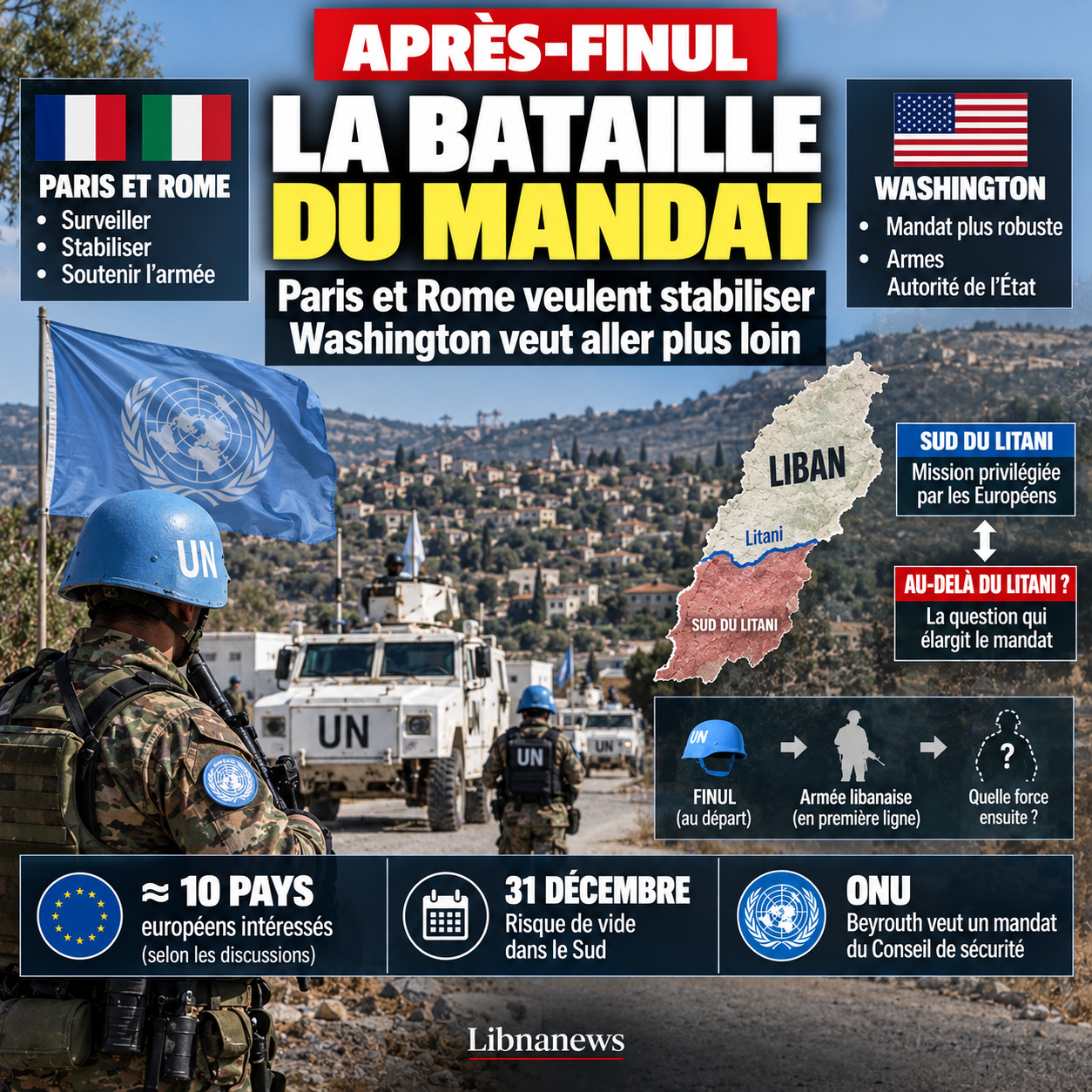
The discussions reveal several scenarios. The most advanced formula is based on a Franco-Italian initiative designed to constitute a European dominant force. About 10 European countries have reportedly expressed their willingness to participate. Asian States with experience in peacekeeping could also join the mechanism. Indonesia and China are among the countries interested in maintaining a presence in Lebanon as part of a future force.
But no final decision was taken. The composition of the quota is only part of the problem. Governments that may send soldiers want to know their exact mission, the geographical limits of their intervention, their rules of engagement and the guarantees given for their safety. They also want to know how their military would react if a confrontation broke out with Israel or Hezbollah.
It is precisely at this level that the differences become deep. Paris and Rome are working on an international presence to preserve stability and accompany the Lebanese army. Washington wants architecture more directly linked to the arms monopoly and the effective extension of state authority. Israel, for its part, shows no enthusiasm for a force that could permanently document its operations or limit its military freedom in the south.
The stakes thus go beyond the administrative replacement of several thousand peacekeepers. It deals with the nature of the security system that must govern the south after their departure.
The Franco-Italian formula is the most advanced track
The most serious path is to build a European core under French and Italian leadership. Emmanuel Macron and Giorgia Meloni worked on this option, while contacts were made with several European capitals to identify states ready to contribute troops. The project could then be extended to non-European countries with experience in international operations.
The interest of this formula is to avoid a sudden break. Europeans are already familiar with the Lebanese terrain. France and Italy have played an important role in the Finul and have operational experience in the south. A force built around their contingents could resume some of the existing functions without fully rebuilding the device.
Institutional continuity, however, is not enough. Finul is currently operating within a specific legal, military and political framework. The future force must have its own foundation. Beirut insists that any international presence should remain under the cover of a Security Council decision. Nawaf Salam explicitly defended this position in New York. It wants to avoid a coalition of countries deploying on the basis of bilateral arrangements or a simple European initiative.
This requirement responds to a sovereignty concern. An international force mandated by the Security Council has a well-known framework, defined obligations and international legitimacy. A force composed solely of a group of States could be more dependent on the political interests of its members. For Beirut, therefore, the question is not just to keep foreign soldiers in the south. An international architecture must be maintained to monitor the situation and produce reports recognized by the United Nations.
The Franco-Italian project remains unfinished. The ten European countries willing to participate have not yet received a definitive response on the missions they should undertake. This question determines the rest: number of soldiers, equipment, rules of engagement and accepted level of risk.
Paris wants to avoid direct confrontation with Hezbollah
France favours a force whose role would remain centered on the south and on support for the Lebanese army. The idea would be to preserve an international presence capable of observing, communicating and contributing to stability without transforming it into an actor responsible for disarming Hezbollah directly.
This distinction is essential. A surveillance force can patrol, document violations, maintain channels of communication and accompany the army. A force to search for weapons, enter depots or intervene against military positions is in a completely different sense. It moves from maintaining stability to a potentially coercive mission.
Europeans do not seem to want to cross this border easily. Their main fear is to send their soldiers to a mission that could place them directly in front of Hezbollah. Such a change would completely alter the level of risk. The contingents would no longer be exposed to the consequences of a confrontation between Israel and Hezbollah. They could become part of the conflict themselves.
This caution explains the preference for a mission mainly concentrated south of Litani. It would enable the future force to help the army consolidate its control in the border area without entrusting it with a general disarmament mission nationwide.
This approach, however, faces a much broader American reading of the problem. Washington does not consider that control of southern Litani is sufficient to resolve the security issue. U.S. applications also cover Hezbollah’s deposits and positions, as well as weapons in other parts of the country.
The debate on future force thus becomes an extension of the debate on arms monopoly. A limited mission in the south can meet the objective of immediate stability. It does not fully meet American expectations for the exercise of state authority throughout the country.
Washington wants to look beyond the Litani
U.S. requirements give the case a much more sensitive dimension. In discussions with Lebanese officials and visitors, Washington asked about the lack of progress of the army towards certain Hezbollah military depots and sites in the south. But the questions don’t stop there. The presence of weapons in the Beirut area is also mentioned.
This approach means that the future international architecture cannot be thought only as a small copy of the Final. For the Americans, the central question is the effective authority of the state. The southern Litani is a first step, but it does not represent the whole problem.
It is here that the difference with the European concept is clear. Paris and Rome are first and foremost looking for a formula that can be accepted by troop-contributing countries and operate without causing further confrontation. Washington wants the post-Final to accompany a deeper transformation of the Lebanese security balance.
However, an international force whose mandate would extend, directly or indirectly, north of the Litani River would be much more difficult to build. European countries should accept that their soldiers are involved in a matter directly related to Hezbollah weapons. They should also have rules of engagement adapted to situations that no longer resemble normal peacekeeping patrols.
The question then becomes almost insoluble: the more limited the mandate, the more acceptable it is to European contributors, but the less it meets American expectations. The broader the mandate, the more it meets Washington’s political objective, but the more dangerous it becomes and the more difficult it is to get States that are likely to provide the military to accept it.
It is this conflict of conception, more than the search for soldiers, that is now delaying the birth of force.
Israel wants no coercion or permanent witness
The Israeli position further complicates the case. Israel does not appear to be in favour of an international force that could limit its freedom of action in the south. In particular, there are strong reservations about a French presence. The difficult relations between Paris and the Israeli government weigh directly on the discussions.
This hostility is not only about the national identity of the contingents. An international force also serves as a witness. His patrols observed military movements, documented incidents and transmitted reports. Its presence makes it more difficult to transform a military operation into an event without an external observer.
The absence of international force would therefore profoundly alter the balance of power. In the still occupied sectors, Israel would have much greater room for manoeuvre. The Lebanese army would remain present, but it would no longer benefit from the same international support or communication mechanism.
It is precisely the scenario that worries Lebanon. The departure of the Finul without replacement could leave Israel in a dominant position south of the Litani River, especially around the remaining settlements. The Lebanese authorities fear that an international vacuum will facilitate the consolidation of a new military reality.
This concern explains why Beirut refuses to consider the departure of Finul as a mere administrative transition. The problem is not just to replace peacekeepers with other soldiers. The aim is to preserve a device capable of producing independent monitoring and maintaining communication channels when tensions increase.
The hypothesis of a six-month extension comes up against Washington
In the absence of agreement on the future force, a transitional solution was envisaged: to extend the Final for about six months. This deadline would allow for negotiations on the composition of the new mechanism, its mandate and the necessary guarantees without creating a break at the end of the year.
In practical terms, this option has an obvious logic. Building a multinational force takes time. It is necessary to determine which countries participate, how many soldiers they supply, who controls the operation, what weapons can be used and what infrastructure will be preserved. A hasty transition could produce exactly the vacuum that Beirut is trying to avoid.
But the extension met with American opposition. Washington does not simply wish to maintain Finul in its present form. This position considerably reduces Lebanon’s room for manoeuvre. Without consensus in the Security Council, a technical extension becomes difficult.
The failure of this solution therefore obliges negotiators to speed up the search for a successor. However, the timetable narrows while the main political issues remain unanswered.
The situation creates a paradox. Everyone recognizes that a badly prepared transition would be dangerous. However, the simplest solution to buy time, namely a limited extension of the current mission, does not receive the necessary support.
Lebanon thus risks having to prepare a mechanism within a few months that the international Powers have not yet managed to define.
Truce observers: a lighter solution
A second path is to strengthen the role of international truce observers already present in the region. This formula would maintain a United Nations presence after the departure of the Finul without immediately rebuilding a force of several thousand soldiers.
The advantage is obvious. Observers already belong to the UN system and have experience in military surveillance. Their number could be increased and their missions adapted. Lebanon would thus maintain an international reporting and reporting mechanism.
But this solution is much lighter than a true peacekeeping force. Observers cannot perform the same tasks as an armed contingent. Their ability to patrol dangerous areas, maintain a permanent presence or accompany the army is more limited.
The problem of protection also arises. If the situation deteriorates, who ensures their safety? What freedom of movement will they have? How can they intervene in areas where Israeli operations continue? The formula keeps international eyes on the ground, but does not automatically replace Finul’s operational capability.
This option could therefore become an intermediate rather than a complete replacement. It would help to maintain a link with the United Nations pending the creation of a more robust architecture.
Donor countries want to know who will protect them
The security of future contingents is one of the most sensitive issues. States ready to participate requested specific guarantees. They want to know what will happen if their soldiers are between the Israeli army and Hezbollah. They also want to know the mechanisms to prevent their positions being targeted.
This question is not theoretical. A force deployed in the south will evolve in a space where bombardments, drones and military movements remain possible. Its mandate must therefore be accompanied by agreements to reduce risks.
A particularly sensitive question concerns the attitude of local and regional parties. Should Israeli guarantees be obtained on the security of troops? Will a form of understanding with Hezbollah also be necessary to allow soldiers to circulate? How far can such coordination go without turning the mission into a political arrangement with armed actors?
These questions explain why European countries are not content with an invitation to participate. They want to know the rules of the game before sending their soldiers.
The future force must therefore be built on an extremely precise balance. It must be robust enough to have real utility, but not to the point of being perceived as a combat force. It must support the army without replacing it. It must observe Israel without becoming its adversary. It must contribute to the state monopoly without being directly entrusted with the disarmament of Hezbollah.
The army says it can assume its responsibilities, but not replace all functions
The Lebanese military institution expresses its readiness to carry out its missions even in the event of departure from the Finul. This statement is essential because it means that Beirut does not present the international presence as a condition for the survival of the State in the south.
The army can deploy its units, secure sectors and exercise sovereign responsibilities. It is already at the centre of the Israeli withdrawal mechanism. Each area evacuated must be under its control.
But being able to assume the military responsibility of the territory does not mean being able to replace all the functions of the Finul. The international force provides logistical capabilities, patrols, communication mechanisms and a diplomatic presence that the army cannot reproduce alone.
International support for the army is therefore becoming even more important. The preparatory meeting held in Paris showed that an international interest still exists. But it also revealed a development: aid is now more conditional on concrete results. The partners want the state to make progress in exercising its authority before committing new resources.
Lebanon is thus faced with a demanding equation. He was asked to strengthen his army in order to gradually replace certain functions of the Finul, while that strengthening itself depended on international aid subject to political conditions.
The departure of the Finul would also cause an economic shock in the south
A much less discussed dimension concerns the local economy. The presence of Finul does not only produce a safe effect. International quotas have been part of the southern economy for several decades.
Their expenses feed into shops, housing, services, transportation and various local activities. Direct and indirect jobs depend on this presence. The departure of the contingents would therefore eliminate part of this activity at the very moment when the South must rebuild the damage of the war.
This is particularly important in areas already affected by destruction and displacement. Villages have lost homes, farms and businesses. The parallel disappearance of the Finul expense would add another shock.
The post-Final question must therefore also be considered as an economic issue. A new, even smaller, force would allow part of this activity to be retained. An almost complete disappearance of the international presence would, on the contrary, have far wider effects than the mere modification of the security arrangements.
The real conflict is about the mission, not the flag
The essential difficulty is finally clear. There are countries willing to participate. France and Italy are working on architecture. A dozen European states have shown interest. Asian countries could complement the scheme. Lebanon wants to maintain an international presence under the authority of the Security Council.
The blockage therefore does not come from an absolute impossibility of finding soldiers. It comes from the lack of agreement on what they will be asked to do.
A military monitoring and support force can probably be formed. A force charged with directly participating in the application of the arms monopoly beyond the southern Litani is much more difficult to imagine. A force accepted by Israel may be too weak to meet Lebanese expectations. A force with a more robust mandate risks, on the other hand, being rejected by Israel or placing its troops in front of Hezbollah.
The deadline of the end of the year now obliges actors to resolve these contradictions. The choice will determine much more than the administrative successor of the Finul. He would say what concept of international security should prevail in the south: a presence intended primarily to observe and prevent escalation, or a more ambitious instrument intended to accompany the transformation of the Lebanese military balance.
It is this question, not the mere name of the future force, which explains why no agreement is yet reached.