

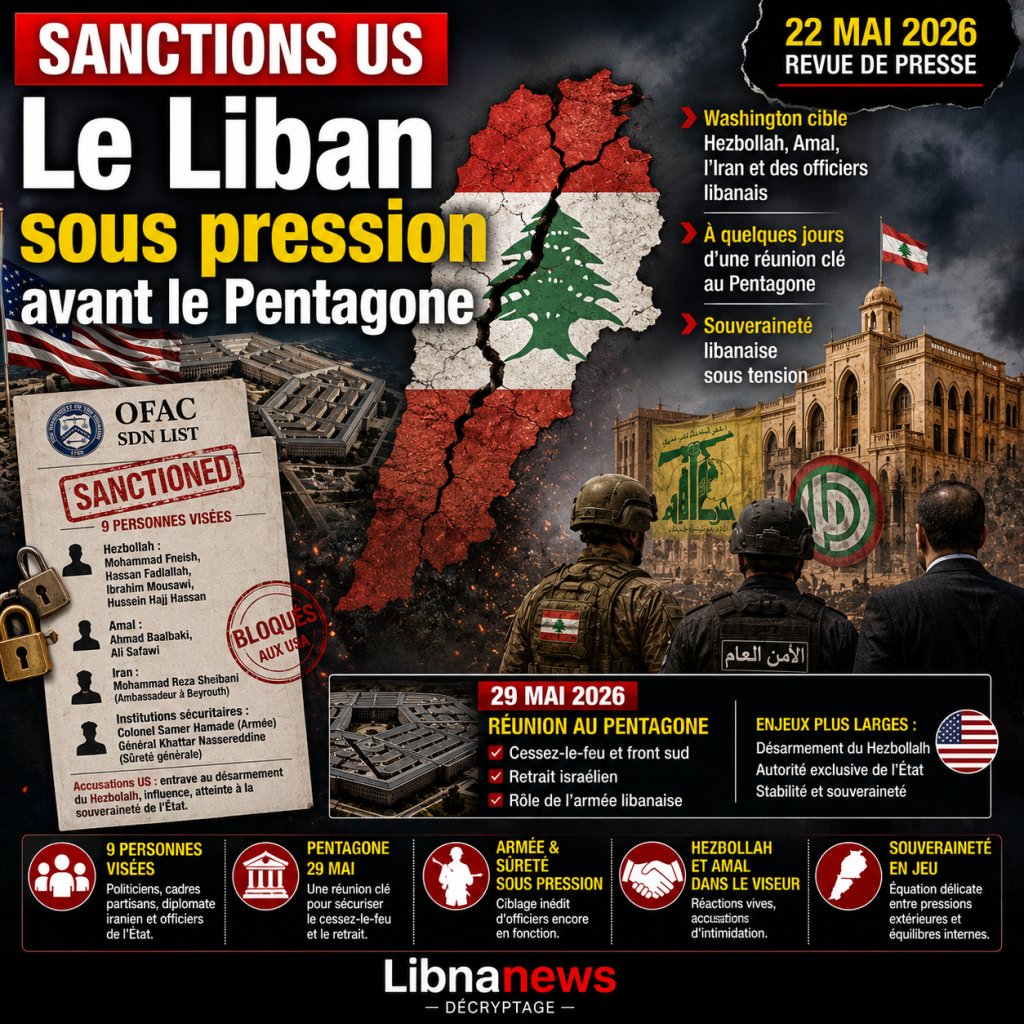
The American sanctions announced against officials linked to Hezbollah, Amal, Iran and two Lebanese security institutions opened a delicate political sequence in Beirut. The measure comes before a meeting scheduled in the Pentagon on 29 May, presented as safe, but already charged with broader issues. It puts the army, the General Security, the presidency, the government and the parties at the same issue: how to defend the authority of the state without causing a new internal divide.
A list beyond the partisan circle
The American decision is aimed at nine people. It first touches on Hezbollah figures. Several Arab media reports that the list includes former Minister Mohammad Fneish, presented by Washington as a leader of the executive structure of the party, as well as three deputies: Hassan Fadllallah, Ibrahim Mousawi and Hussein Hajj Hassan. It also includes the Iranian ambassador in Beirut, Mohammad Reza Sheibani.
The list also includes two personalities related to Amal, Ahmad Baalbaki and Ali Safawi. This choice gives the measure a wider political scope. It is no longer limited to Hezbollah, even if it remains the centre of the American system. It also reaches the environment of the Speaker of the Chamber, Nabih Berri, a central player in any Lebanese internal negotiations.
The most sensitive element concerns two Lebanese security officials. The sanctions were imposed on Colonel Samer Hamade, who was presented in the press as head of an army intelligence bureau in the southern suburbs, and on General Khattar Nassereddine, who was presented as responsible for an analysis function at the General Security. This targeting is described as novel in this type of Hezbollah-related US procedure.
Washington accuses those targeted of contributing to the hindrance to the disarmament of Hezbollah, of supporting its influence or of undermining state sovereignty. These accusations are reported by the press. They are not in themselves a decision of a Lebanese court. They fall under a sanctions scheme decided by the US administration, with financial, diplomatic and political effects.
The novel character of safe targeting
Targeting military and General Security officials changes the scope of the message. So far, US sanctions associated with Hezbollah have mainly concerned political, financial, economic or alleged party relays. This time, the measure falls within the scope of the security institutions still active in the State.
This change creates an immediate risk. It can be read by Washington as a pressure to protect institutions from Hezbollah’s influence. It can also be interpreted by other Lebanese actors as a monitoring of the institutions themselves. This double reading explains the strength of reactions.
The question is not only legal. It affects internal trust. The Lebanese army remains one of the few institutions that still enjoy a relatively broad national image. General Security, for its part, plays a sensitive role in border, administrative and security management. Where names derived from these devices are included, the penalty shall exceed the person. It sends a signal to the entire system.
The measure also comes at a very specific time. A Lebanese military delegation must travel to Washington for a meeting in the Pentagon, in a framework linked to the ceasefire, the southern front and the Israeli withdrawal. The timetable gives sanctions an additional dimension. They seem intended to mark the ground before the discussions.
American Pressure Before the Pentagon
The meeting scheduled for May 29 is officially described as safe. The mandate referred to in the press covers issues on the ground: consolidation of the ceasefire, monitoring Israeli withdrawal, implementation of arrangements related to the South and the role of the Lebanese army. But this technical framework is not enough to ease suspicion.
For Washington, the southern issue cannot be separated from the issue of Hezbollah’s weapons. Sanctions recall this priority. They indicate that the United States wants to place state security sovereignty at the centre of the discussion. In this scheme, the Lebanese army is expected to become the main actor in stabilization.
For Beirut, the risk is that a broader agenda will be imposed than the one it intends to discuss. The Lebanese authorities seek to maintain a distinction between technical monitoring of the ceasefire and political negotiations on the future of weapons. This distinction is fragile. It depends on the ability of the government and the presidency to speak with one voice.
Prime Minister Nawaf Salam is following up with former Ambassador Simon Karam, responsible for the negotiating side. The Presidency also conducts diplomatic contacts with Arab relays. These steps show that the Lebanese State wants to maintain civilian control over a process involving military personnel. That is an essential point. A military delegation cannot alone make such a political decision.
Hezbollah and Amal denounce intimidation
The reactions of Hezbollah and d Hezbollah believes that sanctions against MPs, partisan leaders and officers are part of an attempt to intimidate the United States. It presents the measure as a political support for Israel and as a pressure against those who refuse the imposed disarmament from the outside.
The party also insists on targeting security institutions. In his account, this point would prove that Washington not only seeks to punish Hezbollah, but also to weigh upon the Lebanese state before the Pentagon meeting. This reading is intended to reverse the American argument. Instead of seeing sanctions as a defence of sovereignty, Hezbollah describes them as an infringement of sovereignty.
Amal rejects the sanctions against Ahmad Baalbaki and Ali Safawi. The movement sees it as an attack on its political role and its place in the national balance. This reaction counts because Amal occupies a pivotal position. The Nabih Berri party remains linked to Hezbollah in the Shiite tandem, but it also retains a major institutional function through the parliamentary presidency.
The debate therefore concerns the same concept: sovereignty. Washington says it wants to help the Lebanese state regain the monopoly on security decisions. Hezbollah and Amal respond that foreign pressure weakens institutions and marginalizes a major political component. These two stories clash without meeting each other.
A tool for political remodeling
Sanctions are not just punitive measures. They also function as a tool for reshaping the balance of forces. By targeting MPs, Amal officials, an Iranian diplomat and two security officials, Washington sends several messages at once.
The first message concerns Hezbollah. The United States wants to reduce its capacity to act through institutions and to block disarmament. The second message is about the political environment of the party. By touching personalities related to Amal, Washington reports that Hezbollah’s relays or partners are not out of reach. The third message concerns security devices. He states that the alleged cooperation with the party may expose officials in office.
This strategy can produce contradictory effects. It can encourage some Lebanese actors to stand out from Hezbollah. It can also strengthen solidarity between the forces concerned, especially if the measure is perceived as collective or community. The risk is known in Lebanon. Any external pressure can be recovered by internal actors to consolidate their base and denounce political aggression.
The remodeling sought therefore depends on the reaction of the institutions. If the Lebanese State manages to maintain a clear line, sanctions can become a lever in wider negotiations on arms control. If the state divides, they can instead aggravate internal fragmentation.
The army at the center of a delicate equation
The army is placed in a particularly sensitive position. Western and Arab partners present it as the institution capable of stabilizing the South and incarnating state authority. But it cannot resolve an old political conflict alone. Its operational role depends on the decisions of the civilian power, the balance of forces on the ground and Israel’s reaction.
The controversy over the delegation of the Pentagon illustrates this fragility. Discussions focused on the composition of officers to participate in the discussions. The military command recalled that officers represent the homeland and not a denominational affiliation. This development aims to protect the institution from dangerous debate.
Lebanon cannot ask the army to act as a national arbitrator while submitting it to permanent community readings. Nor can he transfer to him a responsibility that falls under the Government, Parliament and the Presidency. The issue of Hezbollah weapons, Israeli withdrawal and southern control requires a political decision. The army can execute a warrant. She can’t invent.
Sanctions against an army officer exacerbate this tension. They put the institution under pressure without necessarily giving it the political means to act. That point will be decisive in Washington. The success of a security framework will depend less on the rank of officers present than on the clarity of the Lebanese decision.
The role of Nabih Berri and Parliament
Targeting Amal-related personalities also places Nabih Berri in a pressure zone. The Speaker of the Chamber remains a key interlocutor in internal arrangements. It can block, slow down or facilitate compromises. Washington knows that the issue of Hezbollah cannot be addressed without taking Berri’s role into account.
This indirect pressure comes as Parliament remains one of the few places able to give a legal framework to national decisions. Any changes in the role of the army, in the security of the South or in reconstruction policies will have to pass, sooner or later, through institutional arbitrations. Sanctions can therefore also address the environment for future internal negotiations.
The difficulty lies in the nature of the Lebanese system. The country operates through balances, compromises and cross-guarantees. Pressure that bypasses these mechanisms can create a useful shock, but it can also block actors in defensive positions. By targeting relatives of Amal, Washington seems to want to test Berri’s margin against Hezbollah.
This involves a risk. If Amal believes that he is directly threatened, he will be less inclined to distinguish himself from Hezbollah. If, on the contrary, pressure pushes to reaffirm the role of the State, it can open up a political space. There’s no way to figure it out yet.
The limits of a sanctions strategy
Sanctions have a real effect. They financially isolate, make transactions more difficult, complicate travel and report a political gap. They may also discourage partners from dealing with those affected. For the United States, they offer a fast, less costly tool than direct intervention and more visible than a simple communiqué.
But they also have limits. They do not replace a Lebanese strategy. They do not resolve the issue of Israeli withdrawal. They do not say how the army can deploy to all sensitive areas. Nor do they guarantee the accession of a large part of the population to a disarmament process.
In Lebanon, an externally imposed decision can be politically fragile, even if it responds to a real demand from the state authority. The restoration of the State monopoly on weapons requires an internal agreement, a timetable, security guarantees and a clear response to Israeli violations. Without these elements, the sanction can harden positions more than it unlocks them.
The sequence opened by Washington thus puts the Lebanese state before a choice of method. He can use US pressure to speed up a national debate on sovereignty. It can also be subjected to this pressure as an additional constraint, at the risk of seeing institutions themselves become a confrontational ground.
A disputed sovereignty
The word sovereignty goes back to all sides, but it does not mean the same thing. For Washington, he refers to Hezbollah’s disarmament and the government’s exclusive authority over security matters. For the opponents of sanctions, he refers to the refusal of foreign pressure and the defence of the country against Israel. For Lebanese institutions, it should designate a capacity to decide, execute and protect the population.
This third sense remains the most difficult to build. Lebanon has no shortage of declarations on sovereignty. There is a lack of an agreed mechanism to translate it into decisions. The Pentagon appointment will be a first test. He would like to know whether the Lebanese delegation could remain in a technical mandate or whether sanctions had already turned the meeting into a political test.
Immediate development will depend on three factors. The first is the response of the Lebanese authorities to American pressure. The second is Hezbollah’s attitude to the Washington process. The third is Israel’s behaviour on the southern front, where any escalation would reduce the negotiating margin and place Lebanese institutions under security emergency.




