

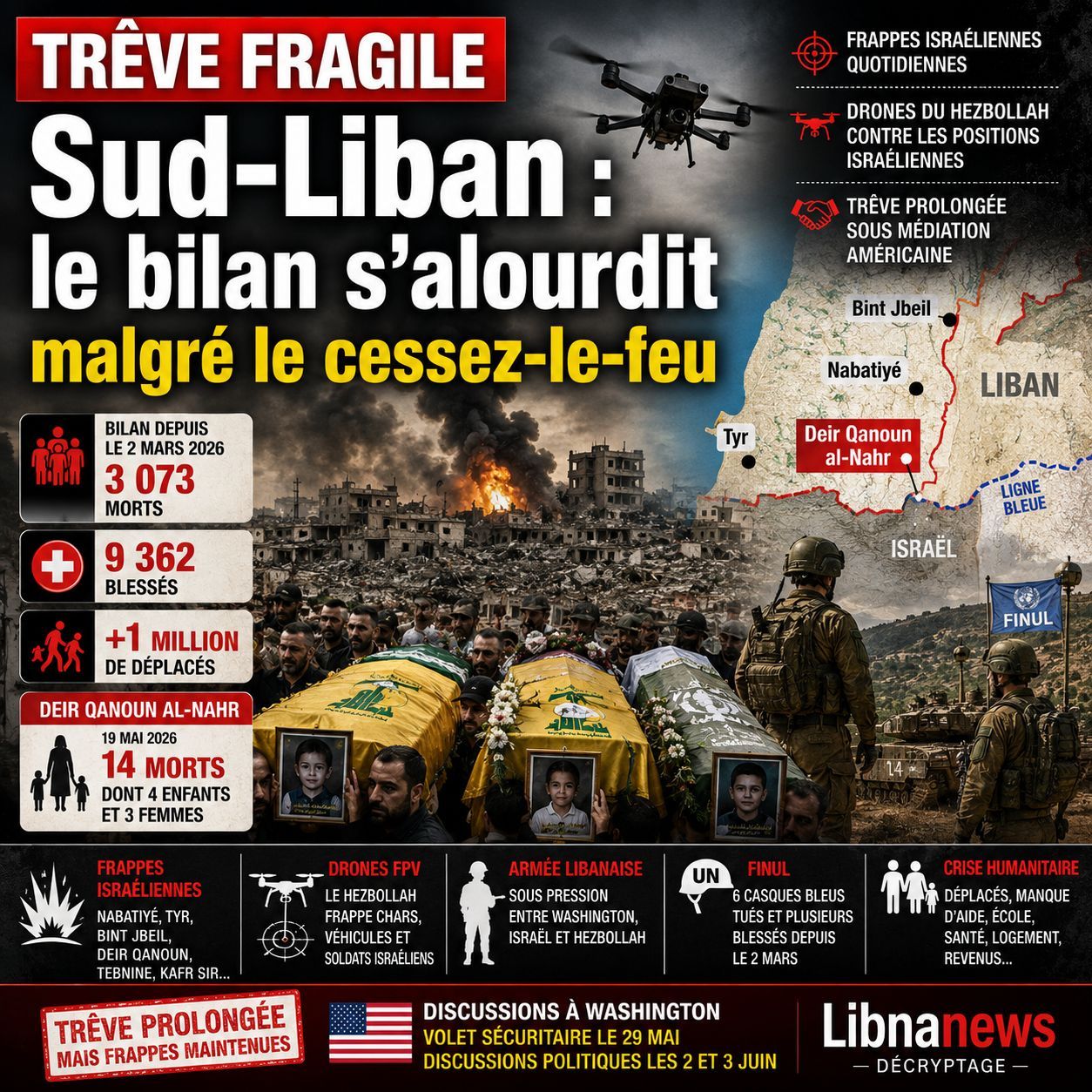
South Lebanon entered the weekend of 22 May 2026 without a real return to calm, despite the extension of a truce negotiated under American mediation. Israeli bombardments continue in Tyre, Nabatiyah and Bint Jbeil. Hezbollah responds with drone attacks, fire and operations against Israeli positions located or advanced near the border. The Lebanese army and UNIFIL remain present, but their role remains constrained by continued hostilities, destruction and the lack of agreement on Israeli withdrawal.
The human balance sheet measures the crisis. The Lebanese Ministry of Health brought the cumulative impact of the offensive launched on 2 March to 3,073 deaths and 9,362 injuries. Among the victims identified in recent days are women, children, rescue workers and residents who remain in their villages despite evacuation orders. More than one million people remain displaced, sometimes far from the South, sometimes a few kilometres from their homes, waiting for a security window to return. So this war no longer has just one front line. It has a civil, family and economic geography.
A prolonged but almost theoretical truce
The ceasefire announced on 16 April and extended for 45 days after discussions in Washington, D.C., was to open a period of reduction of hostilities. It did not produce the expected effect. Israeli strikes resumed only a few hours after the announcement of the extension. They affected southern localities and travel routes. Hezbollah, for its part, has not stopped its operations against Israeli soldiers. Each camp accuses the other of rendering the truce inoperative.
The diplomatic calendar remains active. A security component must open at the Pentagon on May 29. Political discussions are to follow on 2 and 3 June. Beirut seeks Israeli withdrawal, halting the strikes and restoring its authority south of the Litani. Israel calls for guarantees against the military return of Hezbollah to the Blue Line. Washington wants to install the Lebanese army at the heart of the device. These three objectives overlap, but they do not order the parties in the same way.
The main difficulty lies in this reversal of priorities. The Lebanese authorities claim that there can be no stabilization if Israeli forces remain in Lebanese territory. Israel believes that a withdrawal without disarmament or neutralization of Hezbollah would create an immediate threat to the north of its territory. Hezbollah refuses to discuss its weapons while strikes are aimed at Lebanon and Israeli positions are maintained in the South. The truce thus becomes a diplomatic framework without a clear coercive mechanism.
South Lebanon: Deir Qanoun al-Nahr in the centre of the shock
The massacre of Deir Qanoun al-Nahr crystallized anger. On 19 May, an Israeli strike struck the town of Tyre District. The final report from the Lebanese Ministry of Health reported 14 deaths and 3 injuries. Among the deaths are four children, including one Syrian child, and three women. Among the wounded is also a Syrian child. This assessment was confirmed the following day by the health authorities. This is one of the most deadly episodes since the announcement of the April ceasefire.
At the funeral, relatives carried portraits of a decimated family. Ali Reda Dibo identified, in front of a news agency, her 33-year-old brother, who was killed in his home with his wife and their three children. Children were 1 year old, 6 years old and 8 years old. These details gave a precise face to a balance sheet often summarized in figures. The coffins, some of which were covered with Hezbollah flags and the Amal movement, also recalled the interlocking of civil mourning, political affiliation and community mobilization.
The Israeli army claimed to have targeted a Hezbollah member in a structure used for military purposes in the Deir Qanoun area. She assured that she had used specific ammunition and aerial surveillance to mitigate civilian casualties. This version is contested in Lebanon, where the authorities and the inhabitants stress the presence of families in the building. The file illustrates the central fracture of this war: Israel presents its strikes as targeted, while Lebanon retains its human effects and destruction in inhabited areas.
Nabatiyah, Kfar Sir, Tebnine: an expanded map of the strikes
On 19 May, other strikes struck Nabatiyah and Kfar Sir. A news agency reported at least 19 deaths throughout the day in the South, including women and children. The Israeli army reported targeting more than 25 Hezbollah-related sites between Monday afternoon and Tuesday afternoon. The affected localities show that the escalation is no longer confined to villages directly attached to the border. It also reaches areas of the rear-front, where displaced families have sometimes been refugees.
The previous days had already been marked by an increase in strikes. The Lebanese press reported that the Lebanese Ministry of Health had announced 10 deaths and 27 injuries in raids in southern Lebanon. On the previous day, a heavier record of 22 deaths, including eight children, had been reported following vehicle strikes and several villages. These figures show a continuous sequence, not an isolated incident. They contradict the idea of lasting appeasement after the Washington talks.
The sectors of Nabatiyah, Tyre and Bint Jbeil remain the most mentioned in recent balance sheets. Strikes were reported to Deir Qanoun al-Nahr, Nabatiyah, Kfar Sir, Dweir, Tebnine, Qalaouiyah, Harouf, Jibchit and Saksakiyeh. Some attacks are targeting houses. Others affect vehicles, roads, relief points or buildings that Israel describes as Hezbollah infrastructure. This dispersion maintains permanent pressure on the population. It also prevents municipalities from planning returns, even temporary ones.
The case of Saksakiyeh, in the Saida district, had already reported the widening of the danger. Media sources reported seven deaths, including one girl, and 15 injuries, including three children. In Jibchit, reports from the Lebanese press reported that several members of the Fahs family were killed in a strike, while they were in a place they thought was safer. These episodes feed a sense of lack of refuge. The inhabitants no longer know whether the danger is confined to the front or whether it follows the displaced.
Affected First Aid and Care Centres
First aid workers and care facilities are also affected. Strikes targeted points of the هي In Harouf, three relief workers were also killed in a recent attack. The Lebanese Ministry of Health accuses Israel of directly targeting relief personnel. Israel, for its part, supports the fact that it is hitting Hezbollah-related infrastructure. This divergence makes it almost impossible to read the facts by consensus.
Hezbollah relies on FPV drones
The conflict is also taking place in the way Hezbollah adapted its operations. The movement increasingly uses FPV drones, sometimes guided by fiber optics, against Israeli positions, tanks, vehicles and groups of soldiers. These devices cost little, fly low and complicate interference devices. A news agency recorded dozens of videos published by Hezbollah, including a significant part after the announcement of the truce. The movement seeks to show that the Israeli presence in the South remains vulnerable.
The Hadatha sector has become one of the symbolic points of this war of wear and tear. The Lebanese and Arab press reported that Hizbullah claimed to have rejected another Israeli attempt in the area. The party referred to the destruction of a fourth tank and the withdrawal of Israeli force towards Rhaf. Israeli media also reported the injury of an armoured brigade commander and several soldiers by a drone launched by Hezbollah. These statements are part of a communication battle, but they confirm the intensity of fighting around certain axes.
Israel maintains evacuations and destruction
Israel responds by airstrikes, artillery fire and evacuation orders. The Israeli army has repeatedly asked the inhabitants of villages in the South to leave their homes and move towards open areas or north. On 3 May, she had sent a warning to 11 localities. On 2 May, another alert concerned nine villages. These messages are broadcast in a language presented as preventive, but they produce a de facto forced displacement. Families leave without knowing if they will be able to return or if their house will remain standing.
Land destruction exacerbates this uncertainty. Houses are demolished or rendered uninhabitable in border villages. Israel claims to destroy positions or installations used by Hezbollah. Lebanon denounces a policy of emptying and destroying the village fabric. Both narratives contrast, but the effect on the population is measurable. A destroyed house closes the possibility of an immediate return. A cut-off road slows down the rescue. An inaccessible field deprives a family of income. War settles in walls, lands and agricultural seasons.
At the Israeli military level, South Lebanon is presented as a necessary buffer zone. Israel said that it wanted to prevent Hezbollah from returning to direct contact with the border and threatening northern localities. Media sources reported a presence of up to 10 kilometres in some areas. For Lebanon, this presence constitutes an occupation. President Joseph Aoun called on the United States to put pressure on Israel to stop the strikes, bulldozing and destruction. This demand remains at the heart of the Lebanese official position.
Lebanese Army captured between Washington, Israel and Hezbollah
The Lebanese army is therefore in a difficult position. It is called upon by Washington, a part of the international community and the Lebanese executive to regain control of the South. But it cannot fully deploy to areas where the Israeli army still operates and where Hezbollah retains armed capabilities. It must also avoid appearing as the instrument of an external agenda. This caution is further reinforced by recent United States sanctions against Lebanese security officials accused of cooperating with Hezbollah.
The internal debate is lively. Deputy Hassan Fadallah, a figure of Hezbollah, accused Washington and Israel of wanting to instrumentalize the Lebanese army against the Resistance. Prime Minister Nawaf Salam defends the logic of a single State holding the decision on war and peace. According to the Lebanese press, Minister of Foreign Affairs Youssef Raggi stressed the need for a durable ceasefire, the release of Lebanese land and a country free from foreign occupation and any illegal armed organization. These formulations show that the southern front is going through all Lebanese political life.
UNIFIL under increasing pressure
UNIFIL remains present, but its space for action is shrinking. Since the resumption of hostilities on 2 March, six peacekeepers have been killed and several others injured in southern Lebanon, according to the mission. The patrols continue, coordination with the Lebanese army continues, but the United Nations force cannot impose the silence of arms alone. It monitors, reports, sometimes facilitates contacts and recalls Resolution 1701. It does not replace either a withdrawal agreement or a political decision on Hezbollah weapons.
More than one million internally displaced persons, a lasting crisis
The situation of internally displaced persons now weighs as much as the front. The International Organization for Migration reports that more than one million people remain displaced in Lebanon. Some Lebanese estimates suggest a larger volume, up to 1.6 million people who have fled or been affected by evacuation orders and bombings since 2 March. Families from the South live with relatives, schools, public buildings, rented apartments or improvised shelters. Many are not in official centres, which makes aid difficult.
Needs exceed the food emergency. Internally displaced persons need medicines, care, documents, transportation, school for children and alternative income. Farmers in the border strip lose access to their orchards, olive groves and fields. Shops in closed villages no longer have customers. Families who pay rent out of their villages quickly exhaust their savings. Part of this population is already experiencing the consequences of the financial crisis of 2019 and the destruction of 2024. The present war adds a new layer of insecurity.
Finance Minister Yassine Jaber gave an economic measure of the crisis. According to him, the Lebanese economy could contract by at least 7 per cent in 2026 because of the war. Damage is valued at $20 billion. The State has redirected $50 million of public funds to aid for internally displaced persons, while humanitarian funding remains below needs. Of the $300 million requested, only about $100 million had been received. This gap can be seen in schools transformed into shelters, saturated municipalities and overcrowded social services.
A local crisis in a regional power relationship
Finally, the southern front remains dependent on the regional context. Discussions between the United States and Iran, tensions around Gaza, Israeli pressure and US sanctions against Lebanese officials interact with the ground. Hezbollah is not present at the formal table of the Lebanese-Israeli discussions, but it is conditioned by its military capacity. Israel will not accept a withdrawal without guarantees. Beirut cannot guarantee the disarmament of Hezbollah alone without risking a major internal crisis. So Washington is trying to convert a fragile truce into a secure architecture, before the terrain makes it obsolete.
The next few days will be decisive on three concrete points. The first will be the level of the strikes around Tyre, Nabatiyah, Bint Jbeil and Marjayoun. The second will be the intensity of Hezbollah drone attacks on Israeli units in the south. The third will be the ability of the Lebanese army to participate in the Washington talks without being accused of taking sides in an internal confrontation. In Deir Qanoun al-Nahr, families buried this week already give the debate a reality that diplomatic communiqués can no longer circumvent.




