

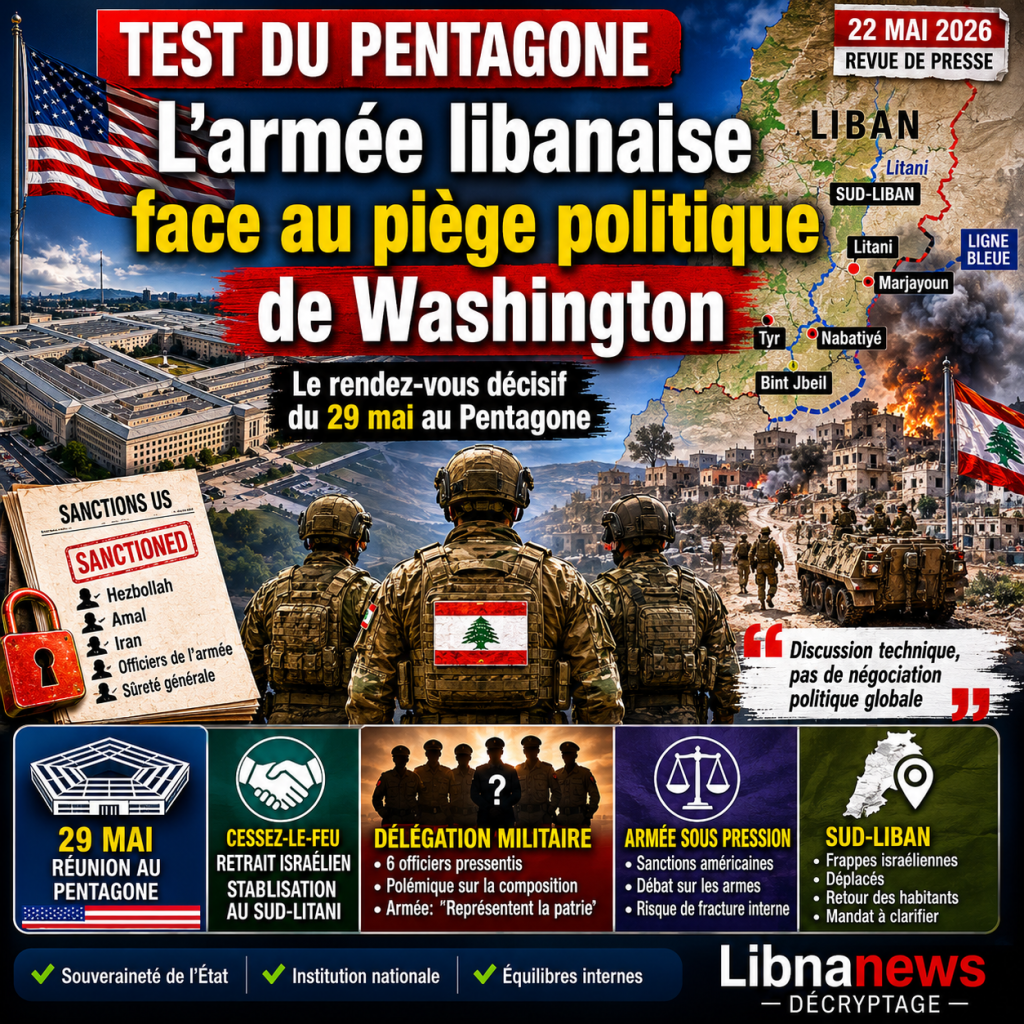
The meeting scheduled for 29 May in the Pentagon places the Lebanese army at the centre of a political and security test. Officially, the delegation sent to Washington must discuss the ceasefire, Israeli withdrawal and stabilization arrangements in the South. But American sanctions, polemics about the composition of the military group and the debate on Hezbollah’s weapons turn this technical meeting into a test for the Lebanese state.
The Pentagon, the first stage of a sensitive journey
The sequence is all the more sensitive as it comes after three rounds of indirect discussions already organized in Washington. These meetings were held, according to the Arab press, on 14 and 23 April, and then on 14 May, in a United States-sponsored framework involving Lebanese and Israeli representatives in Washington. The new stage must be held at the Pentagon. It opens a different, more military format, but the Lebanese power wants to avoid it being interpreted as a diplomatic shift.
The mandate posted remains limited. Officers must deal with the conditions for consolidating the ceasefire, the chronology of an Israeli withdrawal from the remaining occupied points and the needs of the army to ensure a more effective presence south of the Litani. The most political demands, such as the return of prisoners, reconstruction, the sustainable return of the inhabitants to the border villages and guarantees of stability, are being returned to a later stage, expected in early June to the US State Department.
This separation between the military and political aspects is at the heart of the Lebanese strategy. It allows the government to present the meeting on 29 May as an execution discussion, not as a comprehensive negotiation on peace, Hezbollah weapons or normalization with Israel. It also protects the army. A military delegation cannot carry alone a debate that engages the sovereignty, the internal balance of the country and the relationship with an armed party still influential on the ground.
Lebanese Army: a delegation scrutinized before its departure
The composition of the delegation had become a political subject even before its departure. According to press reports, the authorities wanted to form a technical team composed of officers of different specialties. A Lebanese newspaper put forward a list of six names. It would include Generals Georges Rizkallah, Ziad Rizkallah and Omar Halihal, General Engineer Wael Abbas, as well as Colonels Mazen Al Hajj and Wadij Rafoul. The same media refers to the possible participation of the Lebanese military attaché in Washington, General Olivier Hakmeh, without specifying whether he would be a member of the main group or associated with the meetings.
This information was not formally confirmed at the time of publication. However, they were sufficient to trigger a debate on the denominational distribution of officers. This controversy forced the military command to intervene. In a statement, the army recalled that discussions on the denominational distribution of members of the delegation were not related to the principles of the military institution. She added that the designated officers represent the homeland, remain linked to the doctrine of the army and remain engaged by the national constants.
This development summarizes the issue. Lebanon calls upon its army to incarnate the state, but every issue related to the South, Israel and Hezbollah immediately reacts to community readings. The command therefore wants to ensure that officers are not judged according to their supposed affiliation rather than their function. In a country where denominational balances structure institutions, this reminder is more than an administrative formula. It is a defence of the army as a common national space.
A national institution exposed to polarization
The institution’s vulnerability lies in its role. The army remains one of the few structures that maintain cross-cutting confidence, despite the financial crisis and the deterioration of the state’s capabilities. Western and Arab partners see it as a support point. Part of the opinion sees this as the only instrument capable of restoring state authority to the south. But this confidence can crack if the institution is perceived as the tool of one external agenda or one Lebanese camp against another.
The American sanctions announced before the meeting increased this tension. They targeted officials linked to Hezbollah, Amal, Iran, as well as Lebanese security officials. For Washington, they are part of a strategy to reduce obstacles to the restoration of state authority and the disarmament of Hezbollah. For Hezbollah, Amal and their supporters, they appear as a direct pressure against a Lebanese component and against public institutions on the eve of a sensitive appointment.
The timetable reinforces this reading. The sanctions precede the Pentagon meeting by a few days. They also intervene while American officials seek to impose a reading centered on the exclusive sovereignty of the state. The opponents of this pressure see this as an attempt to reshape the internal power relationship. In both cases, the army is exposed. It is presented as a lever for the return of the State, while being suspected by some that it can be pushed towards internal confrontation.
Refusal of direct coordination with Israel
Another topic feeds Beirut’s caution. According to press reports, the Israeli side would seek to establish a form of direct contact with a specific military unit in the South. On the contrary, the Lebanese command favours any passage through the existing coordination mechanism, in order to preserve unity of decision and avoid a direct bilateral relationship that could be exploited politically. This nuance is essential. It affects the difference between military management of a ceasefire and security coordination with Israel.
Sources close to the case claim that the Lebanese delegation has not signed a joint security memorandum or direct military coordination with the Israelis. Its mission would be to work towards a comprehensive ceasefire and to present the army’s readiness to take over the area south of the Litani after an Israeli withdrawal. However, this availability remains conditional. It requires logistical support, adequate resources and a sustained reduction in violations on the ground.
This material condition is often underestimated. Deployment of the army to a destroyed area is not limited to stationing and patrolling. There is a need for practical roads, means of transport, communications, long-term units, clear rules of engagement, appropriate intelligence and coordination with civilian authorities. People must also be able to return. Without the return of civilians, deployment may become a military presence in empty or unstable territory.
Civil power faced with two requirements
The government must therefore meet two requirements. The first one is external. It must convince its partners that the Lebanese State takes the issue of southern control seriously. The second is internal. It must avoid that the strengthening of the army is experienced as an operation directed against a community or as the execution of a road map imposed by Washington. These two requirements may contradict whether they are not accompanied by a clear public discourse.
The role of civil power is decisive. President Joseph Aoun, Prime Minister Nawaf Salam and those responsible for diplomatic follow-up must clarify what will be discussed in the Pentagon and what will not be discussed. The meeting between the Head of Government and former Ambassador Simon Karam, responsible for the negotiating part, shows the will to maintain political leadership. This signal is important. The army must not become the sole interlocutor of a process that concerns the whole state.
The Presidency also seeks to frame the sequence through Arab contacts. Discussions were reported with representatives of Egypt and Qatar. The message is double. Beirut wants to show that it’s not a one-on-one with Washington. He also wants support to strengthen the official position. Qatar continues to provide practical assistance to Lebanese institutions. Egypt, for its part, remains a diplomatic actor familiar with issues affecting Israel and regional security.
The South, place of the real test
These supports do not remove the internal fracture. Hezbollah believes that halting Israeli strikes is the condition for any reconstruction of the State. Its opponents say that the existence of weapons outside government control prevents the state from fully resuming its role. The army is therefore called upon to perform a function which the political system has not yet decided. It must protect without provoking, deploy without appearing as a substitute for a political decision, and cooperate with partners without being accused of dependency.
The South will be the place for the real test. As long as the Israeli strikes continue, even on an ad hoc basis, the supporters of Hizbullah’s arms retention have an argument. As long as Hezbollah retains its own military capacity, supporters of a state monopoly of force have their own. Between the two, the army can only move forward with a precise mandate and verifiable guarantees. Israeli withdrawal, if it occurs, will have to be controlled. The presence of the army must be visible. Displaced populations must be able to return to acceptable conditions.
The American strategy also has a limit. Washington wants to strengthen the Lebanese army, but its pressure can weaken the institution if it is perceived as an injunction that circumvents internal balances. Military assistance, training and logistical support can be useful. But they do not replace national legitimacy. A better equipped army can succeed only if the political power gives it an accepted mandate and if foreign partners avoid exposing it to excessive polarization.
Strengthening the army without creating a breakup
The opposite danger also exists. Refusing any reinforcement in the name of fear of a fracture would mean keeping the state in powerlessness. Lebanon cannot live with several security decision-making centres for long. Nor can he ask the people of the South to return to their villages without a recognized, visible and sustained mechanism. The question is not whether the army should be strengthened, but how it should be strengthened without turning that reinforcement into internal provocation.
A lead in the press relates to a gradual strategy of monopoly of force. Sources claim that the army has a multi-year plan to extend state authority throughout the country. The plan was said to have been hampered by Israeli attacks and the context of war. Again, the central point is the calendar. A five-year plan does not produce the political effect of an immediate decision. However, it can provide a more realistic framework if field conditions and logistical support follow.
The Israeli military context further increases this pressure. According to the Arab press citing Israeli media, military officials in Israel are questioning the usefulness of maintaining in certain areas of the South, while the Washington negotiations are presented as a possible outcome. This expectation does not guarantee any progress. It only shows that the diplomatic calendar also acts on Israeli military calculations. For the Lebanese army, this is crucial. A partial withdrawal, poorly framed or followed by new strikes, would not create real stabilization. It would only move the crisis to another form of uncertainty.
A method test for Washington and Beirut
The appointment of the Pentagon will not solve the Lebanese dilemma alone. However, it may set benchmarks. If the meeting confirms a technical mandate, focusing on ceasefire, withdrawal and operational needs, it can reduce tensions. If it gives the impression of opening up direct coordination or imposing a sequence of disarmament without consensus, it may reinforce refusals. The difference will depend as much on the documents discussed as on how the Lebanese authorities will report.
Public communication will be crucial. The Lebanese will need to know what has been asked, what has been accepted and what remains under discussion. In such a polarized sequence, official silence leaves room for competing narratives. The rumours about the delegation had already given an example. The army had to intervene to recall its national doctrine. The government will have to do the same on the political content of the process.
The Lebanese army thus enters the Washington sequence with a central role, but a narrow margin. It can be strengthened, supported and deployed. It can prepare for stabilization in the South if the Israeli withdrawal becomes effective. It can also embody a part of the state that many Lebanese want to see returned. But it cannot produce the missing national agreement alone. The next expected development will be the Pentagon, where the boundary between technical discussion and political testing will be closely observed.




