

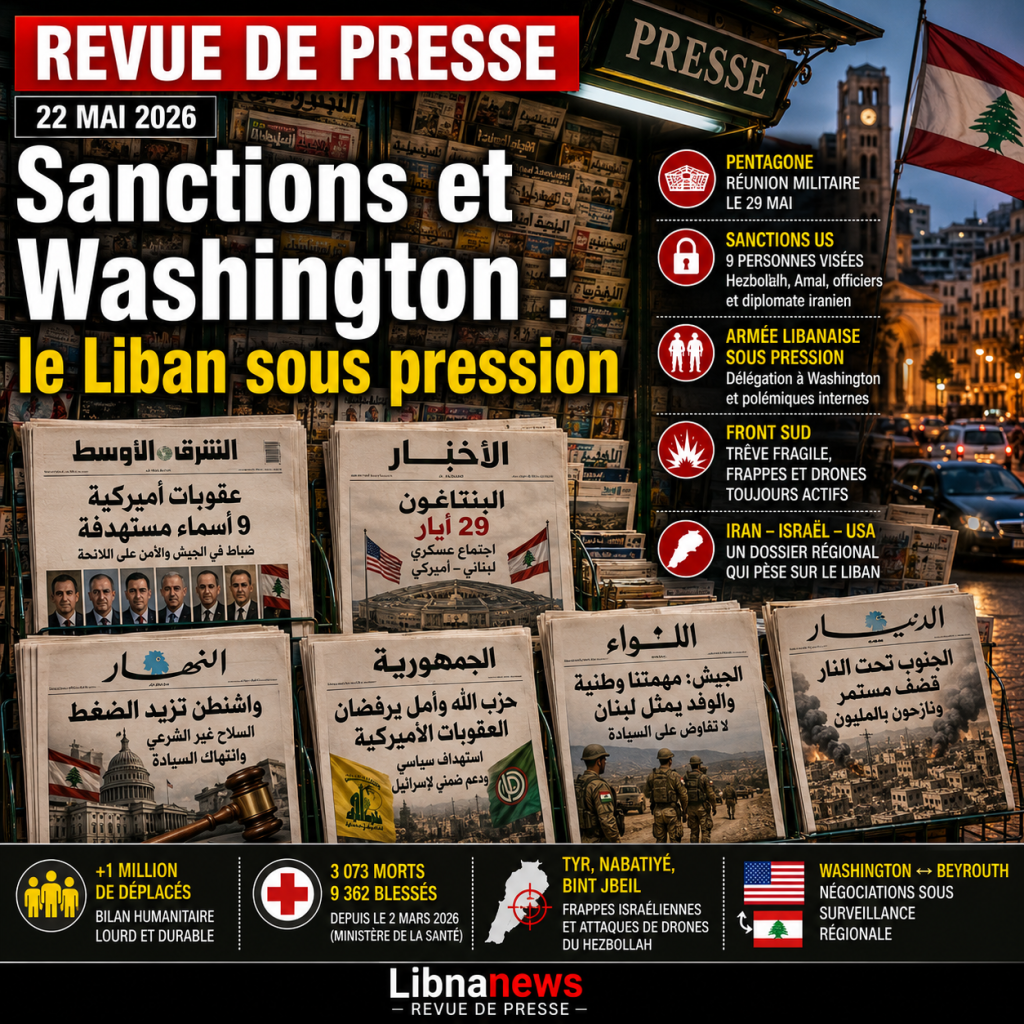
A tight calendar around the Pentagon
The newspapers of 22 May 2026 place Lebanon at the centre of a dense political and security moment. The sequence is dominated by American sanctions, preparations for the military meeting planned for the Pentagon on 29 May, and the direct effects of the regional war on the southern front. According toAl DiyarOn 22 May 2026, the American announcement moved the centre of gravity of Lebanese news. The newspaper points out that the sanctions targeted, for the first time, officers still linked to security institutions, in addition to figures close to Nabih Berri and Hezbollah officials. The same daily sees a message of pressure before the security talks in Washington. He also noted that the army had had to publish a development to defend the national nature of his delegation and to respond to polemics about its composition.
In this climate, the meeting of the Pentagon does not appear as a mere technical meeting.Al AkhbarOn 22 May 2026, claims that the army command finalized the list of the military group to visit the United States. The newspaper states that the announced role of the delegation would be limited to the follow-up to the ceasefire agreement, the timetable for the Israeli withdrawal from the occupied areas, and the preparation of a second diplomatic period scheduled for early June in the US State Department. This precision is important. It shows that Beirut is trying to frame the mission as an implementation issue, not as a comprehensive political negotiation on the future of Hezbollah or on the relationship with Israel.
Sanctions as a tool of pressure
The heart of the crisis lies in the nature of sanctions.Al Sharq Al Awsaton May 22, 2026, states that Washington targeted nine people. The list includes former Minister Mohammad Fneish, three Hezbollah MPs, Hassan Fadallah, Ibrahim Mousawi and Hussein Hajj Hassan, as well as Iranian Ambassador to Beirut, Mohammad Reza Sheibani. It also includes two personalities close to the President of the Chamber Nabih Berri, Ahmad Baalbaki and Ali Safawi, as well as two security officials, Colonel Samer Hamade, presented as head of the army intelligence bureau in the southern suburbs, and General Khattar Nassereddine, presented as head of the analysis department to the General Security. The newspaper insists on the novel character of this extension to the Lebanese military and security circles.
AnnaharOn 22 May 2026, Washington reported that the sanctions were presented as a response to persons accused of obstructing the disarmament of Hezbollah and violating Lebanon ‘ s sovereignty. The newspaper also cites the idea that these measures would be just the beginning. In this reading, American pressure is aimed at putting the issue of the exclusive authority of the State at the centre of national debate. It therefore links sanctions to the disarmament issue, but also to the ability of the Lebanese State to regain full control of security decisions.
Al Liwaa22 May 2026, gives an even more direct formulation of the American position. The newspaper reports that the United States claims to support the Lebanese people and the legal institutions of the State. He adds that the US reward program offers up to ten million dollars for information that disrupts Hezbollah’s financial mechanisms. This announcement reinforces the financial dimension of the arm. It also shows that Washington does not limit its action to the political message. It combines sanctions, diplomatic pressure and war against financing networks.
The reactions of Hezbollah and d-Amal
Local reactions reflect an opposite reading.Al Jumhouriya22 May 2026, reports that Hezbollah describes sanctions as an American attempt to intimidate the Lebanese people and as indirect support for Israeli aggression. The party insists above all that the targeting of Lebanese officers comes on the eve of the Pentagon meetings. He sees it as an attempt to influence security institutions. The same newspaper reports that the Amal movement rejects sanctions against Ahmad Baalbaki and Ali Safawi, which it considers unjustified and directed against his political role.
Al Bina22 May 2026, repeats this reading by stressing that Hezbollah presents sanctions as a response to its refusal to disarmament. The newspaper also reports that the party calls on the state to defend its constitutional, security and military institutions. In this version, the central question is no longer just that of Hezbollah. It becomes that of state sovereignty in the face of external pressure. The newspaper adds that sources close to the Hezbollah-Amal tandem interpret the sanctions schedule as a pressure on Nabih Berri and the army command.
This divergence of reading feeds the internal debate. For supporters of US pressure, sanctions seek to push Lebanon towards a clear decision on Hezbollah weapons. For their opponents, they put Lebanese institutions under threat and risk deepening the community divide.Al BinaOn 22 May 2026, it was suggested that US measures could open a new phase of pressure on the army and security services, imposing a logic of suspicion around certain institutional profiles. The newspaper argues that the issue goes beyond the only issue in the South and touches on the very definition of the state after the war.
The army at the centre of the controversy
The composition of the military delegation thus becomes a sensitive point.Al Diyaron 22 May 2026, reports that the Army Command recalled that the designated officers represent the country and remain committed by the doctrine of the military institution. The development responds to criticisms about the religious balance of the group sent to Washington. It is also used to preserve the image of the army as a national institution, while the forthcoming negotiations cause cross-examination.
Al Sharq22 May 2026, insists on the same clarification. The newspaper reports that the army leadership considers public debates on the denominational distribution of officers unrelated to military principles. He also stressed that the delegation would remain committed to national constants. This sentence reflects the army’s effort to refuse to be dragged into an internal political confrontation. It also shows that the 29 May meeting cannot be isolated from the broader debate on the war, the ceasefire and the future of the southern front.
The Presidency, for its part, is trying to put the discussions within a diplomatic framework.Al Quds Al ArabiOn 22 May 2026, President Joseph Aoun, together with Egypt’s Ambassador Alaa Moussa, reported on developments in Lebanon and the region, in particular the course of the Lebanese-Israeli negotiations in Washington and the Beirut position. The same newspaper also quotes Fadi Karam, MP for the Lebanese Forces, who states that the Israeli withdrawal and deployment of the army can only be completed with the restoration of the role of the State.
South front remains open
On the ground, the South remains the most volatile factor.Al Quds Al Arabion 22 May 2026, reports that Israeli strikes continue despite the ceasefire that entered into force on 17 April and extended until early July. The newspaper cites official reports of thousands of deaths and injuries since 2 March, as well as more than one million internally displaced persons. He also stresses that the attacks of Hezbollah’s bomb drones continue to exhaust Israeli forces in the South. This data links the Washington negotiations to a persistent military reality.
Al Araby Al Jadid22 May 2026, reports that Israeli officers believe that the time for an extension of ground operations in Lebanon could be approaching. The aim would be to repel Hezbollah drone operators and reduce Israeli casualties. But the newspaper also states that the discussions have not yet produced a final decision. This uncertainty gives all its weight to the Pentagon meeting. It comes at a time when war can still shift towards an arrangement or a new military phase.
Al Diyar22 May 2026, quotes the Israeli media according to which field commanders consider the continued use of Israeli forces in the so-called defensive zone in southern Lebanon to be of little use. These officials believe that the Israeli army suffers losses without clear objective, while continuing the destruction of buildings in the southern villages. This reading, if confirmed, indicates that the debate on withdrawal is not just about Beirut. It also crosses the Israeli military apparatus.
The Lebanese issue in the Iranian crisis
Finally, the Lebanese crisis remains linked to the negotiations between Washington and Tehran.Al Sharq Al Awsat, 22 May 2026, reports that Donald Trump insists on the release of the Iranian stock of highly enriched uranium, while the Iranian guide Mojtaba Khamenei sets a red line against the transfer of this stock out of Iran. The newspaper also quotes Marco Rubio, who warns that an Iranian tax system in the Strait of Ormuz would make the diplomatic agreement impossible, while evoking positive signals in the discussions.
Al Quds Al ArabiOn 22 May 2026, Trump reports that Trump claims to want the Iranian stock of highly enriched uranium, without excluding its destruction. The newspaper added that the US president said he was ready to wait for an answer, but also ready to resume the strikes if the answers were not deemed sufficient. In this context, Lebanon appears to be one of the secondary theatres of a wider regional confrontation. Every advance or blockage between Washington and Tehran can therefore affect Lebanese room for manoeuvre.
All these elements place the day of 22 May under the same line of tension. The US sanctions aim to speed up a Lebanese decision on weapons, the Pentagon becomes the place for an institutional test for the army, the South remains exposed to escalation, and the Iranian case continues to determine part of the regional rhythm.
Local politics: the Lebanese state caught between American pressure, military debate and internal fractures
Baabda seeks to keep his hand on the security file
Lebanese political life on 22 May 2026 is dominated by a dual movement. On the one hand, the institutions are seeking to present a consistent official line before the planned military meeting in the Pentagon. On the other hand, parties read US sanctions as a signal to the country’s internal balance. According toAl DiyarOn 22 May 2026, President Joseph Aoun received Interior Minister Ahmad Hajjar in Baabda. The Minister informed him of the general security situation, the measures taken by the services to preserve stability, as well as border and border control procedures at land, sea and air crossings. The same source indicates that the meeting also focused on political developments and the general state of the country. This sequence places the presidency at the centre of a safe, administrative and political management. It also shows that the debate on the southern front is not separated from internal control issues.
In the same context,Al Diyaron 22 May 2026, reports that Joseph Aoun had an exchange with the ambassador of Egypt Alaa Moussa. The discussion focused on developments in Lebanon and the region, as well as on the course of the Lebanese-American-Israeli negotiations in Washington and the Lebanese position. The President also received the Qatari ambassador, Sheikh Saud bin Abdelrahman Al Thani. He reaffirmed Doha’s support for Lebanon, its stability and the positions of the State and Government. He also recalled the continuation of the Qatari aid programme, including a recent delivery of equipment and navigation equipment for Beirut airport. Thus, Baabda tries to compensate American pressure with Arab support. The political message is clear. Lebanon wants to present itself as a negotiating State, but it does not allow itself to be isolated.
Nawaf Salam and preparations for the Washington meeting
The preparation of the Pentagon meeting is not only the responsibility of the army. It also mobilizes the government. According toAl LiwaaOn 22 May 2026, Prime Minister Nawaf Salam received former Ambassador Simon Karam, head of the Lebanese negotiating delegation, to be informed of the last round and the preparations related to Washington. The daily presents this meeting as a sign of official coordination. It comes at a time when US sanctions are changing the political atmosphere and several forces are trying to define the exact meaning of Lebanese participation in the discussions.
The government must therefore manage a difficult equation. It wants to defend a negotiating line without appearing to be engaged in political normalisation. It must also prevent the military delegation from becoming an object of religious suspicion. According toAl JumhouriyaOn 22 May 2026, sources close to the case claim that the official work ceiling remains linked to a clear agenda. This agenda includes the consolidation of the ceasefire, the Israeli withdrawal, the release of prisoners, the return of internally displaced persons and the reconstruction of destroyed villages. It also provides that the State extends its authority throughout the territory, with a central role entrusted to the army in the area south of the Litani to the international border. This formulation allows the government to say that the debate is about the application of state decisions, not a secret arrangement.
Army refuses confessional trap
The composition of the future military group triggered controversy. Exchanges in the media and on social media focused on the denominational distribution of officers. According toAl SharqOn 22 May 2026, the army command, by the direction of the orientation, declared that these discussions did not fall within the principles of the military institution. He claimed that the designated officers represent the homeland, that they remain linked to the doctrine of the army and that they carry out the decisions of the command within the framework of their national duty. The formula aims to protect the army from a debate that could weaken before Washington. It also seeks to close the door to readings that reduce the institution to a balance of communities.
Al DiyarOn 22 May 2026, he repeated the same statement and stressed that the command had tried to cut pressure. The newspaper places this development in a wider climate of distrust. He recalled that the Lebanese authorities were actively preparing for the Washington meeting, while seeking diplomatic support for the official position. In this context, the army is both a technical actor and a political symbol. It must reassure its foreign partners, but also the internal forces. It must meet the requirements of the ceasefire without being perceived as an instrument of one camp against another.
According toAl AkhbarOn 22 May 2026, the military delegation was allegedly conceived as a technical task force. The daily indicates that it would be responsible for discussing the mechanism for implementing the ceasefire and the Israeli withdrawal schedule from the occupied areas. He cites a list of six officers of different specialties. This information gives a precise relief to the controversy. It shows that the debate is not just about names. It covers the nature of the mission, the limits of the mandate and the fear of a shift towards direct political negotiation.
Nabih Berri and Parliament in the area of pressure
The Speaker of the Chamber, Nabih Berri, appears to be one of the most exposed actors. Sanctions affect figures close to its political environment. They also intervene while Berri remains a central part of any institutional compromise. According toAl BinaOn 22 May 2026, political sources close to the Hezbollah-Amal tandem interpreted the sanctions as a message of pressure against Berri, because of his refusal of a direct negotiation and peace path with Israel. The same reading also refers to the army command, accused by these sources of being pressured to participate in direct coordination with Israel against Hezbollah. This interpretation is not neutral. It reflects the perception of a confrontation over the very definition of the Lebanese mandate in Washington.
The parliamentary dossier is not limited to sanctions. According toAl BinaOn 22 May 2026, Nabih Berri received the Chairman of the Board of Directors of the Habitat Bank, Antoine Habib, with a delegation from the institution, on the occasion of the bank ‘ s 50th anniversary. The discussion focused on the social role of this institution, particularly with regard to modest, medium-sized incomes and people with special needs. Habib also presented the course of real estate loans and the steps to obtain new financing from Arab funds. This type of meeting places Berri in a broader institutional function. He’s not just about the strategic arm. It also remains at the centre of social, economic and legislative issues.
Parliament is also linked to the debate on the media. According toAl BinaOn 22 May 2026, Information Minister Paul Morcos expressed his confidence in the role of Nabih Berri in reviewing texts deemed necessary to the media sector. The same newspaper reports that Berri discussed with MP Neemat Frem the general situation, political and military developments, as well as national and legislative issues. This section shows that, despite the centrality of the security crisis, the parliamentary agenda continues to exist. But it is taking place under strong political pressure.
Amal, Hezbollah and Lebanese Forces against the State
The partisan reactions accentuate polarization. According toAl JumhouriyaOn 22 May 2026, Amal considered that the sanctions against Ahmad Baalbaki and Ali Safawi were unacceptable and unjustified. The movement sees it as an attack on its political role, which it presents as attached to national constants and to the protection of the State and its institutions. Hezbollah, for its part, believes that American measures against MPs, officers and officials of Amal and Hezbollah constitute an attempt to intimidate. The party claims that the targeting of Lebanese officers on the eve of the Pentagon meetings aims to scare the official institutions.
On the other hand, Lebanese Forces officials defend a reading centered on the state monopoly. According toAl SharqOn 22 May 2026, MP Fadi Karam wrote that the withdrawal of the Israeli army and the deployment of the Lebanese army throughout the territory will not come from what he calls an Iranian weapon, but from the restoration of the role of the State. He added that the process would be complete only with the handing over of Hezbollah’s weapons and accountability for actions against the Lebanese. This statement expresses a hard political line. It places disarmament at the heart of the restoration of the State. It opposes the reading of Hezbollah, which presents its weapons as a defence tool.
Annahar22 May 2026, highlights another indicator of the local debate. His one presents a survey on the public’s attitude towards direct negotiations with Israel and the issue of Hezbollah weapons. The newspaper has 21.9% strong support for direct negotiation and 27.1% partial support, compared with 33.2% strong opposition. On the disarmament of Hezbollah, the same one indicates 44.7% strong support and 13.5% partial support, compared with 26.1% strong opposition. These figures show a divided society, but also a shift in debate towards previously more marginal options. They give political weight to positions calling for a firmer state.
General amnesty reveals another internal flaw
Local politics is not limited to the Washington issue. According toAl DiyarOn 22 May 2026, the debate on the general amnesty remained marked by a strong denominational division. The newspaper refers to the postponement of the case and the issue of Islamist detainees, including Ahmad Al Assir. The subject is sensitive, as it affects the memory of internal violence and the way the State treats detainees linked to security cases. It also reveals the limits of parliamentary compromises in a climate of distrust.
In this context,Al Diyaron 22 May 2026, reports that the army commander, General Rodolphe Haykal, received the Mufti of Akkar, Sheikh Zaid Mohammad Bakkar Zakaria. Both men referred to the general situation and stressed the importance of preserving national unity and gathering around the army. This meeting takes on a particular meaning. It intervenes at a time when the military institution is criticized for its participation in the Pentagon meeting and when internal security issues remain very sensitive. The reminder of national unity therefore functions as an internal as well as institutional message.
A political scene suspended from defining the role of the State
The political day of 22 May 2026 shows the same issue in several forms. Who decides war and peace? Who speaks for Lebanon? Who controls arms, borders and negotiations? Responses vary between sources and camps.Al Jumhouriyaon 22 May 2026, insists on an official framework based on the ceasefire, withdrawal, release of prisoners, return of displaced persons and state authority.Al Binaon the same day, on the contrary, sanctions were seen as an attempt to reshape the internal political balance and marginalize a lebanese component.Al SharqandAnnahar, again on 22 May 2026, give more room to voices calling for a firmer state in the face of Hezbollah’s weapons. The result is a tense local scene. Institutions are moving towards Washington, but the parties are mainly preparing for an internal battle on the meaning of this approach.
Citation and speech by political figures: sovereignty, arms and negotiation at the heart of speeches
Joseph Aoun and Nawaf Salam facing official framing
The statements and positions reported by the press on 22 May 2026 show a political scene dominated by the state question. President Joseph Aoun appears in the newspapers as the institutional crossing point for diplomatic and security messages. According toAl DiyarOn 22 May 2026, Joseph Aoun was informed by Interior Minister Ahmad Hajjar of the general security situation, the measures taken to preserve stability and the control of borders and crossing points. The same newspaper also reports its discussions with Egypt’s Ambassador Alaa Moussa on the Lebanese-American-Israeli negotiations in Washington and on the Lebanese position. This framing gives Baabda a precise function. The Presidency is seeking to speak on behalf of a State engaged in negotiations, but concerned with preserving an official line.
In the same register,Al DiyarOn 22 May 2026, the Qatari ambassador, Sheikh Saud bin Abdelrahman Al Thani, quoted as saying that Doha’s support for Lebanon, its stability and the positions of the State and the government, continued. This statement completes the presidential sequence. It highlights the idea of Arab support for the Lebanese line, at a time when Washington is increasing pressure. The Qatari word therefore serves as a diplomatic counterweight. It does not contradict the negotiation process. Rather, it seeks to integrate it into a logic of stability and institutional support.
Prime Minister Nawaf Salam intervenes mainly through coordination. According toAl LiwaaOn 22 May 2026, he received former Ambassador Simon Karam, head of the Lebanese delegation, to examine the negotiating file and the formation of the military group sent to the Pentagon. The political message remains sober. It is not based on a strong statement, but on a government follow-up. This discretion is in itself a choice. It allows Nawaf Salam to show that the case is handled by the State, without opening a public controversy about the nature of the negotiation.
The army as an institution and not as a camp
The word of the army occupies a central place in this sequence. According toAl SharqOn 22 May 2026, the military command responded to the discussions on the denominational composition of the delegation to participate in the Pentagon meeting. He recalled that the officers represent the homeland, act according to the doctrine of the army and remain attached to the national constants. This statement aims to reduce the effect of controversy. She refuses to let the army be read as an assembly of communities. On the contrary, it claims that the institution speaks on behalf of the State.
This position is taken up in a wider atmosphere of suspicion.Al Diyar22 May 2026, reports that the army had to publish this message in order to cut short pressure and doubts on the morality and objectives of the group sent to Washington. Vocabulary is important. It shows that the army is not only called to participate in a technical meeting. It must also defend its legitimacy in the internal debate. Military speech thus becomes a political act in the institutional sense of the term. It aims to protect the army from the accusation of serving a foreign agenda.
InAnnaharOn 22 May 2026, Samir Geagea gave another reading of the role of the army. The leader of the Lebanese Forces claims that the army is an institution of the State, not an autonomous party negotiating or claiming rights on its own behalf. He adds that the responsibility to protect the army and the blood of its soldiers lies with the State in all its institutions. This formula moves the debate. It removes from the army the task of resolving the arms and war crisis alone. It refers this responsibility to political power.
Samir Geagea and the challenge of the Lebanese method
The interview granted by Samir Geagea toAnnaharon 22 May 2026, presents itself as a substantive position on the political system. The title highlighted by the newspaper summarizes his point. The Lebanese method would no longer be useful, and a reassessment of the system would become inevitable. This speech comes on the eve of the centenary of the Lebanese Constitution. It therefore combines the current crisis with a longer state record. Geagea does not limit his remarks to Hezbollah or the South. It raises the question of the functioning of the Republic.
The same interview insists on the need for a sustainable state, not just a halt to fighting.AnnaharOn 22 May 2026, Geagea reported that the current need was not only a new ceasefire. He speaks of a stable and fixed position, capable of ending the chronic anguish experienced by the South for decades. This sentence reflects a clear difference between two logics. The first one is just managing the truces. The second seeks to change the security rules. Geagea clearly places her speech in this second logic.
Annahar, May 22, 2026, also published a survey that gave a political context to this speech. According to the data posted, 21.9% of respondents strongly support direct negotiations between Lebanon and Israel, and 27.1% support it to some extent. On the issue of Hezbollah’s weapons, 44.7 per cent strongly supported the party’s disarmament, and 13.5 per cent supported it. These figures are not a declaration of political responsibility. But they form a background for speeches that call for strengthening the state. They show that the public debate has changed its tone.
Amal and Hezbollah denounce an American message
The reactions of Amal and Hezbollah give the reply to this discourse of restoration of the State through disarmament. According toAl AkhbarOn 22 May 2026, the Amal movement claimed that the American sanctions against Ahmad Baalbaki and Ali Safawi were unacceptable and unjustified. The movement believes that they are aimed primarily at Amal and his political role, which he presents as attached to national causes, the country’s constants, the protection of the State and the institutions. The wording seeks to reverse the American accusation. Amal does not present himself as an obstacle to the state, but as one of its protectors.
Hezbollah adopts a more frontal tone. According toAl JumhouriyaOn 22 May 2026, the party declared that the sanctions of the US Foreign and Treasury Ministries against elected deputies, army and General Security officers, as well as Hezbollah and Amal officials, constituted an American attempt to intimidate the Lebanese people. The party added that targeting officers on the eve of the Pentagon meetings sought to intimidate official security institutions. The message is clear. Hezbollah wants to present sanctions as an act against the Lebanese state, not only against it.
Al Bina22 May 2026, gives a more detailed version of this speech. Hezbollah claims that the American accusation is in fact about the refusal to disarm the resistance and the opposition to the surrender plans that Washington would seek to impose on Lebanon for the benefit of Israel. The party adds that sanctions are a badge of honour for the persons concerned and that they will not change their choices. This statement builds a story of challenge. It seeks to transform a punitive measure into proof of political loyalty.
Jean-Yves Le Drian’s Diplomatic Speech
The French word is distinguished by an alert tone. According toAl Quds Al ArabiOn 22 May 2026, Jean-Yves Le Drian claims that Lebanon is in a dangerous situation for its unity and territorial integrity. He also refers to the division of Lebanese components against Hezbollah and against Israel. This sentence gives a diplomatic framework to the crisis. It is not limited to military conflict. It refers to an internal fracture that threatens national unity.
The Drian goes further in the same interview reported byAl Quds Al Arabi22 May 2026. He claims that part of Lebanese territory is occupied by Israel, while another party sees Hezbollah acting, which he describes as serving Iranian interests. He then welcomed the maintenance of the truce, which, he said, opened a 45-day horizon for further discussions. This speech combines alert and encouragement. It recognizes a serious risk, but it presents the negotiation as an open window.
Al SharqOn 22 May 2026, Le Drian reported similar comments. The newspaper points out that it sees further discussions as a possible way out of the conflict between Israel and Hezbollah. He also believes that the Lebanese leaders involved in this process show courage. This is a notable mention. It provides a form of external support to Lebanese officials who accept the negotiation. It can also be read as a pressure on forces that refuse it.
Donald Trump and Marco Rubio on Iran and its Lebanese effects
American statements on Iran have a direct bearing on the Lebanese climate. According toAl LiwaaOn May 22, 2026, Donald Trump claims that the United States will obtain Iran’s stock of highly enriched uranium. He says Washington doesn’t need it and doesn’t want it, but he wants to stop Tehran from keeping it. The point concerns Iran. Yet it resonates in Lebanon, as sanctions against Hezbollah and Amal occur at the same time as the diplomatic escalation between Washington and Tehran.
Marco Rubio adopts a warning tone. According toAl Quds Al ArabiOn 22 May 2026, the US Secretary of State states that no country supports the idea of an Iranian tax system in the Strait of Ormuz. It considered this system unacceptable and considered that it would be an obstacle to any diplomatic agreement if Iran persisted in that direction. He added that the project posed a threat to the world and described it as illegal. This discourse links nuclear, maritime and negotiation. He states that Washington treats Iran as a global issue, with possible effects on Lebanon.
The same Rubio, quoted byAl Quds Al Arabion 22 May 2026, however, acknowledged some progress in discussions with Tehran. He speaks of positive signs, while refusing an excess of optimism. This shade is important. It shows that American discourse is not just about threats. He left a diplomatic issue open. For Lebanon, this uncertainty is central. A breakthrough between Washington and Tehran can reduce regional pressure. On the contrary, failure can harden the southern front and the battle around Hezbollah’s weapons.
Political speech as a battlefield
The speeches of 22 May 2026 show that each side is trying to define sovereignty. For Joseph Aoun and Nawaf Salam, it passes through an official line, diplomatic contacts and institutional control of the negotiations. For the army, it requires maintaining the unity of the institution in the face of denominational readings. For Samir Geagea, it requires a re-evaluation of the system and lasting stability that goes beyond ceasefires. For Amal and Hezbollah, it also means the rejection of American pressure and the protection of a political role presented as national. For Jean-Yves Le Drian, it depends on negotiations capable of preserving unity and territorial integrity. Finally, for Washington, it involves limiting Hezbollah and settling the Iranian case. These words are not only answered. They draw the fracture lines of the Lebanese moment.
Diplomacy: Washington, Paris and Arab mediations around the Lebanese file
US-sponsored negotiation
Lebanese diplomacy of 22 May 2026 focuses on Washington. The planned appointment in the Pentagon on 29 May became the main crossing point between the cease-fire, the Israeli withdrawal, the role of the army and Lebanon’s place in the regional iron arm. According toAl JumhouriyaOn 22 May 2026, information deemed reliable indicates that President Joseph Aoun is continuing his external contacts to establish a roadmap. It is based on the defence of Lebanon’s interest, the preservation of its sovereignty and the unity of its territory. It also aims to end the war, restore security in the South and pave the way for broader stabilization. The newspaper states that the Pentagon appointment is presented by Washington as the launch of a security route between Lebanon and Israel.
This formulation puts the United States at the centre of the game. Lebanon does not have an ordinary direct channel with Israel. It therefore goes through the American sponsor, while seeking to avoid the image of political normalisation.Al Sharq22 May 2026, reports that there will be no Lebanese boycott of the Pentagon meeting. The newspaper states that the so-called security delegation will visit Washington, but that political sources present it as technical and logistical participation, without any direct political dimension. The most sensitive Lebanese demands, such as the ceasefire, the Israeli withdrawal, the return of prisoners, the reconstruction and the return to the South, would be returned to the political path planned for June.
This division shows a cautious diplomatic method. The military meeting is used to prepare the ground. She can’t fix it. Above all, it must avoid a break in the process. According toAl Akhbaron 22 May 2026, the Lebanese military delegation was informed that its role would be strictly technical. It should work on the implementation of the ceasefire agreement and the timetable for Israeli withdrawal from the occupied areas. The newspaper adds that this work is preparing for a next stage of political negotiations in early June in the US State Department. The same article points out that the composition of the military group has already been decided around six officers of different specialties.
Lebanon between Arab support and American pressure
The Presidency seeks to give this path an Arab and not only American framework. According toAl DiyarOn 22 May 2026, Joseph Aoun received Ambassador Alaa Moussa of Egypt to discuss Lebanese and regional developments, as well as the course of negotiations in Washington and the Lebanese position. This meeting gives Cairo a place of consultation. She also points out that Beirut does not want to leave the case to the United States alone. Egypt remains a leading Arab player in regional security issues, especially when they affect Israel and the balances of the Levant.
Qatar is also present in this sequence.Al DiyarOn 22 May 2026, Joseph Aoun received the Qatari ambassador, Sheikh Saud bin Abdelrahman Al Thani. He reaffirmed Doha’s support for Lebanon, its stability and the positions of the State and Government. He also recalled the continuation of Qatari aid, including a recent supply of equipment and navigation equipment for Beirut airport. This support is diplomatic and practical. It shows that Lebanon is seeking support to strengthen its institutions, at a time when American sanctions are putting a part of these institutions under heavy pressure.
The government is accompanying this line. According toAl LiwaaOn 22 May 2026, Prime Minister Nawaf Salam received former Ambassador Simon Karam, head of the Lebanese delegation involved in the negotiating process. The meeting focused on the ongoing discussions, the follow-up to the final stage and the formation of the military group to visit the Pentagon. This sequence shows that the file is not left to the army alone. He remains under civilian control. This preserves an institutional hierarchy and reduces the risk of interpretation that a military delegation alone would negotiate a sovereignty issue.
Paris alerts on the unity of Lebanon
France intervenes with a more anxious tone. According toAl Quds Al ArabiOn 22 May 2026, Jean-Yves Le Drian, Special Envoy of the French President for Lebanon, said that the country was in a dangerous situation for its unity and territorial integrity. He highlighted the division of Lebanese components in front of Hezbollah and Israel. This statement gives the crisis a broader meaning than the only confrontation in the South. Paris sees an internal political risk, linked to the fragmentation of Lebanese positions and the difficulty of defining a single national line.
The same Drian, quoted byAl Quds Al Arabion 22 May 2026, it is believed that Lebanon is threatened with territorial integrity because part of its territory is occupied by Israel and another side sees Hezbollah acting, which it presents as serving Iranian interests. However, he welcomed the continuation of the truce, which, he said, opened a horizon of 45 days to continue the discussions. This French position combines warning and support for the process. It recognizes that the danger is serious, but considers that negotiation remains a possible path.
Al Sharq, May 22, 2026, also repeats the words of Le Drian. The newspaper reports that it considers the Lebanese leaders involved in this courageous journey, in reference to their request to negotiate directly with the Israeli government to get the country out of the state and to restore the means to act and exist. The mention is heavy with meaning. It places France in a role of supporting Lebanese institutional choice, even if Paris is not admitted by Israel as a party to the process. According toAl Quds Al ArabiOn 22 May 2026, however, the Drian found it positive that the United States was engaged in the negotiations, despite the Israeli refusal to include France in the scheme.
Hezbollah is also attempting parallel diplomacy
Diplomacy is not limited to institutions. Hezbollah is also seeking to make its story known to chanceries. According toAl SharqOn 22 May 2026, the party contacted Arab and foreign embassies through its deputies. He sent them a note stating that the right of self-defence is recognized, and that the stop of Israeli aggression constitutes the necessary entry to rebuild the State. This shows that the party is not content with an internal discourse. It tries to influence the international reading of the case, linking its weapons and action to the continuation of Israeli attacks.
This initiative opposes American reading.Al Sharq Al Awsat22 May 2026, reports that Washington preceded the security negotiations between Lebanon and Israel by sanctions against nine personalities. The list includes Hezbollah deputies, Nabih Berri’s relatives, the Iranian ambassador in Beirut, as well as two army and General Security officials. The newspaper points out that this is the first time that United States sanctions of this kind have been imposed on Lebanese officers in this context. American diplomacy therefore acts in two ways at a time. It sponsors a process and punishes actors it accuses of obstructing this process.
For opponents of this pressure, the calendar is not neutral.Al Binaon 22 May 2026, reports that sources consider sanctions as a message to the President of the Chamber, Nabih Berri, who refuses the path of direct negotiation and peace with Israel. They also see pressure on the army commander, General Rodolphe Haykal, as opposed to the use of the army in direct coordination with Israel against Hezbollah. This reading turns sanctions into a diplomatic act of coercion. She claims that Washington is not only seeking to support negotiations, but also to reshape the internal power relationship in Lebanon.
Iran weighs on Lebanese margin
The Beirut margin also depends on the Iranian case. According toAnnaharon 22 May 2026, Iran seeks to include the ceasefire between Israel and Hezbollah in the broader context of discussions with the United States. The newspaper believes that Tehran is trying to recall that it still holds the Lebanese map and the guarantee of Hezbollah’s behaviour. Diplomatic sources cited byAnnaharadd that the lack of American clarification on this point complicates the task of the Lebanese State. Instead of strengthening Beirut with clear pressure on Israel, this ambiguity keeps Lebanon in an area of uncertainty.
The American-Iranian negotiation itself remains uncertain.Al Liwaa, 22 May 2026, reports that Donald Trump claims to want the Iranian stock of highly enriched uranium. The same newspaper reported that US Secretary of State Marco Rubio spoke of positive signals, but warned that an Iranian tax system in the Strait of Ormuz would make any diplomatic agreement impossible. This American line weighs on Lebanon, as the southern front and the role of Hezbollah are linked to regional balances. Relaxation between Washington and Tehran can reduce pressure. Failure can harden positions.
According toAl Araby Al Jadidon 22 May 2026, Pakistani mediation supported by several states in the region, including Qatar, attempted to bring American and Iranian positions closer together. The newspaper reports that Pakistani officials must go to Tehran, while Marco Rubio speaks of some positive signs, despite tensions on uranium and Ormuz. This mediation illustrates the regional scope of the case. Lebanon does not negotiate in isolated space. It depends on a series of discussions from Washington to Tehran, from Doha to Cairo, and from Paris to the Pentagon offices.
The Pentagon as a diplomatic test
The meeting on 29 May therefore concentrates several levels. For Washington, the aim is to impose a pace and test the ability of the Lebanese state to move forward. For Beirut, the aim is to secure Israeli withdrawal, to establish a ceasefire and to preserve a national position. For Paris, the urgency is to avoid a break in Lebanese unity. For Doha and Cairo, support for Lebanese institutions remains a means of preventing the collapse of the state framework. For Hezbollah, the priority is to prevent negotiations from becoming an externally imposed disarmament tool.
According toAl JumhouriyaOn 22 May 2026, preparations for the meeting took place in a tense atmosphere, but the official government did not lose hope for a breakthrough. The newspaper points out that the ceasefire remains the first element of the road map, as it conditions the rest of the discussions. This summarizes the diplomatic logic of the moment. Before any broad solution is reached, the truce must be prevented from being transformed into a simple break between two phases of war.
International policy: Iran, Iraq, Gaza and regional fragmentation under US pressure
Washington and Tehran between signs of agreement and threat of renewed war
The press on 22 May 2026 placed the US-Iran dual at the centre of international politics. According toAl Sharq Al AwsatOn May 22, 2026, Washington posted some optimism about the discussions with Tehran, but Donald Trump maintained a firm demand. He wants Iran’s stock of highly enriched uranium to come out of Iran. The same newspaper reports that Iranian guide Mojtaba Khamenei sets a red line against any transfer of this stock out of the country. This opposition gives the file both strategic and symbolic value. For Washington, uranium must become evidence of Iranian retreat. For Tehran, keeping it on its soil is about preserving a form of sovereignty.
According toAl LiwaaOn May 22, 2026, Donald Trump declared that the United States would obtain this stock. He added that his country did not need it, but that he did not want to leave it to Iran. This sentence reduces the negotiation to a clear objective. She also says Washington is not just looking for technical guarantees. He wants a visible political victory. At the same time,Al Araby Al Jadid22 May 2026, reports that US Secretary of State Marco Rubio speaks of positive signs. However, he warned that an Iranian tax system in the Strait of Ormuz would make any agreement impossible. Thus, the discussions are moving forward, but they are still at risk of a seaway shock.
Pakistan mediation and regional axis
Pakistan’s mediation takes a significant place. According toAl AkhbarOn 22 May 2026, Pakistani Interior Minister Mohsin Naqvi arrived in Tehran for another visit. It would have provided an American response to the negotiating dossiers, with the aim of reviving a diplomatic channel that is being repeatedly blocked. This mediation shows that the crisis exceeds the direct duel between Washington and Tehran. It mobilizes regional actors who want to avoid an extension of the war.
Al Araby Al Jadid22 May 2026 also reports that Pakistani mediation is supported by several States in the region, including Qatar. The newspaper states that Pakistani officials had to go to Iran at the time when Rubio spoke of good signs. The Pakistan Canal is therefore seeking to reduce gaps in uranium, Ormuz and security guarantees. But he has to deal with a harsh climate. Iran refuses to give the image of a defeat after months of war. The United States, for its part, is looking for a clear enough result to be presented as a presidential success.
Iraq in the face of a recast of the Hachd case
Iraq occupies another major place in the sources of 22 May 2026. According toAl Sharq Al AwsatOn 22 May 2026, the United States developed an idea for a step-by-step plan to end the present form of the Hashd Al-Shaabi. The project would include the removal of heavy weapons, the removal of certain factional directorates and the appointment of professional officers to supervise structures. The newspaper links this approach to the visit of former American general David Petraeus to Baghdad. He stated that he had been there for five days and met with senior Iraqi officials.
According toAl Sharq Al AwsatOn 22 May 2026, a spokesman for the US State Department introduced Petraeus as a private citizen. But the level of meetings reported by the newspaper goes beyond that. He reportedly saw high-ranking officials, including figures from the judiciary, the government, Parliament and the fight against terrorism. An Iraqi source quoted by the newspaper states that the discussions focused on a specific objective: to reform the military institution and put an end to the current Hashd formula, while seeking realistic ways to integrate its members into security institutions.
This Iraqi issue is a local version of a broader debate. Washington wants to reduce Iran-related armed forces. Tehran is trying to preserve its relays. According toAl Sharq Al AwsatOn 22 May 2026, Iran encouraged its allies in Baghdad to curb this American momentum, seen as an attempt to remove one of its main military guarantees in the region. In parallel, relatives of Shia groups promoted the idea of a federal security department. This structure could serve as a framework for Hachd and other training. The debate therefore becomes institutional. It’s not just about guns. It concerns the place of armed groups in the Iraqi state.
Gaza, the fleet and the political cost of images
The war in Gaza remains a strong focus of the Arab press. According toAl Quds Al ArabiOn 22 May 2026 Italy and Spain asked the European Union to sanction Israeli Minister Itamar Ben Gvir. This request follows the broadcast of images of activists of the solidarity fleet, arrested after the interception of their boats en route to Gaza. The newspaper reports that the activists appeared with their hands tied and kneeling. Italian Foreign Minister Antonio Tajani denounced acts deemed unacceptable, including the detention of activists in international waters and their humiliation.
Same numberAl Quds Al Arabi22 May 2026 also deals with the Moroccan dimension of this case. The family of Moroccan doctor Chaimaa Drazi, a participant in the flotilla, announced its intention to pursue Moroccan preacher Mohamed Fizazi after publications deemed offensive to women in the humanitarian initiative. The case shows that Gaza also produces internal debates in Arab societies. Humanitarian support is becoming a moral, political and judicial issue. The images of the fleet are not only linked to the Israeli-Palestinian conflict. They open up controversies about the place of women, the limits of religious discourse and the responsibility of public figures.
Yemen, 36 years after unity, between national memory and cantonment
Yemen gives another face to regional fragmentation. According toAl Quds Al Arabi22 May 2026, the date marks the thirty-sixth anniversary of the Yemeni unit. But the newspaper notes that the country is moving towards more division. The war that began in 2015 destroyed much of the economic gains and infrastructure. She also opened a deep fracture in the body of the Yemeni unit. The newspaper reports that some observers consider that the political and geographical unity of Yemen exists more than on paper.
This reading joins the theme of the cantons. Yemen appears to be a country where de facto entities replace the State. The Houthis control part of the territory. Other forces hold the South or coastal areas. The recognized authorities are struggling to restore complete sovereignty. The 22nd of May, the date which was to recall the union, thus becomes the inverse symbol. It recalls the failure of a national project undermined by war, interference and local authorities. The Yemeni case also illustrates a wider regional trend. When the state weakens, internal borders become stronger than the national border.
Cuba and United States force diplomacy
American policy is not limited to the Middle East. According toAl Sharq Al AwsatOn 22 May 2026, US Justice Minister Todd Blanche stated that the United States intended to imprison former Cuban President Raul Castro on their soil, following charges related to the destruction of two civilian aircraft in 1996. The newspaper also reports that Washington sent the USS Nimitz aircraft carrier south of the Caribbean Sea. This has led to speculation about Donald Trump’s possible willingness to put pressure on the current Cuban regime.
The international reaction came from Moscow and Beijing. According toAl Sharq Al AwsatOn 22 May 2026, Russia and China rejected the US policy of threatening Cuba. The Cuban case thus resumes a logic of the cold war, but in a more fragmented world. The United States uses law, sanctions and naval power. Russia and China denounce a policy of coercion. This theatre is not directly linked to Lebanon or Iran. But it reveals the same American method: combining judicial pressure, military message and political objective.
Ebola in the Congo and the international effects of a health crisis
The international policy of 22 May also includes a health record with diplomatic effects. According toAl Araby Al JadidOn 22 May 2026, the World Health Organization confirmed that Ebola risk in the Democratic Republic of the Congo remains high at the national and regional levels, but low at the global level. The newspaper reports that a rebel force controlling a region of South Kivu announced a case in an area far from the main home. India and the African Union decided to postpone a planned India-Africa summit in New Delhi due to health developments in several parts of Africa.
The same articleAl Araby Al Jadidon 22 May 2026, states that the United States imposed entry restrictions on its citizens who visited the Democratic Republic of the Congo, Uganda or South Sudan during the previous 21 days. The Congolese national football team also had to move part of its preparations for the World Cup to Belgium. The health crisis is therefore becoming a complete international fact. It affects diplomacy, travel, sport and health security. It recalls that the global agenda is not limited to wars. Epidemics can also change political schedules and mobility channels.
A world scene dominated by coercion
The subjects dealt with by the newspapers of 22 May 2026 draw an international scene where coercion dominates. Iran is under threat. Iraq discusses the future of an armed force emerging from the war on terrorism, but linked to regional balances. Gaza continues to produce diplomatic and moral crises. Yemen celebrates a unit that has become fragile. Cuba regains a place in the rivalry between Washington, Moscow and Beijing. Lastly, the Congo recalls that the health crises are also geopolitical in scope. In all these cases, the same question comes back. Do States still manage to impose their authority, or do they have to deal with armed forces, external powers, ideological networks and global emergencies that reduce their policy space.
Economy: Lebanon facing the cost of war, fiscal fragility and the need for social recovery
A war-stricken economy again
The Lebanese economy is entering a new phase of decline. According toAl Quds Al ArabiOn 22 May 2026, Finance Minister Yassine Jaber estimated that the war between Israel and Hezbollah should lead to a contraction of at least 7 per cent of gross domestic product in 2026. It even advances a range from 7% to 10%. He added that the direct and indirect cost of the conflict could reach $20 billion. This estimate gives a brutal measure of the shock. It adds to the financial collapse of 2019 and then to the losses associated with the war of 2024. Lebanon is therefore not facing an isolated crisis. He received a series of blows that reduced his ability to recover and undermined his public finances.Al DiyarOn 22 May 2026, Yassine Jaber’s assessment of a 7% to 10% contraction and an overall bill of $20 billion was also repeated, linking it directly to the continuation of the war and to the uncertainties before the Washington talks.
The reminder of the figures of 2024 worsens the table.Al Quds Al Arabi22 May 2026, quotes the World Bank, according to which the 2024 war already cost Lebanon at least $8.5 billion in property damage and economic loss. The same source indicates that real gross domestic product fell by 7.1% in 2024, bringing the cumulative decline in activity to about 40% since 2019. Thus, the economy does not start from a normal level. It is already reduced, impoverished and dependent on external flows. The forecast of a 4% recovery in 2026, envisaged in January by the World Bank under conditions of stability, reconstruction aid and reform, is now very fragile.
Budget, displacement and reduced State margins
The military shock quickly led to fiscal pressure. According toAl Quds Al ArabiOn May 22, 2026, Yassine Jaber explained that the government was hoping for a budgetary surplus this year. But it had to spend $50 million in public funds to support more than one million people displaced by the war. This sum shows the direct link between conflict and public finances. Emergency spending replaces recovery objectives. They also reduce the State’s capacity to finance other priorities, such as reconstruction, services or regular social assistance.
The Minister also links the final extent of the damage to several variables. According toAl Quds Al Arabion 22 May 2026, the level of losses will depend on the financial transfers of expatriates established in the Gulf, the success of the summer tourist season and the continuation of Israeli strikes against property, land, commerce and livelihoods in Lebanon. This point is central. Lebanon is not only measuring its losses by destroyed buildings. It must also count the erosion of family incomes, the decline in tourist bookings, the destruction of small businesses and the possible decrease in remittances.
Expatriate transfers as a survival line
Diaspora transfers remain one of the pillars of the Lebanese economy. According toAl Quds Al ArabiOn 22 May 2026, Yassine Jaber recalls that these remittances form a cornerstone of the economic system. Hundreds of thousands of Lebanese in the Gulf capitals support their families, invest in the country or return during the holidays. But the war with Iran also weighs on the Gulf economies. The Minister is therefore concerned that expatriates will no longer be able to maintain the same level of support. This concern goes beyond households. It also concerns consumption, the real estate market, services and a share of local liquidity.
International aid does not compensate for this risk. Still according toAl Quds Al ArabiOn 22 May 2026, Yassine Jaber estimated that the aid received this time was much lower than that obtained during the 2024 war, when Lebanon received $700 million in humanitarian aid and dozens of relief aircraft. Despite the call of UN Secretary-General Antonio Guterres to mobilize 300 million dollars, only about 100 million would have been obtained. A $200 million loan from the World Bank and a €45 million grant from the European Union provided partial relief. But Jaber points out that Lebanon depends mainly on loans, and receives few donations.
The stable book, but in a dark landscape
In this context, maintaining the value of the pound against the dollar is presented as a rare positive point.Al Quds Al ArabiOn 22 May 2026, it was reported that government revenues also declined, but that the government managed to preserve the value of the national currency against the dollar. This stability is not enough to erase the risks. It limits immediate anxiety about prices and incomes. But it is based on a fragile basis if the war goes on, if currencies become scarce, or if diaspora transfers decline. The country therefore remains in a paradoxical situation. The currency seems to be held. The real economy is contracting.
This tension is visible in the way sources link economy and security.Al DiyarOn 22 May 2026, Yassine Jaber’s estimates were placed in the same context as the Pentagon meeting, American sanctions and American-Iranian trade. The newspaper suggests that the Lebanese economic record cannot be read separately from the southern front. The results of regional negotiations can affect currency, aid flows, defence spending, expatriate transfers and investor confidence.
Housing as a social and economic tool
In a very dark landscape, housing offers another indicator. According toAl SharqOn 22 May 2026, Antoine Habib, President and CEO of the Habitat Bank, visited Nabih Berri in Ain al-Tiné on the occasion of the 50th anniversary of the establishment. He presented the course of real estate loans and efforts to obtain new funding from Arab funds. The journal details the records recorded until 18 May 2026. Purchases of already divided housing represent 886 files, for $62.662 million. The construction represents 44 files for $3.715 million. The renovation represents 27 files for $990,000. In total, the Habitat Bank records 957 files, for $67.367 million.
These figures show that the social demand for housing still exists. It is even structured around households with limited or medium incomes. According toAl BinaOn 22 May 2026, Antoine Habib thanked Nabih Berri for his support for the continuity of the social mission of the Habitat Bank, which focuses on modest incomes, average incomes and people with special needs. In a war-affected country, the banking crisis and the fall in purchasing power, this mission is broader than just real estate credit. It becomes a tool for social stability.
New Bank of Lebanon project
The most important part is the launch of a new project.Al SharqOn 22 May 2026, the Central Council of the Bank of Lebanon reported that it had agreed to release part of the Bank ‘ s own funds held in Lebanese books in order to launch a real estate development project adapted to current needs. The purpose of this decision is to reinvigorate part of the construction sector. It also seeks to meet the need for housing without relying solely on external loans.
According toAl BinaOn 22 May 2026, the Board of Directors of the Habitat Bank decided to use the amount released to purchase one or more land and build residential units. Such housing would be used for loans to low- and middle-income Lebanese, people with special needs, and the public and private sectors. The scheme could involve conventional loans, rental with option of purchase, or financing housing under construction. The area of units should not exceed 150 square metres. This ceiling indicates a social orientation. It limits the risk of turning the program into real estate luxury support.
Oil and Gulf weigh on Lebanon
External risks remain high. According toAl Quds Al ArabiOn 22 May 2026, oil prices rose by more than 3 per cent after information on Iran ‘ s refusal to transfer highly enriched uranium from the country. At 1330 Greenwich time, the Brent reached $108.53 per barrel, while the U.S. gross was $101.93. This increases the global burden on costs. For Lebanon, an energy-importing country dependent on Gulf stability, the rise in crude oil can affect prices, transport, electricity and the balance of payments.
Al Sharq Al Awsaton 22 May 2026, also describes a wider disruption of the world economy. The newspaper reports that the war has led to higher oil prices and a gradual shortage of raw materials. Despite falling prices with the hope of a diplomatic solution, the Brent remains around $105, about 50% more than before the war. The newspaper also reports that India wants to ensure the return of its frozen ships to the Gulf first before sending more fuel. Thirteen vessels flying the Indian flag and one ship belonging to an Indian company remain stranded west of Ormuz Strait.
A regional security-related economic crisis
The economic section of 22 May 2026 does not show a classic crisis. It shows a Lebanese economy suspended from war, foreign exchange flows, external aid and regional stability. Yassine Jaber’s figures indicate a deep contraction and a possible $20 billion bill. World Bank data recall that the country had already lost a large share of its wealth since 2019. Expenditure on internally displaced persons reduces budgetary margins. Expatriate transfers remain vital, but vulnerable. At the same time, housing is trying to open up a path of social support and limited recovery, with the Housing Bank and the Bank of Lebanon. The whole is happening in a region where oil, Ormuz and war with Iran can, at any time, aggravate costs and delay recovery.
Justice: amnesty, accountability and fragility of the rule of law
The Ahmad Al Assir case returns through the amnesty door
The Lebanese judicial process of 22 May 2026 focuses mainly on an old but still explosive case. This is the general amnesty and the Ahmad Al Assir case. According toAl SharqOn 22 May 2026, the debate was revived by the decision of Nabih Berri to postpone consideration of a draft general amnesty law. The newspaper presents this report as a choice to avoid a new Community outbreak. He points out that the case is not limited to convictions or detainees. It also awakens the memory of clashes, fears and opposite readings of political violence in Lebanon.
In the same article,Al SharqOn 22 May 2026, Ahmad Al Assir returned at length. The newspaper defends a very critical reading of the procedure and claims that shadow areas remain around the Abra clashes. He refers to the hypothesis of a « third actor » who would have played a role in the chain of events. This thesis remains attributed to the newspaper. It is not a judicial decision. However, it shows how the Assir case continues to be perceived by a party to the opinion as an incomplete judicial case, or at least as a case that the justice system has failed to make fully readable for all camps.
Justice between security memory and political logic
The Ahmad Al Assir case raises a broader question. Can an amnesty appease the country without removing responsibility? The debate is sensitive because it affects Islamist detainees, the army, victims and community balance. According toAl SharqOn 22 May 2026, the subject slipped into a controversy over how justice deals with certain security issues, while other armed or political actors seem to remain out of reach. The newspaper also cites the episode of the threat to Judge Tarek Bitar by Wafiq Safa in 2021 as part of the case of the explosion in Beirut port. This reference links two distinct judicial universes. On the one hand, Islamist detainees. On the other hand, the port investigation. In both cases, justice appears under pressure.
This paralleling reveals a flaw. When justice is not perceived as equal for all, it ceases to be an arbitrator. It becomes a field of political struggle. The debate on the general amnesty is therefore not just about the release of detainees. It deals with trust in judges, access to files, the state’s ability to establish a truth and equality before the law. In this context, any amnesty project may produce the opposite effect of the one sought. He can appease some families, but revive the anger of other victims.
The port of Beirut as a symbol of a barred justice
The reference to Judge Tarek Bitar remains central, even when the file does not occupy the first pages. InAl SharqOn 22 May 2026, the reminder of the threat attributed to Wafiq Safa against Judge Bitar served as a point of support to denounce the alleged impossibility of judging certain powerful actors. The newspaper quotes Safa’s threatening sentence of 21 September 2021. This reminder shows that the investigation into the port explosion remains one of the strongest symbols of the Lebanese judicial crisis.
The port file goes beyond criminal procedure. It crystallizes the issue of political responsibility, the protection of judges and the access of victims’ families to the truth. In the absence of clear advance in the sources of the day, it appears as a background. It haunts every debate on the rule of law. It also serves as a comparison with other security cases. Thus, Lebanese justice is judged not only on its decisions, but also on what it fails to do. The silence of a dossier itself becomes a political fact.
Public money and transparency
Justice is not just about the courts. It also affects the management of public money. According toAl AkhbarOn 22 May 2026, Minister of Education Rima Karami requested approval of a monthly funding of $1.8 million to cover so-called operational costs related to 416 IDP reception centres. The newspaper notes that the request, addressed to Prime Minister Nawaf Salam on 26 March, would not include any specific details of the study invoked, nor of the breakdown of expenditures. The dossier is presented as a risk of waste and as a test for transparency rules.
Al Akhbaron 22 May 2026, added that donors would be reluctant to transfer these amounts directly to a ministry responsible for managing operational expenses itself. The newspaper also notes the lack of details on the number of internally displaced persons, the needs per centre and the verification mechanisms. He stressed that assistance to internally displaced persons was a national and moral obligation, but that it did not exempt the authorities from complying with the rules of good governance. This reading moves the file to accountability. It does not question the principle of aid. She questions the method.
The Council of Ministers faced the risk of ex post validation
The same case reveals another institutional problem. According toAl Akhbar, May 22, 2026, the difficulty does not concern only an expenditure poorly explained. It also relates to the role of the Council of Ministers, which may end up covering decisions already taken or initiated. The newspaper talks about a risk of transforming the Council into a validation of facts, rather than an authority that examines, discusses and decides. This criticism has a quasi-judicial dimension. It concerns administrative legality, political control and accountability in the use of public money.
In a country where the financial crisis has destroyed some of the trust between citizens and institutions, every public expenditure becomes a matter of justice in the broadest sense. The state must prove that it can count, verify and report. Otherwise, even an urgent social policy may be suspected of serving networks or interests. The case of displacement centres illustrates this tension. There’s a humanitarian emergency. But there is also a requirement for control. Both must not be opposed. Instead, they should be strengthened.
Reforming the judicial system, a generational demand
The judicial question also appears in the constitutional debate. According toAnnaharOn 22 May 2026, young people from political parties discussed the necessary changes in the Lebanese State during the centenary of the Constitution. Hania Kneio, a member of the Central Bureau of the Youth Sector of the Future, believes that the culture of fighting corruption must be strengthened from top to bottom, including through the improvement of justice. It links this requirement to the cost paid by Lebanese after years of corruption.
This position shows that justice is no longer just a technical subject. It becomes a generation demand. Young people who have grown up in economic collapse, wars and institutional blockages see the judicial system as one of the weak points of the state. They demand stronger guarantees, not only to judge past cases, but also to prevent the repetition of practices that led to bankruptcy. Reform of the judge, control and procedures thus become a condition of public survival.
Ordinary civil justice, a discreet but real presence
Next to the big files, today’s press also shows ordinary justice.Annaharon 22 May 2026, publishes judicial announcements and civil notifications. Some relate to proceedings before Zina Zein, the Personal Status Judge in Zahlé, concerning the deregistration of deceased persons in civil status registers. Another notification is from the Beirut Court of First Instance, in an arbitration case involving an engineering and construction company. These announcements are modest. However, they recall that justice is not limited to major political trials. It also regulates family acts, registers, civil disputes and notifications necessary for the normal functioning of the State.
This contrast is important. Lebanese justice continues to operate in many areas of daily life. But her public image remains dominated by cases that she cannot close. Small procedures are moving forward. Major cases stagnate or face pressure. This difference creates discomfort. The citizen may receive a summons, correct a register or follow a civil case, but he does not always see political or security officials responding to the same logic.
A regional reading of justice and accountability
Sources of 22 May 2026 also provide non-Lebanese examples of the relationship between justice and politics.Al Quds Al Arabion 22 May 2026, reports that the family of Moroccan doctor Chaimaa Drazi, a participant in the solidarity flotilla with Gaza, initiated a judicial action against preacher Mohamed Fizazi. She accuses of defamation and damage to reputation after publications deemed offensive to women involved in the humanitarian initiative. This case shows that justice can become a tool to protect against verbal violence and digital stigma.
Al Sharq Al AwsatOn 22 May 2026, for its part, mention was made of the release of figures linked to the former regime of Muammar Gaddafi in Libya, which reopened the debate on the usefulness and the outcome of the February revolution. Although this issue is outside Lebanon, it shows a common dynamic among several Arab societies. The unfinished political transitions leave heavy trials, expectations of justice and deep disappointments. When courts do not produce shared truth, judgment moves to the political and media space.
Justice at the centre of state reconstruction
On 22 May 2026, Lebanese justice appeared less in verdicts than in lacks, controversies and requests for control. The general amnesty reopens the case of Ahmad Al Assir and the question of Islamist detainees. The memory of the inquiry into the port of Beirut recalls the vulnerability of judges to pressure. The travel centre file transforms budget transparency into accountability issues. Young people interviewed byAnnaharimproving justice at the heart of the fight against corruption. Thus, justice remains one of the clearest tests of Lebanon’s ability to become a complete State again, capable of punishing, protecting, verifying and accounting without yielding to power relations.
Society: war, displacement and social fatigue in a coerced country
Palestinian camps in Tyre under pressure
The press of 22 May 2026 shows a Lebanese society caught in deep fatigue. The weight of war is not limited to the front lines. It travels to camps, families, schools, places of worship, daily expenses and intimate choices.Al Araby Al JadidOn 22 May 2026, a dossier was devoted to the Palestinian camps in Tyre. The newspaper describes the camps of Rachidieh, Bourj Al Chamali and Al Bass, recognized by the United Nations agency for Palestinian refugees, as well as unofficial groups such as Jal Al Bahr, Al Maachouk, Shabriha and Qasmieh. These already fragile areas receive new displaced persons from the South. The newspaper points out that Palestinian families share the little they have, as aid declines and needs increase. This situation creates real solidarity, but also daily pressure. The inhabitants must absorb the war of others in addition to their own precariousness.
Al Araby Al Jadid, 22 May 2026, speaks of a gradual strangulation. The newspaper refers to the fear of rising thefts, social tensions and neighbourhood conflicts. It attributes this fear to lack of perspective and material insecurity. The formula is strong because it shows that poverty is not just a lack of money. It becomes a climate. It weakens family ties. She uses the mechanisms of patience. It also increases the moral burden of residents who refuse to leave their homes, but no longer know who to turn to. The camps thus appear as a hard mirror of the Lebanese crisis. They are both places of reception, places of memory and places of abandonment.
Displacement as a national test
The issue of internally displaced persons goes through several sources.Al Akhbaron 22 May 2026, reports that Minister of Education Rima Karami requested $1.8 million per month to cover the costs of 416 reception centres. The journal presents this dossier in terms of the risk of waste and lack of detail. But beyond the administrative debate, information provides a social measure of the crisis. Four hundred and sixteen centres mean thousands of people out of their normal surroundings. This means families sleeping elsewhere, displaced children, schools or public buildings transformed, and constant needs for water, food, hygiene, safety and medical care.
War therefore transforms social life into survival management. Displaced persons are not an abstract category. They affect their neighbourhoods, schools, municipalities and associations. They also weigh on themselves, because waiting is fatigue.Al Sharq Al Awsaton 22 May 2026, published an image of a camp set up by the Lebanese authorities in Beirut for displaced persons from the south and the southern suburbs. This image summarizes the enlargement of the crisis. The South War is no longer just a border matter. It settles in the capital, in reception centres and in urban routines.
The pilgrimage to Mecca in the face of the cost of living
Society is also literate in religious practices.Annahar22 May 2026, devoted an article to the participation of Lebanese in the pilgrimage to Mecca. The newspaper writes that wars and expensive living have not prevented participation, but it shows a sharp increase in costs. A campaign manager, Hayat Awali, explained that the cost was between $4,000 and $4,500 a year earlier, compared to a minimum of $5,250 this year. She said that the amount paid to the authority responsible for the pilgrimage had increased from $1,750 to $3,100. The demands are shrinking too. His campaign would have increased from 40 cases last year to 25 this year. Another official said he had increased from 90 to 33 requests.
Annahar, 22 May 2026, details the reasons for this increase. The newspaper cites airline tickets, the increase in oil after the war against Iran, the change of some air routes, the cost of insurance, transportation, accommodation and services in Saudi Arabia. Even the luggage and clothing needed for the pilgrimage have increased, due to the cost of freight and the lack of control over prices in Lebanon. The subject is social, as it shows how a religious obligation, though conditioned by means, becomes an indicator of an economic divide. Those who leave maintain a strong spiritual gesture. Those who renounce do not always do so by choice, but by coercion.
Public opinion worked by fear and fatigue
The social debate is not limited to expenditure and travel. It also affects collective representations.Annahar22 May 2026, published a poll on Lebanese opinion against Israel and Hezbollah. The figures show a society divided, but also tired of instability. On the question of primary responsibility in the current escalation, 32.9 per cent of respondents cited Israel and 32.8 per cent cited Hezbollah. This quasi-equality is a major social fact. It shows that war no longer produces a single reading. It crosses families, backgrounds and regions.
The same survey published byAnnaharOn 22 May 2026, 21.9 per cent of respondents strongly supported direct negotiations between Lebanon and Israel, while 27.1 per cent were more favourable. Of Hezbollah’s weapons, 44.7 per cent strongly support disarmament, and 13.5 per cent support it. These figures are not sufficient to define a stable political majority. But they show a change in social demand. Many Lebanese seem to be looking for a sustainable exit, although the proposed routes remain highly contested. So war has changed public language. Topics long reserved for specific political circles enter into the ordinary conversation.
The economic crisis as a daily experience
The sources of 22 May 2026 also link the social to the economy. InAnnaharOn 22 May 2026, Samir Geagea claims that the Lebanese, in the South as elsewhere, pay the price of war by fear, loss of activity, declining incomes and weakening public finances. The Committee estimates that the income provided for in the 2026 budget is down by at least 40 per cent, while expenditure increases by 10 to 20 per cent. Although this reading is political, it describes a very concrete social reality. A decline in government revenues results in fewer services. Higher spending results in difficult choices. Households, on the other hand, see prices rise and incomes decline.
This pressure mainly affects the most vulnerable. The Palestinian camps in Tyre, the displaced from the South, the families who repulse a pilgrimage, the young people who seek to continue their studies and the people with fixed incomes live in the same situation. They must reduce, postpone or request help. War thus becomes a total social fact. She doesn’t just hit the bombs. It acts on the price of a ticket, on the cost of a bed, on the schooling of a child, on the decision to stay in the village or to leave, on the choice to help a neighbour or to protect his own family.
Education, archives and the role of universities
In the midst of this crisis, educational institutions try to preserve a civic role.Al SharqOn May 22, 2026, reports that Information Minister Paul Morcos received a delegation from Lebanon American University. The meeting focused on cooperation with universities, particularly in the field of archives and their digitisation. The president of the university, Chawki Abdallah, mentioned the interest of students in using these digital archives in their research. This subject seems less urgent than war. It remains important. A society in crisis needs organized memory. She also needs to train students who can work on reliable sources.
This initiative relates to the link between knowledge and state. Archives are not mere documents. They keep track of public decisions, protect collective memory and feed research. In a country where many facts are disputed, digitization can help to reduce forgetfulness. It can also strengthen the relationship between universities and public institutions.Al Sharqon 22 May 2026, reports that the discussion emphasized the role of universities in serving the public interest, students and graduates. This type of cooperation gives another face to Lebanese society. Despite the war, actors continue to build tools for knowledge and institutional continuity.
Health, mobility and regional vulnerability
Lebanese society also remains exposed to regional crises.Al Araby Al Jadidon 22 May 2026, reports that the World Health Organization considers the risk of Ebola in the Democratic Republic of the Congo high at the national and regional levels, while considering it low at the global level. The newspaper reports that Saudi Arabia is following developments related to Ebola and other viruses, with emphasis on the preparation of the health surveillance system to protect citizens, residents and pilgrims. This information does not relate directly to Lebanon. But it is at a time when Lebanese are preparing for the pilgrimage. She recalled that religious and family mobility also depended on global public health.
The health dimension adds a constraint to an already busy society. Families need to think about cost, air routes, insurance, regional security and health risks. Travel is no longer a simple travel. It becomes a calculation. This applies not only to the pilgrimage, but also to expatriates, students, the sick and scattered families. Lebanon lives in a region where every external crisis can translate into expenditure, fear or restriction.
A society between solidarity and exhaustion
The company section of 22 May 2026 highlights a contradiction. The forms of solidarity remain strong. The Palestinian camps in Tyre host internally displaced persons. Families continue to help. Pilgrims maintain their plans despite rising prices. Universities seek cooperation with the state. But exhaustion is progressing. Resources are falling. Aid is missing. Prices are rising. Opinions are polarizing. Displaced families settle in a long wait. The survey figures published byAnnaharshow that society is no longer content with war. It seeks answers, even contradictory, to the question of security and the future. In this landscape, Lebanese society does not collapse. But she’s sweating.
Culture: Lebanese cinema, artisanal memory and wartime creation
Lebanese cinema seeks a global place
The cultural section of 22 May 2026 highlights a constant tension. Lebanese creation exists, circulates and wins prizes. But it is developing in a country where war, social crisis and lack of resources weaken artists. According toAl SharqOn 22 May 2026, Lebanese director and screenwriter Angela Murad won the Best Asian Film Award at the fifth World Film Festival in Barcelona. The award-winning film,N91 AM LUMINA, is presented by the newspaper as a new international recognition for its journey. Angela Murad pays tribute to Lebanon and Lebanese cinema. This formula gives the prize a scope that goes beyond personal distinction. It places the work in a visibility search for a national cinematography still constrained by budgets, instability and the absence of sustainable structures.
The same articleAl SharqOn 22 May 2026, it was stressed that this award highlights the ability of the Lebanese film narrative to reach an international audience. This is an important point. Lebanese cinema has often been built on stories of war, exile, family memory and social divide. But his current stake is no longer limited to testifying. It must also prove that it can produce forms and languages capable of circulating in festivals. The award awarded to Angela Murad is therefore a positive sign. It shows that a film from Lebanon can be read out of its immediate context. It can carry an identity, without being reduced to a topical crisis.
Lebanese Creation Between Witness and Impotence
However, war returns as a permanent background.Annahar22 May 2026, dedicated an article to Lebanese writers honoured in France and invited to the literary festivalAmazing Travellersin Saint-Malo. The newspaper reports the words of writer Hala Moughanie, who claims that art does not change the political situation or the course of decisions. This sentence is not a waiver of writing. Rather, it says the painful limit of the work in the face of a war that kills, moves and destroys. The writers present are thus between two duties. They want to testify. But they know that testimony is not enough to stop violence.
According toAnnaharOn 22 May 2026, these authors experienced the difficulty of writing from a country whose ordinary life remained traversed by the noise of drones and the anguish of bombings. This situation gives literature an ambivalent place. It becomes a shelter, but also a mirror. It makes it possible to name what is happening, without guaranteeing any reparation. It can preserve voices, but it does not replace political action. In this perspective, the presence of Lebanese writers in France is not only a cultural exchange. It becomes a way of bringing abroad the language of a country subjected to long violence. The literary gesture therefore remains fragile, but it retains a function. It prevents erasure.
A living heritage around flower water
Culture is not limited to films and books. It is also read in rural gestures, odours and passed knowledge.Al Liwaa, 22 May 2026, publishes a report on the manufacture of orange blossom water and rose water in Lebanon. The newspaper describes a process still practiced in villages in Akkar, with fire, l’alambic, steam and slow transformation of flowers into perfumed drops. The report explains that the bigaradier flower or Damascus rose is distilled by steam. The product is used for cooking, desserts, home care and party rites. This matter is immaterial. It tells of a family culture, a local economy and a Lebanese taste.
The reportAl Liwaa, May 22, 2026, also gives precise details of the method. Producer Abdelrazak Chambour explains that the flowers must be picked before the sun. If they are picked too late, they give bitter water. Distillation takes about six to eight hours. According to the same testimony, five kilos of fresh flowers give about one kilo of concentrated flower. The liquid is then stored in glass bottles for almost three months before being sold. These data show a very late-to-time relationship. Knowledge is not just about the recipe. It is due to the time of gathering, the control of fire, the patience and the eye of the craftsman.
A tradition threatened by the market
The same report fromAl Liwaa22 May 2026 shows that this tradition is fragile. Abdelrazak Chambour claims that the production of flower water is not a very profitable profession, but rather a inherited passion. He also said that young people had little interest in local production and artisanal autonomy. The newspaper notes that the market combines authenticity and modernity, but also competition and less identifiable products. The price per kilo of flower water is about ten dollars. This figure places the product between popular use and high manufacturing cost. It also indicates that heritage does not survive alone. He needs buyers, transmission and trust.
This subject has a strong cultural significance. Flower water is not just an ingredient. It enters desserts, drinks, houses and parties. It goes through generations. It connects villages, kitchens and memories. To preserve it therefore amounts to protecting part of Lebanese daily life. The economic crisis makes this protection more difficult. Families reduce their expenses. Young people leave villages. Craftsmen sometimes lack opportunities. The intangible heritage could then become a decor. The reportAl Liwaaon the contrary recalls that it is a concrete, long and precise work.
Cannes and cinema as world reading
International culture is also important.Al Quds Al Arabi, 22 may 2026, publishes a review of the filmMinotaurrussian filmmaker Andrey Zviaguintsev, presented in official competition at the Cannes Film Festival, which takes place from May 12-23. The newspaper describes a work marked by the war in Ukraine and a Russia represented as a moral maze. The film, according to critics, does not show the destruction by great shrapnel. He takes her into homes, corridors and private relationships. Violence becomes an ordinary subject. This approach gives the cinema an analytical function. It not only shows events. It reveals what power, corruption and fear do to human ties.
This criticism ofAl Quds Al Arabi22 May 2026, resonates with the Lebanese subjects of the day. The film speaks of Russia, but it questions a broader question. How does a society live when brutality becomes normal? How does it distinguish survival from dignity? These questions also cross the cultural scenes of the Levant. War changes the way you watch a movie. It makes works that talk about homes, families, waiting and fear more sensitive. World cinema becomes a space for comparison. It allows us to read the profound effects of crises across borders.
Aesthetics, Politics and Public Space
Al Quds Al Arabi22 May 2026 also published a text on the policies of ugliness and the effects of the absence of aesthetic reflection. The article reviews critical studies from Frankfurt school and cultural studies. He recalls the link between aesthetics and politics, notably through the analyses of Theodor Adorno, Walter Benjamin and Susan Sontag. The text is interested in visual forms that seduce, order, simplify and shape collective sensitivity. This subject seems theoretical. But it directly affects societies in crisis. Public space, war images, posters, destroyed buildings, uniforms and political rites also form a visual culture.
In the Lebanese context, this reflection takes on a particular meaning. The country lives surrounded by strong images. He sees destroyed villages, war speeches, martyr posters, political campaigns, maps, flags and mourning scenes. The aesthetic is therefore not a luxury. It shapes the way society accepts, rejects or trivializes violence. The text ofAl Quds Al Arabithis allows the crop to be placed in a wider field. It is not only the production of works. It is also formed by the collective gaze.
Rewards, actors and regional traffic
Arab popular culture appears through audiovisual awards.Al Quds Al Arabi, 22 May 2026, indicates in one that actor Mutassim Al Nahar received the award of the best actor for his role in the seriesLoubi Al Gharam. The subject belongs to both culture and personalities. It shows the strength of the series in Arab space. Television productions are no longer just entertainment programmes. They make regional careers and give actors visibility beyond their home country.
This distinction also points to the role of platforms and prices in the circulation of works. Arab actors, many of whom work between several capitals, are building up in a larger market than the national market. The borders between Lebanese, Syrian, Egyptian and Gulf culture are becoming more flexible. For Lebanon, this traffic can be a chance. Lebanese and Lebanon-related talents sometimes find out what local budgets, studios and audiences are missing. But this opportunity can also become a lasting leak if the country does not rebuild its own production tools.
The lack of a structured cultural agenda
Sources of 22 May 2026 provide little precise information on a complete Lebanese cultural agenda. They do not provide an organized list of concerts, exhibitions or plays in Beirut and the regions. This absence is in itself revealing. It does not mean that cultural life is stopped. Rather, it shows that today’s news has been dominated by war, sanctions and negotiations. In this environment, cultural events often take second place, even when they exist.
However, the available evidence provides continuity. Angela Murad carries Lebanese cinema in Barcelona. Lebanese writers are present in France. Artisans from Akkar maintain a tradition of distillation. The Arab critic follows Cannes and questions the political effects of the forms. The actors of the series circulate in the regional space. Thus, the culture of the day is not presented as a season of events. Rather, it appears as a series of resistances. Resistance by the image, the book, the artisanal gesture, the taste and the audiovisual scene.
Technology: digital currencies, domestic robotics and platform power
The Strait of Ormuz as a digital financial laboratory
The technology section of 22 May 2026 is built around a central point. Innovations are not presented as separate objects from the global crisis. Instead, they appear to be tools of power, circumvention and control. According toAl Akhbaron 22 May 2026, Iran announced in mid-May a platform calledHormuz Safe, described as a digital marine insurance system based on Bitcoin. This platform would target tankers and cargo vessels crossing the Strait of Ormuz and the Gulf. The choice of place is not neutral. Ormuz concentrates an essential part of world energy trade. It thus becomes a space where financial technology can be used to redraw the rules of payment, insurance and economic sovereignty.
The same articleAl Akhbar, 22 May 2026, explains that the stakes go beyond a simple experiment. The platform is part of the idea of a « petrobitcoin », i.e. an attempt to replace the dollar as a necessary passage in part of the energy trade. In this reading, Bitcoin would be used to settle transactions without going through a conventional banking intermediary or the Swift network. The newspaper points out that the Strait of Ormuz, by its oil density and geographical position, forms an appropriate ground to test this hypothesis. Technology is becoming a response to the financial war. It seeks to transform geopolitical constraint into payment architecture.
Bitcoin versus stable digital currencies
The choice of Bitcoin is presented as a technical and political decision.Al Akhbar, 22 May 2026, recalls that Iran had widely used the stable digital currencyUSDTAccording to reports from the company Chainalysis specializing in block chain analysis. But the paper highlights a major limitation. Even when they belong to the digital asset world, stable currencies reproduce a weakness of the traditional banking system. They depend on a central actor who can block transactions or freeze assets. Bitcoin is based on a more decentralized structure. No single player can, in principle, stop an already validated transaction or freeze a balance held in a private portfolio.
This distinction turns technology into a sovereignty issue. In a context of sanctions, the question is not just to pay quickly. You have to pay without being able to be blocked.Al Akhbaron 22 may 2026, considers thatHormuz Safecould change the nature of Bitcoin’s demand, as it would no longer be just an investment asset or a speculative tool. It would become a settlement infrastructure attached to an energy road. This analysis remains prospective. It will depend on the actual use of the platform, its safety, acceptance by maritime actors and the US response. But it indicates a significant shift. The digital currency leaves the only market space to enter the world logistics area.
The technical limits of a geopolitical project
However, the scope of such a project remains uncertain. Bitcoin offers centralized freezing resistance, but it does not erase other risks. Ships, ports, insurers, brokers and states must recognize the value of the system. Conversions into conventional currencies can still be monitored. Exchange platforms remain vulnerable to pressure. Finally, the volatility of Bitcoin can complicate its use in marine insurance contracts. The technological promise must therefore face practical constraints.
However, the interest of the initiative lies precisely in this tension. It shows that states under financial pressure are seeking technical paths to reduce their dependence on Western circuits. The Iranian case thus links the chain of blocs to war, maritime trade and sanctions. It gives an example of the strategic use of technology often presented as neutral. Here it is not neutral. It serves a specific purpose: to maintain an exchange capacity in a space where banking supervision has become a weapon.
SpaceX between space conquest and financial valuation
Technology is also addressed from the perspective of space conquest. According toAl Araby Al Jadidon 22 May 2026, SpaceX launched a new version of the launcherStarshipin a mission that precedes a possible stock exchange of the company. The newspaper recalls that the company of Elon Musk seeks to make Starship the first fully reusable orbital launcher. The aim is to transport people and goods, with a version followed by the Nasa for its future lunar missions. However, this technology remains incomplete. Refuelling in orbit, necessary for the project, has not yet proven its effectiveness.
The same articleAl Araby Al JadidOn May 22, 2026, Starship returned to the history of SpaceX. The newspaper recalls the company’s difficult beginnings, its failures, and the success of Falcon 1 launcher in 2008. He then referred to the role of Falcon 9, which became the main tool of SpaceX missions, and the arrival of the Dragon capsule at the International Space Station in 2012. This trajectory shows a clear industrial logic. SpaceX has built its power on partial re-use, contracts with Nasa and lower space access costs. Starship must now push this logic much further.
Risk as a driver of space innovation
Starship’s stake is double. Technically, it is a question of proving that a giant launcher can return, be repaired, be restarted and reduce the cost of the kilogram sent into space. Financially, the aim is to increase SpaceX’s value before its capital is opened.Al Araby Al Jadidon 22 May 2026, stresses that the success of the mission could pave the way for new contracts for lunar and space exploration. The launcher thus becomes both a scientific object, an industrial asset and a market argument.
This sequence illustrates a profound transformation of space. States retain a major role, but private companies now carry some of the most visible bets. They still depend on public contracts, accumulated expertise and regulatory authorities. But they also impose a rhythm, a culture of risk and communication that change the image of space conquest. In this model, the failure of a flight can be presented as a stage of development. The boundary between technical essay, media show and financial operation becomes more blurred.
Domestic Robotics Between Family Helper and Chinese Market
Domestic robotics is another aspect of the technological heading. According toAl Liwaaon 22 May 2026, GigaBrain, based in Wuhan, announced the launch of the first Chinese multitasking domestic robot namedShiguang S1. The robot was presented on May 20 in theOptics Valley. It was designed for everyday use at home, not for industrial production chains. This precision is important. It marks the transition from factory robotics to proximity robotics. The robot is no longer only designed to assemble, wear or solder. He enters the family space.
According toAl LiwaaOn May 22, 2026, Shiguang S1 was able to perform several domestic tasks. It can fold clothes, prepare meals, clean a table after use, interact with family members and provide support to elderly people at home. The journal also indicates that the robot learns continuously and can adapt to new tasks. This adaptability distinguishes it from the machines programmed for fixed gestures. It is based on applied artificial intelligence, environmental recognition and domestic routines.
Technical progress that raises social issues
The domestic robot meets several needs. He can help the elderly. It can reduce the burden of housework. It can also become a comfort tool for urban families. But it raises issues of cost, security and privacy. A robot circulating in the house observes the intimate space. It collects data on habits, schedules, gestures and voices. The success of this type of product therefore depends as much on confidence as on performance.
China appears here as a major player. It has a broad industrial base, a large internal market and a strong strategy in applied artificial intelligence. Shiguang S1 is not only a product. It is a sign of global competition. Large technological countries no longer seek only to dominate chips, networks or satellites. They also want to enter the homes. Domestic robotics could thus become a new field of competition between China, the United States, Japan, South Korea and Europe.
Digital platforms and control of public debate
Platform technology also appears as a political subject. According toAl Araby Al JadidOn 22 May 2026, an article on digital platforms evokes the links of Elon Musk, owner of the X platform, with radical right-wing leaders in several countries. The text cites the analysis that these relationships would serve to defend the interests of large US technology companies and prevent their influence from being limited. The article also criticizes the discourse of freedom of expression adopted by the major platforms. He believes that they do not always defend general freedom, but rather a selective freedom that favours certain discourses while marginalizing other voices.
This theme exceeds the only figure of Elon Musk. It affects the power of platforms in the formation of opinion. Social networks are not mere publications. They classify, amplify, reduce or render invisible certain contents. The public debate then depends on algorithms, internal rules, moderation decisions and economic interests. Technology is becoming a political infrastructure. Those who control the platform can influence visible subjects, conflicts and forms of mobilization.
Digital media as a tool for image warfare
The role of platforms is also seen in the media.Al Akhbar22 may 2026, reports that the digital pages of the american arabic-speaking channelAl Hurraresumed activity after the announcement of the closure of the channel in April 2025 and the dismissal of its employees. The newspaper claims that these pages have published reports from southern Lebanon, in conjunction with Israeli forces. He recalled that the employees had received an e-mail closing after the U.S. Congress frozen the channel’s budget before Donald Trump came to the presidency.
This information shows that the life of a media is no longer limited to its antenna. A channel can close, then return via its digital accounts. Platforms maintain a presence with fewer means, but with a real political effect. They are also used to wage a war of image. Online reporting, short video, direct and targeted publication become narrative tools. In a conflict like South Lebanon, digital media becomes almost as important as content. It can reach mobile, fast and often polarized audiences.
Technology as an extension of power
The 22 May 2026 sources therefore give a coherent picture of technology. Bitcoin becomes a possible response to sanctions and bank control. Starship embodies the fusion of space conquest, public contract and private valuation. The Shiguang S1 robot shows the entrance of artificial intelligence into the house. Digital platforms reveal their role in forming opinion and in influencing conflicts. The online media show that war is also played by formats, stories and channels of dissemination.
Technology does not appear as a neutral or separate domain. It is linked to war, trade, old age, surveillance, space and sovereignty. It promises to solve concrete problems. But it also creates new relationships of dependency. On 22 May 2026, newspapers showed a world where technical tools no longer merely accompanied politics. They become one of the main instruments.
People: Lebanese personalities between world stage, memory and cultural visibility
Ibrahim Maalouf, a public emotion around Lebanon
The material available for this section remains more limited than for the policy components, but it highlights a clear thread. Lebanese or Lebanese-related personalities appear mainly through culture, music, cinema, memory and the press. According toAl Sharq Al AwsatOn 22 May 2026, musician Ibrahim Maalouf held a central place in a ceremony marked by emotion and attachment to Lebanon. The newspaper describes him as the engine of the appointment. He reports that a granddaughter of Andrée Chedid read, with the participation of former French Minister of Culture Rima Abdel Malak, a poem by her grandmother charged with nostalgia, memories and quest for the country.
The same articleAl Sharq Al Awsat, 22 May 2026, insists on the moment when Ibrahim Maalouf tried to read the words of a song written from his memories of Lebanon. The musician was won by tears before continuing his reading hard. The artists present then performed together this song dedicated to Lebanese streets and regions, from north to south. The newspaper adds that the facade of the Institute of the Arab World has been illuminated with the words « I love Lebanon » in French and Arabic. This scene gives the personality of Ibrahim Maalouf a wider reach than music. In this moment, he becomes a face of Lebanese emotional memory in the diaspora.
Rima Abdel Malak and the Lebanese presence in the French cultural space
Rima Abdel Malak’s participation gives this sequence another relief. According toAl Sharq Al AwsatOn 22 May 2026, the former French Minister of Culture took part in the reading of the poem by Andrée Chedid at the ceremony coordinated by Ibrahim Maalouf. Its role shows continuity between cultural figures from Lebanon or related to it and French institutions. It is not a decorative presence. It embodies the transition from a family and literary memory to a cultural public space.
This scene brings together several generations. Andrée Chedid represents writing, exile and poetry. Ibrahim Maalouf wears music, scene and contemporary emotion. Rima Abdel Malak embodies the institutional and political link with culture. Together, these figures portray Lebanon as a creative country, but also as a country carried by its children outside its borders. The war context reinforces this reading. When artists talk about the country, they don’t just talk about beauty or memory. They also address a collective concern.
Angela Murad, an international award for Lebanese cinema
Cinema provides another strong figure. According toAl SharqOn May 22, 2026, Lebanese director and screenwriter Angela Murad won the Best Asian Film Award at the World Film Festival in Barcelona. The award-winning film,N91 AM LUMINA, is presented by the newspaper as a new step in its international journey. Angela Murad dedicated this distinction to Lebanon and Lebanese cinema. This dedication gives the prize a national scope. It turns personal success into a sign of presence for a Lebanese cinematography that seeks to remain visible despite the crisis.
Al Sharq22 May 2026, points out that this distinction confirms the strength of the Lebanese film narrative and its ability to reach audiences abroad. In a section dedicated to personalities, Angela Murad appears as a passing figure. She is not just a rewarded artist. She is also an ambassador of narrative. His journey shows that Lebanese creators continue to reach festivals, even when local conditions remain difficult. This international visibility is important because it prevents Lebanon from being reduced to images of war, crisis or sanctions alone.
Lebanese writers face war and the duty to speak
Today’s press also gives room to writers. According toAnnaharon 22 May 2026, Lebanese authors were honoured in France and invited to the literary festivalAmazing Travellersin Saint-Malo. The newspaper quotes writer Hala Moughanie, who claims that art does not change political situations or decisions already taken. This sentence gives a serious tone to the presence of Lebanese writers abroad. They don’t pretend to stop the war. Rather, they seek to tell what war does to bodies, families and tongue.
In this perspective, Hala Moughanie becomes a figure of a generation of authors facing a difficult task. Writing about Lebanon at war means avoiding two traps. The first is to transform suffering into simple decor. The second is to remain silent in view of the magnitude of the tragedy.Annahar22 May 2026, describes writers torn between the will to testify and the feeling of impotence. This tension places them at the heart of the news of Lebanese cultural personalities. Their reputation is not just from books. It also comes from their ability to carry a lucid word, without excessive illusion about the immediate power of art.
Andrée Chedid, literary memory reactivated by the stage
The figure of Andrée Chedid returns by the poem read in the ceremony reported byAl Sharq Al Awsat22 May 2026. Even if the writer belongs to an earlier generation, her name remains present in the news through this family and artistic transmission. His granddaughter read a text about nostalgia, memories and research of the country. This gesture recalls that some personalities do not disappear from public space with their death. They return through readings, tributes, songs and shared scenes.
In this case, the memory of Andrée Chedid works as a bridge. It links literature, diaspora, Lebanon and France. It also gives a deeper context to the emotions of Ibrahim Maalouf. The poem and the song respond. One says the country by language. The other says it by sound, voice and scene. This meeting of figures gives the section a more intimate tone. Today’s personalities are not just known names. They become memory bearers.
Mutassim Al Nahar and the regional star market
The Arab audiovisual scene appears through a non-Lebanese personality, but is present in the cultural space followed by Arab newspapers.Al Quds Al Arabi, 22 May 2026, indicates in one that Mutassim Al Nahar received the award of the best actor for his role in the seriesLoubi Al Gharam. This information does not enter directly into the Lebanese heart of the section. However, it sheds light on the regional market in which many Lebanese artists also work. The Arab series are now creating visibility beyond national borders.
This distinction shows that the Arab star is built in a shared space. Actors, directors, producers and platforms travel between several countries. Lebanon remains one of the markets, even when it does not dominate every production. In this landscape, Lebanese personalities must compete with figures from Syria, Egypt, the Gulf or the Maghreb. Mutassim Al Nahar’s success is therefore a useful fact. Contemporary fame in the Arab world is no longer strictly national. It depends on series, festivals, awards and regional audiences.
Mohammad Khalil Al Sibaai, tribute to a discreet figure in the press
The section of personalities also includes tributes. According toAl Liwaaon 22 May 2026, journalist Mohammad Khalil Al Sibaai died after working in several Lebanese and Arab newspapers and media, includingAl Anwar,Al Diyar,Nidaa Al Watan,Al Liwaaand the central news agency. The newspaper states that he was born in 1965, that he had a license in information and that he had been on the union chart since 2008.
Al LiwaaOn 22 May 2026, Joseph Kossaifi, president of the order of journalists, also pays tribute. He describes Mohammad Khalil Al Sibaai as a serious, hard-working, discreet, professional, modest and close journalist. The tribute insists that he worked away from the lights, with patience and fidelity. This figure is a useful complement to the more well-known profiles. Not all personalities are defined by fame, awards or international scenes. Some occupy a place in the memory of a profession. The Lebanese press also lives from these sober paths, often invisible to the general public.
Tarek Mitri, a public presence between law and diplomacy
Today’s press also mentions public figures at the political and social borders. According toAl LiwaaOn 22 May 2026, the National Commission on International Humanitarian Law in Lebanon was to hold a meeting at 10 a.m. in the Grand Serail, chaired by Deputy Prime Minister Tarek Mitri, with the ambassadors accredited to Lebanon. This type of presence is less about fame than about institutional visibility. But it corresponds to a form of Lebanese public personality, linked to law, diplomatic dialogue and crisis management.
In the context of 22 May 2026, this mention takes on a particular relief. Lebanon is caught in war, sanctions and debates on sovereignty. A meeting on international humanitarian law recalled that public figures were not limited to party leaders. They also include actors working on standards, protections and relationships with chanceries. Tarek Mitri appears here as an institutional mediation figure, in a country where violence creates a constant need for legal frameworks.
Personalities as a mirror of a dispersed country
The profiles found in the press of 22 May 2026 draw a dispersed Lebanon. Ibrahim Maalouf mourns the country from a cultural scene in Paris. Rima Abdel Malak participates in a literary and institutional memory. Angela Murad is wearing a Lebanese film in Barcelona. Hala Moughanie expresses the limit of art to war. Andrée Chedid returns by the voice of her offspring. Mohammad Khalil Al Sibaai is hailed as a modest figure in the press. Tarek Mitri embodies a public presence focused on humanitarian law.
These figures do not belong to the same universe. Yet they tell the same reality. The contemporary Lebanese personality is often built outside Lebanese territory alone. She lives in festivals, cultural institutes, newspapers, embassies, music scenes, tributes and professional networks. It bears a country that politics weakens, but that memory and creation continue to make visible.




