

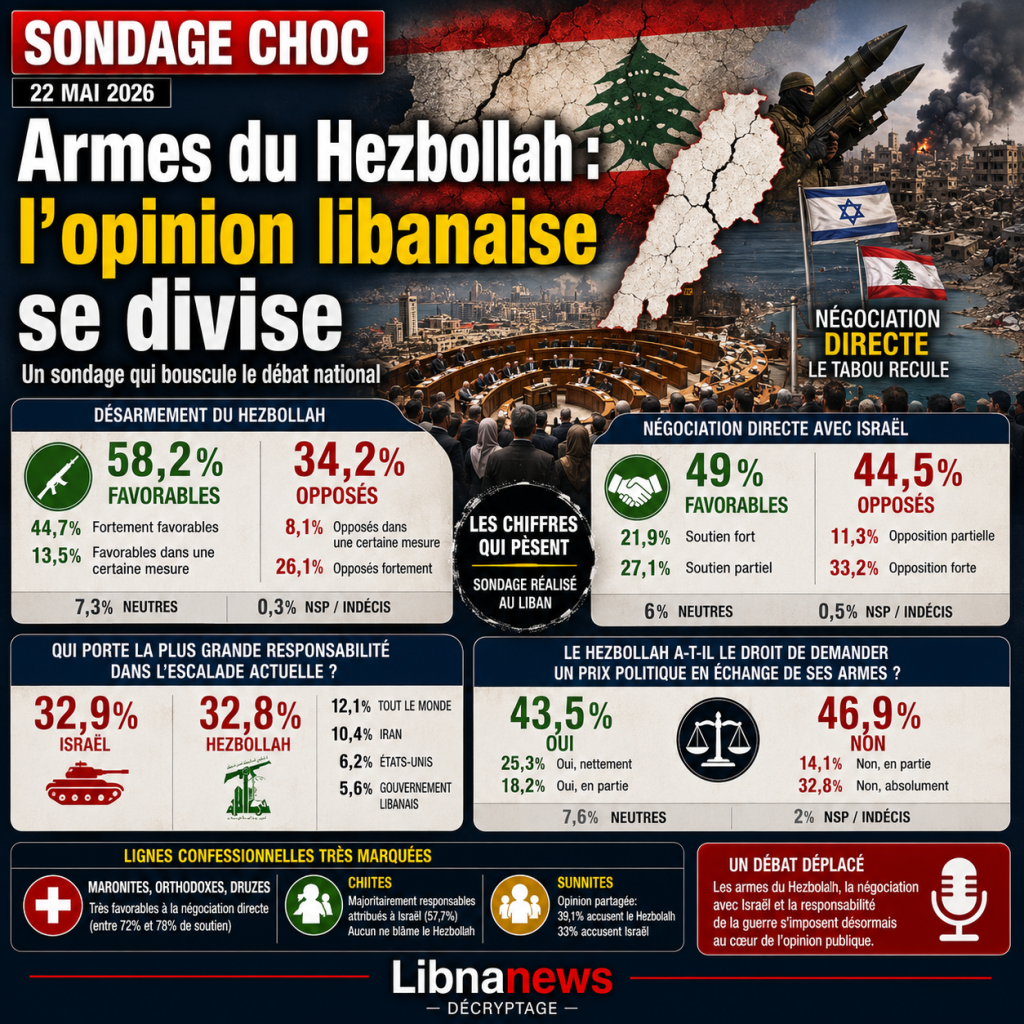
A poll published on 22 May by the newspaper An Nahar places Hezbollah’s weapons and relationship with Israel at the centre of a visible shift in public debate. The figures show a divided but less static view than before: almost six in ten respondents say they are in favour, to varying degrees, of the party’s disarmament, while nearly one in two support direct negotiations between Lebanon and Israel. In a country marked by war, displacement and American pressure, this data becomes a political fact in its own right.
A poll that puts Hezbollah’s weapons at the centre of the debate
The first lesson relates to the hierarchy of subjects. The Lebanese debate is no longer limited to the question of whether the war should cease. It now focuses on the conditions for lasting stability, the place of the army and the state monopoly in the security decision. The survey published on 22 May gives an encrypted translation of this move.
In response to the question on Hezbollah disarmament, 44.7 per cent of respondents said they strongly supported it. In addition to this category, 13.5% of respondents were supportive to some extent. The total thus reached 58.2% favourable opinion. On the other hand, 8.1% say they oppose it partially and 26.1% strongly oppose it, or 34.2% opposition. Neutral respondents accounted for 7.3%, while refusals or undecided respondents were almost non-existent at 0.3%.
These numbers do not resolve the file. They do not say how disarmament could be implemented, on what timetable, or with what guarantees. However, they indicate that the issue is no longer confined to party statements. It gains the space of measured opinion. It becomes a demand, a concern or a visible fracture line in a significant part of society.
This development comes at a time when the United States has sanctioned officials linked to Hezbollah, Amal, Iran and Lebanese security institutions. Washington presents these measures as a pressure for state authority. Hezbollah and its allies see it as an attempt at intimidation and interference. The poll therefore arrives in an atmosphere in which the word sovereignty is used by all, but with opposite meanings.
Direct negotiation: a taboo become a public subject
The second lesson relates to direct negotiations between Lebanon and Israel. Again, the figures show an opinion divided into two almost equivalent blocks. Strong support reached 21.9%. Partial support reaches 27.1 per cent. Together, the two favourable categories represent 49% of the responses. Partial opposition reached 11.3%, while strong opposition reached 33.2%. The total oppositions thus stood at 44.5%. Neutrals represent 6%, and refusals to respond 0.5%.
In recent Lebanese political history, such a level of declared support for direct negotiation is a notable indicator. It does not mean unanimous adherence to a formal peace. Nor does it mean that the respondents approve of Israeli policies. Above all, it shows that prolonged war, displacement, destruction and economic uncertainty push some Lebanese to seek exit routes that would have been harder to defend publicly before.
The context gives weight to this result. A meeting is scheduled for May 29, in a format presented as safe and technical. It must concern the ceasefire, the Israeli withdrawal and the modalities for stabilization in the South. The Lebanese authorities say they want to limit this meeting to the operational phase, before a political stage is expected in June. Yet, for opinion, the boundary between technical discussion and political choice remains difficult to trace. As soon as the case involves Israel, the debate becomes existential.
The survey confirms this difficulty. Almost half of respondents say they are open to direct bargaining, but more than a third strongly reject it. The country is therefore not moving towards consensus. Rather, it enters a phase in which the old ban is discussed more frontally. This change changes the terrain of politicians, who can no longer consider the subject as absent from public space.
A responsibility for the almost shared war between Israel and Hezbollah
The question of responsibility for climbing further illuminates the fracture. To the question about the actor who bears the greatest responsibility for the current escalation in Lebanon, 32.9 per cent of respondents cite Israel. Hezbollah reached almost the same level, at 32.8%. This is one of the most important figures in the survey. It shows that the perception of war is no longer structured by a single dominant reading.
Other answers lie far behind. A share of respondents felt that everyone was responsible for 12.1%. Iran and the United States are cited at lower levels. The Lebanese government also appears in the replies, but in a minority way. The central result remains the statistical face-to-face between Israel and Hezbollah.
This data should be read with caution. It does not mean that the respondents put the military action of Israel and Hezbollah on the same level. It means that a significant part of Lebanese opinion also assigns direct responsibility to the party in the current situation. This perception is politically heavy. It touches the heart of Hezbollah’s narrative, which presents itself as an actor in defence of Israel. It also feeds the discourse of its opponents, who believe that the party’s military decisions lead the country into wars not decided by the state.
The figure is all the more sensitive when the southern front remains unstable. The Israeli strikes, destruction, displacement and operations of Hezbollah feed on opposing narratives. For some, the Israeli army and occupation make the resistance necessary. For others, the existence of a parallel armed force prevents the State from protecting the country. The survey does not resolve this debate. It shows that it is now going through society in a clear way.
Very marked denominational lines
The denominational breakdown published by the daily gives another dimension to the results. According to these data, Christian and Druze respondents first attribute responsibility for climbing to Hezbollah, ranging from 50% to 61%. The majority of Shia respondents attributed responsibility to Israel at 57.7%, and no Shia respondent in the sample identified Hezbollah as the main culprit. The Sunni appear more divided, with 39.1 per cent assigning responsibility to Hezbollah and 33 per cent to Israel.
This distribution recalls that Lebanese opinion remains deeply structured by community membership. The same event is not read in the same way according to the groups. War therefore did not only cost material. It also acts as a revealing of different political memories, fears and fidelities. The figures do not only describe preferences. They show worlds of interpretation.
Support for direct negotiations with Israel also follows differentiated lines. According to the published breakdown, 78% of Maronites are in favour of this option, of which 36.2% are strongly and 41.8% to some extent. Among Orthodox, support reached 73.6%, with 37.5% strong support and 36.1% partial support. Among Druze, it reached 72%, of which 50.9% were strong support and 21.1% were partial support. These figures indicate that openness to negotiation is particularly high in some communities.
This reality makes any national decision more complex. An arithmetic majority is not sufficient in a Lebanese system based on balance and fear of cross-dominance. Even if an option progresses in the overall opinion, it can be rejected by an important component. This is one of the main challenges facing the state: to transform divergent social demands into acceptable decisions without fuelling a new break.
The political price of disarmament in question
The survey also addresses a delicate question: would Hezbollah have the right to demand a political price in exchange for the surrender of its weapons. The answers show a shared country. 25.3% answered yes clearly and 18.2% answered yes to some extent, i.e. 43.5% expressed support for the idea of a political counterpart. On the other hand, 14.1% say no to some extent and 32.8% say not absolutely, or 46.9% of the opposition. Neutrals represent 7.6%, and undecided/refused responses 2%.
This result is important because it moves the policy debate towards the method debate. One thing is to say that Hezbollah’s weapons must return to state authority. Another is whether the party can negotiate guarantees, a political role or a form of symbolic compensation. The figures show that there is no clear answer. A slight plurality refuses the idea of a political prize, but an almost equivalent share accepts.
This could become a central issue if a disarmament or integration process were one day open. Hezbollah does not present itself as a mere militia to lay down its arms. It presents itself as a resistance force, with a social base and parliamentary representation. Its opponents respond that weapons outside the state create political and security inequality. Between these two positions, the question of a political counterpart would be difficult to avoid.
The Lebanese State should then strike a balance between two requirements. The first would be to restore its monopoly on force. The second would be to avoid a political humiliation of an important national component. The survey shows that there is no single answer to this equation. He also suggested that any solution imposed without internal negotiations might face strong resistance.
The US Poll and Pressure
The figures published on 22 May cannot be isolated from the regional and diplomatic context. The United States sanctions, the Pentagon meeting, the discussions on the ceasefire and the negotiations between Washington and Tehran form the same background. The issue of Hezbollah’s weapons is not only Lebanese. It is also in the balance of power between the United States, Israel and Iran.
For Washington, the disarmament of Hezbollah is linked to the sovereignty of the Lebanese State and the stabilization of the South. For Hezbollah, American pressure is aimed at imposing political surrender for Israel. Between these two stories, public opinion becomes a strategic field. Disarmament-friendly figures can be used by supporters of a stronger State. Confessional divisions can be used by those who denounce an attempt to isolate a community.
Therefore, the survey should not be read as a simple mandate. It gives trends. It measures a climate. It does not replace a political process. Decisions on war, peace, arms and negotiation cannot be made by adding percentages. They must take into account the law, the institutions, the security of the people, the Israeli withdrawal and the guarantees necessary to avoid internal war.
The risk would be to turn the numbers into an immediate political weapon. A triumphal reading of support for disarmament could strengthen the positions of Hezbollah and its allies. A defensive reading, which would deny any evolution of opinion, would ignore the real fatigue of a large part of the population. The survey therefore requires a finer reading. It shows a demand for change, but also the limits of brutal change.
A shift in public debate
What the survey reveals above all is a shift in public debate. Hezbollah weapons, negotiation with Israel and responsibility for war are no longer peripheral issues. They now structure the perception of the crisis. Lebanese opinion seems tired of the war, worried about the economy, divided by the reading of responsibilities and more open than before to stabilization options.
This development does not mean that the country is moving towards an early agreement. There are still many obstacles. Israel must cease its violations and withdraw from the occupied points. The Lebanese State must clarify the mandate of the army and the framework for negotiations. Hezbollah must respond to the growing demand to limit decisions to war outside institutions. Foreign partners must avoid turning pressure into an internal failure factor.
The poll, published on 22 May, therefore puts Lebanese officials before a double reality. On the one hand, a significant part of the opinion calls for a stronger State capable of deciding war and peace. On the other hand, community divides remain deep enough to make any passage into force dangerous. It is in this narrow space that the following must be played: in the Pentagon, in Lebanese institutions and on the ground of the South.




