

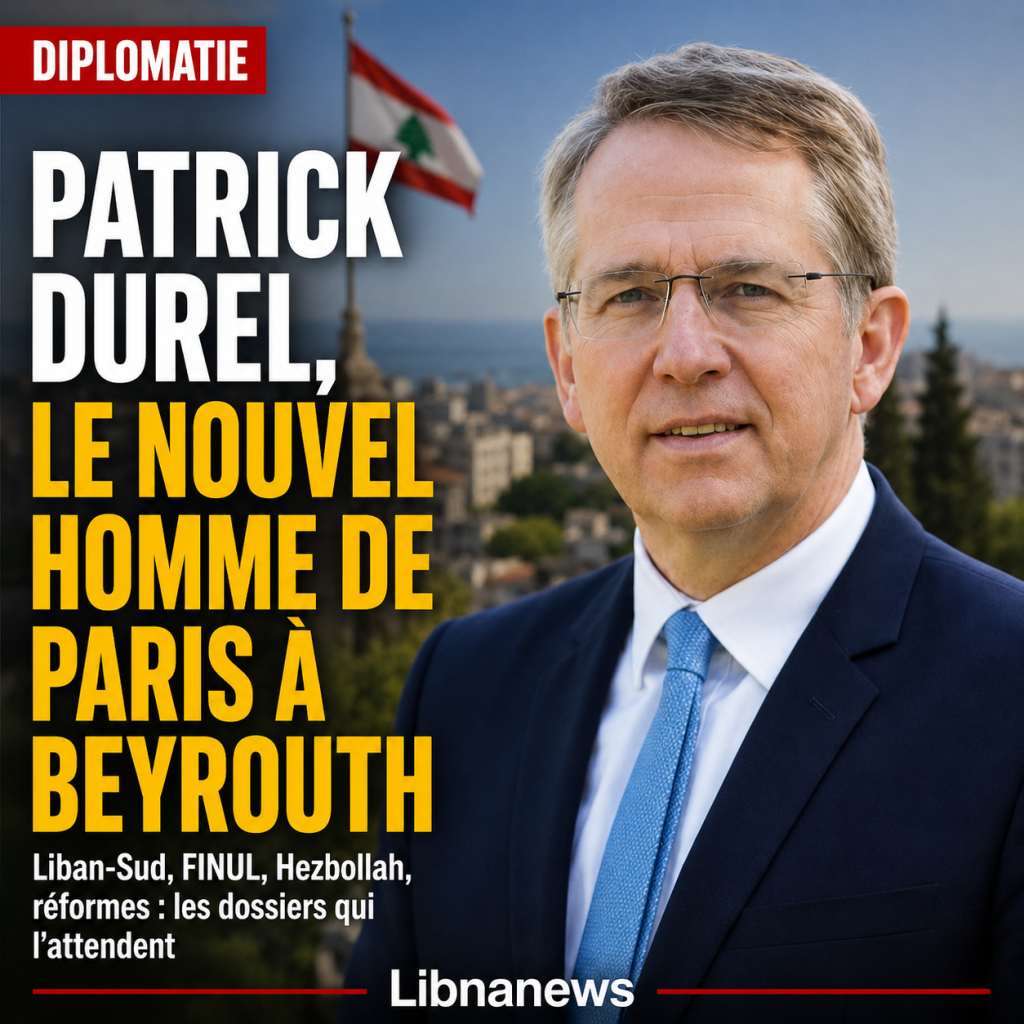
Patrick Durel took up his duties as the new French Ambassador to Lebanon, with a particularly familiar profile of Lebanese issues. Former adviser to North Africa and the Middle East of Emmanuel Macron at the Élysée, the diplomat directly participated in French efforts in Beirut after the explosion of the port of 4 August 2020. He is now returning to Lebanon in a different role, at a time when Paris intends to influence negotiations on Israeli withdrawal, the stabilization of the South Lebanon, the future of the international machinery and economic reforms.
A diplomat who already knows Lebanese actors
Patrick Durel’s choice ensures a form of continuity in French politics in Lebanon. The new ambassador does not discover the country’s institutions or the politicians with whom he will have to work. He followed Lebanese affairs for several years from the diplomatic cell of the French presidency and carried out several missions in Beirut.
At the Elysée, Patrick Durel served as adviser to Emmanuel Macron in charge of North Africa and the Middle East. This post placed it at the heart of the preparation and follow-up of French policy in a region marked by the Syrian and Lebanese crises, tensions between Israel and Hezbollah, the Iranian issue and relations with the Gulf monarchies.
Lebanon had become particularly important in its work after the explosion of the port of Beirut. Emmanuel Macron visited the Lebanese capital on 6 August 2020, two days after the disaster, before returning a few weeks later. Paris then launched an initiative to secure the formation of a government and the rapid adoption of economic and institutional reforms.
Patrick Durel had already been sent on a mission to Beirut
Patrick Durel had played an operational role in following up this initiative. He had been sent to Beirut to meet Lebanese politicians and to convey the positions of the French presidency. His name had thus become familiar in political circles long before his appointment as ambassador.
These missions had enabled him to interact with the main components of the Lebanese system. The French objective was then to keep pressure on the leaders to comply with the commitments made before Emmanuel Macron after the explosion of the port.
The mission had proved difficult. Paris’ deadlines had been exceeded and the promised reforms had been delayed. At the same time, the financial crisis continued to worsen, while the formation of Governments remained subject to power relations between the various political groups.
Patrick Durel is therefore directly aware of the obstacles faced by French diplomacy since 2020. This experience distinguishes his arrival from that of an ambassador who became aware of the file after his appointment.
From the Élysée to the French Embassy
Its change of function is nevertheless important. When he intervened since the Élysée, Patrick Durel acted as advisor to the French president and could be sent on an ad hoc basis to convey political messages or participate in consultations.
As ambassador, his role became permanent. He will have to follow the relations between Paris and Beirut on a daily basis, dialogue with the Presidency, the Government and political leaders, while reporting to Paris on Lebanese developments.
This proximity to Elysée can be an asset. The Lebanese issue remains strongly followed by the French Presidency and regularly goes beyond the framework of a classical bilateral diplomatic relationship.
South Lebanon as the first major issue
The new Ambassador arrives as South Lebanon is one of Beirut’s top diplomatic priorities.
President Joseph Aoun awaits a new American proposal to clarify the stages of a complete withdrawal of Israeli forces still present on Lebanese territory. The discussions also focus on verification mechanisms and actors that will need to ensure the safety of the evacuated sectors.
Paris supports the principle of an Israeli withdrawal and the strengthening of the authority of the Lebanese State. France regards the Lebanese army as the institution responsible for exercising control over the territory in the South.
Patrick Durel will have to follow a dossier which he already knows in its regional dimension, but whose parameters are changing rapidly.
The future of UNIFIL, subject of divergence with Washington
The question of the United Nations Interim Force in Lebanon should also play an important role in its initial discussions.
France remains strongly committed to an international presence to accompany the Lebanese army and maintain a monitoring mechanism in the South. Washington is pushing for a much deeper transformation of the system and hopes for the end of the current mission.
Paris has defended solutions to maintain an international observation capacity. The United States is more reserved on this option.
For Lebanon, this divergence is essential. The Israeli withdrawal, the deployment of the Lebanese army and the evolution of UNIFIL are now three elements of the same file.
France will therefore have to try to preserve its influence in defining the future security mechanism.
Hezbollah weapons in the equation
The issue of Hezbollah will also be a must.
Joseph Aoun would have told his American interlocutors that he would be prepared to open the movement’s arms file at the national level if Washington provided serious guarantees regarding Israeli withdrawal and security arrangements in the South.
France has long defended the strengthening of State institutions and the role of the Lebanese army. However, it must cope with the internal political balances and the weight of Hezbollah in the Lebanese system.
Patrick Durel already knows these constraints. His previous missions had enabled him to observe the relationship between the various political forces and the difficulty of dealing with sovereignty issues only through external pressure.
The Lebanese Army, Paris’ privileged partner
Support for the army is one of the most constant elements of French policy in Lebanon. For years, Paris has been involved in training and equipping Lebanese forces and regularly mobilizes its partners to maintain their operational capacity.
This cooperation is now becoming more important. The army must increase its presence in the South, gradually resume areas evacuated by Israel, secure villages and participate in the demining of areas affected by the fighting.
If the international machinery is reduced, the responsibilities of Lebanese forces will increase further.
The new ambassador will therefore have to work as much on diplomatic matters as on the mobilization of material and financial support for the military institution.
Reconstruction and financial crisis
Franco-Lebanon relations will also remain dominated by the economy. The country has still not resolved the banking crisis opened in 2019 and needs to restructure a financial system that still blocks a significant part of depositor savings.
France supports negotiations with international financial institutions and reforms to restore a functioning banking system. In particular, Lebanon’s partners call for transparent recognition of losses and effective restructuring of institutions.
The cost of reconstruction is now added to this crisis. Military operations have led to significant destruction in South Lebanon. Housing, infrastructure, commerce and agricultural land must be rehabilitated, while some areas remain exposed to unexploded ordnance.
Beirut will need international funding. Paris could play a role in mobilizing them, but donors are likely to continue to link their assistance with guarantees of transparency and reform.
A return to Lebanon in a much more exposed role
The appointment of Patrick Durel thus appears to be a choice of continuity on the part of Paris. France entrusts its embassy to a diplomat who has already worked directly with Emmanuel Macron on the Lebanese file and who knows a large part of the officials with whom he will have to negotiate.
This familiarity does not make its mission simpler. Several cases on which the French initiative had faced political blockages since 2020 remain open. The banking crisis is not resolved, reforms remain incomplete and reconstruction requires considerable funding.
To this now adds a much heavier security file. The Israeli withdrawal, the future of UNIFIL, the deployment of the army and the issue of Hezbollah weapons can redefine the balance of the South Lebanon in the coming months.
Patrick Durel therefore returned to Beirut with an unusual knowledge of the terrain for a new ambassador. His first challenge will not be to discover the Lebanese interlocutors, but to turn this knowledge accumulated since the Macron Initiative years into diplomatic results in a profoundly different regional context from that of 2020.




