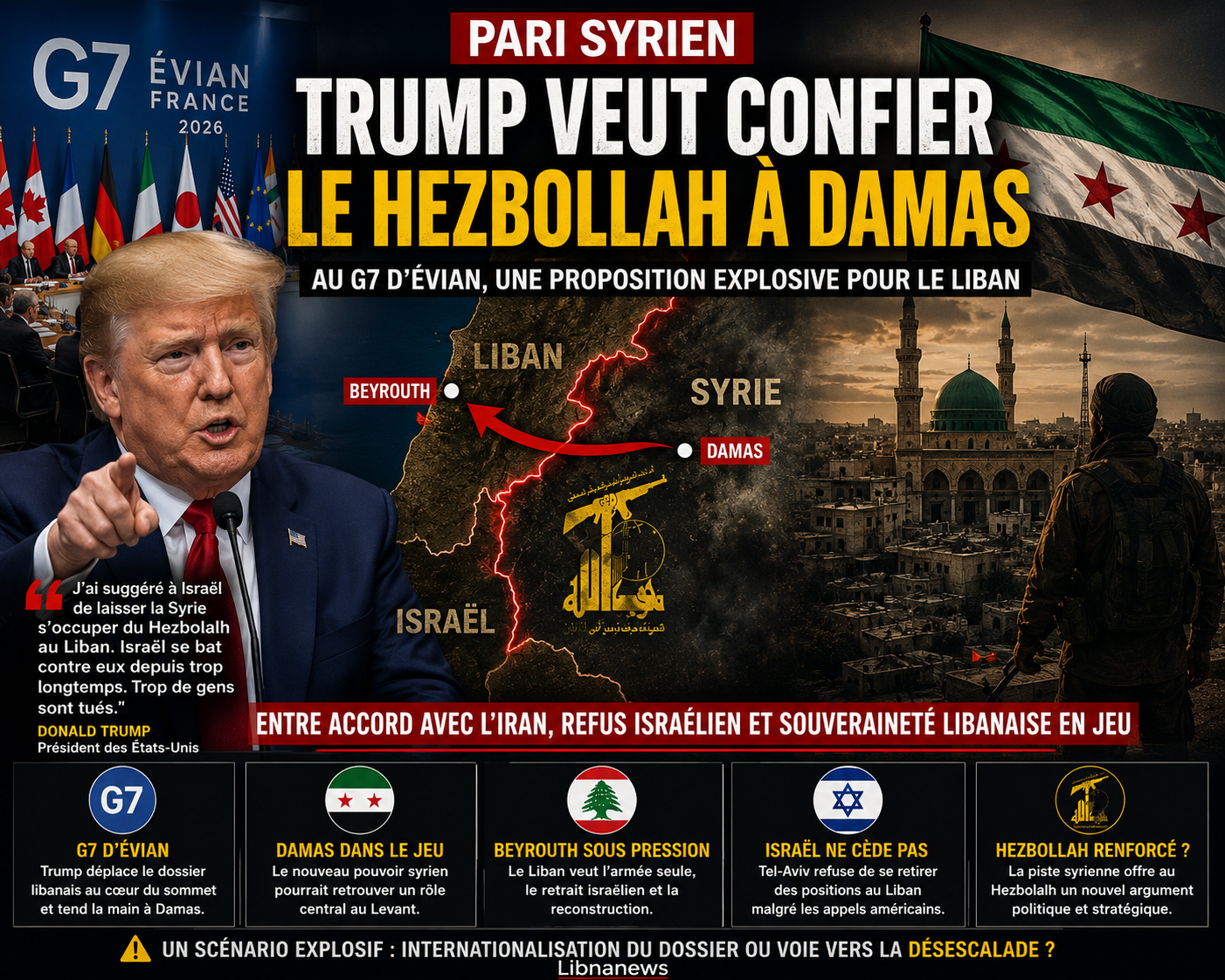
Donald Trump moved the Lebanese dossier to the heart of the G7 summit in Evian, saying that he had suggested to Israel that Syria « take care » of Hezbollah in Lebanon. The US president explained that Israel had been fighting the Shiite movement for too long and that « too many people » were killed. This statement, reported by the American press on the margins of the discussions between Western leaders, comes in a dense diplomatic sequence. Washington defends a framework agreement with Iran, Israel refuses to withdraw from positions in Lebanon, and Beirut is trying to impose its own conditions on the negotiation: permanent cessation of fire, Israeli withdrawal, deployment of the Lebanese army and reconstruction. In referring to a Syrian role against Hezbollah, Trump opens an explosive scenario for Lebanon, where any intervention by Damascus remains loaded with heavy political memory.
Trump’s speech marks an inflection in his approach to the Lebanese front. A few days earlier, the US president was still insisting on more targeted strikes against Hezbollah. Since Evian, his message is moving. He blames Israel for the length of its confrontation with the armed movement and suggests that a neighbouring actor, Syria, could be called upon to play a more direct role. The formula remains vague. It does not specify the legal framework, the operational form or the exact role Washington would have for Damascus. But it is enough to revive a sensitive question: are the United States considering making the new Syria a security partner in Lebanon?
Trump shows his impatience to Israel in Evian
At the top of the G7, Donald Trump also showed a more tense relationship with Benyamin Netanyahu. The US President said the Israeli Prime Minister must act more responsibly in Lebanon. He expressed dissatisfaction with the Israeli conduct of the case, while Washington was trying to consolidate an agreement with Tehran. This does not break the alliance between the United States and Israel. It shows, however, that the White House wants to prevent Israeli strikes against Hezbollah from failing a wider diplomatic sequence. For Trump, the priority now seems to be regional stabilization, even if this stabilization is done through unusual arrangements.
The context weighs heavily on this exit. The American-Iranian framework agreement, announced in the sequence opened by the Pakistani mediation, aims to reduce regional hostilities and gradually reopen the Strait of Ormuz. It includes, according to several reported formulations, a Lebanese dimension. Iran presented the Lebanese front as an integral part of the de-escalation, while Israel claims not to be bound by an agreement in which it did not take part. Trump’s statement on Syria therefore comes at a time when every actor seeks to preserve his space. Washington wants to save the deal with Tehran. Israel wants to keep its military freedom. Hezbollah wants to present the ceasefire as a result of its balance of power. Official Lebanon wants to avoid being treated as a simple regional issue.
Syria returns to Hezbollah equation
The idea of entrusting Syria with a role in the face of Hezbollah reacts to a complex history. For decades Damascus has had a decisive influence on Lebanon. Its military presence, begun during the civil war, was extended until 2005. The Syrian withdrawal had been experienced by part of the Lebanese as a condition for the return to sovereignty. Any mention of a Syrian role in Lebanese security thus awakens reflexes of mistrust. Although the Syrian context has changed, the issue remains sensitive. A Damascus role against Hezbollah would not be seen as a mere security arrangement. It would affect the internal balance of Lebanon, the memory of Syrian tutelage and the sovereignty of Beirut.
The Syria Trump talks about is no longer that of Bashar Al-Assad. The new power in Damascus, led by Ahmad Al-Sharaa, seeks to regain international recognition after years of war and isolation. Washington has already shown interest in this new Syrian leadership. Trump praised Damascus’ leadership and mentioned, according to the regional press, the possibility of a Syrian role in the stabilization of Lebanon. For Syria, such a perspective would represent an opportunity to become again a central player in the Levant. It would offer Damascus a diplomatic leverage to the United States and Arab capitals. But it would also expose the new Syrian power to direct conflict with a Lebanese actor firmly established, armed and supported by Iran.
A difficult scenario in Beirut
In Beirut, Trump’s formula could cause immediate embarrassment. The Lebanese authorities have built their position around a clear principle: the Lebanese State must take over its authority alone throughout the territory. President Joseph Aoun and Prime Minister Nawaf Salam recalled the constants of this position before the next round of negotiations in Washington. They include the permanent cessation of fire, the Israeli withdrawal from the occupied territories, the deployment of the Lebanese army to international borders, the return of Lebanese prisoners and reconstruction. The idea of a Syrian actor charged with « occupying » Hezbollah is not in this architecture. It even makes it deeply complicated.
Official Lebanon could hardly accept a neighbouring country as a direct player in its internal security. Even limited coordination with Damascus should go through strict State mechanisms. It should also avoid any impression of an external mandate given to Syria on part of Lebanese territory. For the Lebanese army, this scenario would be politically risky. The institution seeks to appear as the only legitimate instrument of sovereignty. If Syria were presented as a security substitute, it would weaken its role. This would also give Hezbollah a powerful argument: that of a foreign project to reintroduce regional tutelage under the guise of disarmament.
Israel faces its own paradox
The Israeli response will also be decisive. Israel considers Hezbollah a direct threat to its northern communities. His Government had stated its desire to maintain safe areas in Lebanon, Gaza and Syria for as long as necessary. This position reflects a simple doctrine: Israel no longer wants to depend on international guarantees or the promises of neighbouring States. But Israel’s refusal to withdraw has an opposite political effect. It strengthens Hezbollah by giving it the argument of occupation. As long as Israeli soldiers remain in Lebanese areas, the movement can justify the permanence of its weapons in the name of the resistance.
Trump’s suggestion may seek to address this paradox. By saying that Syria could take care of Hezbollah instead of Israel, the US president seems to want to take back Israel’s burden of endless war. It also seeks to limit human casualties and avoid an escalation that would threaten the agreement with Iran. But this reasoning is based on a fragile hypothesis: that of a Syria capable of acting against Hezbollah without causing a Lebanese crisis, a regional confrontation or an Iranian reaction. Hezbollah is not an outside actor in Lebanon. It has a social base, political representation, a military network and territorial legitimacy in certain regions. Treating it as a simple cross-border security issue would underestimate its internal depth.
Washington seeks a regional exit
The US proposal is part of a broader strategy. Trump wants to present the deal with Iran as a major peacemaking step in the Middle East. The Evian summit offers him an international stage to defend this line with Europeans, some of whom remain cautious. The Iranian file, the Strait of Ormuz, Lebanon, Israel and Syria are now linked in a single sequence. This interlocking makes each front dependent on the others. An Israeli strike in Lebanon can weaken the discussion with Tehran. An ambiguity about the Israeli withdrawal can revive Hezbollah’s discourse. A Syrian entry into the file can awaken Lebanese fractures. Washington tries to hold balances that do not always overlap.
Europeans observe this acceleration with reservations. They want to avoid an agreement too fast with Iran, poorly verified or too favourable to Tehran. They also seek to preserve their role in nuclear, sanctions and maritime security. France, host of the G7, is trying to influence the second phase of negotiations, particularly on the Strait of Ormuz and associated guarantees. But on Lebanon, the American word dominates. In referring to Syria, Trump is not only consulting on an operational solution. It publicly redraws options. This method can produce a surprise effect. It can also create diplomatic instability, as the actors concerned must react to a formula whose contours remain unclear.
Hezbollah can exploit the statement
For Hezbollah, Trump’s statement offers several angles of political exploitation. The party can first see evidence that the Lebanese case is being dealt with outside, between Washington, Tel Aviv, Damascus and Tehran. He can then present any Syrian involvement against him as a foreign pressure project. Finally, he may recall that the Israeli refusal to withdraw maintains a cause for confrontation. This triple reading would allow him to defend his arsenal despite internal criticism. It will not convince all Lebanese. But it can reduce the space of those calling for rapid and strictly institutional disarmament.
This situation places Lebanese sovereign forces in an uncomfortable position. They demand an end to weapons outside the state. They denounce Lebanon’s entanglement in the Iranian case. They refuse to maintain Israel. But they cannot openly support a Syrian security role in Lebanon without contradicting part of their own political history. Trump’s formula therefore obliges them to defend a narrow path: complete Israeli withdrawal, refusal of any Syrian tutelage, monopoly of the Lebanese army and negotiations led by Lebanese institutions alone. This path is consistent. It remains difficult to impose if the major Powers favour rapid regional arrangements.
Damascus between diplomatic opportunity and military risk
For Damascus, Trump’s hypothesis would be double-edged. It could speed up Syria’s return to regional diplomatic channels after a long period of isolation and sanctions. It would allow the new Syrian power to present itself as a security partner capable of dialogue with Washington, the Arab capitals and perhaps Israel. But it would also expose her to heavy responsibility. Hezbollah is not only present in Lebanon. For years he has maintained military, political and logistical ties with Syrian space. An open confrontation with him could weaken Damascus’s power, reopen lines of tension in eastern and western Syria, and test the internal balances of a country still marked by war.
Syria’s possible role would also pose a mandate question. Acting at the border, controlling crossings, cutting logistical roads or participating in regional pressure against Hezbollah are not of the same level of involvement. Intelligence cooperation with Washington would not produce the same effects as a security presence near the Lebanese border. Direct military action would be even more explosive. It could turn the Lebanese crisis into an open conflict between Iran’s allies and opponents. The Lebanese authorities would then find it difficult to maintain their own line, based on the exclusive role of the national army and the refusal of any external guardianship.
The G7 facing solitary American diplomacy
The G7 framework provides additional scope for this. In Evian, United States partners seek to understand the contours of an Iranian agreement whose details remain incomplete. Europeans want safeguards on nuclear, sanctions and maritime safety. They also want to avoid Lebanon, Syria or the Strait of Ormuz becoming adjustment variables in a negotiations led mainly by Washington. The statement on Syria shows, however, that Trump prefers a diplomacy of rapid blows, where a public formula can move a balance of power even before the mechanisms are written.
This method corresponds to the logic of the American president. It creates pressure, forces actors to position themselves and gives the image of a permanent initiative. But it can also disturb allies. Israel may see this as an attempt to limit its freedom of action. Lebanon can read this as a potential violation of its sovereignty. Syria can see this as a risky invitation. Iran can see this as a threat against one of its main regional allies. Finally, Hezbollah can see confirmation that its future is being discussed in a framework beyond Beirut. The summit of Evian was expected to show stabilization. It also reveals areas of conflict that the American-Iranian agreement has not yet resolved.
A small analysis: the risk of a cure that worsens the evil
Trump’s statement starts from a simple observation: the war between Israel and Hezbollah lasts too long and costs too much. But the solution is likely to worsen the problem it claims to solve. To give Syria a role against Hezbollah would be to further internationalize a case that Beirut is trying to renationalize. This could offer Hezbollah a new story of resistance against foreign pressure. This could also weaken the Lebanese army, when it is supposed to be the central instrument for the return of the State to the South.
The decisive point therefore remains the Israeli withdrawal. Without withdrawal, Hezbollah maintains a strong political argument. Without the exclusive role of the Lebanese army, Beirut’s sovereignty remains incomplete. Without a clear mechanism in Washington, Trump’s statement can become a summit phrase rather than a policy. The next few days will say whether Washington specifies this Syrian option or whether it will remain an exit to push Israel, Lebanon, Syria and Iran to adjust their positions before the next phase of negotiations.