





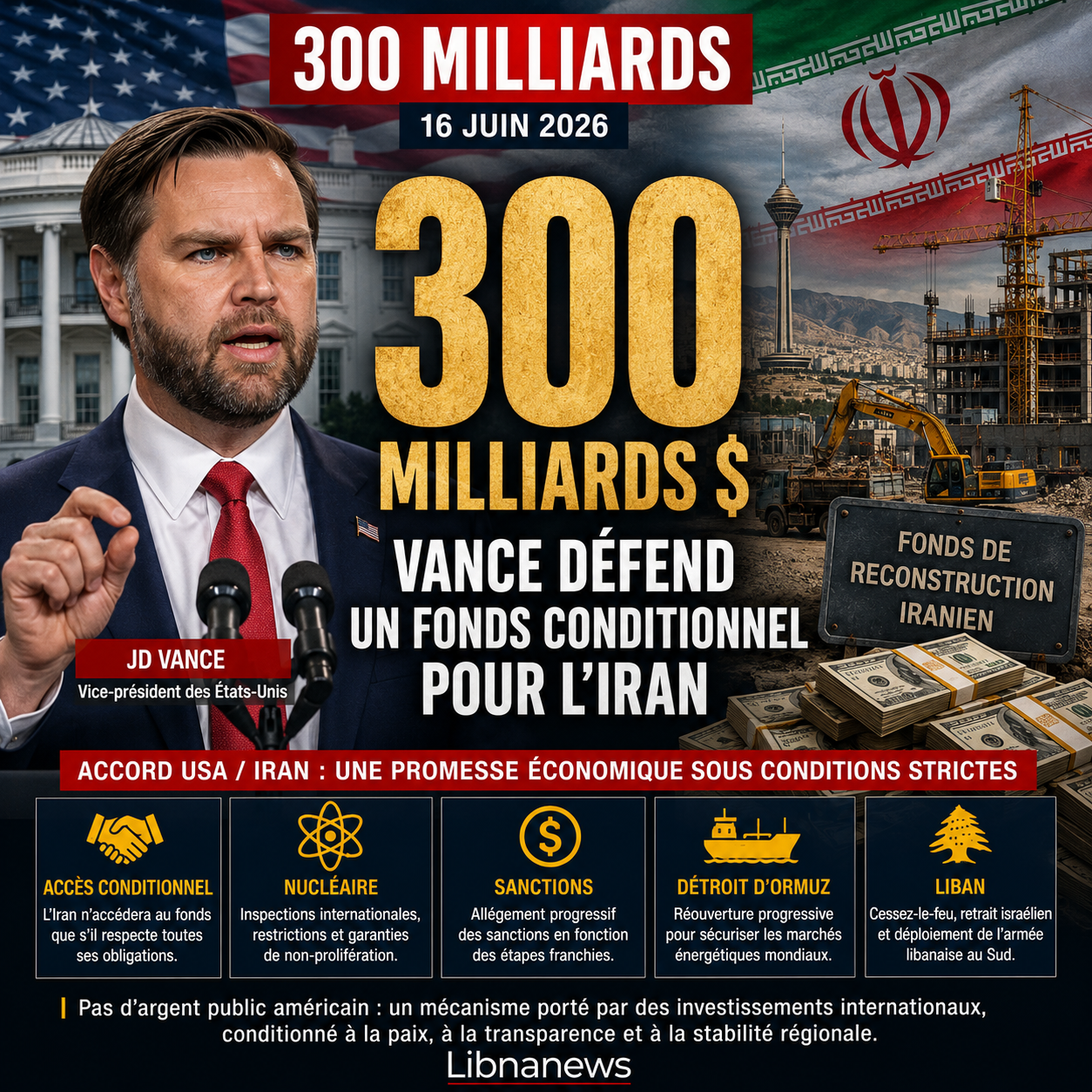
US Vice President JD Vance confirmed that Iran would be able to access a $300 billion reconstruction fund under the United States peace agreement, provided Tehran complies with the obligations set out in the text. This clarification comes as the US administration tries to defend a regional compromise still surrounded by many shadow zones. The Iranian reconstruction fund would not be presented as a direct payment from Washington, but as a conditional mechanism, backed by investment and a gradual reduction of economic restrictions. The announcement opens a new political phase. It shows that the settlement sought is not only based on military and nuclear coercion, but also on a promise of a major economic recovery for Iran.
Vance insists on conditional access
JD Vance’s statement answers a sensitive question in the United States. Any financial concession in Tehran causes a strong controversy in Washington, where the precedent for the 2015 nuclear agreement remains a subject of political debate. The Vice-President therefore sought to frame his remarks. He stressed the conditionality of the scheme. Iran could only access the fund by fulfilling its commitments. These commitments relate to nuclear power, regional de-escalation and the implementation of the ceasefire. The US executive also wants to avoid the image of a check offered to an opponent. The White House claims that US taxpayers’ money would not be mobilized directly in this plan.
The sum mentioned, 300 billion dollars, gives an unprecedented scale to the sequence. It places the Iranian economy at the heart of the political settlement. After months of regional war, reinforced sanctions, maritime blockades and destruction, the need for reconstruction and recovery is considerable. The amount advanced far exceeds emergency aid. It is a signal to the Iranian state apparatus, the private sector and regional partners. The message is clear: compliance with the agreement could pave the way for gradual economic reintegration. Conversely, any violation could suspend promised profits and reduce diplomatic and financial pressure.
Still incomplete agreement
The agreement between Washington and Tehran has not yet delivered all its public details. U.S. officials talk about a step-by-step process, with an initial phase of confidence, and then more in-depth technical discussions. The U.S. President presented the text as a acquis, but indicated that it should enter a second phase. This formulation shows that the compromise remains incomplete. It sets a direction, but it must be translated into precise mechanisms. The most sensitive issues relate to Iran’s nuclear programme, international inspections, the fate of enriched uranium stocks, the phasing out of sanctions and guarantees of non-resumption of hostilities.
The fund announced by JD Vance is part of this conditionality logic. This would not be an immediate transfer. Access would depend on verifiable milestones. Tehran should respect its nuclear commitments, accept a return of inspections and refrain from using economic benefits to strengthen its regional armed relays. This latter condition is particularly important for Western and Arab capitals. The United States wants to prevent Iran’s reconstruction from leading to financial consolidation of its allies in Lebanon, Yemen, Iraq or Syria. The issue of flow control will therefore be one of the key points in implementation.
The financial framework remains to be specified. Several American and economic media sources refer to a fund supported by international investments, with the expected participation of Gulf countries and private actors. Washington would facilitate the political and legal framework, without appearing as the direct financier. This distinction is crucial for the US administration. It makes it possible to defend the agreement with an opinion hostile to any payment to Iran. It also makes it possible to involve the countries of the region in the stabilization of a neighbour whose military and nuclear capabilities have fueled several crises. But this architecture raises a question: which states will agree to finance Iranian reconstruction after denouncing Tehran’s regional action?
The U.S. Congress Under Tension
The case is also explosive in Congress. Republican and Democratic elected officials could ask for more stringent guarantees before any reduction of sanctions or facilitation of investment. Criticism is about three risks. The first concerns nuclear power. Some of the elected officials feared that Tehran would accept a tactical pause without permanently abandoning its sensitive capabilities. The second concerns missiles and drones, which do not yet appear to be at the heart of the public system. The third concerns Iran’s allied groups. For opponents of the agreement, a fund of this magnitude could give the Islamic Republic new means, even if the money does not pass directly through the US state.
The US administration responds with the opposite argument. It believes that economic incentives can support de-escalation if it remains progressive and reversible. In this reading, Iran would not receive a reward for its past behaviour. It would obtain conditional access to future profits if it changes its course. The choice of words is essential. JD Vance speaks of possible access, not automatic grant. This is intended to reduce political risk. It also helps to maintain pressure on Tehran in the coming weeks. The agreement must produce immediate actions, but reconstruction can only begin after proof of compliance.
For Iran, the prospect of a reconstruction fund is an internal asset. The country is emerging from a period of military, economic and social pressure. Sanctions have affected oil exports, access to financial channels, industrial investment and living standards. A $300 billion promise can help the authorities to present the agreement as a diplomatic and economic victory. It can also create very strong expectations among the population. If profits are delayed, the Iranian government may find itself exposed to internal criticism. Economic promise therefore becomes a resource, but also a constraint.
Nuclear remains the heart of Iran’s case
The nuclear issue remains the heart of the device. The available information refers to the resumption of discussions on enrichment, accumulated stocks and the role of international inspectors. Washington wants guarantees to prevent the rapid reconstruction of sensitive infrastructure. Tehran wants to preserve a share of technological sovereignty and achieve a gradual lifting of sanctions. This explains the caution of American language. The fund would not be released on a political statement, but on a series of audits. The problem will be to determine who judges Iranian conformity. Too political an assessment would expose the mechanism to arbitrary accusations. Too slow a procedure could deprive the agreement of its immediate economic benefits.
The White House communication also seeks to correct a political weakness. The figure of 300 billion hits the minds and can become the dominant image of the agreement. Opponents will talk about a gift in Tehran. The supporters will insist on the absence of US public money and the logic of conditional investments. Between these two readings, the administration will have to repeat that the fund is not an automatic compensation, but an instrument to support behaviour change. This battle of vocabulary will be decisive. In such agreements, public perception weighs almost as much as technical clauses. A poorly understood formula can weaken the text even before it is implemented.
The calendar adds another constraint. The next meetings should clarify the terms of the agreement and prepare a more technical phase. During this period, each regional incident may affect the process. An attack on a ship, a strike in Lebanon, a ceasefire violation or a controversy over nuclear inspections could slow down the momentum. Conversely, quick gestures on both sides can build confidence. The reconstruction fund serves as a perspective here. It gives an economic horizon to discussions that would otherwise remain dominated by weapons, sanctions and suspicions.
The Strait of Ormuz and Lebanon in the equation
The Strait of Ormuz occupies a central place in the compromise. Its gradual reopening is one of the elements associated with de-escalation. This route remains essential for global energy markets. Any lasting disruption affects oil prices, marine insurance and supply chains. The announcement of an agreement has already helped to relax markets, although transport professionals remain cautious. The normalisation of traffic is not only dependent on a political communiqué. It implies a real reduction in risks, military coordination and minimum confidence among Gulf actors. The Iranian reconstruction fund is therefore linked to a broader economic equation.
The Lebanese side gives the agreement an additional scope. The Lebanese front was included in the regional discussions, which confirms the interlocking of the Lebanese file with the Iranian file. This reality places Beirut in a delicate position. On the one hand, Lebanon needs a solid ceasefire, an Israeli withdrawal, the deployment of its army and the reconstruction of the South. On the other hand, part of these developments depends on negotiations between Washington and Tehran. This interlocking politically strengthens Hezbollah, which can argue that the Lebanese front is part of a regional power relationship recognized by the major powers.
The Israeli refusal to withdraw from certain areas of Lebanon further complicates the situation. It gives Hezbollah a territorial argument at a time when its Lebanese opponents are demanding an end to weapons outside the state. As long as an Israeli presence remains, the party can present its arsenal as a response to an occupation. This argument does not resolve criticism of his decision to war or his relationship with Iran. But it weighs in the internal debate. The American agreement with Tehran and the Israeli position thus produce a paradoxical effect. They seek to reduce tensions, but they can also preserve part of Hezbollah’s political space.
A still fragile financial mechanism
For the Gulf countries, the possible fund raises another issue. Several Arab capitals have suffered or feared the effects of tensions with Iran. Their participation in a reconstruction envelope could be described as an investment in regional stability. It could also be challenged as a bonus granted to Tehran after years of indirect confrontation. The success of the mechanism will therefore depend on political guarantees. The contributing States would like to know how the funds would be used, who would monitor them and what consequences would be foreseen in case of violations. Without these guarantees, the $300 billion will remain closer to a diplomatic promise than an operational tool.
The issue of sanctions will be equally crucial. Iran will not be able to attract massive investment without access to financial channels and without sufficient legal protection for companies. Partial relief can open doors. It is not always enough to reassure banks, insurers and large groups. These actors look at the stability of the legal framework, the risk of secondary sanctions and the possibility of political change in Washington. The agreement will therefore have to convince beyond governments. He will have to convince investors that the rules will not change abruptly. This is one of the major challenges in transforming an announced fund into concrete projects.
Caution remains all the more necessary as the full text has not been published in full. The announcements follow, but some formulations remain unclear. The signature schedule, compliance criteria, the role of inspectors, the source of funds and the manner of suspension will need to be clarified. American statements seek to show that the agreement is not a drop in pressure. They also seek to provide Iran with sufficient incentives to meet its obligations. This balance line will be difficult to maintain. Too much rigidity could fail the compromise. Too much flexibility could feed the accusations of weakness.
Small analysis: a peace through incitement
The small analysis of this announcement is in one sentence: Washington is trying to replace part of the war logic with a logic of price and profit to be earned. The Iranian reconstruction fund is the main carrot of the scheme. It gives Tehran an economic interest in respecting the agreement. But it also gives its political opponents an obvious angle of attack. They will be able to say that Iran is getting a promise of reconstruction without having yet provided all the guarantees. The effectiveness of the plan will therefore depend less on the 300 billion figure than on the credibility of the control.
This announcement also changes the regional reading. Iran appears not only as an opponent to be contained, but as an actor to be reinstated under conditions. This can reduce the risk of open war. This may also cause concern to US allies who fear an arrangement that is above their own interests. Lebanon illustrates this tension. If the agreement leads to a real ceasefire, an Israeli withdrawal and a Lebanese army deployment, it can strengthen the state. If he confines himself to stabilizing the fronts without resolving the political causes, he will give Hezbollah a margin of manoeuvre. Future discussions will have to say whether the 300 billion mentioned by JD Vance are a lever of peace or a fragile promise in a still incomplete agreement.