





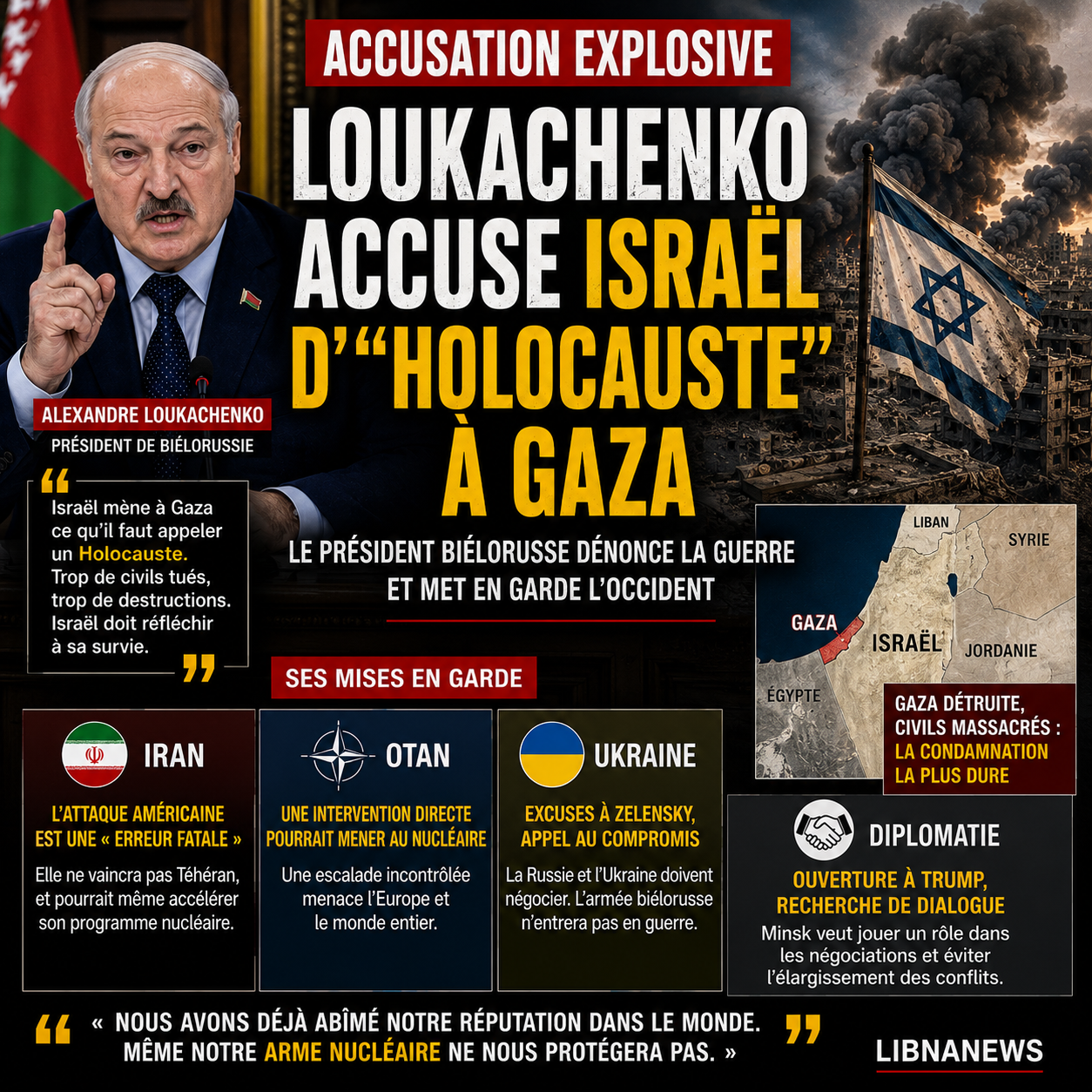
Belarusian President Alexander Lukashenko chose an interview with Al Arabiya English to intervene on several diplomatic fronts at once. From the Independence Palace in Minsk, against journalist Melinda Nucifora, the Belarusian leader accused Israel of leading what he called the « Holocaust » in Gaza, while warning that ongoing wars could provoke scenarios that no one controls. Lukashenko also denounced the American attack on Iran, which he described as a « fatal mistake, » and warned that direct NATO intervention in the Ukrainian conflict could pave the way for a nuclear confrontation. He finally sought to display a more conciliatory tone on Ukraine, going so far as to apologize to Volodymyr Zelensky and repeat that the Belarusian army should not enter directly into war.
Lukashenko and the charge on Gaza
The interview, broadcast on Counterpoints, gives Lukashenko a rare forum for an Arab and international audience. The Belarusian President takes up several constant topics of his diplomacy: Israel’s criticism, opposition to the use of force by Washington, warning against the enlargement of the war in Europe and defence of a settlement negotiated between Moscow and Kiev. But the tone is distinguished by the violence of certain formulas. The word « Holocaust », applied to Israeli operations in Gaza, is the most explosive statement. It refers to a central historical memory for Israel and the Jewish people. His employment by a Moscow allied head of state, already challenged by the Western chancelleries for his internal repression and support for Russia, gives the maintenance a strong political charge.
For Gaza, Lukashenko accuses Israel of destroying the enclave and killing many civilians, especially women and children. He claims that the Hebrew state has already damaged its international reputation through its bombings. He also found it absurd to build tourist projects on the ruins of a bruised territory. In its formulation, Israel should reflect on its own political and strategic survival, as even its nuclear capabilities would not be sufficient to protect it if its isolation were to worsen. These statements are part of a global wave of criticism of the conduct of the war in Gaza, but they go beyond the usual diplomatic condemnations. Lukashenko is not just talking about disproportion, crimes or humanitarian catastrophe. It uses a term historically associated with the extermination of Jews from Europe by Nazi Germany, which makes its exit highly controversial.
The Belarusian leader does not hold on to Israel. He claims that the United States has the power to compel the Hebrew state to stop its military action. In his reasoning, Washington remains the ultimate guarantor of Israel’s ability to continue the war. This reading aims to move part of the responsibility to the White House. She joins her other critic, dedicated to Iran. Lukashenko claims that the US attack on Iran is a major mistake. According to him, Tehran cannot be defeated by air strikes. He believed that a land operation would be necessary to impose a complete military defeat, but that the United States could not afford such a war because of the human and political cost it would entail.
Iran, another target of the speech
On Iran, Lukashenko develops a precise thesis. The American and Israeli strikes would not have weakened the Islamic Republic politically. Instead, they would have helped to resuscitate an Iranian society that he described as previously divided. The Belarusian President also claims that bombing Iran will not permanently block the development of nuclear weapons. On the contrary, it maintains that these attacks can encourage Tehran to accelerate this path, if it is already under way. This analysis repeats a common argument among critics of the military strategy against nuclear programmes: destroying facilities does not remove know-how, and can strengthen the political will to rebuild it.
Lukashenko links this criticism to the aborted diplomacy around enriched uranium. He claims that Iran would have offered to send nuclear material to China, while Russia would also have offered a storage option. According to him, Washington refused this lead for political reasons related to its rivalry with Beijing. The Belarusian President presents this refusal as a missed opportunity to place sensitive materials under external control. This version, favourable to Tehran and Moscow, must be read as a political position. However, it illustrates how Minsk seeks to challenge the Western reading of the Iranian case. For Lukashenko, the problem comes less from Iran than from the American will to impose its conditions on an opponent.
NATO and nuclear risk
The same logic of caution appears when he refers to NATO. Lukashenko claims that direct intervention by the Atlantic Alliance in the Ukrainian conflict would be extremely dangerous. He believes that it could trigger a nuclear escalation, with catastrophic consequences for Europe and perhaps for the whole world. This message first targets Western capitals. Since the beginning of the large-scale war in Ukraine, Minsk has reiterated Moscow’s arguments against the enlargement of Western engagement. But Lukashenko adds a more personal tone. He insists on the human exhaustion of both armies, the lack of soldiers and the absence of a decisive military solution.
On this point, the interview also marks an attempt to open up. Lukashenko claims that Russia and Ukraine must accept compromises to get out of the war. He considered the idea of a total victory on the battlefield unrealistic. He again proposed a three-way meeting between himself, Vladimir Putin and Volodymyr Zelensky to discuss a peace agreement. This proposal is old, but the Belarusian President presents it as always relevant. It allowed him to mediate, despite the role played by his territory in the Russian invasion of 2022. Minsk then allowed Russian forces to use Belarus as a base of attack on Ukraine, which Kiev and its allies did not forget.
Apologies to Zelensky
To reduce this mistrust, Lukashenko seeks to reassure Kiev. He claims that Ukraine has nothing to fear from Belarus and that military actions from its territory should not be expected. He goes further by apologizing to Volodymyr Zelensky for words he may feel too harsh. He explained that he understood that the Ukrainian president was under pressure and that he was young, inexperienced and placed in a difficult war. This formula combines regret, condescendence and diplomatic calculus. It does not change the Minsk alliance with Moscow. Rather, it aims to show that Lukashenko wants to avoid a direct extension of the conflict to his own country.
The reasons he gave are also military. The Belarusian President acknowledges that his country would be vulnerable if Ukraine decided to hit Belarus like it hit Russia. It refers to vital infrastructure, industrial and logistical, which could become targets. He also claims that a Russian offensive to Kiev from Belarus territory would extend the front approximately 1,500 kilometres along the Belarus-Ukraine border. According to him, neither Minsk nor Moscow could adequately secure such an area under current conditions. This argument is important. It presents Belarusian non-intervention not only as a political decision, but as a choice of military prudence.
Minsk seeks a diplomatic place
The interview takes place at a particular time for Lukashenko. The Belarusian President remains one of Vladimir Putin’s closest allies, but he is also seeking to improve some channels with Washington. Release of prisoners has already been discussed in this context. The Belarusian leader does not exclude a meeting with Donald Trump, provided that it is not limited to human rights issues. This clarification confirms Minsk’s desire to broaden the dialogue to include regional security, Ukraine and relations with the West. Lukashenko wants to appear as an indispensable interlocutor in a period of diplomatic recomposition.
However, there is a contradiction in this strategy. Outside Lukashenko talks about peace, compromise and negotiations. Inside, his regime remains accused of suppressing the opposition, controlling the media and keeping political prisoners. Western critics of him have not disappeared. His contested election in 2020 triggered widespread protests, followed by massive repression. The Belarusian President is now seeking to move the debate. He wants to be judged on his ability to avoid a wider war, talk with Moscow and open channels with Washington. His opponents remind them that this position of mediator cannot erase the internal balance sheet.
The interview of Al Arabiya English should therefore be read as an act of diplomatic communication. Speaking to an Arab media outlet, Lukashenko addresses several audiences. He speaks to the views of the Middle East, sensitive to the war in Gaza and confrontation with Iran. He speaks to Europeans, whom he warns against climbing with Russia. He speaks to the Americans, to whom he blames their strikes against Iran while leaving open the possibility of contact with Trump. He finally talks to Ukraine, saying that Belarus does not want to open a new front. This multiplicity of messages explains the density of maintenance.
Small analysis: a calculated verbal offensive
The sequence on Gaza, however, will have the most immediate impact. It will probably place Minsk in a new controversy with Israel and its supporters. Using the word « Holocaust » to describe Israeli action in Gaza cannot be seen as a mere humanitarian criticism. The term is charged with a precise history, and its political use often leads to accusations of relativisation or memory instrumentalisation. Lukashenko, however, takes on this rupture of language. It seeks to strike public opinion and to place itself in the camp of the leaders who denounce Israel most frontally. This can be reflected in some opinions of the global South. It can also reinforce its isolation from Western countries.
The Iranian sequence produces another effect. Speaking of American « fatal error, » Lukashenko challenges Washington’s ability to resolve crises by force. He suggested that the strikes would push the target States to tighten, not step back. This argument is also addressed to Iran, to which it offers a form of political recognition. It corresponds to the Moscow line and several countries opposed to Western interventions. But it does not answer the central question posed by the Westerners: how can we guarantee that Tehran cannot cross the military nuclear threshold? Lukashenko responds through external control and negotiation. His critics will say that this answer underestimates the mistrust accumulated around Iran’s program.
The Ukrainian side finally shows the role that the Belarusian President wishes to play. He does not want to appear as a mere auxiliary to Moscow. He wants to introduce himself as a man who can talk to Putin, reassure Kiev and open a door to Washington. This ambition remains fragile. Ukraine does not consider Belarus as a neutral mediator, since its territory has served the Russian army. Europeans do not forget the internal repression. The United States can search for a tactical channel, without fully rehabilitated Minsk. Lukashenko knows that. That is why it is multiplying the messages of peace, while maintaining its strategic alignment with Russia.
Little analysis. The interview reveals less a shift in Belarusian politics than an attempt to reposition. Lukashenko wants to enjoy a moment when all the crises seem to be linked: Gaza, Iran, Ukraine, NATO, relations with Washington. He criticized Israel and the United States for speaking to Arab opinions and the anti-interventionist camp. He talks about compromise in Ukraine to give himself a status as a mediator. He promises that Belarus will not enter into war to reduce pressure on its own country. This combination can have a diplomatic effect, but it is based on a difficult balance. The Belarusian leader wants to be seen as an actor of peace without breaking with Moscow, and as an international interlocutor without responding to criticism of his internal power.
Follow-up to this interview will now depend on Israeli, American and Ukrainian reactions. Israel could denounce the use of the word « Holocaust ». Washington could ignore criticism of Iran while keeping a discreet channel with Minsk. In particular, Kiev will examine whether Belarusian assurances translate into observable military movements at the border. In the immediate future, Lukashenko has put Belarus back in an international conversation where his country wants to weigh more than its size, at a time when the ongoing wars force each capital to reopen channels that it still considered closed.