

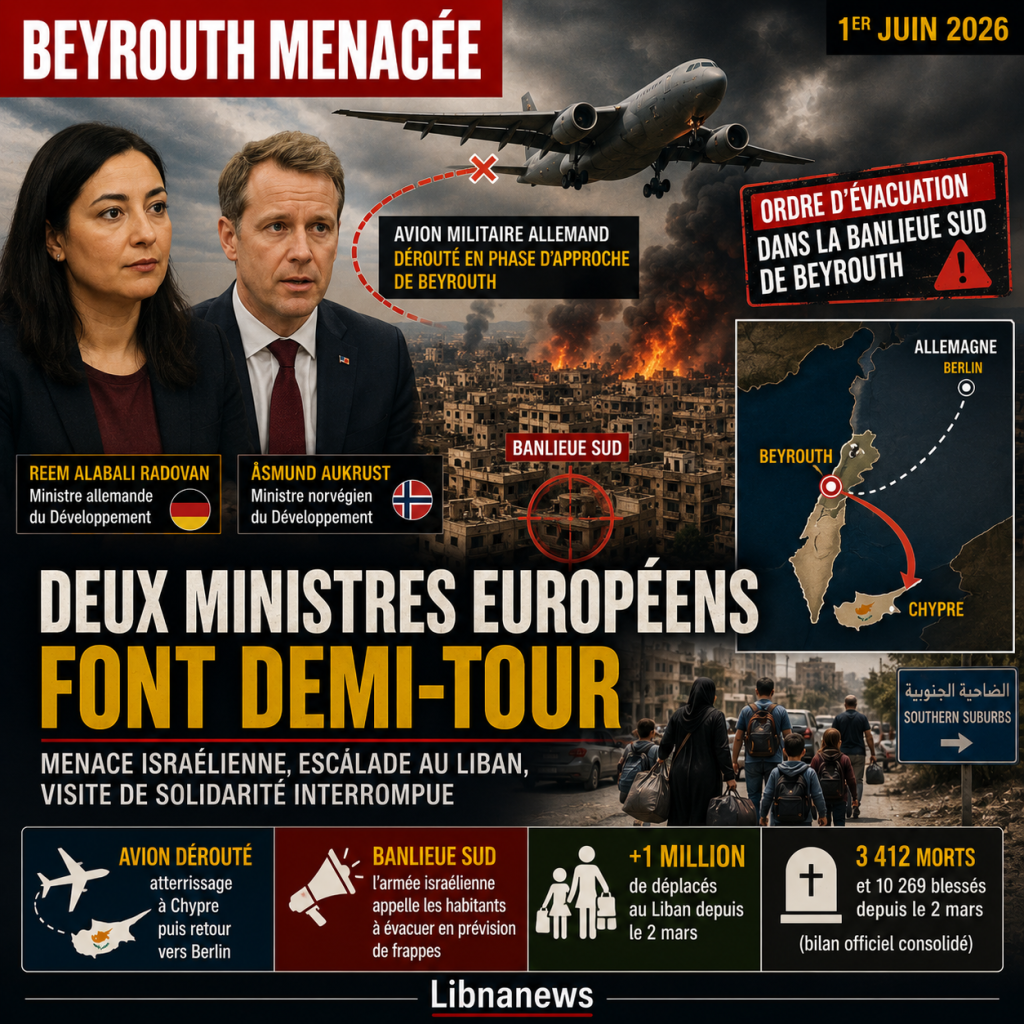
Two European ministers gave up on Monday to visit Beirut when the Israeli army called on the inhabitants of the southern suburbs to evacuate in anticipation of strikes against Hezbollah. The German Minister of Development, Reem Alabali Radovan, and his Norwegian counterpart, Åsmund Aukrust, were on a German military plane approaching the Lebanese capital when their trip was interrupted. The aircraft finally landed in Cyprus, before a planned return to Berlin. This turn gives a concrete measure of the security degradation around Beirut.
The decision comes in a rapid escalation sequence. Benjamin Netanyahu and Israel Katz announced that they had ordered the Israeli army to strike targets in the southern suburbs of Beirut, citing Hezbollah’s fire on Israeli cities and repeated ceasefire violations. Shortly thereafter, the Arab-speaking spokesman of the Israeli army, Avichay Adraee, called the inhabitants of this densely populated area to leave. For Lebanon, already faced with more than 3,400 deaths since 2 March and more than 1 million internally displaced persons, the cancellation of this ministerial visit confirms that the threat now affects the heart of the capital.
A diplomatic turn over the Mediterranean
The displacement of the two ministers should carry a political and humanitarian message. Reem Alabali Radovan and Åsmund Aukrust travelled to Beirut to express their solidarity with the Lebanese population, to meet with the authorities and to interact with representatives of civil society as well as with internally displaced persons. The voyage therefore had a strong symbolic reach. It had to show that the European partners were not content with distant statements, but wanted to see the effects of war and exodus on the spot.
This programme was cancelled in the Beirut approach phase. A spokesman for the German ministry invoked « military reasons » and a situation that was rapidly deteriorating. In Oslo, the Norwegian government services confirmed the cancellation. According to a Norwegian newspaper, the German military aircraft was diverted to Cyprus. The choice of Cyprus is not insignificant. The island often serves as a point of withdrawal, transit or coordination during Lebanese crises, due to its geographical proximity to Beirut and its infrastructure capable of hosting diplomatic or military aircraft.
This flight interruption strikes the minds because it translates an immediate alert, not a simple change of agenda. Visits by ministers to countries at war are prepared with specific security assessments. When an aircraft already engaged to the capital abandons landing, this means that the risks have changed between departure and arrival. The message is therefore stronger than a cancellation announced the previous day. It points to an evolving threat, serious enough to make it impossible for European officials to be present in Beirut.
Beirut under evacuation order
A few hours before the announcement of this turn, the Israeli army had called on the inhabitants of the southern suburbs of Beirut to evacuate. The message of Avishay Adraee, published on Telegram, linked this threat to the continued firing of Hizbollah into Israeli cities and towns. He warned that the army would respond with targets in southern Beirut if the movement continued its attacks. This formulation transforms the civilian population into a direct recipient of a military warning.
The southern suburbs, often called Dahiyeh, are considered by Israel as a stronghold of Hezbollah. However, it is home to a large population, residential areas, shops, schools, hospitals, roads and displaced families from southern Lebanon. An evacuation order in such a dense area is therefore not a precautionary measure. It causes immediate concern, improvised departures, traffic jams, communication breaks and pressure on other parts of the capital.
Experience from previous strikes shows that the evacuation of an urban sector does not automatically protect civilians. Many families do not have vehicles. Others don’t know where to go. Some already live with relatives or in precarious housing after leaving villages in the South. Older people, chronically ill people and children cannot leave in minutes. The Israeli order therefore puts the inhabitants in the face of a brutal choice: to stay in a threatened area or to flee without a guarantee of shelter.
The capital once again becomes a potential front
For several weeks now, most of the Israeli offensive has been concentrated in southern Lebanon. The areas of Tyre, Nabatiyah, Deir al-Zahrani, Litani and Zahrani were subjected to repeated strikes and evacuation orders. The capture of Beaufort Castle by the Israeli army marked a major military milestone, as this site dominates part of the South and refers to the period of Israeli occupation from 1982 to 2000. But the direct threat to Beirut changes the national perception of war.
Beirut is not only Lebanon’s political capital. It focuses on ministries, embassies, reference hospitals, universities, the media, humanitarian organizations and much of the remaining economic activity. A strike in its southern suburbs can disrupt all urban functioning. Roads to the airport, access to the city centre, connections to the mountain and evacuation routes can be blocked within minutes. The impact therefore exceeds the immediate perimeter of the neighbourhoods concerned.
For foreign missions, this configuration reduces the travel margin. An official visiting minister must be able to enter, travel, meet with his interlocutors and leave. If the air path, airport or roads become vulnerable, the visit can no longer be secured. The German and Norwegian half-tour thus reveals that the threat on the southern suburbs already has diplomatic effects even before any strike in the capital.
European solidarity prevented
Displacement should be devoted to solidarity with the Lebanese. Åsmund Aukrust said, in statements reported by the Norwegian press, that more than 3,000 people had been killed since March and that this situation made it even more necessary to support Lebanon and international humanitarian law. Reem Alabali Radovan called on all parties to de-escalate and called for negotiations for a ceasefire. These statements extend an increasingly critical European line towards military escalation.
Germany occupies a delicate position. It remains one of Israel’s important partners in Europe, while supporting humanitarian aid to Lebanon and regional stabilization efforts. Norway, for its part, is placing greater emphasis on international humanitarian law and assistance to civilian populations. The joint presence of the two ministers in Beirut would therefore have brought a balanced message: support for Lebanese civilians, call for de-escalation, but also the maintenance of a diplomatic framework for speaking to the various actors.
Cancellation does not delete this message. It makes him more dramatic. Two European leaders who want to show solidarity cannot reach Beirut because of the risk of Israeli strikes. The scene summarizes the state of Lebanon: a country that waits for help, but whose capital becomes too exposed to accommodate those who come to carry it. It also shows the limits of humanitarian diplomacy when military decisions evolve faster than government agendas.
Israel invokes Hezbollah fire
The Israeli government presents its decision as a response to Hezbollah’s attacks. Benjamin Netanyahu and Israel Katz claim that the pro-Iranian movement violates the ceasefire and continues to target Israeli cities and citizens. The Israeli army claims that the strikes against the southern suburbs would target Hezbollah’s objectives, not the civilian population. The evacuation message is part of this argument: Israel says to warn the inhabitants before acting against the movement’s military or political infrastructure.
This reading is contested in Lebanon. The Lebanese authorities accuse Israel of expanding the war, hitting civilian areas and causing further forced displacement. The Lebanese Government calls for the restoration of the ceasefire and the withdrawal of Israeli forces from the positions advanced in the South. Hezbollah claims to respond to Israeli aggression and the presence of Israeli troops on Lebanese territory. Both sides therefore refer to the responsibility for the first shooting and the break of the truce.
This causation dispute blocks diplomatic efforts. Washington proposes a step-by-step de-escalation: stop Hezbollah attacks on Israel and then Israeli commitment not to extend the strikes in Beirut. On the contrary, Hezbollah’s allies and several Lebanese officials argue that Israel must stop operations first. The half-turn of the European ministers comes precisely in this vacuum: no mechanism has yet imposed a simultaneous stop to the shots and strikes.
An already overflowing humanitarian crisis
The threat to Beirut adds to a massive humanitarian crisis. The latest consolidated official assessment of the Lebanese Ministry of Health, published on Sunday evening, reported 3,412 deaths and 10,269 injuries since 2 March. This total does not necessarily include all the partial balances reported on Monday after further strikes in the South. An attack in Deir al-Zahrani resulted in eight deaths and nineteen injuries according to health authorities. The already fragile medical structures in the South must accommodate the wounded while maintaining regular care.
Population displacement remains the other major indicator. More than one million people have been forced to leave their homes since the start of the March offensive. The families from the border villages first settled in nearby areas and sometimes had to leave as the evacuation orders extended to the Litani and Zahrani. Many live with relatives, schools, public buildings, collective centres or high-cost rented housing.
In this context, an evacuation order targeting the southern suburbs of Beirut may cause a new wave of departures. The capital is already home to some of the displaced from the South. If its neighbourhoods become areas of flight, families will seek refuge in the mountains, the north or other areas of Beirut. The reception capacity, already reduced by the economic crisis, is likely to be exceeded. Municipalities, schools and humanitarian organizations will have to absorb an additional shock.
Cyprus, the back of a Lebanese crisis
The landing in Cyprus of the aircraft carrying the two ministers also illustrates the regional role of the island. Located less than an hour from Beirut, it provides support for evacuations, diplomatic rotations and humanitarian operations. In previous crises in Lebanon, Cyprus has often served as a platform for foreign nationals, NGOs and European governments. Monday’s diversion reactivates this geography of crisis.
For Europeans, Cyprus offers relative security and operational proximity. It allows a mission to be suspended without immediately returning it to its starting point. It can also be used to maintain remote contacts with the Lebanese authorities. But it underscores the growing isolation of Beirut. When a ministerial visit can no longer reach the capital, the message sent to NGOs, businesses and international delegations is clear: the mobility margin is narrowing.
This will have an impact on aid. Official visits are not only used to show political solidarity. They also help to coordinate funding, visit reception centres, talk to humanitarian agencies and convince European public opinion. A cancelled visit can be replaced by remote meetings, but it loses part of its political weight. The Lebanese see a promise of presence transformed into a warning signal.
Diplomacy Under Aircraft Pressure
The turn of German and Norwegian ministers sums up a shift. Diplomacy is no longer confined to communiqués, capitals and crisis meetings. It also decides in cockpits, according to the security information received in real time. An evacuation order, a threat of attack or a military evolution may change the calendar of a European State within minutes. This uncertainty complicates all mediation efforts.
It also weighs on the Lebanese government. Nawaf Salam seeks to mobilize international assistance for internally displaced persons and to support efforts to restore the ceasefire. Joseph Aoun defends the diplomatic option, including through direct negotiations to stop the escalation. However, these efforts face an area that is deteriorating faster than the discussions. When foreign ministers renounce to land in Beirut, the Lebanese capital loses a symbolic space of normality.
Monday’s decision does not close the door to a subsequent visit. Rather, it indicates that any international presence in Beirut will now depend on the immediate evolution of strikes, Hezbollah fire and security guarantees around the airport. The German and Norwegian ministers wanted to meet with the authorities and the displaced. They leave without having reached the capital, while the inhabitants of the southern suburbs wait to know whether the evacuation order will turn into actual strikes or a new lever of military pressure.




