

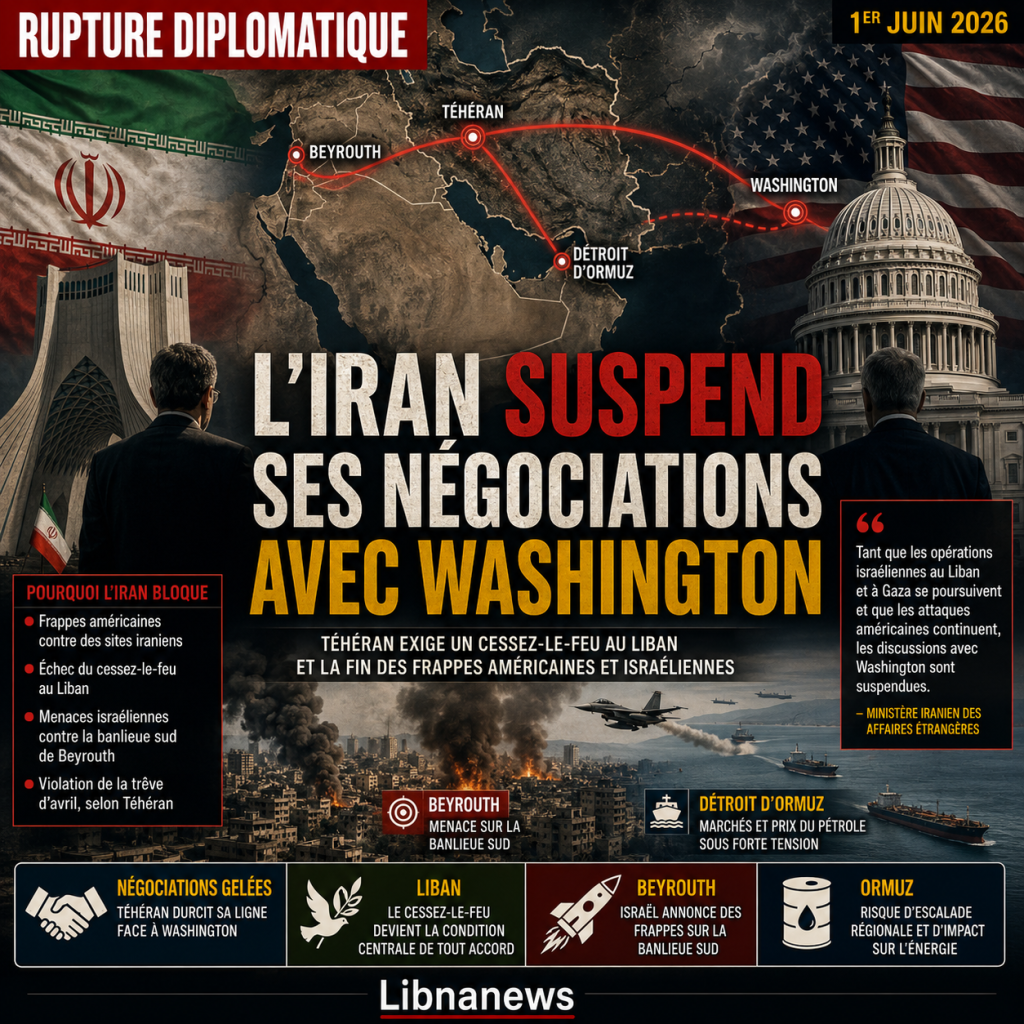
Iran tightened its position in negotiations with Washington on Monday, following American strikes on Iranian sites, the failure of the ceasefire in Lebanon and new Israeli threats against the southern suburbs of Beirut. According to several international media, Tehran is now suspending indirect exchanges until Israeli operations in Lebanon and Gaza cease. The Iranian Foreign Ministry had already established a ceasefire in Lebanon as a central condition for any regional agreement. The Lebanese crisis thus becomes one of the major blocking points between Iran and the United States.
This rupture occurs in a very dense military sequence. Washington and Tehran accused each other of violating the April truce. Iran claims that American strikes in the south of the country have broken the fragile balance of the discussions. The United States portrays these attacks as defence actions. At the same time, Israel expanded its operation in southern Lebanon, took Beaufort’s strategic position and announced strikes against targets in the southern suburbs of Beirut. Regional diplomacy is therefore caught between three homes: the Iranian-American front, the Lebanese front and the threat of an extension to the capital.
Iran closes door to immediate discussions
Tehran no longer only speaks of diplomatic slowness. The Iranian message, as reflected in the statements and information released on Monday, is to suspend discussions as long as the conditions on the ground remain unchanged. The spokesman for the Iranian Foreign Ministry, Ismail Baghaei, said in the morning that the negotiations were taking place in a climate of deep mistrust. He also accused Washington of constantly changing his positions. A few hours later, the line got tougher: there can be no real continuation of dialogue if Israel continues its operations in Lebanon and if the United States continues its own strikes.
This distinction is important. Indirect channels may not disappear. Mediators can continue to send messages. But political negotiations, which were to prolong the truce, reopen the Strait of Ormuz and outline a regional agreement, are entering a phase of deadlock. Iran wants to avoid giving the image of a country that talks while its allies are struck and its own territory is targeted. He also wants to preserve his ability to respond, without appearing to be the one who permanently burys any diplomatic exit.
The most correct formula is therefore that of suspension, rather than irreversible closure. Tehran closed the door in the short term, but suggested that it could reopen if Israeli operations ceased and Washington respected the framework of the ceasefire, according to Iranian reading. That shade counts. It distinguishes a tactical break, intended to influence the discussions, from a complete abandonment of the diplomatic path. For markets, chanceries and regional actors, however, the immediate effect remains the same: uncertainty increases sharply.
American strikes as a break point
One of the factors that accelerated the crisis is the exchange of strikes between the United States and Iran. According to the international press, the US Army hit several Iranian sites over the weekend, including facilities in the southern part of the country and in the Ormuz Strait area. Washington claims to have acted in defence, facing threats against its forces and navigation. Tehran describes these strikes as a serious violation of the ceasefire concluded in April. The difference is therefore not just about the facts, but about the very definition of truce.
Iran claims that the ceasefire should cover all the fronts involved in the regional war. In this reading, American strikes against Iranian sites and Israeli attacks in Lebanon are part of the same bloc. Tehran refuses to separate the actions of Washington from those of Israel. The Iranian spokesman also stressed the indivisibility of United States and Israeli operations in the region. This position allows Iran to present the strikes in Lebanon as an indirect violation of the framework negotiated with the United States.
The United States, for its part, seeks to maintain another reading. They say they respond to immediate threats and preserve freedom of navigation. They also want to prevent attacks by their forces from being interpreted as abandoning diplomacy. The U.S. President said Iran wanted an agreement. But this optimistic language comes up against military facts. When strikes occur during message exchanges, the already low confidence becomes almost non-existent.
Lebanon becomes the regional lock
The Lebanese issue is now central to the blockade. Tehran affirms that any agreement to end the war must include a ceasefire in Lebanon. This condition is not new, but it becomes more binding after the failure of the truce on the ground. For several days, Israel has intensified its strikes in southern Lebanon, declared a combat zone between the Litani and the Zahrani, and taken Beaufort Castle, a strategic position that dominates part of the South. This progress has changed the nature of the conflict.
The latest consolidated official assessment of the Lebanese Ministry of Health, published on Sunday evening, reported 3,412 deaths and 10,269 injuries since 2 March. This figure does not necessarily include all victims reported on Monday after further strikes. An attack in Deir al-Zahrani resulted in eight deaths and nineteen injuries according to the Lebanese health authorities. More than one million people were displaced by strikes and evacuation orders. For Iran, these figures reinforce the idea that an endless regional agreement on the Lebanese front would be politically unsustainable.
Hezbollah, an ally of Tehran, also rejects the idea of a unilateral halt to its fire. His allies claim that he cannot stop his attacks if Israel maintains positions in Lebanon and continues its strikes. But Washington proposes a reverse sequence: Hezbollah would stop its attacks on Israel first, then Israel would avoid expanding its offensive towards Beirut. This gradual method aims to obtain a verifiable first step. It runs against the Iranian line, which requires a more global and simultaneous stop.
Israeli threats to Beirut change equation
The Israeli declaration against the southern suburbs of Beirut weighed heavily in the Iranian decision. Benjamin Netanyahu and Israel Katz announced that they had ordered the army to strike targets in this area, Hezbollah’s stronghold. The Israeli communiqué invokes repeated violations of the ceasefire in Lebanon and attacks on Israeli cities. For Tehran, this announcement confirms that the truce is no longer respected and that negotiations cannot progress under the current conditions.
The southern suburbs of Beirut are not just military theatres. It is a dense, populated, urban area, integrated into the functioning of the capital. A strike in this area can cause massive displacement, disrupt hospitals, block roads and trigger a Hezbollah response. It can also weaken the position of Lebanese President Joseph Aoun, who seeks to support de-escalation and to bring forth the option of direct negotiations to stop the escalation. As the threat to Beirut increases, Baabda’s political margin narrows.
Israel claims to be targeting Hezbollah’s infrastructure and capabilities. But the timing has a clear diplomatic significance. The announcement came as the United States tried to contain precisely the risk of an attack on Beirut. It gives Iran a strong argument to suspend discussions. Tehran can now argue that Washington does not have the ability or will to control Israeli escalation. This perception is at the heart of the current crisis.
Washington caught between Israel and the Iranian truce
The United States is in an uncomfortable position. On the one hand, they want to preserve discussions with Tehran, prevent a prolonged closure of the Strait of Ormuz and avoid a lasting surge in oil prices. On the other hand, they support Israel and recognize its right to respond to Hezbollah attacks. An American official quoted by the press said that Washington did not expect Israel to absorb attacks against its civilians indefinitely. This sentence limits US pressure on the Israeli government.
This ambiguity feeds Iranian mistrust. Tehran believes that the United States cannot stand as mediators while striking Iran and allowing Israel to intensify its operations in Lebanon. On the contrary, Washington considers that Iran uses Hezbollah and other regional allies to maintain military pressure while negotiating. Both readings respond and block. Each accuses the other of negotiating under cover of climbing.
The result is diplomacy suspended from the conduct of the armed forces. A drone shot, a strike on a base, a bombardment in the southern suburbs or an attack on a ship can change political conditions in minutes. Mediators are losing time restoring channels that the military closes. Iran, by suspending the discussions, also seeks to resume the narrative initiative: it wants to present the blockade as the consequence of the American and Israeli strikes, not as an Iranian refusal to negotiate.
Ormuz and the markets under tension
The Strait of Ormuz remains the other immediate issue. The talks between Iran and the United States should focus on extending the truce, freedom of navigation and guarantees around this essential energy route. The suspension of negotiations therefore increases the risk to oil flows. Markets responded by rising crude oil prices, fuelled by fears of more sustainable blocking or attacks on navigation-related infrastructure.
Iran has also denounced what it describes as maritime piracy and infringements of its navigation. He claims that he will take the necessary steps to defend his sovereignty. This formulation leaves open several options: diplomatic pressure, limited military response, threats to waterways or actions of its regional allies. The Gulf States are following this development with concern. An escalation around Ormuz would immediately affect their exports, financial markets and domestic security.
The fall of several Gulf markets on Monday shows that the crisis is not only diplomatic. Investors are integrating the risk of prolonged war, rising energy costs, new strikes and declining regional trade. The war in Lebanon, the American strikes in Iran and the threats to Ormuz now form a single cluster of risks. This is precisely what Tehran wants to see recognized in the negotiations: no file can be dealt with separately.
Lebanon pays the price of blocking
For Lebanon, this suspension of negotiations aggravates an already critical situation. The country hoped that regional discussions could curb the Israeli offensive and restore an effective ceasefire. If Iran suspends trade, the diplomatic window narrows. The Lebanese government continues to work with friendly and brotherly countries to restore the truce, but it does not control Hezbollah’s decisions, Israel’s, Washington’s and Tehran’s. This dependency reduces the state’s ability to protect its population.
The government of Nawaf Salam must manage the emergency. A report on accommodation and travel needs should be published on Tuesday. A further urgent appeal to the international community is expected on Friday to meet growing humanitarian needs. Displaced families need shelter, food, water, care and financial support. Municipalities and schools are saturated. Southern hospitals operate under pressure, while strikes have already injured health workers.
If regional diplomacy blocks, needs will increase further. A major strike against the southern suburbs could move new families to other parts of Beirut, to the mountains or north. An Israeli advance beyond the current positions would cause other localities to flee. Each diplomatic failure is translated into emergency beds, queues, closed classes and municipal budgets that cannot be maintained.
A suspension that can become broken
The question for the next few hours is whether the Iranian suspension will remain a lever of pressure or whether it will become a lasting break. Tehran has an interest in maintaining a diplomatic margin, especially if economic and military costs increase. Washington wants to avoid a global energy crisis and maintain a channel with Iran. Israel wants to keep its hands free against Hezbollah. Hezbollah wants to prevent a regional agreement from being made at its expense. These objectives are incompatible as long as no actor agrees to make the first move.
The main risk is that of gear escalation. The United States knocks by claiming to defend itself. Iran responded by claiming to be attacked. Israel strikes in Lebanon in response to Hezbollah. Hezbollah is firing in response to the Israeli offensive. Each actor claims to react, but the whole produces a wider war. In this context, the suspension of negotiations is not only a diplomatic event. She pointed out that the restraint mechanisms no longer worked.
The next indicator will come from three directions. First, Israeli decisions around the southern suburbs of Beirut. Secondly, the American reaction to Iran’s accusations of ceasefire violations. Finally, the mediators’ ability to maintain a discreet channel despite the announcement of suspension. For Lebanon, the immediate challenge remains more concrete: to avoid the failure of Iran-US diplomacy resulting in a new wave of strikes, displacements and heavy human balances.




