

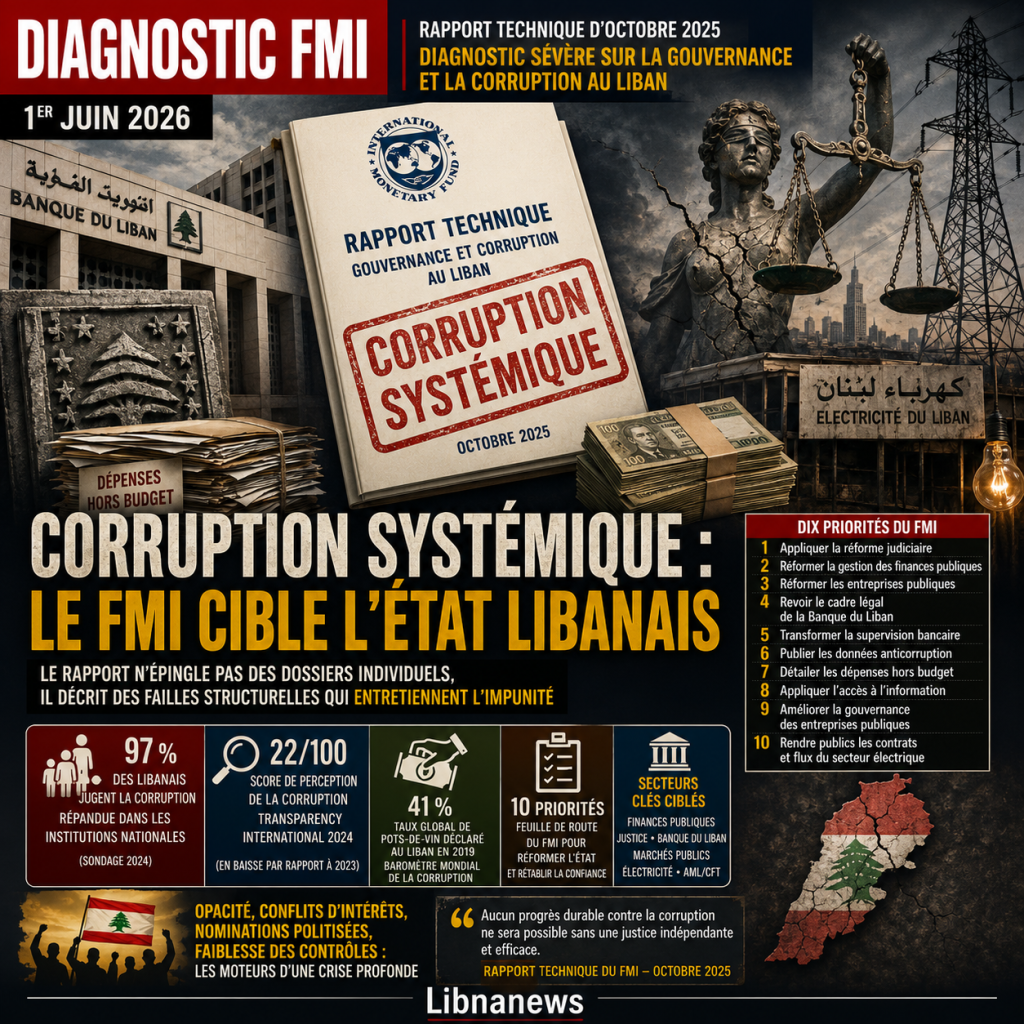
A technical report by the International Monetary Fund on governance and corruption in Lebanon states that systemic corruption is not only a symptom of the crisis, but one of its drivers. The document, dated October 2025, examines public finances, the Bank of Lebanon, banking supervision, the fight against money laundering, justice, public enterprises and access to information. It does not cover individual files. It analyses structural flaws that prevent the state from controlling its spending, protecting public resources and restoring citizens’ confidence.
The diagnosis comes after the formation of the government of Nawaf Salam and the election of Joseph Aoun, two events that reopened the dialogue with the international institution. The report recalls that Lebanon requested this assessment in February 2022, following the preliminary agreement with the IMF. The agreement, which has now been exceeded, provided for funding of approximately $3 billion, conditional on heavy reforms. Three years later, the IMF notes that progress remains limited, despite some macroeconomic improvements since 2023.
Corruption in Lebanon: a straightforward diagnosis
The issue goes beyond the only relationship with the IMF. The report describes a State where rules often exist on paper, but where their implementation is hampered by political interests, faith-based networks, under-supported administrations and weak controls. The financial crisis opened in 2019 aggravated these vulnerabilities. It reduced the capacity of the administration, accelerated the departure of skills and increased public distrust. In this reading, the economic reconstruction of Lebanon begins with the reconstruction of the State.
The document’s strongest formulation is its general diagnosis: systemic corruption and weak governance are among the root causes of Lebanese fragility. The IMF does not present corruption as an additional isolated abuse. It describes it as a system that crosses the essential functions of the State. Public finances, justice, taxation, customs, electricity and the central bank are affected to varying degrees by opacity, conflict of interest, political appointments and the absence of sanctions.
The indicators cited are heavy. In 2024, 97 per cent of Lebanese respondents considered that corruption was widespread in national institutions. Transparency International’s Corruption Perception Index attributed the country a score of 22 out of 100 in the same year, down from 2023. The overall rate of bribes reported in the Global Corruption Barometer reached 41% in 2019. One in four Lebanese said they had to pay a bribe to access basic services, such as public schools, clinics, identity papers, public services, police or courts.
The private sector is also experiencing this situation. The World Bank Business Survey reported in 2019 that 21.8% of companies had faced at least one informal payment request. The report also cites a massive distrust of public officials: 79 per cent of respondents in 2019 felt that government officials and parliamentarians were corrupt, while 87 per cent found the state’s action against corruption to be bad. These figures reflect a break between administration and administration.
Laws passed, but an incomplete application
The report insists on an essential dimension: the texts adopted in recent years are not enough. Lebanon has a national anti-corruption strategy for 2020-2025. It explicitly recognizes systemic corruption, political and denominational complicity, as well as the social normalization of the Wasta. It sets out three objectives: to enhance transparency, to activate accountability and to end impunity. But its implementation has been slowed down by political, financial and security crises.
The National Anti-Corruption Commission illustrates this distance between ambition and reality. It was welcomed when it was put in place, but it is not fully operational. It still depends on external support and lacks human resources. Other key bodies, such as the Central Inspectorate, the Court of Auditors, the Civil Service Council or the Office of the Minister of State for Administrative Reform, also suffer from limited resources. The control capacity therefore exists by fragments, without a critical mass sufficient to change practices.
Justice and the rule of law, the central hub
Justice is the other weak pillar of the system. The report recalls that corruption undermines the rule of law, while weak rule of law fuel corruption. In 2024, only 13% of Lebanese reported trusting the justice system. The courts lack staff, budget, supplies and equipment. Appointments and transfers of judges remain vulnerable to political balance. High-ranking judicial positions often carry denominational labels. The IMF believes that no lasting progress against corruption will be possible without independent and effective justice.
The new law on the organization of the judiciary, adopted in July 2025, represents an important step in this direction. It provides for more elections within the judiciary, clearer rules for mandates, reporting obligations and a strengthened role for judicial inspection. But the report insists on the next step: implementation. Lebanon has often passed reform laws without the necessary decrees, budgets or appointments. The test will therefore not be legislative, but operational.
Public finances: budgetary opacity involved
Public finances concentrate much of the diagnosis. The IMF describes an old legal framework, dominated by the 1963 Public Accounting Act, and procedures that are not adapted to a modern state. Budget preparation remains disorderly. The budget schedule is frequently violated. State accounts are not audited on a regular basis, which weakens parliamentary oversight. Expenditure decisions can then become ad hoc, with little transparency and little effective control.
The report focuses on the extent of out-of-budget spending. Their exact amount is not known precisely because the Ministry of Finance does not publish them in budget documents. The Basil Fuleihan Finance Institute estimated them at about 15.5% of GDP, while another estimate raised them to 60% of the budget implemented in 2018. This opacity distorts the picture of public spending and deficit. It also increases the risk of fraud, as a large part of public money escapes ordinary rules.
Bank of Lebanon and supervised banking sector
The Bank of Lebanon also appears in the diagnosis. The report considers that its governance framework is not aligned with international best practices in terms of mandate, autonomy, decision-making and accountability. He stressed the excessive weight of the governorship, the lack of counter-powers and the opacity of certain operations. The Sayrafa platform, used until 2023, is described as a mechanism that has created annuities opportunities for actors with privileged access to currencies.
Banking supervision is another critical issue. The IMF notes a fragmented architecture among several institutions, poorly distributed responsibilities, limited transparency and inadequate mechanisms against conflicts of interest. The framework for dealing with related parties remains incomplete. The dominance of family banks reinforces these vulnerabilities. For the IMF, financial sector reform cannot be limited to the distribution of losses from the banking crisis. It must also review the rules of control, governance and accountability.
The fight against money laundering exists legally, but its effectiveness remains limited. The report notes that corruption is considered the main threat of money-laundering in Lebanon. The tools for beneficial owners and politically exposed persons are partly aligned with international standards, but their implementation remains insufficient. The average amount of proceeds of corruption confiscated between 2017 and 2021 would have been only about $4.9 million per year, a figure judged unrelated to the magnitude of the risks.
Public procurement and electricity, two revealing
Public procurement is a concrete example of these frailties. Between 2011 and 2020, they accounted for an average of 20% of central government expenditure and 6.5% of GDP. The Public Procurement Act of 2021 was intended to reduce the risk of corruption by creating a regulatory authority, a review authority, standard documents, an electronic platform and training mechanisms. But its application remains slow. A survey by the Central Inspectorate cited in the report shows that 62 per cent of the contracts reviewed were awarded by mutual agreement, compared with 7 per cent by public tender, and 94 per cent were not controlled by the Central Tender Board.
The electricity sector embodies the social and financial cost of bad governance. Electricity in Lebanon has been operating for decades with government-funded deficits. The IMF estimates that $3.66 billion was spent by the government on electrical projects between 1990 and 2019. International donors added $1.28 billion through the Development and Reconstruction Council between 1992 and 2021. Despite these amounts, supply remains unstable, private generators thrive and structural reforms have been blocked.
The report details the rent mechanisms in this sector. Fuel importers, private generator owners, opaque contracts, temporary workers and politicized appointments form an ecosystem where established interests hinder any reform. Between 2019 and 2023, the Bank of Lebanon reportedly provided $9.9 billion to finance import subsidies and preferential payments. Private generators, initially introduced to fill the absence of public electricity, have become a powerful parallel economy, often close to local or national actors.
Customs, taxation and access to information
Customs and tax administration are also at risk areas. The report recalls that in 2013, the Ministry of Finance estimated the loss of customs revenue related to border corruption at about 1% of GDP. The VAT compliance gap was estimated at 3.3% of GDP. In 2015, the Minister of Finance said that customs corruption cost the state $1.2 billion. The IMF notes that these data need to be updated, but stresses the lack of structural reforms that can address the problem.
Access to information is another indicator. The law represents a step forward, but its application remains partial. At the national level, 190 out of 310 administrations were reviewed: 56 per cent had received requests for information, 76 per cent had responded and 69 per cent had met the legal deadline of 15 days. Proactive publication remains weak. More than half of national institutions and three quarters of local entities have not appointed information officers. Transparency therefore remains dependent on the goodwill of administrations.
Ten priorities to break out of impunity
In view of this table, the IMF makes ten priority recommendations. The first five focus on structural reforms: implementing the law on the organisation of the judiciary, reforming the management of public finances, reforming public enterprises, reviewing the legal framework of the Bank of Lebanon and transforming the banking supervision architecture. The other five are aimed at transparency: publication of anti-corruption data, detailing out-of-budget spending, real implementation of access to information, improving governance of public enterprises and making public contracts and financial flows in the electricity sector.
This roadmap comes at a difficult time for the authorities. War in the South, internal displacement and pressure on public finances can relegate institutional reforms to the background. The IMF, however, takes the opposite of this reading. He suggested that the security and social emergency make governance more necessary, no less urgent. International aid, reconstruction programmes, energy contracts, emergency expenditure and possible external financing will create new risks if controls remain weak. In this perspective, anti-corruption reform is not an administrative supplement. It becomes a condition for the protection of public funds and credibility with donors.
The report does not promise a quick solution. It distinguishes short, medium and long term horizons, sometimes up to thirty-two months. It also recognizes that reforms require a Parliament, a government and a presidency capable of acting on a lasting basis. But its message is clear: without transparency, functional justice and oversight of public finances, Lebanon will not be able to stabilize its economy or restore confidence. The next step will depend on the ability of government, Parliament and oversight institutions to transform this diagnosis into verifiable decisions.




