

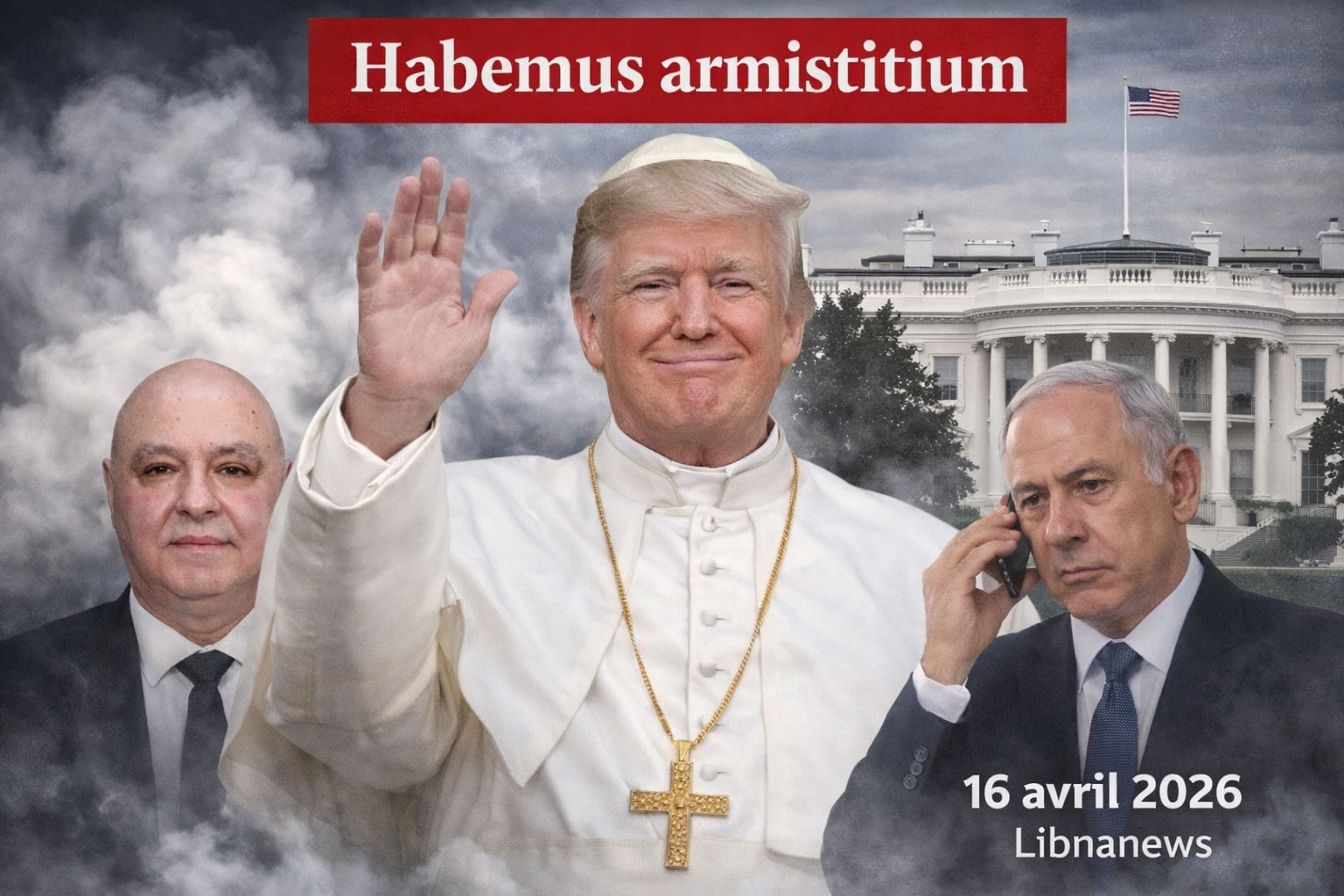
Donald Trump announced on Thursday a ten-day ceasefire between Israel and Lebanon, presented as opening a sequence of « peace » after more than a month of war on the Lebanese front. In a message published on Truth Social, the US President claimed to have had discussions with Israeli Prime Minister Benjamin Netanyahu and Lebanese President Joseph Aoun, and set the formal start of the truce at 5 p.m. in Washington, D.C., at 11 p.m. according to the timetable relayed to Beirut. The announcement immediately gave weight to the diplomatic track opened this week in the United States, but it was accompanied by several shadow zones, starting with the Lebanese version of the day’s trade or if Tel Aviv reserves the right to strike Hezbollah as during the previous truce.
The most sensitive point is this shift. In his message, Donald Trump assured that the two leaders had accepted the ten-day truce principle. He added that he had instructed Vice President JD Vance, Secretary of State Marco Rubio and Joint Chief of Staff Dan Caine to work with both countries to transform this suspension of fighting into a more lasting arrangement. In a second message, he also said he wanted to invite Benjamin Netanyahu and Joseph Aoun to the White House for what he presented as constructive discussions.
But in Beirut, official communication remained much more cautious. The Lebanese presidency confirmed contacts with Washington, first with Marco Rubio, then with Donald Trump. It thanked the United States for its efforts towards a ceasefire. On the other hand, it did not confirm any direct exchange between Joseph Aoun and Benjamin Netanyahu. At the same time, an official Lebanese source quoted by the AFP claimed that the Lebanese President had refused « direct contact » with the Israeli Prime Minister and had informed Marco Rubio. Several Lebanese officials cited by Reuters also indicated that there were no calls with Netanyahu at this stage.
In other words, the political fact of the day is not only the announcement of a truce. It is also the existence of two parallel accounts. The American story highlights a personal breakthrough by Donald Trump, a ten-day agreement and a Aoun-Netanyahu tandem presented as a first step towards a broader peace. The Lebanese account validates the American effort on the ceasefire, but refuses to endorse the idea of direct contact at the summit with Israel. This nuance is essential in a country where the very word of standardization remains politically explosive.
American announcement after rare contacts in Washington
Donald Trump’s announcement comes two days after the first direct meeting between Lebanese and Israeli representatives in Washington in 34 years. On Tuesday, under the aegis of Marco Rubio, officials from both countries met in an American setting to try to open a political channel against a background of war that is still active. This meeting had already marked a break. However, it had not led to any immediate truce. Both delegations had remained on very different priorities: Lebanon called for a halt to the strikes, humanitarian relief and an Israeli withdrawal; Israel, for its part, maintained its line on Hezbollah and the security of its northern border.
It is in this context that Donald Trump chose to go further. His message does not speak of a simple window of de-escalation or technical progress. He talks about a ten-day « formal » ceasefire. The wording gives the sequence a greater political scope than a de facto break. It suggests that a commitment has been obtained, at least at this stage, from both governments. The US President clearly attributes merit and presents the truce as a new demonstration of his ability to « solve » conflicts.
On the American side, this staging meets several objectives. It first allows Washington to show that he remains the central player on the Lebanese issue, despite parallel mediation initiatives from Pakistan on the Iranian issue. It also allows Donald Trump to put the Lebanese front back in his broader story of regional de-escalation. Finally, it provides a political framework for the Washington meeting, which could otherwise have been seen as a mere exploratory contact without any concrete result.
For Lebanon, however, the equation is more delicate. Beirut needs the United States to influence Israel. But the Lebanese government does not want to appear to be engaged in summit diplomacy with Israel as long as no cease-fire is actually implemented. This caution explains why the Lebanese Presidency communiqué remained focused on the goal of a truce, without going so far as to take over the American version of an Aoun-Netanyahu exchange.
Beirut confirms Washington, not Netanyahu
President Joseph Aoun met well with American officials on Thursday. This is confirmed by the Lebanese Presidency and several international dispatches. He thanked Marco Rubio for his efforts to achieve a ceasefire with Israel. According to a news agency, he also spoke with Donald Trump in what was the first known exchange between the two men. But what Beirut has not confirmed is just as important: there is no official Lebanese validation of a direct call with Benjamin Netanyahu at the time of the announcement.
This reservation is not a communication detail. It corresponds to a political line followed by Baabda for several days. Joseph Aoun reiterates that the cease-fire must be « natural entry » to any direct negotiation. In other words, official Lebanon accepts the diplomatic route, but wants to limit it to the cessation of hostilities, Israeli withdrawal and stabilization of the front. A direct presidential conversation with Netanyahu, without an effective ceasefire and without visible results on the ground, would immediately have been interpreted in Beirut as a much heavier acceleration, close to a beginning of normalization.
The Lebanese official source cited by the AFP also gave this caution explicit content. According to her, Joseph Aoun refused the American request to establish direct contact with Benjamin Netanyahu and reported it to Marco Rubio. The same source added that the United States understood the Lebanese position. Other dispatches reported that several Lebanese officials said that there were no immediate calls with Netanyahu and that the Lebanese embassy in Washington had warned the US administration before even the exchange between Aoun and Rubio.
This discrepancy between Donald Trump’s announcement and Lebanese communication summarizes the tension in the sequence. Washington wants to give life to a dynamic. Lebanon wants to keep control of the political threshold that it agrees to cross. Israel, for its part, has every interest in seeing the idea of presidential or quasi-presidential contact validated, as this would reinforce the story of a diplomatic reorganization imposed by military pressure. By refusing to go so far, Joseph Aoun maintains a line: yes to a truce; No, for now, at a direct scene with Netanyahu.
In the field, strikes continued until the last hours
The American announcement did not take place in an already visible context. On the contrary, Thursday was marked by a new series of strikes and fighting in the South Lebanon and beyond. The Lebanese National Information Agency reported Israeli raids in several areas, severe damage to the government hospital in Tebnine, destruction in various southern localities and further intensification around Bint Jbeil and Yarun. Other dispatches from the same agency reported the destruction of the Qasmiyeh bridge and strikes on the Dahr al-Baidar axis, further widening the map of military pressure.
An international news agency reported that an Israeli strike had destroyed the last bridge over the Litani River, which would link a part of the South directly to the rest of the country, according to a Lebanese security source. The same agency also pointed out that the fighting continued around Bint Jbeil, presented as one of the major military homes of the moment. This city has remained at the centre of the clashes for several days, with repeated bombings, fighting reported by the ANI and strong Israeli pressure on its approaches and access routes.
The essential fact is therefore that the ceasefire announced by Donald Trump was not born on a ground already calmed down. It arrives after a day marked by strikes, destruction of infrastructure and active fighting. This chronology is important to measure the expectation now placed on the theoretical hour of entry into force of the truce. In Beirut as in the South, the question is not just what Donald Trump wrote about Truth Social. The question is whether, from the time announced, the bombings actually stop.
In fact, Elysée summed up this expectation by welcoming an « excellent news » that will have to be « checked on the ground ». The brief formula reflects the general state of mind of chanceries. The American announcement is far-reaching if it is followed by effect. It will quickly lose credibility if the strikes continue in the following hours, or if one of the parties considers that it is not bound by the terms and conditions presented by Washington.
Bint Jbeil, Tebnine, Qasmiyeh: the last hot spots before the truce
The most observed front is Bint Jbeil. Over the past several days, this city and its surroundings have concentrated a significant part of the ground fighting, artillery fire and bombing. On Thursday, the National Information Agency reported heavy bombardments on Bint Jbeil and Yarun, in the continuation of the clashes already recorded in the previous days. For Beirut, this zone is an obvious test of the reality of the announced truce: if the exchanges of fire continue after the so-called hour, the political scope of the American announcement will immediately be weakened.
Tebnine is another sensitive point. The strikes reported on Thursday caused heavy damage to the government hospital, according to ANI. This information has reinforced the impression of rising Israeli pressure on civilian and medical infrastructure. In the current diplomatic sequence, the issue of hospitals, roads and bridges is not secondary. Lebanon has made the humanitarian aspect one of the central reasons for its request for a ceasefire. Every new strike on this type of infrastructure therefore makes it politically more urgent to immediately stop hostilities.
Qasmiyeh Bridge gives another measure of tension. Its destruction, reported by the ANI, came as speculation on a truce was already gaining ground. Symbolically, the image is strong: at the very moment when Washington talks about a suspension of fighting, the Lebanese terrain continues to change as a result of the strikes. The war on Thursday had nothing to do with a war already suspended. It remained active, visible and destructive.
This discrepancy between the diplomatic agenda and the military rhythm explains Beirut’s prudence. Joseph Aoun cannot politically sell too dramatic a breakthrough as long as his own services and national dispatches continue to record raids, destruction and injuries. The Lebanese State has therefore chosen to stick to the narrowest formulation: yes to a ceasefire; Yes to American mediation; But the rest will be judged on the facts.
A ten-day ceasefire, and then what?
On paper, the ten days announced must be used as a launch ramp. Donald Trump presents this period as a first step towards a « sustainable peace » between Israel and Lebanon. He explicitly placed the truce in a broader perspective, with the involvement of JD Vance, Marco Rubio and Dan Caine. The White House therefore seeks to give the cease-fire a function other than strictly military. It would not only be a momentary stop of fire, but the beginning of a more structured process.
For Lebanon, logic is more cautious. If the truce actually enters into force and lasts for several days, it could create the space for a resumption of indirect or direct dialogue, with American mediation, on three topics that Beirut puts at the forefront: the lasting cessation of strikes, the Israeli withdrawal from the areas of the South where its forces still operate, and the return of the displaced. The Lebanese Government also wants the truce to provide safer access to infrastructure and heavily affected civilian areas.
But several obstacles remain. The first is Hezbollah’s position. The movement rejected the direct talks between Lebanon and Israel and denounced what it considered free concessions. At this point, there is no public indication that he has validated the exact terms of the ceasefire announced by Donald Trump. The second obstacle is Israeli. Until the last few hours, Israel continued to hit heavily in Lebanon and to present its campaign as necessary to permanently weaken Hezbollah. Finally, the third obstacle is the very fragility of the announcement: it was formulated in Washington, but its precise contours, control mechanisms and concrete guarantees are not yet publicly detailed.
That is why the first night of this truce will count as much as the accompanying political text. If the fixed hour passes without major strikes or rapid resumption of fighting, the American announcement will gain in consistency. If violations appear very quickly, the sequence could turn into a new episode of premature announcements. For the time being, official Lebanon has chosen a simple formula: to welcome the perspective of the ceasefire, without taking over the entire American narrative that accompanies it.
A diplomatic moment, but not yet an acquired turning point
Thursday will have produced three separate facts. The first is Donald Trump’s announcement of a 10-day ceasefire between Israel and Lebanon. The second is Beirut’s confirmation of contacts with Washington, but not a direct exchange with Benjamin Netanyahu. The third is the continuation of strikes and fighting until the last hours before the announced entry into force of the truce.
Taken together, these three facts draw a real diplomatic moment, but still suspended from its execution. Lebanon sees this as a possibility of stopping hostilities that it has been demanding for days. The United States sees this as an opportunity to show regional success and regain control of a front that has become central to its strategy. Israel can see this as a tactical respite and a way to partially convert its offensive into a diplomatic lever. But on the ground, it is first of all the silence or the noise of the strikes that will say whether the announced ceasefire actually exists.
In Beirut, the caution displayed by Joseph Aoun is also explained by this. The Lebanese President knows that the slightest word commits. He knows that a direct appeal with Netanyahu, even if only mentioned, would immediately have moved the ceasefire debate to normalization. By refusing this slide, while leaving the door open to a truce, he tries to keep the file on what he considers to be the absolute urgency: to stop the bombings, to check the effects of the American announcement and to see if, for once, diplomacy arrives before the next strike.




