

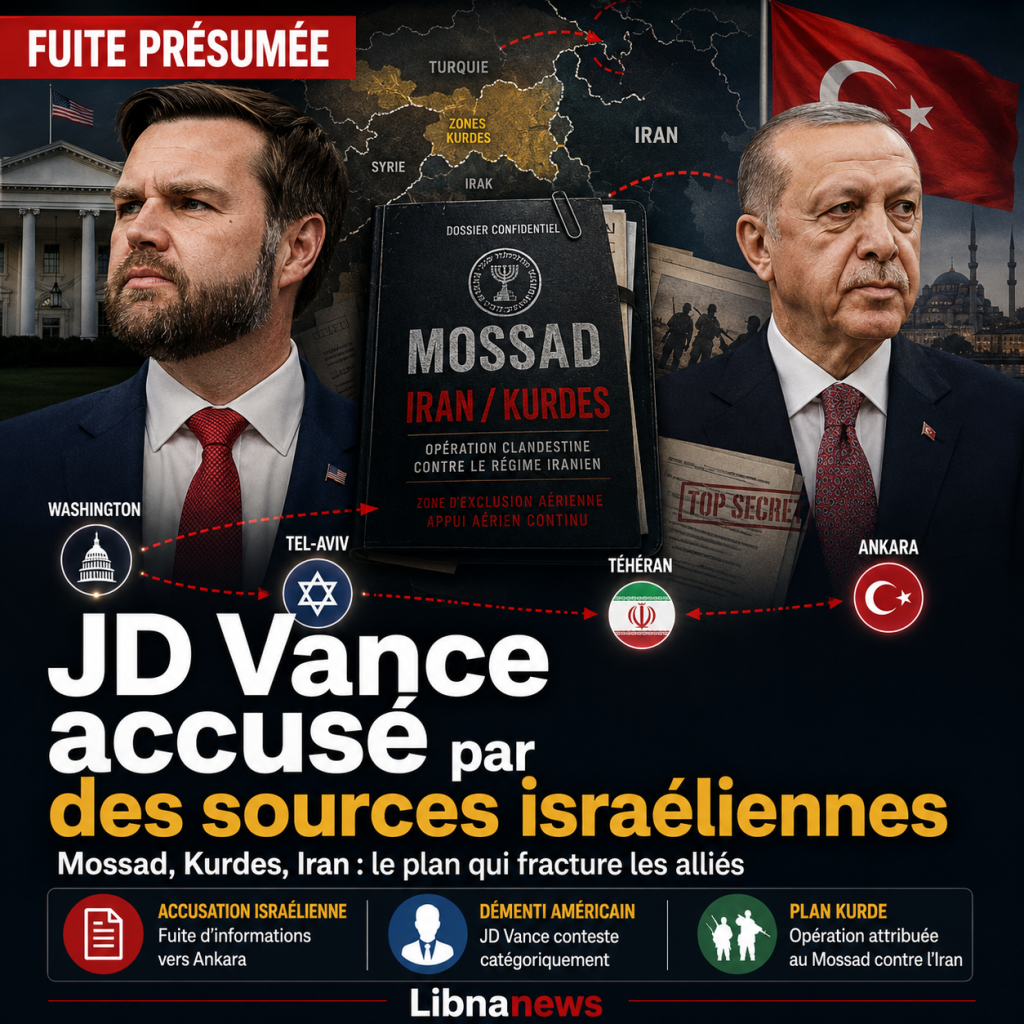
Israeli sources accuse White House officials of transmitting to Recep Tayyip Erdoğan elements of a project attributed to Mossad to mobilize Kurdish forces against the Iranian regime. The accusation, reported by the Israeli press, places JD Vance at the centre of a sensitive case, at the crossroads of the war against Iran, tensions between Israel and Washington, and the strategic rivalry between Turkey and Kurdish movements. The US Vice President’s entourage categorically denied these accusations, calling them false.
According to this information, the Israeli project planned to support Kurdish groups in a ground operation against Iran, with a no-fly zone and continuous air support to facilitate their progress against Iranian forces. The alleged leak would have allowed the Turkish President to reach Donald Trump in time to block the operation before its launch. Ankara, which has been fighting for decades the armed Kurdish movements linked to the PKK and fears any rise in Kurdish power at its borders, would thus have obtained the abandonment of a plan deemed dangerous for its own security interests.
An explosive charge in Washington
The case remains explosive because it opposes several versions. Israeli sources speak of a flight from the heart of the White House. Several of them refer to JD Vance, known for his public reservations on the 2026 war with Iran and on US military commitments deemed too extensive. His spokesman, Luke Schroeder, rejects the accusation and claims that the story is categorically false. No public evidence has been produced at this stage to establish that the US Vice President, or a specific member of his team, has transmitted information to Ankara.
However, the file reveals a real fracture. Israel wanted to push further military and political pressure against Tehran. Turkey wanted to prevent Kurdish forces from gaining capacity, legitimacy and strategic depth. The White House, on the other hand, was to arbitrate between the Israeli alliance, relations with Ankara, the risks of regional burning and the internal divisions of the Trump administration. The alleged escape, whether proven or not, exposes a rare level of mistrust between partners engaged in the same war sequence.
The project loaned to Mossad
According to the Israeli press, former Mossad leader David Barnea had defended an ambitious strategy against Iran. It was not limited to air strikes at military, nuclear or security-related sites. It was also intended to activate internal armed protest centres, particularly in the Kurdish regions of north-western Iran. The reasoning given to Israeli officials was simple: pressure from the sky, combined with a land offensive by armed minorities, could weaken the Iranian regime beyond mere military relations.
The plan reportedly concerned Iranian and Iraqi Kurdish groups, already organized into armed factions and present around the border. Reports published by several Israeli media include arms deliveries, financial assistance, vehicles, ammunition, small arms, anti-tank launchers, grenades and mortar shells. Some weapons were allegedly seized earlier by Israel during its operations against Hamas in Gaza and Hezbollah in Lebanon. The CIA would have been associated, at least in the design or in some support components, according to the same media accounts.
The objective was not just to open a local front. Project promoters hoped to trigger a drive effect. The Kurds are said to have advanced under Israeli and American air cover, while attacks were directed against Iranian forces, military bases, Basij sites, police stations and command structures in the areas concerned. This offensive was intended to encourage other minorities, including Sunni and Baloch, to join a dynamic of revolt. Those in favour of the plan said that the Iranian regime could be shaken or even placed on a medium-term downward path.
A disputed scenario in services
This vision was disputed even in Israeli circles. Military intelligence officials reportedly doubted the feasibility of an operation based on divided Kurdish groups, air cover promises and the hypothesis of a wider uprising. The Iranian geography, the power of the security services, the risk of reprisals against local populations and the hesitation of Kurdish factions made the scenario very uncertain. Such a plan required perfect coordination between Israel, the United States, Kurdish relays and regional actors. Any leak could be enough to compromise it.
It is precisely this point that feeds the current accusations. Israeli sources claim that United States officials reportedly informed Erdoğan of the project or its outline. The Turkish President would then have contacted Donald Trump to raise the risk of such an operation. For Ankara, the arming of Kurdish forces, even directed against Iran, could create a dangerous precedent. Turkey fears that any Kurdish military consolidation in Iraq, Syria or Iran indirectly strengthens PKK-related networks, which it considers a terrorist organisation.
Turkey as an unexpected arbitrator
The Turkish reaction would therefore have been swift. Erdoğan allegedly presented the operation as a threat to Turkish national security and regional balance. It is also said to have highlighted the risk of a Kurdish domino effect, which could fuel claims of autonomy or independence beyond Iran. This argument is part of a constant doctrine of Ankara. For years, Turkey has been opposed to Western support for Kurdish forces when it considers that such support reinforces organisations hostile to its interests. The Iranian case did not escape this reading grid.
Donald Trump would have finally decided to stop the operation. According to Israeli and Turkish accounts, this decision came after Turkish objections, the reluctance of some American officials and the proliferation of leaks in the press. The White House has not publicly validated all of these elements. American officials had already held different lines on Kurdish involvement, between verbal support, denial of arms deliveries and caution on the possibility of bringing the Kurds into a war against Tehran. This ambiguity has fueled Israeli mistrust.
JD Vance, fracture figure
JD Vance appears in this folder as a fracture figure. The Vice-President has repeatedly expressed reservations about the extension of US commitments and the political costs of a prolonged war against Iran. This position distinguishes it from part of the camp which favours a maximum pressure strategy. For Israeli detractors, she would make him a natural suspect in a leak intended to block a risky operation. For his entourage, this accusation is, on the contrary, a political manoeuvre to make him fail a disputed plan.
Luke Schroeder, JD Vance’s Special Assistant and Spokesperson, rejected the charge in clear terms. He claimed that the account was categorically false and that the media that gave the information should have requested a response before publication. This denial is important. It turns the case into open controversy, not in fact established. At this stage, Israeli accusations were not accompanied by public documents, recordings, messages or material elements to establish the exact transmission chain to Ankara.
Israel, United States, Turkey: Tensile Alliances
The controversy is coming at a delicate time for relations between Israel and the United States. The war against Iran has strengthened military cooperation, but it has also exposed differences on the final objectives. Israel has long been pushing for a lasting reduction in Iranian nuisance capacity, including through clandestine operations and indirect actions. Part of the US administration wants to limit direct engagement and avoid unmanageable occupation, sluggishness or regional war. The Kurdish issue crystallizes this tension between strategic ambition and risk management.
Turkey’s role further complicates the equation. Ankara remains a central member of NATO, has a powerful army and controls essential balances in Syria, Iraq, the Black Sea and the Caucasus. Washington cannot treat Turkish objections as mere diplomatic noise. Israel, for its part, sees Turkish sensitivity to the Kurdish question as an obstacle to its plans against Iran. The result is an unstable triangle: Israel wants to exploit Iranian internal fractures, Turkey wants to prevent the rise of Kurdish forces, and the United States is trying to preserve conflicting alliances.
Kurds at the centre of a regional calculation
The Kurds are again at the centre of a regional calculation that goes beyond them. Iranian Kurdish groups opposed to Tehran have long sought support, recognition and military means. But they also know that foreign supports can be reversible. Recent history has shown them that American or Western promises can change quickly according to the priorities of the moment. An operation against Iran, even initially supported by Israel and Washington, reportedly exposed Kurdish fighters and civilian populations to severe reprisals from Tehran.
The Iranian regime would have had every interest in exploiting the leaks. Although the project had been brought to his knowledge, he could strengthen his positions, monitor Kurdish regions more closely and stop the relays suspected of working with Israel or the United States. The media leaks were thus able to serve several interests at the same time: offer Ankara an argument to intervene with Trump, allow some American officials to stop the escalation, and give Tehran time to anticipate. It is this superimposition of calculations that makes the case so sensitive.
A missed opportunity for Israel?
For Israel, the failure of the project illustrates a wider frustration. Clandestine operations, targeted strikes and peripheral alliances have been part of Iran’s strategy for years. But these actions often depend on narrow political windows. They require the silence of partners, the cooperation of allied services and the restraint of hostile regional actors. When a plan becomes public before its launch, it loses operational value. In this case, Israeli sources seem mainly to want to appoint an American official to what they consider a missed opportunity.
The publication of these charges can also serve an internal purpose. In Israel, the debate on the war against Iran remains intense. Some officials advocate a regime change strategy. Others consider this project too uncertain and too costly. Accusing the White House, and even more JD Vance, allows to move part of the responsibility to Washington. The story then becomes that of a bold Israeli plan prevented by American leaks and Turkish intervention. This version protects project promoters, but it does not prove that the operation would have been successful.
American political battle
In Washington, the case may exacerbate internal tensions. The camp for a hard line against Iran may denounce a capitulation in front of Erdoğan. Supporters of a more restrictive strategy will be able to respond that a plan based on a Kurdish offensive could trigger an uncontrollable regional war. JD Vance, placed at the center of the accusation, becomes the symbol of this battle. The denial of his spokesman will not necessarily put an end to suspicions, especially if Israeli sources continue to feed the file into the press.
The legal issue remains a serious one. Arming non-State armed groups to conduct an operation against a sovereign State raises issues of international law, accountability and parliamentary control. If the United States or Israel had supported such an initiative, they would have to answer questions about the decision-making chain, arms supervision and the protection of civilians. While the project has never gone beyond planning, the controversy shows that the idea of using Kurdish forces against Tehran has been circulating at a high level.
For the region, the episode confirms that the war with Iran is not only in the air or in the nuclear negotiations. It is also played in ethnic margins, clandestine networks, rivalries between allies and direct contacts between heads of state. The role played by Erdoğan illustrates Turkey’s ability to block an initiative which it considers to be contrary to its interests. JD Vance’s role reveals the depth of American divisions on the conduct of war and on the level of alignment with Israel.
The file remains suspended from several unknowns. Will Israeli sources maintain their accusations against the White House? Will the entourage of JD Vance go beyond the initial denial? Will Ankara confirm that it received direct information about the project prior to its intervention with Trump? Will the Kurdish groups concerned recognise that they have been prepared for an operation against Iran? For the time being, there is only one certainty: a plan attributed to Mossad, intended to mobilize Kurdish forces against Tehran, opened a crisis of confidence between Israel, the United States and Turkey, even before it had been able to emerge from the shadows.




