

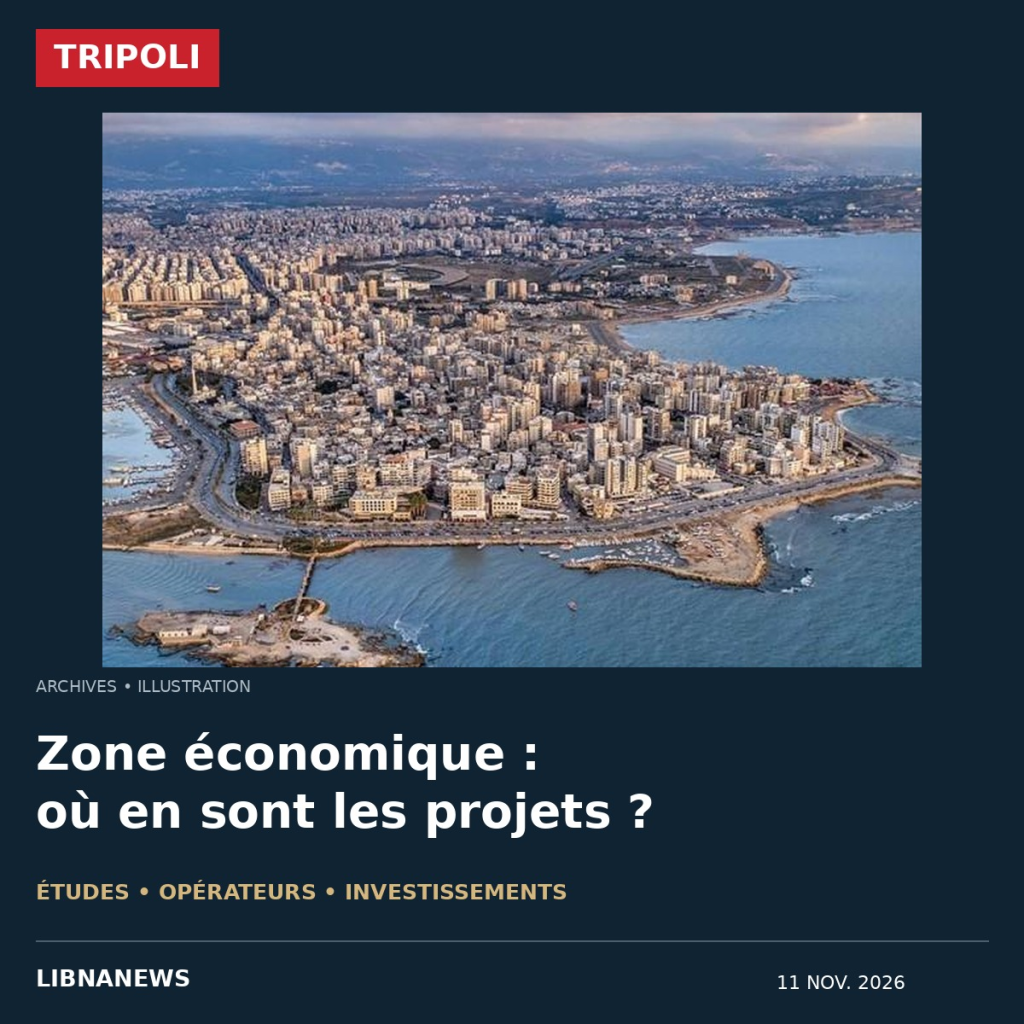
In Tripoli, the active port, the future industrial and logistics centre and the plans related to the Rachid Karamé International Fair are not at the same stage. The announcements of the special economic zone allow for a real institutional progression in 2026. However, they are not enough to present the whole as a new platform already open to businesses.
The programme of the economic forum of 10 November brings together precisely these ambitions: connection to the markets, complementarity with the port, participation of the private sector and training of the labour force. This program outlines the questions proposed to stakeholders. It does not constitute a record of contracts signed or a balance sheet of investments received. To measure progress, it is necessary to go back to project-specific decisions.
The industrial centre takes steps to prepare
On 20 May, the authority of the Tripoli Special Economic Zone, TSEZ, announced the preliminary acceptance of its project within the national framework of public-private partnerships. This recognition by the High Council of privatization and partnerships opened an institutional path. It did not yet designate a company to build or operate the centre.Source: TSEZ, announcement of May 20, 2026.
A second stage was announced on 17 September. According to TSEZ, the Council of Ministers approved the studies of the industrial and logistics centre and authorised the qualification procedure of an international developer-operator. The authority was to prepare and issue an international call for qualifications. This decision is more precise than just a declaration of interest: it concerns the transition from studies to the selection of candidates.Source: TSEZ, September 17, 2026.
In such a procedure, check the candidates’ abilities before choosing an offer and the contractual organisation of the project. A potential operator can be experienced without having yet obtained the market. Similarly, the authorization to seek a partner does not demonstrate that the funding is closed. These distinctions determine what a company can reasonably expect from the announced schedule.
Two sites and several functions not to be confused
In an interview published by the TSEZ on 22 May, its president Hassan Dennaoui distinguished two sets. The port’s neighbouring site was to host industrial and logistical activities. The project associated with the Rachid Karamé International Fair was to focus more on technology and services. This presentation constitutes a development orientation, not the list of companies already installed.
He then referred to the intervention of KPMG, Dar Al-Handasah and Mohamed Alem & Associates for the studies and preparation of the partnership. The proposed allocation of the port’s neighbouring project in the first quarter of 2027 was conditional on progress in accordance with the plan. This timetable, expressed in May, must remain identified as an initial forecast.Source: interview of Hassan Dennaoui reproduced by the TSEZ, 22 May 2026.
Investor services are also preparing
During the presidential visit on 24 October, the TSEZ again described the preparations for international prequalification. It also pointed to nearby landfills as an environmental and commercial obstacle. The protocol renewed with the Chamber of Commerce on 6 November concerns the coordination of licences, studies and services relating to the origin of goods.Source: TSEZ official communications of 24 October and 6 November 2026.
This administrative dimension counts as much as land. In order to invest, a company must be able to identify the necessary authorizations, the available services and their cost. The announced cooperation can facilitate this organization. Its effectiveness will have to be measured by usable procedures and then by requests actually processed, rather than by the number of institutional signatures alone.
The next review will have to deal with evidence of execution
The port is an operating equipment to which the project seeks to adobe. This proximity does not prove the existence of a new integrated supply chain with the Kleiat railway or airport. Each liaison involves its own decisions, works, financing and operating conditions. Bringing these infrastructures together in the same territorial vision does not simultaneously make them operational.
The next useful inventory should therefore specify, for each component, whether the call for applications has been published, whether a holder has been selected, whether the contract has been signed and whether the work has begun. The expected jobs and investments can then be reconciled with the achievements. The documents examined establish a more structured preparation of the economic zone; They do not yet allow to take stock of a new open and occupied industrial centre.
Aerial view of Tripoli and El-Mina, archival photograph Libnanews published in December 2024. Photographer and exact date not indicated. Illustration of the territory, not the construction site of the economic zone. Integer photograph preserved, deterministic editorial editing without retouching the scene.





Comments