





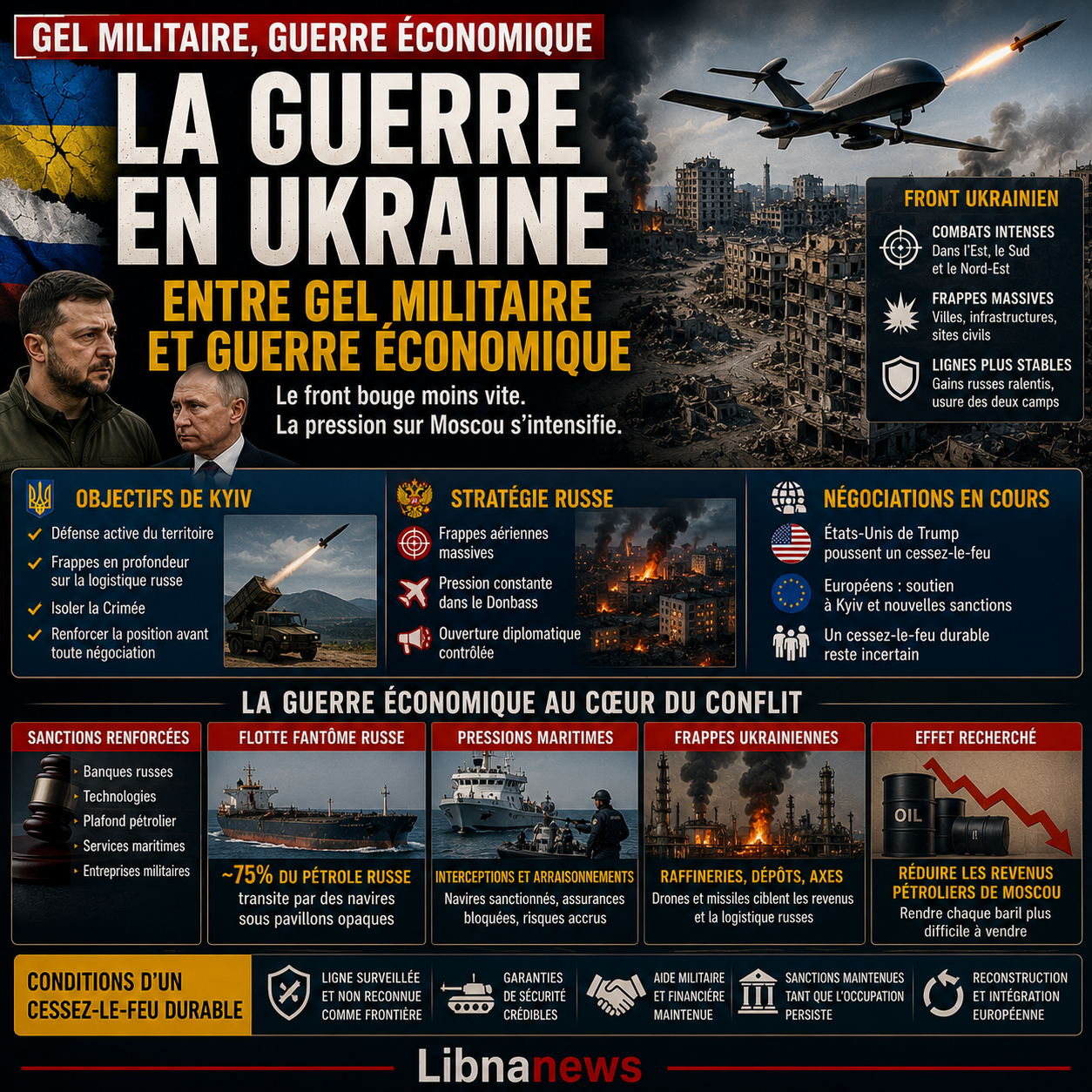
The war in Ukraine is entering a paradoxical phase. The front did not freeze in the strict sense, as fighting remained intense in the East, South and Northeast. But the idea of a military freeze settles in diplomatic calculations. The lines move less quickly. Russian offensives are expensive. Kyiv seeks to resume the initiative without having the means to make a decisive breakthrough. At the same time, Westerners are moving part of their effort towards economic war: banking sanctions, pressure on the Russian ghost fleet, control of maritime services, Ukrainian strikes on energy infrastructure and targeting Moscow’s oil revenues.
This change does not mean that war is mechanically approaching its end. Rather, it indicates that immediate objectives are changing. Ukraine does not formally renounce its entire territory. Russia does not renounce its territorial requirements. But discussions about a ceasefire, even temporary, are multiplying. Donald Trump’s US pushes negotiation formats. Europeans want to keep pressure on Moscow. Kyiv tries to strengthen his position before any discussion table. Russia, for its part, combines massive air strikes against Ukrainian cities with controlled opening speeches. The war becomes less a race for a total victory than an arm over the freezing conditions.
A less mobile front, but still murderous
It should be used with caution. Soldiers continue to die every day. Drones strike trenches, roads, depots, command posts and cities. Russian bombings against Kyiv, Kharkiv, Sumy, Zaporijjia and other regions show that the intensity of the war remains high. The attacks in mid-June again affected buildings, electrical infrastructure and cultural sites. Ukraine responds with deep strikes against Russian logistics roads, refineries, fuel depots, air defences and routes leading to Crimea.
The difference comes from the territorial rhythm. After months of Russian pressure, Moscow’s gains slowed down. Military analyses indicate that Russian forces are struggling to move at the same pace as in 2025. The Ukrainian army claims to have recovered more than 600 square kilometres since the beginning of 2026, a figure not fully independently verifiable, but consistent with the idea of a more disputed front. This dynamic does not yet give Kyiv a general superiority. However, it contradicts the story of a continuing Ukrainian collapse.
War remains above all a war of wear and tear. Both camps seek to make the cost of the opponent unbearable. Moscow focuses on air strikes, missiles, Shahed drones, human attrition and constant pressure in the Donbass. Kyiv focuses on mobility, drones, precision strikes, air defence and the destruction of logistics chains. In this context, the military freeze is not peace. It is a situation where the main positions stabilize, while violence changes form.
The decline in Kyiv’s immediate ambitions
Ukraine continues to affirm that its sovereignty extends to all its internationally recognized territory. This position remains central to Volodymyr Zelensky. It is also supported by Europeans. But, in fact, immediate ambitions were more limited than at the beginning of the major counter-offensive. Kyiv no longer talks about a rapid recovery of all the occupied territories. The speech places more emphasis on active defence, local gains, Crimean isolation, protection of the sky and improvement of the Ukrainian position before possible negotiations.
This displacement does not mean abandonment. It translates a constraint. Ukraine still lacks troops, air defence, ammunition and industrial depth. Western deliveries remain vital, but depend on political debates in Washington and Europe. Patriot systems, precision missiles, drones and artillery are not enough to guarantee a lasting breakthrough if the troops and logistics do not follow. Kyiv must therefore choose his priorities. It tries to hit where Russia is vulnerable: fuel, supply lines, Crimea, military factories, bridges, air bases.
The campaign against Crimea illustrates this new approach. Rather than announcing a major land operation, Ukraine seeks to make occupation more expensive and more difficult to support. Drone strikes on roads, bridges, depots, anti-aircraft defences and logistics axes aim to isolate the peninsula. The objective is twofold: to weaken Russian military capacity in the South and to increase Ukrainian weight in any future discussion. The recovery becomes less a linear step than a gradual pressure strategy.
Moscow combines diplomatic openness and air war
Russia plays on two sets. Diplomatically, she pays attention to American proposals and accuses Europeans of wanting to impose ultimatums. It leaves open the idea of a peace process, but maintains its territorial requirements. Moscow continues to demand recognition of military or political gains that Kyiv refuses. In this posture, the ceasefire can become a Russian tool: freeze part of the front while consolidating the occupation and calling for the alleviation of sanctions.
Militaryly, Russia is stepping up attacks on Ukrainian cities. This strategy responds to its difficulties on the ground. When land progress slows down, the Kremlin attempts to compensate for air pressure. Attacks on electrical infrastructure, residential neighbourhoods, railway stations, industrial facilities and symbolic sites are aimed at exhausting the population, diverting Ukrainian air defence and showing that Russia retains a massive nuisance capacity. Attacks on heritage or religious sites add a psychological and political dimension to this campaign.
This combination creates a negotiation under fire. Moscow can talk about peace while striking. Kyiv can demand a ceasefire while attacking Russian infrastructure. The United States can push talks while providing military assistance. Europeans can support the idea of direct discussions while preparing new sanctions. This mix explains why the temporary cease-fire announcements, like the one in May, quickly showed their limits. Each party tests the other before accepting any lasting stop.
Economic war becomes central
Faced with this military blockade, economic war is taking on new importance. The Western objective is no longer just to arm Ukraine. It is also to reduce the income that finances the Russian war effort. Banking sanctions, technological restrictions, oil ceilings, export bans and measures against companies linked to the military-industrial complex form a second front line. It is less visible than the fighting in Pokrovsk or Kharkiv, but it weighs on the duration of the conflict.
The Russian ghost fleet became one of the symbols of this battle. Moscow uses hundreds of aging oil tankers, opaque owners, changing flags and contested insurance, to continue exporting its oil despite restrictions. London estimates that a very large share of Russian crude oil is passing through these vessels. The European Union has already sanctioned hundreds of buildings. The United Kingdom has taken an additional step by allowing and then conducting boarding operations against vessels suspected of participating in this circumvention. The interception of the tanker Smyrtos in the Channel gave an operational dimension to this strategy.
This maritime pressure changes the cost of war for Moscow. A sanctioned vessel becomes more difficult to insure, finance, refuel and enter certain ports. Shipowners and intermediaries take more risks. Banks are less easily matched. Flag countries are under pressure. Inspections can slow down the flow. Even if Russia retains markets in Asia, the proliferation of controls reduces its margins and complicates its chains. The economic war aims precisely at this point: making each barrel more difficult to sell and each bypass more expensive.
Russian oil, nerve of war
Oil remains the financial nerve of the Russian war. Western sanctions did not suppress Moscow’s energy revenues, but sought to reduce, delay and make them more uncertain. Price caps, insurance restrictions, measures against the phantom fleet and prohibitions on maritime services are part of this logic. Europeans and G7 countries are discussing further tightening, particularly on services associated with Russian exports. The aim is to avoid Moscow selling its oil with the help of an ecosystem of front companies, alternative insurers and complacent pavilions.
There are risks to this strategy. Too much pressure on Russian oil can raise world prices, which paradoxically would give Moscow more revenue on the remaining volumes. Too little pressure leaves Russia to finance the war. Westerners are therefore seeking a balance: reducing Russian profits without causing a global energy shock. This balance is difficult, especially in a year marked by other crises, including the Middle East war and tensions around Ormuz. Ukraine therefore depends on a world economic war that must remain tough enough to weaken Moscow and controlled enough not to destabilize its own allies.
Kyiv complements this pressure with his own strikes on Russian energy infrastructure. Refineries, fuel depots, military plants and logistics axes have become regular targets. This strategy does not replace sanctions. It reinforces them. A damaged refinery reduces processing capacity. A destroyed depot disrupts military supply. An axis to cut Crimea obliges Russia to expensive detours. The Russian war economy is attacked both by Western texts and Ukrainian drones.
Europe seeks a long-term strategy
Europe is at the heart of this economic war. It wants to support Ukraine, maintain pressure on Russia and avoid excessive dependence on American choices. The new sanctions package proposed by the European Union covers banks, ships, businesses and bypass circuits. The Nordic and Baltic countries are pushing for rapid tightening against the ghost fleet. France, Germany and the United Kingdom support the discussions on a ceasefire, but they do not want it to commit a Russian victory. Europeans know that a poorly negotiated freeze can become a useful break in Moscow.
The European difficulty lies in the duration. Sanctions are accumulating, but their effectiveness depends on their application. The ships change their names. Screen companies are moving. Intermediaries use more opaque jurisdictions. Buyers bypass the devices. Europeans must therefore move from a policy of advertising to an economic police policy: inspections, exchanges of information, cooperation with flag states, secondary sanctions, insurance checks, tracking of cargoes and boardings where law permits. Economic war becomes a daily administration, not a mere summit statement.
This development also requires political cohesion. Some European states fear the effects on energy prices or their businesses. Others call for tougher measures. The United States remains indispensable, but its attention shifts according to crises. War in the Middle East, US elections and Donald Trump’s priorities can change the pace of support. Europe is therefore trying to show that it can carry part of the burden. She knew that the credibility of sanctions depended as much on her ability to vote as on her ability to enforce them.
Conditions for a durable ceasefire
A lasting ceasefire in Ukraine cannot be limited to a suspension of fire. He must answer several questions. Where’s the line? Who checks the violations? What happens to the occupied areas? Are sanctions maintained, lifted or suspended in stages? What security guarantees are offered to Ukraine? What is the place for NATO, the European Union, the United States and third powers? How can we prevent Russia from using the pause to rebuild its forces? How to organize prisoners, displaced children, nuclear power plants, ports and trade corridors?
The contact line is the first problem. A ceasefire on current positions could stop the deaths in the short term. He could also freeze an occupation Kyiv refuses to recognize. This formula would be presented by Moscow as a military reality. Ukraine would see it as a suspension, not as a regulation. Europeans fear that such a freeze will reproduce a model already seen: a war stopped without peace, and then revived when the balance of power changes. Sustainability will therefore depend on the political status of the line. Military freeze should not mean legal recognition.
Security assurances will be the second problem. Ukraine will require concrete commitments: air defence, arms deliveries, training, intelligence, response capacity and financial support. A vague guarantee will not suffice. Russia will seek to limit Ukraine’s western military integration. The United States will want to avoid overly costly direct engagement. Europeans will have to compensate for some of this caution. Without strong guarantees, Kyiv will fear that the ceasefire will prepare for the next Russian offensive. Without credible limitations, Moscow will denounce the militarization of Ukraine under Western protection.
Can a military freeze serve Kyiv?
The military freeze is not necessarily a defeat for Ukraine if it gives it time, weapons, a better protected economy and a clear European trajectory. A break can help rebuild infrastructure, train brigades, strengthen air defence, repatriate civilians, support the drone industry and prepare a more modern army. But this scenario assumes that Western aid will continue during the ceasefire. If the break leads to a reduction in aid, a relaxation of sanctions and political fatigue, it will serve Moscow.
So everything will depend on conditionality. Sanctions must remain linked to Russian behaviour, not just the absence of fire. Freezing Russian assets, oil restrictions and measures against the ghost fleet can remain levers until the occupied territories are returned or a political settlement is found. Europeans can also use Ukrainian reconstruction as a strategic tool, combining economic integration, infrastructure and defence. The economic war must not stop at the moment when the guns are silent. It must become a bargaining lever.
For Kyiv, the risk is political. Accepting a break on current lines can be interpreted as a step back. Zelensky must explain that the cease-fire does not mean territorial abandonment, recognition of occupation, or end of resistance. It will also have to manage the expectations of the population, soldiers, families of prisoners and refugees. An exhausted country may want peace, but refuse a peace that looks like a surrender. That is why the formula must be precise. An acceptable ceasefire for Ukraine will have to preserve the right, guarantee security and maintain economic levers against Moscow.
A less territorial but no less total war
The war in Ukraine becomes less exclusively territorial, but it is no less total. It is played on the front, in the sky, in ports, in banks, in insurance, in refineries, in cables, in factories and in Western political debates. The possible military freeze does not reduce the stake. He moves it. The lines can stop moving without the war ending. Drones can continue. Sanctions can intensify. Pressure on ships can increase. Negotiations can open as each camp prepares for the next round.
The next step will therefore depend on the articulation between three fronts. The military front, where Ukraine tries to resume the initiative without overestimating its forces. The diplomatic front, where the United States is seeking an agreement and where Europeans want to avoid unfavourable peace. The economic front, where the ghost fleet, Russian banks, oil revenues and energy infrastructure become central targets. If these three fronts move forward together, Kyiv can approach discussions with more weight. If they disalign, Moscow will seek to transform Western fatigue into a strategic advantage.
The long-term ceasefire, if it comes, will therefore not be the product of a mere cessation of fighting. It will depend on a full power ratio. It will require a monitored line, security guarantees, continued military assistance, applicable sanctions, real maritime pressure, financed reconstruction and a clear refusal to recognize annexations. In this phase, Ukraine is no longer seeking only to regain ground. She’s trying to stop time from working for Moscow. This is where war is now played: less in the announcement of a great offensive than in the ability to transform a possible military freeze into a lasting economic failure for Russia.