






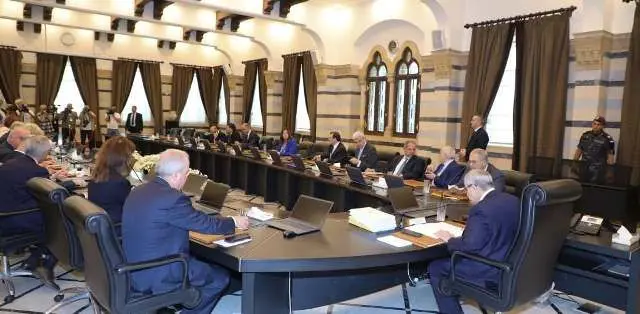
The Lebanese Council of Ministers has chosen prudence on the issue of official reviews, at a time when the country is waiting to know whether the announcement of a ceasefire between the United States and Iran can really produce a lull on the ground. Meeting in the Grand Sérail under the presidency of Nawaf Salam, the government discussed the latest political, security and humanitarian developments. It adopted most of the administrative items on its agenda. But the most anticipated decision was for senior students, who had been suspended for several days from rumours of cancellation, postponement or replacement of the examination with school certificates.
The official message is now clear, even if it does not close the debate. The government does not remove official examinations at this stage. Nor does he confirm their immediate behaviour. He’s temporing. The Prime Minister considered that it was necessary to wait to see whether the announced ceasefire would be effectively implemented. In all cases, the session will not be able to start on the dates originally scheduled for late June or early July. The Ministry of Education will have to reassess the security situation, update the candidates’ location data and consult educational actors before returning to the government with a final decision.
Ceasefire as a political condition
The meeting of the Council of Ministers was first dominated by the regional sequence. Nawaf Salam recalled that the government has been working since the beginning of the war to secure its arrest and to reduce the damage inflicted on Lebanon and the Lebanese. He expressed the hope that the announcement of a ceasefire negotiated between Washington and Tehran could put an end to the deaths, destruction, displacement and suffering accumulated since the escalation. The Head of Government also thanked the actors who had contributed to this outcome, while avoiding presenting the announcement as a guarantee already acquired.
This caution reflects Beirut’s delicate position. Lebanon is affected by an agreement that it does not sign directly. Iran claims that the Lebanese front is included in the cessation of hostilities. Israel continues to defend its freedom of action against Hezbollah. The United States is seeking to protect a regional compromise that also targets Ormuz, Iranian nuclear power and energy markets. The Lebanese government must therefore turn a diplomatic announcement into a local reality: a halt to the strikes, an Israeli withdrawal, the return of displaced persons and a minimum resumption of civilian life.
Nawaf Salam linked this sequence to two national priorities. The first is the continuation of the ongoing negotiations in Washington to secure full Israeli withdrawal from the occupied Lebanese territories and the release of prisoners. The second is the preparation for reconstruction, with the support of Arab countries and international partners. This link is essential. The ceasefire will have political value for Lebanon only if it allows the return of the inhabitants to their towns and villages, and then the repair of houses, roads, schools, hospitals and agricultural land.
Official reviews: a decision postponed, not abandoned
The official examination file was central to the session. For several days, families, school management and bachelor’s students had been living in uncertainty. Should the trials continue despite the war? Should we report them? Should school certificates be granted as an exceptional option? The Prime Minister acknowledged the proliferation of rumours and interpretations. He said he followed up with the Minister of Education, Rima Karami, throughout the previous days.
The approach is based on three principles. The first is the protection of the educational level of Lebanon. The government wants to preserve the value of official certification, which remains important for access to university, foreign files and the credibility of the school system. The second principle is student safety. The authorities do not want to expose candidates to dangerous routes, centres in unstable areas or long trips to a country still under threat. The third principle is equal opportunities. A student displaced from the South, a candidate living in a bombed area and a candidate in a quiet area are not in the same preparation conditions.
That is why the government refused a hasty decision. The delay allows to win a few days of observation. It also allows the Ministry of Education to test the practical feasibility of examinations. The authorities will need to know where the candidates are, which centres can open, which routes are possible, how many students are directly affected by travel and what security guarantees can be obtained. An educational decision thus becomes a national security decision.
Rima Karami defends the principle of equity
Education Minister Rima Karami welcomed the decision to delay. She stressed the need to bring the case back to the Ministry and then to the Council of Ministers, far from the confounding climate that has disturbed the students. In her view, candidates should never have been placed at the centre of such a chaotic debate when they must concentrate on their preparation. The choice of government does not close the case. It opens a short re-evaluation, conducted on two axes: safety and pedagogy.
The Minister announced an expanded educational meeting by videoconference, with teachers’ associations, private school unions, representatives of public schools and schools in hazardous areas. The objective is to examine the consequences of each scenario: maintenance with small postponement, cancellation of the tests, or granting of school certificates. Rima Karami expressed his preference for a solution to maintain the exams, if conditions permit. But it also reaffirmed that security takes precedence over any other consideration.
The argument of fairness remains at the heart of his intervention. The Ministry stated that it had up-to-date information on the location of candidates. A first follow-up was carried out in early June. A new update is under way. This data should help to avoid a student being forced to travel a long distance or cross a dangerous area to reach an examination centre. The organisation of the tests will therefore depend less on a theoretical calendar than on a real mapping of pupils, roads and risks.
A sensitive alternative: school certificates
The option of school certificates remains officially open. It would be activated if security conditions made examinations impossible. But the government and the minister want to avoid making a choice by default too fast. In the Lebanese system, the official baccalaureate has a strong symbolic and practical value. It represents a national validation, different from a simple certification issued by each institution. Replace it with certificates can be understood as a protective measure. It can also be seen as a deterioration in the value of the diploma.
This tension explains the government’s caution. Giving certificates would protect students from risky travel. But this would raise questions of institutional fairness, academic recognition, credibility abroad and comparison among students. Maintaining the exams would preserve the value of the diploma. But this would require security guarantees that the State does not fully control. Lebanon is thus faced with a dilemma typical of long crises: to avoid sacrificing the school future of students while refusing to expose them to danger.
The purpose of a few days’ deferral is therefore to maintain both options. If the cease-fire holds, an appropriate session could be organized. If the strikes resume or the displacement areas remain too unstable, the certificates will become a possible solution. The minister called on students to continue studying, recalling that preparation is not a waste of time. Even in case of adaptation, admission to university will require solid knowledge. This message aims to prevent the psychological dropout caused by uncertainty.
A Council of Ministers between emergency and administration
The session was not limited to war and examinations. Information Minister Paul Morcos said the Council had approved most of the items on its agenda. Several decisions relate to administrative reform, public control and management of essential infrastructure. They may seem technical. Yet they give an indication of the government’s willingness to continue to operate the state despite the crisis.
The Commission approved applications related to the Central Inspectorate. It authorized the organization of a closed competition to promote deputy inspectors. It also accepted a restricted competition to fill technical vacancies in several general inspections, including engineering, health, social and agricultural. This is important because the Central Inspectorate remains one of the most necessary administrative control instruments in a country where the reforms required by donors directly concern transparency, public procurement and the quality of administration.
The government also approved the request of the Ministry of Public Works and Transport to establish a company to carry the structure of Beirut International Airport. This decision comes at a time when Rafic Hariri Airport is at the heart of security, economic and tourist concerns. It can prepare a new governance, better management or institutional framework that is more appropriate for the operation of this strategic infrastructure. But it will require guarantees of transparency, public control and independence to prevent the reform from becoming a mere administrative shift.
Bank of Lebanon, prices and waste: other signals
The Council also approved a request from the Bank of Lebanon to enter into a contract with a specialized international audit company by direct agreement. Its mission would be to track funds transferred through the study of their movement from a consulting account to screen companies or third parties. This is part of a context of increased pressure on financial transparency, compliance, FATF grey list and demand for flow traceability. It also illustrates the need for the Bank of Lebanon to show that it can examine suspicious movements with international tools.
The Ministry of Economy has obtained the adoption of a draft decree amending certain provisions of Decree 7137 to activate the National Price Policy Council. In a country marked by inflation, past monetary collapse, de facto dollarization and household vulnerability, this council can become a price tracking tool. However, its effectiveness will depend on its real means, its ability to collect data, cooperation with traders, and the possibility of distinguishing between excessive increases, import costs and the effect of a security crisis.
The Ministry of the Environment has, for its part, obtained the approval of an implementing decree relating to the Integrated Solid Waste Management Act 2018. This case is old. It affects municipalities, landfills, sorting, collection, costs and public health. In a country where waste crises have regularly fuelled social anger, the adoption of implementing legislation can be useful. But, as with other decisions, the test will be executed. A standard without funding, without municipalities capable of acting and without contract control will not change the situation on the ground.
A government that saves time
The meeting of the Council of Ministers reveals a method: to save time without completely suspending public action. On the ceasefire, the government hopes, but does not declare the war over. On official exams, he postpones, but does not delete. On reconstruction, he announces a future mobilization, but waits for the ground to allow the return. On administrative matters, it advances by technical decisions, in inspection, airport, financial audit, prices and waste. This method can be criticized as overly conservative. It also responds to a reality: the Lebanese State decides in an environment where many parameters escape it.
The main risk is that of prolonged waiting. Students cannot remain indefinitely suspended from a decision. Displaced families cannot wait weeks until they know if they can return. Schools must organize their teachers, centres and calendars. Universities are waiting for the results. Donors are waiting for reconstruction plans. Administrations are waiting for instructions. Temporization is useful only if it quickly leads to a clear decision.
For exams, the schedule will be tight. The department will need to consult, map, evaluate and return to government. He will have to explain the decision chosen with simple criteria: security, fairness, educational level, logistical feasibility. He will also have to avoid a new wave of rumours. In a period of war, official information becomes a form of protection. A student who knows what’s waiting can prepare. A student delivered to the rumors picks up.
The Council of Ministers wanted to send a balanced signal. He doesn’t sacrifice the official bachelor’s degree. He doesn’t sacrifice security either. He was waiting to see whether the ceasefire existed other than in the statements. In the coming days, the value of this prudence will be measured by three concrete signs: the reality of the cessation of hostilities, the possibility of a gradual return of the displaced, and the capacity of the Ministry of Education to propose a just solution for candidates who have already studied too much under the noise of drones and alerts.