

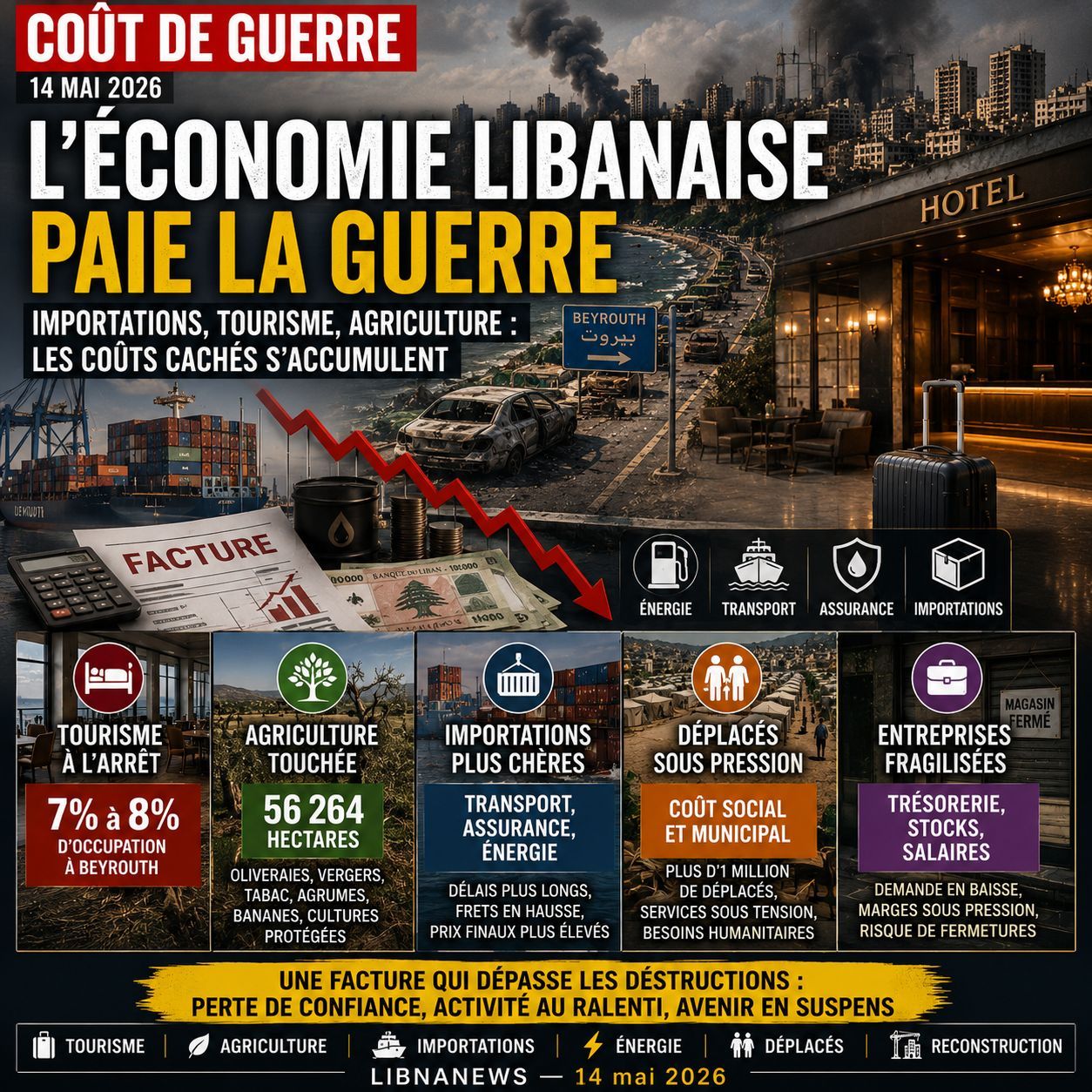
The Lebanese war economy begins with destruction. Cars targeted on the coastal axis, hit villages, damaged agricultural land, displaced families and almost empty hotels make up the visible part of the bill. But the most sustainable cost is often elsewhere. It appears in more expensive imports, heavier insurances, transport delays, loss of confidence, cancelled reservations, abandoned fields and the cash flow of companies that contract week after week.
This diffuse cost is more difficult to measure than a destroyed building. It slips into prices, margins and deferred decisions. A company that no longer imports out of prudence is not always included in a war balance sheet. A hotel that keeps its doors open with 7% or 8% of occupancy does not disappear from the registers, but it runs out. A farmer who can no longer access his land does not lose only one harvest. It loses a season, sometimes a tree, often a market.
The authorities are now seeking to objective this bill. The announced use of image analysis and artificial intelligence tools, supported by international partners, is an attempt to break out of the rough estimate. This method can help distinguish direct damage, visible on the ground, from indirect effects affecting entire sectors. It also shows that economic war does not begin after the military war. Both are moving forward together.
Lebanese war economy: the visible cost
The first layer of loss is material. It includes houses, roads, cars, public facilities, farms, shops and networks affected by strikes. This layer is measured with images, field reports and technical assessments. It allows us to say what has been destroyed, where, how much and at what initial repair cost.
But even this visible part is complex. A car destroyed on an axis between Beirut and the South is not only a lost property. It turns the road into a risk zone. It alters displacement behaviour. It weighs on delivery providers, families, carriers, relief workers and traders. A hit on a vehicle therefore becomes an economic shock beyond its immediate target.
Attacks on the coastal highway and on routes leading to the south have a particular effect. They affect a vital traffic space for the country. When a major road seems vulnerable, mobility declines. Goods move less easily. Drivers hesitate. Companies add a risk margin. Clients delay their travel. Lebanon’s economic geography is shrinking.
The destruction of housing produces the same kind of chain effect. The cost is not limited to rebuilding walls. Residents must be accommodated, temporary solutions financed, students must be moved, cared for, families must be reorganized and a minimum income maintained. The destruction of housing becomes a public expenditure, a family burden and a social shock. It brings out the loss of the real estate register to place it in the heart of the daily economy.
Agricultural losses as a heavy indicator
Agriculture offers one of the clearest examples of this accumulation. The damage recorded in the agricultural and forestry sector in the South would affect approximately 22.5 per cent of the area concerned, or 56,264 hectares. Damage includes olive groves, fruit trees, tobacco, citrus orchards, banana groves and protected crops. This type of loss is not repaired at the pace of a roadworks.
Tobacco cultivation, for example, supports entire families in several villages. Olive groves give a deferred income, linked to the season and regular tree maintenance. Citrus and bananas depend on transport chains, labour, markets and sometimes fragile facilities. When land is damaged or inaccessible, the farmer loses more than daily production. He can lose his connection to the market.
Agricultural loss also affects food security. In a country heavily dependent on imports, each weakening of local production increases vulnerability. To produce less means to buy more outside, at a time when transportation, insurance and energy costs are rising. War therefore creates an unfavourable circle. It destroys part of the local capacity and at the same time increases the imported alternative.
The agricultural strategy announced for 2026-2035, focusing on food security, rural development, sustainability and digital transition, is taking on a new focus. It is no longer merely a ministerial programme. It becomes a response to a risk of economic sovereignty. Lebanon cannot produce everything, but it cannot accept that its agricultural areas become areas of repeated loss.
More expensive import, the final price more fragile
The most immediate indirect cost concerns imports. Economic leaders say that the crisis is not just from within. Energy, fuel, shipping, insurance and the availability of goods are affected by a regional and international crisis. That precision counts. Lebanon imports an essential part of its energy, consumer goods and inputs. It is therefore exposed to every external increase.
When oil prices rise, the effect spreads. Electricity costs more to produce. Private generators weigh more heavily on households. Companies pay more to run their machines, keep their products cold or deliver. Some of these costs are passed on by businesses. Consumers reduce their purchases. Energy growth is becoming a contraction of demand.
Transport and insurance add another layer. If the sea or land routes seem more risky, insurance increases. If the deadlines increase, stocks become more expensive. If getting goods becomes more difficult, distributors order less or require faster payments. The Lebanese economy, already marked by the banking crisis, then operates with less flexibility.
This mechanism also affects food prices. Importers must integrate freight, insurance, energy and foreign exchange risk. Retailers must protect their margins in a market where customers have less purchasing power. The result may be an increase in prices or a reduction in quality and volumes. In both cases, the household pays war indirectly.
Electricity as a vulnerability point
The ministerial meeting on the effects of the crisis on electricity illustrates this fragility. The Ministers concerned seek to coordinate their positions to reduce the negative effects on the sector. The problem is known: without stable energy, there is no normal industry, no competitive tourism, no efficient food conservation, no regular commercial activity.
Electricity acts as a hidden price. Even when it does not appear directly in the invoice of a product, it is reflected in the cost of production, storage, service and transportation. A plant that relies on fuel to compensate for the cuts is losing its margin. A restaurant that supplies its refrigerators and kitchen with expensive solutions adjusts its prices. A hotel that keeps empty rooms but has to keep its equipment energized loses twice.
The risk is that the most fragile sectors will reduce their activity before they close. A company can start by lowering its hours. Then it limits its stocks. Then she postpones recruitment. Finally, it renounces certain markets. This slow degradation is not seen in a single figure. It is read in the defensive decisions taken by entrepreneurs.
The government can coordinate, arbitrate and seek emergency measures. But as long as the war keeps pressure on external costs and supply routes, electricity remains a point of macroeconomic vulnerability. Lebanon then pays for a crisis that is not only local, but absorbs it with weakened institutions and a proven private sector.
Tourism, revealing the lost confidence
Tourism shows the loss of confidence faster than other sectors. Beirut hotels have an occupation of only 7 to 8 per cent, and the regions are doing even less well. No strong dynamics appear for the Adha festival. Professionals at best evoke a weak internal movement outside the capital. This weakness is not only a trade problem. It measures the level of concern.
Tourism depends on decisions that can be cancelled within minutes. A visitor gives up if a road is hit. A family postpones if news of the front gets tougher. An event becomes empty if guests fear an incident. A hotel can lower its prices, but it cannot sell security. This limitation explains why the war destroys demand before even destroying infrastructure.
The hidden cost is found in related jobs. An empty hotel reduces working hours. A less frequented restaurant buys less from its suppliers. A driver loses trips. A guide cancels his visits. A guest house postpones its maintenance purchases. A musician or technician loses an event. Tourism acts as a chain of small revenues. When it breaks, the losses are dispersed in often poorly protected occupations.
The capital is under additional pressure. Beirut remains affected by security conditions and displacement. It cannot fully play its role as a national showcase. Visitors want open streets, simple travel, regular services and an exit atmosphere. The city still offers a lot, but it operates in an atmosphere of crisis. This is enough to reduce reservations.
Displaced persons, social and economic costs
Massive displacement is another difficult cost to reduce to a budget line. The official data cited in the press indicate more than one million displaced persons since the beginning of the expanded offensive. This figure refers to a human emergency. It also refers to economic transformation. Displaced families otherwise consume, work less, rely more on aid and weigh on the host cities.
Displaced families do not just lose their homes. She often loses her regular income, school, neighbourhood network, access to land or business. It spends on housing, moving around, treating itself and restoring a minimum of property. Personal savings are decreasing. Family debts can increase. Children study less well. Adults reject care or accept less stable jobs.
Municipalities and associations absorb part of this burden. They open centres, distribute aids, coordinate primary care and try to maintain services. But their resources are limited. As displacement continues, local solidarity becomes a budget. It requires medicines, mattresses, water, maintenance, transportation, safety and administrative management.
Displacement also creates a loss of national productivity. Farmers no longer grow. Workers no longer reach their places of employment. Shopkeepers close their shop. Students learn in degraded conditions. This cost is not always counted immediately. Yet, it weighs on future growth. A disorganized school year or lost farming season has effects beyond the current month.
School and health in the hidden bill
School and health crises are not just social. They are economic. When schools become shelters, the education system must adapt. Examinations are discussed, courses move online or fragment, and families lose visibility. The country’s human capital is affected. This term may seem cold, but it describes a concrete reality: less learning today means less skills tomorrow.
Health follows the same logic. Displaced persons outside the centres are often less visible. They need medication, follow-up and guidance. The elderly, chronically ill, children and pregnant women require continuity of care. If this continuity breaks, the bill increases later. A poorly followed disease becomes a hospitalization. Prolonged stress becomes a mental health problem. A drug breakdown becomes an emergency.
These costs are not always included in the first damage assessments. They don’t appear on satellite images. They don’t look like a destroyed bridge. Yet, they reduce the country’s capacity to recover. War uses the institutions that must prepare for the post-war period.
The financial system in the face of a precautionary economy
The banking crisis adds a particular fragility. The banking reform under discussion aims to organize the resolution of banks, define the roles of supervisory bodies and deal with losses. But the real economy is already advancing in a precautionary regime. Companies keep cash, households are wary of accounts, transactions often take place outside formal channels, and fees become a subject of tension.
The fight against the cash economy, monopolies and price speculation requires rules, but above all surveillance. A decision on fees and fees can help clarify certain costs. It is not enough if controls remain weak. In a war context, the temptation to justify each increase by risk is strong. Consumers then find it difficult to distinguish the real cost of abuse.
Precautionary economy changes behaviour. Households postpone non-essential purchases. Companies keep stocks when they can, or reduce their orders when they fear a break. Banks no longer fully play their financing role. Informal circuits are becoming more important. This situation reduces the capacity of the State to monitor activity and collect the necessary revenue.
Banking reform and economic stabilization cannot therefore be separated from war. A ceasefire will not solve everything. But without a ceasefire, reform tools remain difficult to implement. Investors do not only expect laws. They expect safe roads, predictable energy, functional banks and less paralyzed demand.
A moving national bill
The country tries to measure the war as it continues. This is the main difficulty. Direct losses can be revised after each strike. Indirect losses depend on the duration of the crisis. An empty hotel month does not have the same effect as three months. A lost agricultural season does not have the same cost as a land made unusable. A short displacement does not have the same impact as a prolonged internal exile.
The assessment method should therefore remain evolving. It will have to add visible damage, operating costs, lost income, imported prices, production losses and social expenditure. It should also avoid double counting and distinguish between what is confirmed and what is still estimated. This rigour will be essential in order to demand external assistance, organize reconstruction and prevent the bill from becoming an object of political struggle.
The private sector will expect concrete signals. Hoteliers will watch the reservations. Importers will monitor freight and insurance. Farmers will wait for access to land. Carriers will judge the condition of the roads. Households will monitor energy, food and services prices. The recovery will not depend on a single ad. It will depend on a series of practical confirmations.
The next decisive fact will come from Washington’s ground and decisions. If the hostilities actually retreat, the first measures of reparation can begin. If the strikes continue, the Lebanese war economy will remain an economy of stacked costs, delayed losses and suspended decisions, with a bill that increases even when destruction is not yet fully counted.




