

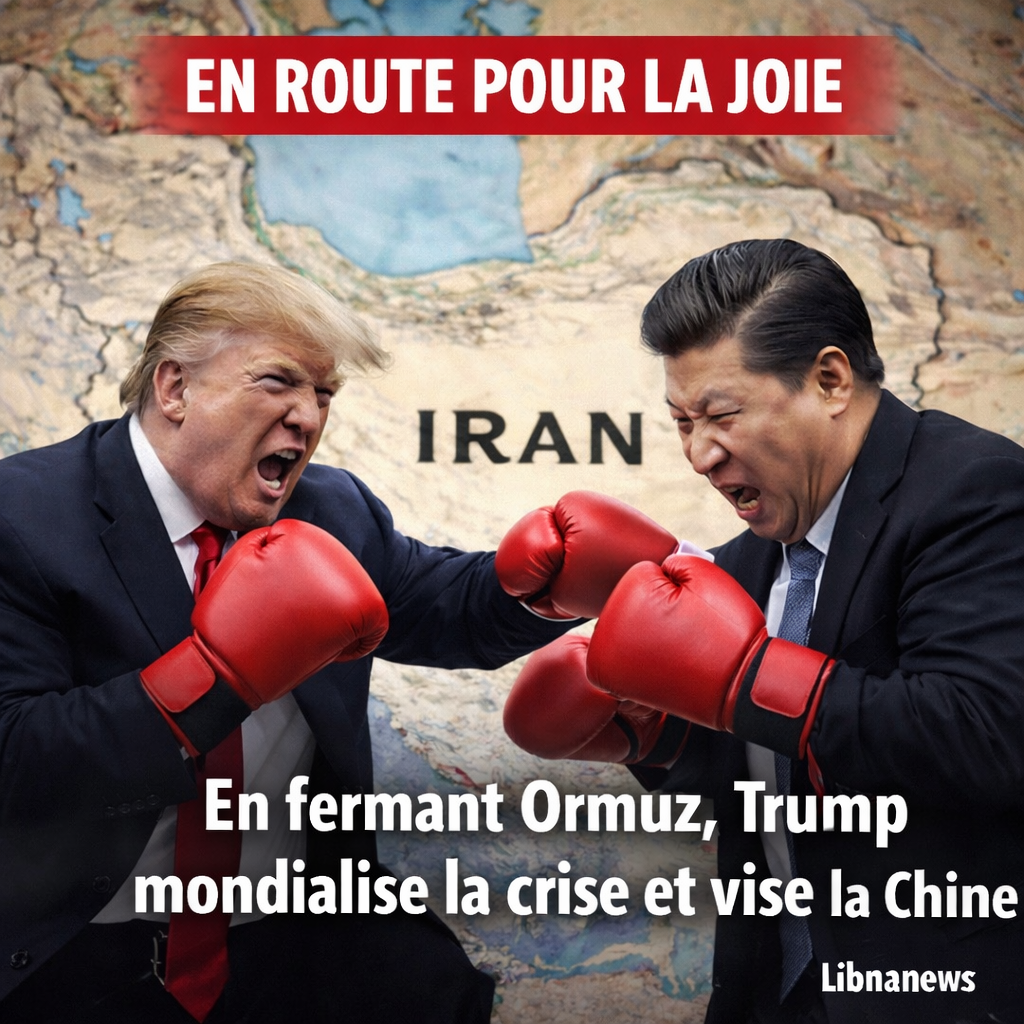
Donald Trump is no longer content with brutalizing the Iranian crisis. By announcing that the U.S. Navy was going to enter into a blockade of the Strait of Ormuz, and then warning that any country assisting Iran militarily could face a 50% surcharge, including China, the U.S. President changed the nature of the conflict. He’s not only talking to Tehran anymore. He speaks to maritime routes, great powers, markets, armies, allies and opinions. That’s where the danger becomes global.
Ormuz is no longer a simple strait
The first threshold was crossed when Donald Trump claimed that the U.S. Navy would begin blocking the Strait of Ormuz after the failure of discussions with Iran in Islamabad. He not only promised to prevent Tehran from drawing an annuity from a sea crossing. He also announced that the United States would seek to intercept ships paying tolls to Iran on the high seas. In other words, Washington no longer only wants to challenge an Iranian measure. Washington wants to decide who can circulate, under what conditions, and under what protection. When the world’s first military power says it will filter access to one of the world’s major energy locks, it turns a regional crisis into a system crisis.
This gesture is not administrative. In the real life of the powers, a naval blockade is an action of war, even when it presents itself as a defensive response. It involves frigates, rules of engagement, intelligence, inspections, interceptions and the constant possibility that a shooting, an identification error or a collision will change the situation. The fact that Donald Trump later acknowledged that such a device would take time confirms a simple truth: what was launched is not a mere verbal threat, but a military process. The important word is therefore not « immediate ». The important word is blockade. And this word, in 2026, already places the world in a logic of expanded confrontation.
The second threshold is the nature of the location. The Strait of Ormuz is not a margin of the world economy. This is one of the few points where geography still commands global politics. In 2024, about 20 million barrels per day passed through the city. This represents around 20% of global consumption of petroleum liquids. More than a quarter of the world’s maritime oil trade also passes, while about a fifth of the world’s liquefied natural gas trade crosses the same corridor. The figures are important because they show this: when Ormuz closes, it is not only Iran and the United States that face each other. Importing Asia, Gulf producers, insurers, central banks, shipowners and poor energy-importing countries are entering the shock zone.
It is therefore not a local confrontation that Donald Trump is opening, but an attempt to take control of a key point in world trade. The International Maritime Organization recalled that freedom of navigation is a fundamental principle of international maritime law. His council then condemned the attacks on merchant ships, called for international coordination and called for the establishment of a safe passage framework for civilian ships trapped in the area. When a technical organization of this nature speaks in terms of humanitarian emergency and freedom of navigation, this means that the problem has already gone beyond the conventional deterrent. The trade corridor is becoming a military theatre.
Trump opens a front with Beijing
The other shift, even more serious, is that Donald Trump did not limit his offensive to Iran. He threatened to impose 50 per cent tariffs on any country that would militarily assist Tehran. In the current context, this threat is aimed primarily at China, and to a lesser extent at Russia. The message is strategic. He said in Beijing: if you continue to protect your energy, technological or military interests around Iran, you will pay the price on the commercial ground. The American president thus merged two conflicts which were still partially distinct: the war around Ormuz and the systemic rivalry between Washington and Beijing. This linkage is precisely what makes the logic of a global conflict emerge.
China cannot look at this sequence as a mere Middle Eastern episode. Energy data show that Asian markets absorb the overwhelming majority of oil and gas flows through Ormuz. For crude oil and condensate, 84 per cent of the volumes that crossed the Strait in 2024 went to Asia. For liquefied natural gas, 83 per cent of the fluxes were in the same direction. China, India, Japan and South Korea were among the first presentations. This means that an American blockade on Ormuz does not only threaten an Iranian opponent. It also places Asia’s energy security under US strategic surveillance. Seen since Beijing, this is a demonstration of power that goes well beyond the Iranian nuclear issue.
It is for this reason that the Chinese and Russian veto in the Security Council on a text to protect navigation in the straits has become much broader than a further diplomatic disagreement. Beijing and Moscow found the text unbalanced and hostile to Iran. Western countries replied that it was a minimum defensive device to secure commercial shipping. Behind the UN dispute, a reality emerges: the great powers no longer manage to agree on the basic rules that would stabilize one of the vital arteries of world trade. When the Security Council blocks on a strait, the problem is no longer regional. It becomes structural. The mechanisms of regulation of the international system cease to function as military pressure increases.
Grammar of a World War
The word « world war » still shockes because it refers to an ancient image, that of two blocks that formally declare themselves war. This is no longer how great confrontations develop. They’re moving in line. A local crisis disrupts energy. Energy is increasing freight costs. Cargo disorganizes power supply. Food feeds social anger. Sanctions re-design alliances. Alliances move the fleets. The vetoes in the Security Council paralyze mediation. Then the economies, public opinion and military apparatus begin to reason on a global risk scale. The 3rd World War, if it were to take shape in the 21st century, would look much less like a 1939 photograph than the addition of nested fronts. This is exactly what the sequence opened by Donald Trump produces.
The conflict is changing in scale because it simultaneously affects the sea, energy, trade, multilateral institutions and power relations between major powers. The International Energy Agency has spoken of the biggest supply shock in the history of the world oil market and has decided to release 400 million barrels of emergency reserves, from the world’s never before. When it is necessary to draw at this level from strategic reserves to cushion a shock, it is no longer a simple surge of volatility. It is already a partial war economy. The market no longer corrects a normal voltage. He is trying to absorb a major geopolitical rupture.
Moreover, the observed disturbances are not an abstract fear. Flows almost stopped for weeks. The International Energy Agency found that movements of crude oil and petroleum products via Ormuz had grown from about 20 million barrels per day to almost nothing at the height of the crisis. On the trade side, the United Nations development agency reported that Ormuz transits had collapsed by more than 95 per cent. This dual data is essential. It shows that the world does not only respond to incendiary discourses. It reacts to a real strangulation of physical flows. But when physical flows strangle, diplomacy often arrives too late on the economic ground.
The economy becomes a battlefield
Perhaps the most revealing is the nature of damage already visible. The United Nations trade institution points out that Ormuz concentrates about a quarter of the world’s maritime oil trade, but also large volumes of liquefied natural gas and fertilizer. Another paper published at the end of March shows that the degradation of gas and fertilizer flows already increases the risks to agricultural production, food prices and vulnerable economies. The shock is therefore not confined to refineries or market rooms. It extends to future crops, public accounts and the social stability of importing countries. A world war does not just begin when missiles cross. It also begins when the daily life of very distant countries suddenly depends on the same point of breakup.
The international financial institutions now speak of the war in the Middle East as the third major global shock after the pandemic and Russia’s invasion of Ukraine. The growth projections of emerging and developing economies for 2026 have been lowered, with a central scenario around 3.65% and a risk of slippage to 2.6% if the conflict persists. The alert also concerns inflation and food security. A joint statement has already warned that rising oil, gas and fertilizer prices, combined with transport gullies, would inevitably lead to higher food prices and increased food insecurity, especially in poor and importing countries. This is what a modern systemic war looks like: multilateral banks, humanitarian agencies and commodity markets all describing the same crisis with different words.
The signal is even heavier when African institutions also set up emergency mechanisms dedicated to the Gulf conflict. A large pan-African bank has announced a $10 billion programme to help African and Caribbean economies cushion the deflagration from the Middle East. This detail counts a lot. It shows that the impact zone is no longer limited to Iran’s neighbours, nor even to the major importing countries of Asia or Europe. Whole regions are already preparing for a sustainable shock wave on their balance of payments, currencies and supply chains. This is how a war becomes world-wide before even the map of fighting is fully mapped.
The Washington allies themselves have no reason to rejoice at this flight forward. The Gulf monarchies want free movement, not Iran’s strategic nationalization of the Strait, but they have no interest in transforming the area into a corridor of permanent interception between American ships and vessels suspected of dealing with Tehran. While Saudi Arabia has restored its large East-West pipeline to full capacity, increasing to 7 million barrels per day, energy data also show that bypass roads remain limited. The US administration can therefore display its naval force; It cannot erase the dependence of the world market on Ormuz. This contradiction increases the risk of armed siding rather than a rapid return to normality.
Trump plays with full climbing
What distinguishes Donald Trump in this crisis is not just the brutality of the announcements. It’s his way of connecting all the levers between them. He speaks as a naval warlord, as a commercial sanctioning president, as a diplomatic maximalist negotiator and as a strategic bloc leader. This merging of registers creates a sideration effect, but it also has a very concrete consequence: it shortens the response times for all others. Staffs must anticipate the worst. Markets need to take the risk back. Shipowners must change their roads. Allies need to clarify their red lines. The rivals must decide whether or not they test the American will. In such a dense environment, misunderstanding becomes explosive.
Above all, the scope of the precedent must be measured. If Washington arrogates the right to intercept ships on the high seas that would have paid Iran a toll, then the sanction logic comes out of the financial domain to fully enter the physical domain. Trade is no longer punished a posteriori by a fine or by denied access to the dollar. It is stopped by war buildings. It’s a major change. For years, the United States had already exerted extraterritorial pressure through law, banks and sanctions. With Ormuz, the risk is that of a shift to maritime extraterritoriality. And when a power starts to enforce its geopolitical preferences directly on world maritime routes, it approaches the imperial logic that historically precedes generalized conflicts.
The most worrying is the training effect. China can choose restraint, but it cannot accept without strategic cost that an opponent locks the passage through which a major part of its energy supplies pass. Russia can remain as a second curtain, but it already sees this crisis as a way to further use Western order. Europe can call for de-escalation, but it will suffer the price shock. Poor countries can demand financial support, but they do not control the causes of the shock. Everyone has good reason not to want world war. Yet, everyone is already aspired to a conflict that expands daily its physical perimeter. This is precisely how a world slides towards inconceivable: not by a single decision, but by the accumulation of decisions that make each step more costly than the previous one.
By closing Ormuz in fact, or promising military control of access, and then targeting China in the same movement, Trump does not just raise pressure on Iran. It blows up the partitions that still prevented this conflict from becoming the matrix of a wider confrontation. The sea, trade, alliances, international institutions, energy prices and Asian balances are now caught in the same twist. The danger is no longer theoretical. It is already part of how the world is beginning to reorganize around this crisis and China could now respond well.




