

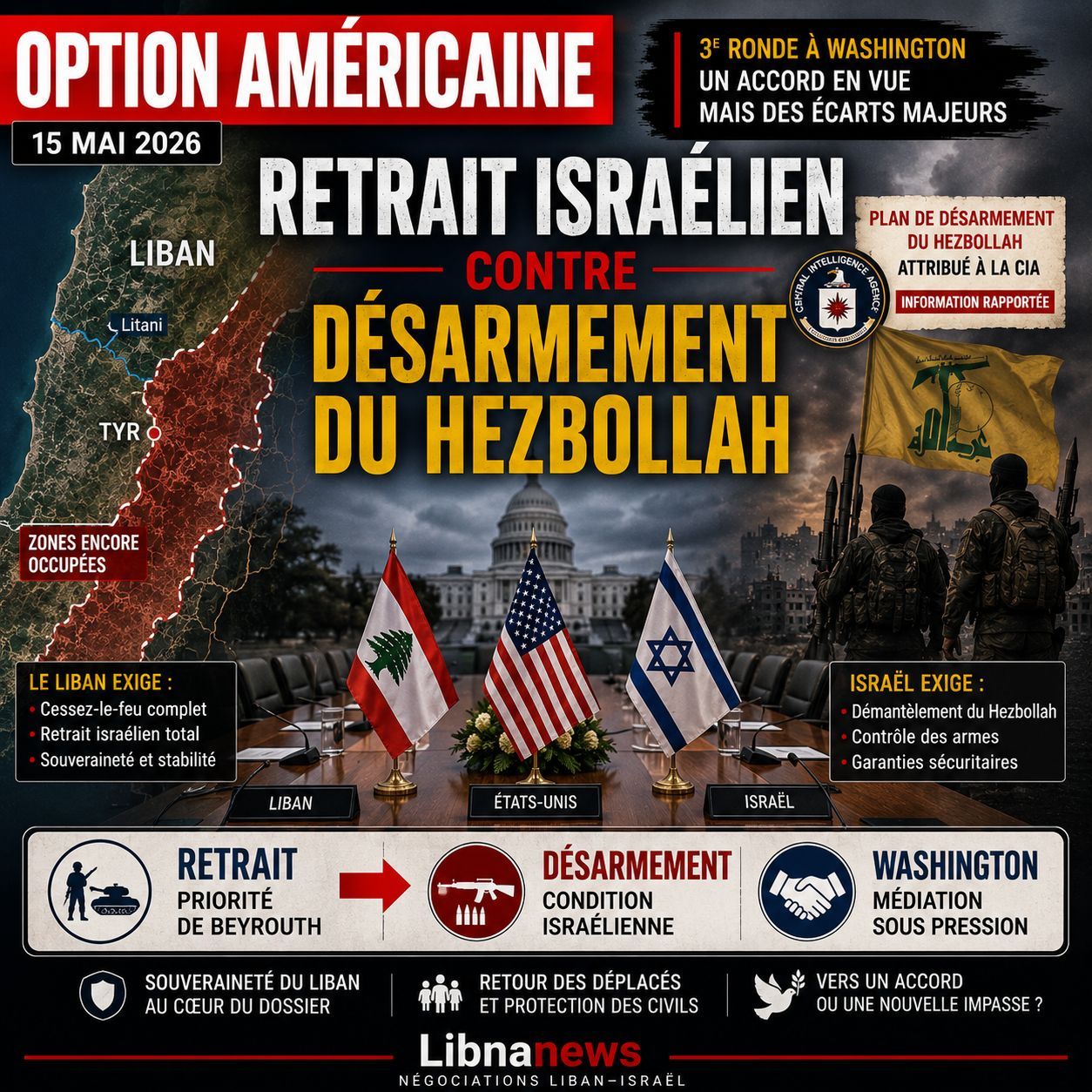
The third round of direct talks between Lebanon and Israel is entering a more sensitive phase this Friday in Washington. According to an Israeli public media, the two sides could move towards an agreement linking Israeli withdrawal from Lebanese territory to the disarmament of Hezbollah. The information remains reported and has not been officially confirmed by Beirut. However, it sets the tone of the day. The United States is seeking to transform a fragile truce into a political framework. Lebanon first calls for a complete ceasefire and withdrawal. Israel places Hezbollah’s weapons at the centre of the case. Between these two priorities, the Lebanese margin of manoeuvre remains narrow.
A simple but explosive scheme
The formula circulating in Washington is seemingly simple. It provides for an Israeli withdrawal from the areas still occupied in southern Lebanon in exchange for a process of disarmament of Hezbollah. But this simplicity masks several blockages. Who would check the withdrawal? On what calendar? Who would control the delivery of weapons? Above all, would this issue be dealt with in negotiations with Israel or within an internal Lebanese framework? These questions determine the actual scope of the sequence. They also explain the caution of Lebanese officials, who want to avoid turning a demand for sovereignty into a concession imposed under military pressure.
The discussions are held in a contrasting atmosphere. An official of the US State Department described Thursday as a productive and positive day. He didn’t give any details. This formula contrasts with the pessimism of part of the Lebanese and Arab press. There are still several reports of significant differences between positions. Lebanon calls for a genuine cessation of hostilities. Israel wants to link the truce to the military future of Hezbollah. Washington is trying to bring these two lines together, without being able to ignore the continuing violence in the South and the political repercussions in Beirut.
The role played by the CIA
The most sensitive novelty is the role played by the CIA. According to the Israeli public media, the U.S. agency has prepared a plan to disarm Hezbollah. No verified details at this stage specify its content. There is also no evidence that Beirut has accepted it. This information should therefore be treated as a reported element, not as an agreement. It nevertheless indicates that Washington wants to structure the file beyond a mere cessation of fire. Disarmament is becoming a possible architecture, with steps, guarantees and monitoring mechanisms.
For Lebanon, this approach poses an immediate risk. It can reverse the order required by Beirut. The Lebanese position, as reported by a close official, places the ceasefire first. Then comes the Israeli withdrawal. The issue of Hezbollah’s weapons would then be addressed on the domestic stage, not as a condition imposed by Israel. This hierarchy aims to preserve state sovereignty. It also seeks to avoid a major political crisis, as Hezbollah refuses to see its arsenal negotiated directly with Israel.
Israeli withdrawal: Beirut’s priority
The Lebanese delegation is led by Simon Karam, a former ambassador to Washington and a lawyer familiar with mediation cases. The Israeli side was to be represented by Yossi Draznin, Deputy National Security Adviser. This level of representation marks an evolution. The first meetings had better prepared the ground. This sequence involves more political envoys. It is not yet a formal peace negotiation. Rather, it resembles an attempt to set the parameters of a security arrangement under American arbitration.
US Secretary of State Marco Rubio did not attend the session on Thursday, being on a trip with President Donald Trump in China. His absence does not mean disengagement. The United States remains the guarantor of the process. Washington organized the previous sessions and pushed for a result before the end of the truce. The calendar adds pressure. Failure could reopen a tougher military phase. An imprecise agreement could produce a disputed truce upon its entry into force.
The Israeli withdrawal is the heart of Lebanese demand. Beirut does not want to negotiate indefinitely while the Israeli army retains positions in southern Lebanon. This presence maintains a state of de facto war. It blocks the stable return of displaced people. It prevents municipalities from regaining normal administration. It also gives Hezbollah a central argument for maintaining its weapons. As long as the occupation continues, the movement can present its arsenal as a response to a direct threat.
Lebanese state facing its own test
So the question is not just about a military line. It affects the authority of the Lebanese State. If Israel withdraws, the Government will be able to affirm that the defence of the Territory must be the responsibility of the official institutions. If Israel remains, even on limited points, internal pressure will fall on Beirut. Hezbollah’s opponents will demand disarmament. Hezbollah will answer that the danger remains. The Lebanese army will find itself between two expectations: to reassure the people of the South and not to appear as the instrument of a foreign agenda.
A Lebanese official mentioned a scenario in which Hezbollah would hand over its weapons to the army if Israel accepted a complete ceasefire and withdrawal. The army could retain some weapons and destroy others. Individual Hezbollah fighters could also join the regular forces, provided they met the admission criteria. This assumption remains political. It is not worth Hezbollah’s public engagement. However, it shows the search for a Lebanese exit to the problem of arms, distinct from a capitulation imposed by Israel.
This distinction is crucial for Nabih Berri, for the presidency and for part of the government. The Hezbollah file cannot be treated as a mere article of a bilateral agreement. It concerns the religious balance, the security of the South, relations with Iran, the memory of the occupation and the monopoly of force by the State. A brutal decision could cause an internal crisis. A postponement without a timetable could, on the other hand, empty the negotiation of its content. Beirut therefore seeks a gradual formula, capable of satisfying Washington without causing an internal rupture.
Israel pushes disarmament before the truce
Israel approaches the sequence with a reverse logic. Its officials highlight the military dismantling of Hezbollah. They consider that withdrawal and truce are not enough if the movement retains its firing capacity. The Israeli ambassador to the United States even mentioned a negotiation for a comprehensive peace, with borders, embassies, visas and tourism. He added that this perspective would depend on the success of a second strand, focusing on the dismantling of Hezbollah. Standardization thus appears as an Israeli horizon, but not as an objective accepted by Beirut.
At this stage, Lebanon refuses to talk about normalization. Rather, its officials evoke a security agreement, armistice or stabilization of the front. President Joseph Aoun declined the idea of a meeting or direct call with Benjamin Netanyahu. This caution responds to an obvious inner constraint. A handshake without a solid result could be presented as a free concession. It could also weaken the Lebanese position if the talks subsequently failed. The Lebanese President seems to want to reserve any major political gesture for the signature of a verifiable agreement.
The White House wants a strong gesture. Donald Trump publicly called for a meeting between Joseph Aoun and Benjamin Netanyahu. According to a Lebanese official, the Lebanese President explained his reservations during a recent exchange with his American counterpart. He would have indicated that he could go to Washington to inaugurate a security agreement if it were concluded. That shade counts. It allows Beirut not to refuse American mediation, while avoiding early normalization.
A negotiation caught up in the field
The terrain weighs on every sentence. The American-mediated truce reduced the fighting, but it did not stop them. Fires, drones and strikes continue to be reported. Civilian casualties have been reported in Lebanon in recent days. Israel claims to be targeting Hezbollah positions. Lebanon denounces violations and insists on the protection of the inhabitants. This fact weakens confidence. It also makes any text difficult to apply. A truce cannot hold if the two sides give opposite readings from the first day.
Thursday opened after a drone attack claimed by Hezbollah against Israeli troops near the border. Israel, for its part, continued to strike in Lebanon. These events remind us that Hezbollah is not at the table, but that it remains a decisive player on the ground. Its absence complicates negotiations. The Lebanese government speaks on behalf of the State. Israel wants a result that engages Hezbollah. Washington is trying to build a bridge between these two realities, without having a direct guarantee of movement.
The situation in South Lebanon reinforces this tension. Villages affected by strikes, warnings and displacement are already living in permanent instability. Families are reluctant to go home. Schools and businesses remain exposed to the military decisions of each camp. Roads can become dangerous in minutes. In this context, the Washington discussions are not an abstract exercise. They condition the possibility of restoring a minimum civilian life in the localities close to the border and around the major axes of the South.
The Lebanese Army at the centre of the system
The Lebanese army occupies a central place in all scenarios. It would be called upon to deploy more forces in the South, receive arms from Hezbollah, control sensitive areas and reassure the population. This mission requires resources, political coverage and international support. It also assumes that the army is not placed in direct confrontation with part of Lebanese society. The success of an arrangement would therefore depend as much on the negotiated text as on its practical implementation in the villages.
Washington seems to want to build a multi-storey mechanism. The first would be the cessation of hostilities. The second would be the Israeli withdrawal. The third concerns arms control in Lebanon. The fourth could open a broader file, including borders, prisoners, displaced persons and reconstruction. But each floor depends on the previous one. If the ceasefire fails, the rest collapses. If withdrawal remains partial, the debate on weapons is blocked. If Hezbollah refuses the transfer, Israel will maintain its military pressure.
The other files don’t disappear. The demarcation of the land border, the fate of the detainees, the return of the displaced and access to the destroyed areas are in the background of the negotiations. Lebanon wants to treat them as elements of a single package of sovereignty. Israel seeks to subordinate them to the military neutralization of Hezbollah. This difference in method explains the tensions around the word itself. For Beirut, an agreement must first stop the war and return the territory. For Israel, it must first prevent the reconstruction of a threat in the north. The United States is trying to write a sequence that does not call these contradictions too brutally.
Agreement still far from achieved
The issue of reconstruction remains in the background. The affected regions need funding, security and guarantees. Residents will not rebuild homes, shops or farms if the risk of strike remains daily. International donors will also require a clear political framework. This dimension gives Hezbollah disarmament an economic reach. It is not just about military power relations. It also conditions Lebanon’s access to sustainable aid and stabilization of its South.
The main risk lies in the ambiguity of a compromise. A text announcing an Israeli withdrawal without a specific timetable would not be sufficient in Beirut. A text that would speak of disarmament without a credible Lebanese mechanism would not be sufficient for Israel. A text that would pave the way for normalization without internal consensus would create a crisis in Beirut. Negotiators must therefore avoid attractive but inapplicable formulae. American diplomacy is looking for a quick result. Lebanon, for its part, needs an agreement that survives the return of delegations.
At this point, there is no room for agreement. There is a lead, carried by Israeli information and American exchanges. There is a Lebanese line, which places the ceasefire and withdrawal before the weapons file. There is an Israeli line that puts the disarmament of Hezbollah at the top of its priorities. Finally, there is an American mediator, determined to produce an outcome before the end of the truce. Friday must tell whether these lines can form a common framework or whether they will remain three parallel stories of the same crisis.




