

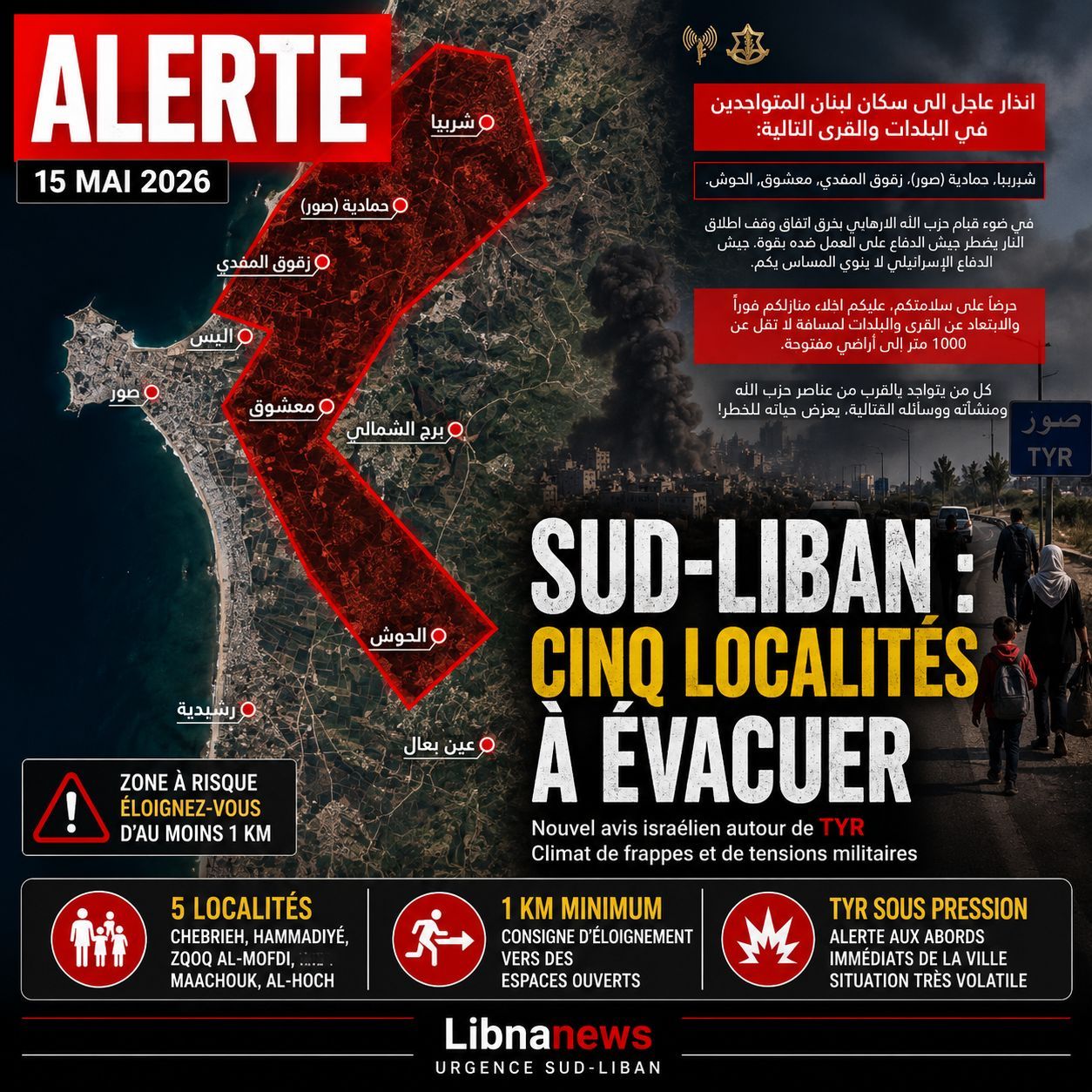
This Friday morning, a new Israeli evacuation notice targeted five locations in southern Lebanon around Tyre and its immediate vicinity. The alert concerns Chebrieh, Hammadiyah, Zqoq al-Mofdi, Maachouk and Al-Hoch, according to the dispatches of the national agency. It intervenes in a climate of high military tension, following a series of night strikes and warnings already addressed to other villages in the South and Western Bekaa. The inhabitants were called upon to leave the designated areas and move at least one kilometre away to open spaces. In Beirut, as in border localities, the morning opens up to a changing situation, between security emergencies, displacement of civilians and political discussions under pressure from the ground.
An Israeli alert in the heart of southern Lebanon
The message broadcast in the morning resumes a format that has become frequent since the intensification of Israeli operations in Lebanon. It designates villages, identifies an area at risk and asks civilians to remove them without delay. The Israeli text invokes violations attributed to Hezbollah and affirms that the Israeli army intends to act against its positions. This justification is not accompanied, in the dispatches consulted, by independent evidence to verify its exact scope. The confirmed data at this stage remains the dissemination of a notice targeting five localities and the withdrawal order imposed on residents.
The area in question forms a sensitive arc north and east of Tyre. Chebrieh and Hammadiyé are located in the immediate environment of the coastal city. Maachouk and Al-Hoch also belong to this fabric of neighbourhoods, villages and mixed areas where homes, secondary roads, shops, agricultural land and access to neighbouring Palestinian camps cross. Zqoq al-Mofdi appears in the alert as another point to evacuate. The whole is in an area already tested by successive departures, by the point closure of road axes and by the fear of strikes targeting buildings or vehicles.
Tyre bordering the red perimeter
The map accompanying the opinion shows a red area that bypasses Tyre without including it entirely. This is a particular concern. It places the city in direct contact with the announced perimeter, while Tyre remains a major administrative, commercial and hospital hub for the south of the country. Traffic there depends on coastal roads and inland axes regularly used by ambulances, displaced families and municipal services. Even when the alert does not officially target the urban centre, its effects go beyond daily life. Travel is shrinking, schools and shops are assessing their risks, and residents are looking for reliable information before taking the road.
This morning’s opinion is not an isolated episode. The national agency’s dispatches have reported several similar warnings in recent days. An earlier message had targeted Maashuk, Yanuh, Burj al-Shemali, Hallousiyah al-Faukah, Debal and Abbasiyah. Another involved Arzoun, Tayr Debba, Bazouriyé and Al-Hoch. This repetition puts constant pressure on the villages. It makes it difficult to distinguish between a one-time alert and a broader strategy to distance populations. It also complicates municipal management, as local officials must respond to people who ask where to go, how long to stay away and what routes to avoid.
People facing difficult instructions
A practical problem is the instructions for moving away to open spaces. In southern Lebanon, villages follow one another at a short distance. Roads pass through inhabited areas, orchards, valleys and areas already marked by damage. Leaving a village for a minimum distance of one kilometre does not always guarantee access to a safe point. Families must choose between staying near their homes or reaching more distant places, sometimes without sufficient fuel or prepared destination. Older people, the sick and the children make such departures more difficult. The dispatches do not report, at this time, a human assessment directly related to this morning’s warning.
The triggering of an alert before possible strikes alters the behaviour of the inhabitants. Some leave immediately, others await confirmation of a bombardment or call from a relative. In several localities in the South, the experience of the last few months has anchored emergency routines: bags ready, documents collected, cars oriented towards the exit from the village. But this adaptation is not enough to absorb fatigue. Repeated departures weigh on income, school, care and agricultural work. They also increase dependency on family and community networks, which often provide reception in neighbouring cities or in regions further north.
Fragmented hits, alerts and information
In the last 24 hours, the dispatches also reported attacks on communities in the south and east of Lebanon. Labaaya and Sohmor in Western Bekaa were mentioned after raids. Other media reports quoted by the National Agency indicate that several villages in the South have been hit, including areas around Nabatiyah, Bint Jbeil, Marjeyoun and Tyre. The rhythm of operations creates a mosaic of incidents rather than a single front. These include aerial attacks, artillery fire, drone overflights and evacuation alerts that overlap over time.
This dispersal of events complicates the monitoring of the situation. Residents receive information about telephones, local media, municipalities and messages from relatives. The authorities, for their part, must check the affected places, organize relief and prevent panic movements. In several cases, the first minutes produce partial information. An explosion noise may be reported before the exact location is confirmed. A strike can target an open space, road or building. The article must therefore distinguish between established facts, reported information and unverified claims.
The humanitarian situation remains difficult to measure in real time. Previous strikes have resulted in deaths, injuries and property damage in several areas. Recent dispatches have reported the destruction of a residential project in Srifa, with at least two deaths reported by rescue personnel. Other reports, published by the health authorities after strikes in the South, mentioned civilian casualties, rescue workers and a Lebanese military. These elements recall that alerts do not only cause temporary disruption. They are part of a sequence where neighbourhoods, houses, vehicles and civilian infrastructure have already been affected.
Tyre, point of support and area of concern
In Tyre, concern is as much about the immediate risk as about the role of the city in the balance of the South. Ports, markets, health facilities, schools and public services are concentrated in regional life. An alert to outlying localities can cause movement to the centre, but also the reverse effect if families fear an expansion of the target area. Municipal officials and relief services must therefore deal with two opposing constraints: maintaining reception capacity and preventing road saturation. The presence of Palestinian camps in the environment in Tyre adds a dimension sensitive to displacement.
The political context also weighs on this morning. The Lebanese press relayed by the national agency has been insisting since the previous day on the contrast between diplomatic discussions and military intensification. Talks related to the ceasefire, security arrangements and the border situation are being discussed in parallel with a tightening on the ground. The Lebanese leaders cited in recent days claim that priority remains the effective cessation of hostilities. The vocabulary of « negotiation under fire » returns in titles and declarations. It reflects the idea that military dynamics seek to influence the margins of discussion.
For official Lebanon, the central issue remains the protection of civilians and the restoration of a stable security framework in the South. But the balance of power remains unfavourable on the ground. Alerts and strikes impose their tempo on local authorities. Municipal governments have limited resources. Hospitals must prepare for sudden admissions. Schools and shops operate at a slow pace as evacuation notices multiply. The security forces, on the other hand, focus on the movement, rescue and identification of dangerous areas. In this climate, political declarations face the urgency of roads and shelters.
The weight of military justifications
The Israeli vocabulary of the alert deserves to be read with caution. The message states that the Israeli army does not want to reach civilians and that it is targeting Hezbollah. He warns, however, that the presence in the vicinity of elements, installations or military means of the movement exposes the inhabitants to danger. This formulation places civilians under an unfulfilled responsibility. They do not always have reliable information about what is near their home. They cannot verify the military information invoked. Yet they must decide quickly, often under pressure from the fear and noise of planes.
Hezbollah, for its part, remains at the heart of the security equation, but this morning’s alert is not accompanied, in the available dispatches, by an independent operational detail on the alleged targets. War announcements and any claims must be dealt with separately from the facts observed on the ground. A confirmed strike, a distributed evacuation notice and an established health record fall into different categories. The inhabitants, on the other hand, suffer together without always being able to separate information levels. This confusion reinforces the need for accurate local communication, including on safe routes, reception centres and emergency procedures.
The succession of warnings raises another question: duration. An alert may last a few hours, but its effects continue. Families are reluctant to go home. Traders keep their curtains closed. Farmers postpone work in the fields. Drivers avoid roads that are essential to supply. Municipalities must check the state of the electricity and water systems after each nearby explosion. When opinions repeat themselves, normality becomes fragmented. Residents come back intermittently, pick up business, sleep elsewhere, and then consult the information again from dawn.
A crisis beyond the targeted villages
In Western Bekaa, the strikes reported at Labaaya and Sohmor remind us that the tension is not limited to the coast of Tyre or to the border villages closest to Israel. The geographic depth of operations extends the scope of vigilance. It affects agricultural areas, liaison roads and localities which sometimes serve as reception points for displaced persons from other sectors. This extension complicates the mapping of areas perceived to be safe. It also weighs on families who had left the South to the Bekaa or to villages in the interior, before discovering that these areas can also be targeted.
Rescue workers play a central role in this sequence. Civil defence teams, ambulance workers, health associations and municipal volunteers often intervene in unstable conditions. The minutes following a strike require a quick reading of the terrain: fire presence, risk of second strike, access to the equipment, condition of the injured, evacuation of neighbouring inhabitants. The official balance sheets can evolve several hours after the facts, especially when rubble has to be searched. Previous strikes in Lebanon have reinforced the caution of the teams. They must save without unnecessary exposure, in an environment where airspace remains monitored.
In terms of information, the morning also requires a particular discipline. Social media quickly broadcast maps, videos, smoke photos and alert messages. Some content is authentic, others circulate out of context. Residents are interested in whether their street, building or land is in the red zone. The media should avoid turning an alert into a balance sheet, or a confirmed claim. The national agency’s short dispatches provide a useful basis, but they do not replace field confirmations, health announcements and information from local authorities.
One morning under surveillance
The economic scope of these alerts is already reflected in ordinary gestures. Markets become empty when families avoid displacement. Transporters report tours. Fishermen, farmers and artisans lose hours of work. Schools must decide between prudent opening, interrupted teaching or immediate closure. Hospitals maintain their services while preparing contingency plans. This cost rarely remains quantified in the early hours, but it accumulates. In a region already weakened by the Lebanese economic crisis, every day of uncertainty further reduces household margins.
The situation on Friday morning is therefore threefold. The first is immediate: five localities in southern Lebanon are subject to an Israeli evacuation notice. The second is regional: strikes and warnings have been increasing for several days in the South and Western Bekaa. The third is political: discussions on a cessation of hostilities take place in a climate of military pressure. None of these levels alone explain the day. Their combination creates continuous uncertainty, in which civilians have to make quick decisions while the authorities expect further developments.
At mid-morning, no verified data were available to establish the number of persons leaving Shebrieh, Hammadiyah, Zqoq al-Mofdi, Maachouk and Al-Hoch after the opinion. No human reports directly related to this alert were reported in the available dispatches. The eyes turn to Tyre, its exit axes, emergency services and its outlying localities. The next sequence will depend on possible Israeli strikes, new Israeli instructions, Lebanese political responses and field confirmations that local correspondents will provide over the course of the morning.




